Baroque Art Exam 3
 Studied by 0 people
 Call Kai
 Learn
Learn Practice Test
 Spaced Repetition
 Match
Match Flashcards
 Knowt Play
1/35

There's no tags or description
Looks like no tags are added yet.
Name | Mastery | Learn | Test | Matching | Spaced |
|---|
No study sessions yet.
36 Terms
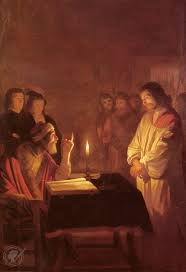
Christ Before the High Priest (1620), Gerard van Honthorst
Subject: nocturnal scene, biblical story, monumental scale, leads up to the The Passion, brought before the Jewish High Priest because he is accused of treason/blasphemy, Guistianiani is the patron
Form: warm light from candlelight, plain background, other Jewish leaders are plotting on Jesus’ downfall, false witnesses, all look smug and hateful, soldiers present looking in from doorway, focus is Christ and the High Priest, book is on table illuminated, contains the Law and rules that cannot be broken, accusing Christ of something with hand and look, pointing up - are you claiming to be God question, Christ is accepting of His fate, hands are tied, can see details and softness of Christ’s face, priest is also lit up, light also coming from within Christ
Function: historical religious painting that is Catholic inspired
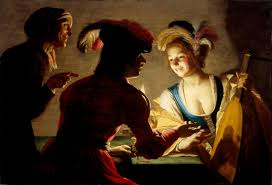
The Procuress (1620), Gerard van Honthorst
Subject: old woman is the procuress - woman who runs the brothel, man is reaching out to young woman prostitute with a bag of money
Form: dark background, lit up by candlelight, old woman is ugly, wrinkled, shows she is indulging in sinful behavior, Caravaggio inspired, outfit is very telling, very revealing - she is a prostitute, red hair, rosy cheeks, smiling, feathers in hair, flute in hand - symbolic, harmony, flirtatious behavior, direct subject matter, man has feathers in his hat, genre scene, ¾ figures, very dark but lit up faces, dramatic lighting, he is cast in a very heavy silhouette - big style choice, lot of detail in feathers and clothing
Function: playful element, also a lesson to be learned
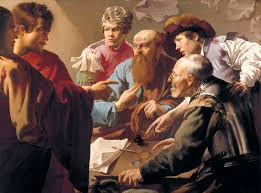
Calling of St. Matthew (1620), Hendrick ter Brugghen
Subject: group counting money around a table, Jesus and Peter are going to Matthew to call him to join them
Form: soft silvery lighting, contrast of dark and light but not extreme, diagonal lighting, delicate feeling to create intimacy, space left open for viewer on the picture plane - Baroque element, simple background with a focus on the people, tacked up papers on the wall, glue spots, figures are not idealized, wrinkled and regular people feel, all different figures, some are young and confident/learning the trade while others are old and weathered - figures are unusual in their dress but Christ, Peter, and Matthew are all dressed in their time period, Christ is cut off but his gesture and Matthew’s gesture are the most important part of the scene, Matthew points at himself while the others point at their money, papers, pen, money, ink, one figure is dressed in armor, glasses on one figure speaks to spiritual blindness
Function: shows connection between Matthew and Christ in a different kind of scenario, think about whether we are choosing Christ or money in everyday life
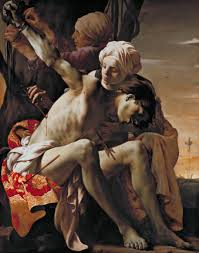
St. Sebastian Tended by St. Irene (1620), Hendrick ter Brugghen
Subject: scene where St. Sebastian, after being shot with arrows, is being tended to by St. Irene, caring for him in need, saved because of faith and good works
Form: low horizon line, monumental and immediate representation of the suffering saint, silver kind of lighting, would look up at it, green skin tone of Sebastian, near death, body is struck with many arrows, suffering greatly through face, arm is raised up, extreme muscular detail, great contrast between helper woman and Irene (sunburnt skin and red nose), gentle and kind manner and expression of Irene, very careful when tending to his wounds, sweet face with lighting, toes are curled in pain, sky in background is a warmth of sunshine, speaks to the care he has received and the coming of another day, red and gold cloth stands out against skin and white drapery of Sebastian, contrast between their clothes and the tree against the garment, famous piece of cloth - color, pattern, design matches a cloak that belonged to a pre reformation bishop of Utrecht, became a symbol of oppression by the local Protestants against the Catholics
Function: St. Sebastian is the patron saint of plagues so he is used as an image of strength and help while in pain, church is reinforcing doing good works and their importance, altarpiece in a hospital to treat plague victims
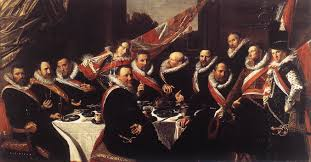
Banquet of the Officers of the St. George Guard (1620), Frans Hals
Subject: militia company portrait, popular subject portraying a group identity to be formed, large scale
Form: focusing on the banquet/feasting part, dynamic and energetic, taken out of the past context of portrayal of posing and now more close to a genre scene - everyday life, sense of momentary but still portrait likeness, uniqueness, and character brought out in each person, some have inebriated look, everyone is engaging with someone, not idealized, red cheeks and noses, high ranking members of the company, dressed in black with Dutch white ruffs - shows the wealth of the country, sashes show they are officers, gold/orange sash is the leader, standard flag bearer carrying flag, big fanciful hats, have weapons on hips, beautiful drapery on the top corner, lot of details in the glasses and food, glances don’t feel permanent, different gazes and directions, diagonals in play with flag, people, sashes, flag keeps us from going into the landscape, many figures looking outside of the frame at the viewer
Function: charitable nature displayed through a meal and working together for those who need assistance
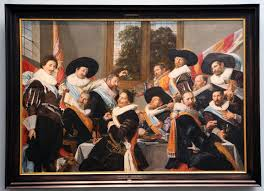
Banquet of the Officers of the St. Adrian Civic Guard (1630), Frans Hals
Subject: militia company portrait, popular subject portraying a group identity to be formed, large scale
Form: loose brush strokes, much lighter composition, very individualized figures for their portraits, show the drunkenness of the characters, flag is good, diagonals but much less unity, figure in the front left has taken his hat off to greet the viewer, very busy table just now noticing the viewer, window with pretty tree in back but can still focus on the scene at hand, dog on the bottom, fanciful embroidery work and looks costly, major X composition to show energy and liveliness
Function: show the character and individuality of each person in the portrait
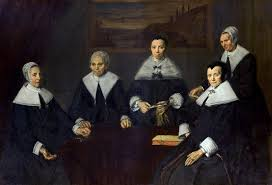
Women Regents of the Old Men’s Home (1660), Frans Hals
Subject: women who would run the old men’s home for elderly, single men who were alone and had no one to take care of them, large scale
Form: look serious and severe, immediacy, simple background, nice landscape on the wall, simple drapery, women are forefront and focus, individuality in each face of the governesses and a maid - delivering a message, tries to show their character, several women looking in the direction of the viewer - shows confidence, piercing gaze, skeletal hands, assertiveness, rigidity, all around a table with a hand on the ledger book, faces and hands communicate different things about each person, woman on the side has an open hand so she might be more lenient, woman beside here looks distracted and hollowed eyes, fist clenched so maybe nervous/anxious, woman next to her is proper and uptight, gloves in hand, fidgety, maid adds a feeling of movement and genre painting, women are sizing us up and trying to figure out what the viewer’s role is
Function: commission of charity possibly, held up in the home to show who the governesses were
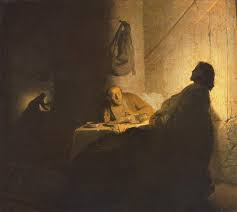
Supper at Emmaus (1631), Rembrandt van Rijn
Subject: studied with Peter Lastman, Leiden piece, religious painting, scene where Christ reveals himself to his followers
Form: nocturn scene, not classically influenced, dynamism, dramatic flair, diagonals with form, pulling viewer into the distance, Christ is surrounded in light, apostle is shocked and in fear (gesture and face), wooden background, very dramatic lighting, other apostle is on the floor because of how shocking this scene was, resting head in Christ’s lap, chair is knocked over, glasses are knocked over on table, very dark silhouette of Christ to see some details but not very specific features, transformation scene, divine light emanating from Him, simple setting, balanced silhouette figure in the background too working in the kitchen, warm and harmonious simple color palette
Function: religious paintings should be interpreted in human terms
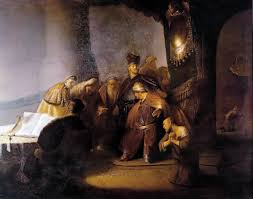
Judas Returning the Thirty Pieces of Silver (1631), Rembrandt van Rijn
Subject: religious painting, done in Leiden, rarely depicted subject, villain, betrayer Judas, scene where Judas has come forward to the religious leaders and gives back the 30 pieces of silver, Constantijn Huygens saw this and really liked it, was close to the Dutch Stadholder Frederick Hendrick, Prince of Orange
Form: Judas is overcome with remorse and tries to make amends but they don’t accept the money back so he throws it onto the floor, in the temple of Jerusalem, 30 pieces in spotlight, very light scene on the left but very dark in the front/right, Judas kneeling on the floor, hands clasped in pleading motion, humility, eyes are closed and head is bleeding from tearing his hair out, high priests are shunning him away with hands, mean look from highest priest, powerful image, massive column in the background (not historically accurate at all), elaborate and decorative tapestries, figures are in costume (not historically accurate, Eastern look), sense of wealth with furs, long beards, figure cast in dark silhouette looking at book of Jewish law opened, very illuminated area, softer and atmospheric color, impasto used
Function: wants to be recognized for his inventive genius so he wants to portray a distinct subject and make a statement about it, wants us to feel compassion for the sinner, no one wants to allow Judas forgiveness, looks at him from a human point of view

Blinding of Samson (1631), Rembrandt van Rijn
Subject: religious painting, continues relationship with Huygens and Frederick Hendrick, inventive subject, Delilah seduced him to find out the secret of his strength, cuts his hair and the Philistines tackle him to the ground, blind him, and throw him into prison
Form: grisly scene, deep hurt of Samson, did it because he thought that Constantijn would like this style, swooping diagonal forms, bright lighting coming in to create a dramatic silhouette, particular details, dramatic emotional expressions, decorative costumes that show creativeness and inventiveness, within a cave, armored people, Samson is fighting against them unsuccessfully, curling toes in pain, dagger goes right in Samson’s eye while he is also being chained up, great show of bodily force, immediacy popping out into our space, feel like a part of the crowd, Delilah has an expression of success on her face as she turns away, teeth are clenched, blood is spurting from his eye, captures the struggle and pain of Samson but the triumph and victory of the Philistines and Delilah, Delilah is represented as his wife
Function: wanted to portray emotion, surprise, and anger for Huygens (gift for him), Huygens did not like the painting and said it was too horrific
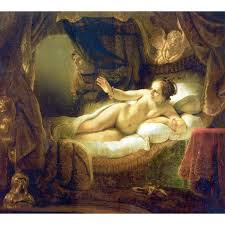
Danae (1631), Rembrandt van Rijn
Subject: mythological subject, daughter of King of Argos, king would be killed by his grandson, so he locked up his daughter but Zeus rained down on her as a golden shower and impregnates her, gives birth to Perseus, different from typical portrayal
Form: not overly dramatic, not as much of a contrast between dark and light, softens and quiets the scene, warm light and soft color palette, no obvious golden shower, not looking up, legs are closed, looks off to the left, illuminated by the light, more like someone is coming into the door, being invited in as by her gesture, maid servant is pulling back curtain, acknowledging a potential suitor as a partner more than a sex object, has a slight smile on her face and a light in her eyes, decoration on the bed, maid is not worried or afraid, show of wealth and status but all she wants is to be loved, pearls and rings, winged cupid is shackled because of the desire of the father to prevent his own fate, cupid is crying because he cannot be freed to help her love freely
Function: wanted to show a different way of portraying Danae getting impregnated, wants to reimagine the story in human terms and not the love of the gods
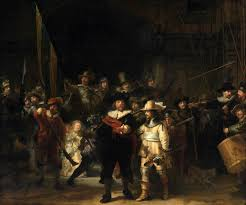
The Night Watch (1640), Rembrandt van Rijn
Subject: not original name, Amsterdam militia guard painting, rifle company, monumental painting, missing part of it, is a bit more inventive with his portraiture of the subject, puts them in a traditional context - engaged in protecting the city
Form: lot of dark and light contrast, figures on the picture plane, energetic, lot of diagonals, arched gate, dramatic lighting, invented location and moment, leaders in the front explaining strategy to each other, 18 portraits in painting, names are “engraved” up top, lot of filler people to make it feel more believable and real, lot of weapons, drums, little boy helping, dog barking, Rembrandt self portrait in the back of the painting, man in red stands out, active motions with rifles (3 primary stages of shooting a rifle at this time), little girl is brightly illuminated and focused on - product of Rembrandt’s imagination, “golden girl", wearing a chicken on her belt, looks like his wife, maybe an allegorical figure - emblem for the rifle company was a golden claw on a blue seal, dressed fancifully, actually a day scene but falsefully interpreted as a night scene
Function: ordered for new meeting guild house, historical painting meets portraiture, looks like a real event happening in a Baroque manner
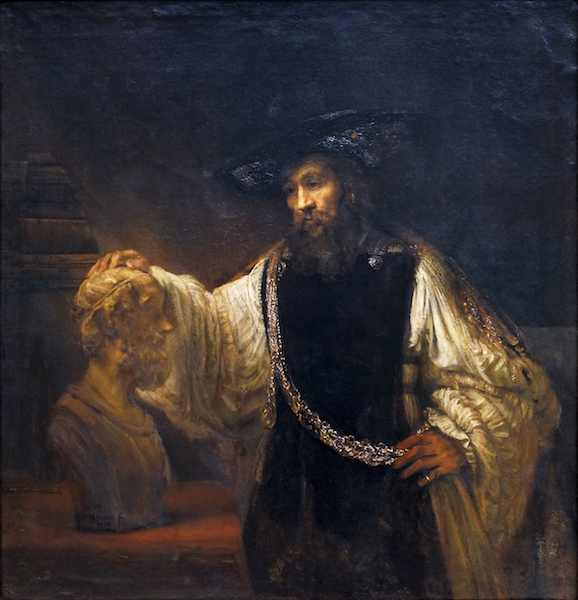
Aristotle with the Bust of Homer (1658), Rembrandt van Rijn
Subject: nobleman patron from Sicily, unusual and inventive subject, Aristotle (Western Greek philosopher), teacher (Alexander the Great) putting hand on the bust of Homer, Greek poet
Form: meditative, quiet, in deep thought and reflection, less emphasis on diagonals and energy, soft contrast of light and dark, flowy and all pulled together harmoniously, image of contemplation, gaze is titled, light illuminates his face and he is staring off at the bust of Homer (thinking hard about something important to him, a bit melancholy), Homer based off of Hellenistic model, dressed fanciful and not from time period, wide brimmed Dutch hat, reflects Rembrandt’s desire to invent and give him status of someone important (wears a gold chain across his chest), one hand on Homer and the other is placed on the chain, good job with plenty of opportunities but “chained” to the hard situation he had with Alexander, bound to a master and creates a lack of freedom, Homer was taught to Alexander by Aristotle (considering the freedom to be and do what he wants to do verses maintain his allegiance to the king - Homer vs Alexander),drapery pulled to the side show education and knowledge through books, illumination of Homer and the white drapery of Aristotle, Rembrandt signs his name on the bust and dates it - shows he chooses personal independence and being able to paint whatever he chooses and not what others tell him
Function: commissioned to make a painting of a philosopher, shows his personality and reflectiveness as he struggles with something internally, shows Rembrandt’s internal struggle with being able to do what he wants vs working for a political leader
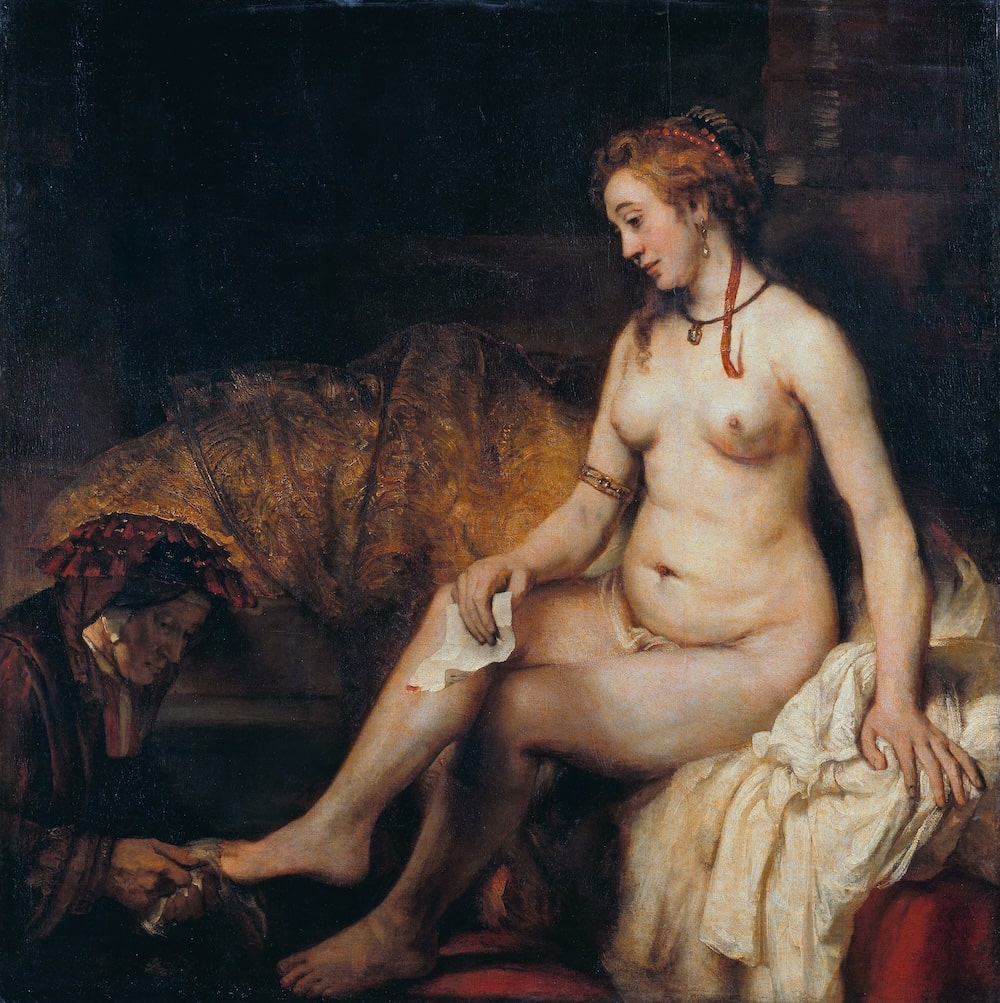
Bathsheba (1658), Rembrandt van Rijn
Subject: Biblical subject, OT, human point of view, David falls in love with Bathsheba but she is married so he sends his husband out to war to die and he marries her, unusual subject since she is never displayed thinking like this
Form: quiet, contemplative, not dramatic, lot of vertical lines and not diagonals, built with horizontals too, locks the figures place to inspire contemplation and reflection, she is deep in thought, maid is washing her feet, holds the summons letter in her hand, model for Bathsheba is Hendrickje Stoffels - becomes her common law wife and banned from receiving communion, nude because she is taking a bath, presents her less as an object and more as a vulnerable woman - didn’t ask to be desired by the king in a difficult situation, drapery in background, column, young woman and an older woman - illuminates Bathsheba but puts old maid in the shadows, associations with prostitution and how she is a victim in this scenario, she is not idealized and there is some realism present
Function: shows her contemplating if it is the right thing to do to leave her husband and go see the king - moral dilemma of betraying her husband or going against the king’s orders, wonders how she felt in this difficult moment
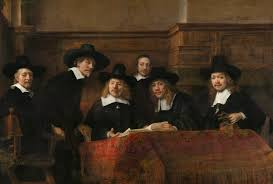
Syndics of the Draper’s Guild (1658), Rembrandt van Rijn
Subject: group portrait of the Amsterdam textile guild, governors assured quality of the textiles produced, placed in business building, one of last public commissions, large scale
Form: active portrayal of the subject, unified aspect of the good job that these guys do, sat around a table with a book of rules/expectations for quality, discussion with hands in active movement, viewer has interrupted them so all but one of them look over at us, beautiful red textile drapery laid across the table, black and white puritan dress outfits - wealth and position exuded, browns and golds in the background, lot of wooden features, chair that is detailed, scene carved into the wooden background - sea scape with a lighthouse, chosen to draw reference to the proper governing demonstrated by these men, symbol of guidance, adds to the function of the painting but not take away from the central figures
Function: major industry there, very important to economy, show their committment to their job

Return of the Prodigal Son (1670), Rembrandt van Rijn
Subject: parable with scene of the prodigal son returning to his father in a state of poverty, monumental image
Form: quiet, meditative, warm colors, focuses on central figures, immediacy, speaks to significance of forgiven, son is embraced on his knees by his father, in rags with tattered clothes, father is in a gentle state of caring with his hands on the son’s back, separation between those two and the other figures, not sure who the other figures are but we do know they are witnesses to this action, father and son connection, son leans his head in and closes his eyes, simple palette but features are still prominent, physical signs of emotional torment he is going through (hair being torn out, bare skin and holes), moment of reflection, not very dynamic and just quiet instead
Function: image of forgiveness for the penitent sinner, works out the essence of the story,
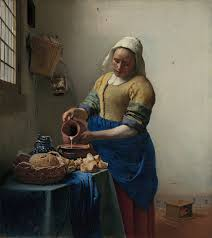
Milkmaid (1665), Jan Vermeer
Subject: wealthy patron, Pieter van Ruijven, working in Delft, genre painting, domestic interior, a milkmaid is pouring milk into a pot
Form: single female in the corner of a room absorbed in an everyday task, window across from her, light plays softly over his figures and the walls, quiet image, private intimate moment, light flattens detail on her body subtly, monumental presence, interaction between the viewer and the subject, lot of bread on the table next to her, making a bread porridge, elaborate pottery, particulars of the basket, metallic quality of the object in the back, simple but bright palette, yellows and blues are major, reddish orange, greens, neutrals, but all are soft, delicate handling of light and color, dot like effect on the bread and the basket - trademark of early genre painting, halation (“circles of confusion”) - suggestion that he was experimenting with optical effects associated with using camera obscura, view bright highlights through a lens, emphasis on a little box to the side, a foot warmer - associated with feminine desire, little tiles in the background - blue and white typical of Delft pottery, little cupid figure - symbol of love, little traveling man too
Function: painted for a male patron, show a quiet scene of a woman doing a daily job in Dutch Republic, milkmaids/kitchen maids were regarded as available - man of the house would peak in at the servant, amorous aspect and fantasy like, maybe it’s actually like her thinking of her love and if he will come back soon
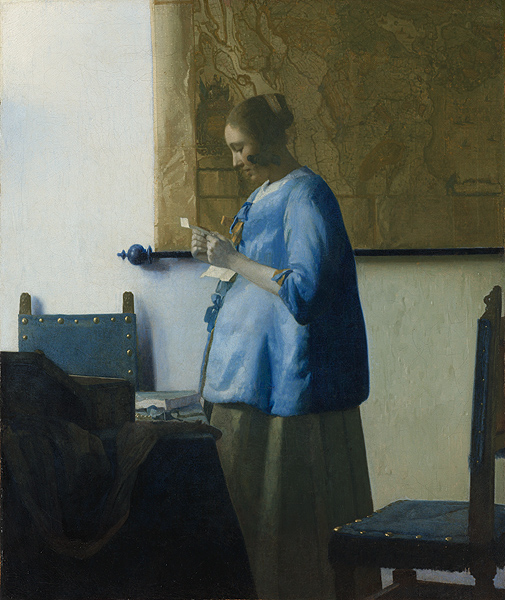
Woman in Blue Reading a Letter (1665), Jan Vermeer
Subject: wealthy patron, well to do middle class woman reading a letter in her home, not unusual to have a woman reading a letter
Form: single female in the corner of a room absorbed in an everyday task, window across from her, light plays softly over his figures and the walls, quiet image, private intimate moment, light flattens detail on her body subtly, monumental presence, interaction between the viewer and the subject, not a housemaid but the lady of the house, not excessively dressed, but typical of the time, not a lot of expression but a little positive, more subtle, large map on the wall, suggestive of husband traveling for work, might be pregnant, more cold composition, blues and greens, lot of horizontals - locks objects into place, very still image
Function: show an average moment of a woman reading a letter
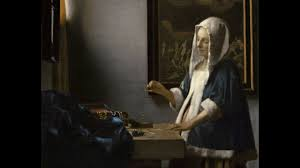
Woman Holding a Balance (1665), Jan Vermeer
Subject: wealthy patron, merchant class woman holding a delicate scale
Form: single female in the corner of a room absorbed in an everyday task, window across from her, light plays softly over his figures and the walls, quiet image, private intimate moment, light coming in from above is beautifully bright, emphasis on jewelry and money: speaks to familial wealth, jacket is very extravagant too, vertical and horizontal forms, absorbed in her activity, completely balanced scale, last judgment painting in the background speaks to her holding the balance - souls will be balanced at the end of time, places her centrally in the painting, a mirror is across from her - device associated with prudence, woman of careful judgment conducting her life with temperance and moderation and recognizing her responsibility to balance her actions
Function: she is balancing her own soul and how good her actions are, stepped away from material possessions
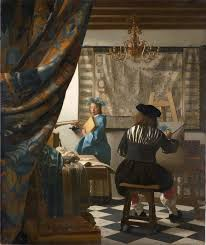
Art of Painting (1665), Jan Vermeer
Subject: potential patron piece, artist is hard at work painting his model
Form: complex image, allegory with a deep meaning, view into the artist studio, decorative chair in foreground, artist is not dressed in 17th cent. clothing, more 16th cent. - historical garb, woman posing with interesting elements - trumpet is personification of fame, book of recorded history, and a crown of green laurel leaves represents victory, muse of history Clio, artist is not starting in a typical manner but puts more emphasis on glory, map of Dutch Republic in back, golden chandelier, maps are a major part of Dutch life, “description” is written up top on the map - part of Dutch style, type of art that achieves fame in the Netherlands, beautiful drapery, mask is symbol of imitation and capturing the details of what you see
Function: honor and success in history painting, promoting genre painting as a type of history painting
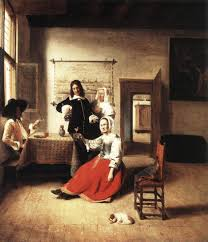
Woman Being Plied with Wine (1660), Pieter de Hooch
Subject: tavern kind of setting, enjoying each other’s company
Form: sleeping dog - lack of protection, painting on the wall, map in the background, religious subject in painting - Christ and the Adulterous Woman, writing in the dirt about forgiveness, old woman and young woman - suggestive of a young woman getting taken advantage of by two men pouring her drink who looks like she has had too much to drink, she is placed below them, vulnerable state - reference to position of Adulterous woman if she does not practice prudence and moderation, old woman seems to be brokering a deal with them so she is manipulating her too, door is open in the back to another room, a sculpture of Mercury - god of commerce
Function: shows a scene where every person is engaged in some aspect of sin, no one is free of sin and all are guilty of doing bad things, do not just judge the woman since the others are fully involved in the poor decisions being made
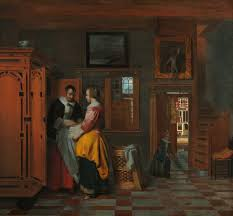
Linen Cupboard (1660), Pieter de Hooch
Subject: domestic scene with the role of the mother, her duties in the house, very common subject, Jacob Cats, Marriage - Christian view of a family’s role, scene where woman of the house is working with the housemaid with laundry
Form: beautifully adorned home, not excessive but there are elements of luxury like golden frames, an upstairs, and a large cupboard, crisp and folded linen sheets, immaculate house, floor is swept, basket of laundry amassing, little girl is part of the scene watching the mother’s example, landscape paintings in background, courtyard in background, interior is ordered - harmony and structure in household, vertical and horizontal forms - stability and order, interior spaces pulls us through successive spaces, diagonal pulling us to outdoor area, front door is open, Mercury statue above doorway, outside is realm of men and inside is realm of women
Function: shows a responsible mother/woman of the house, monitors housemaid, cleanliness is next to godliness
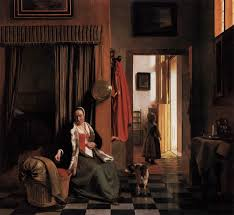
Mother Lacing Her Bodice (1660), Pieter de Hooch
Subject: domestic scene with the role of the mother, her duties in the house, very common subject, mother is lacing up her bodice and is gesturing towards her baby, not heavily practiced throughout the west at this time, among the other upper classes
Form: little girl looks longingly outdoors, still chores to complete, sheen on the floors, landscape paintings, Dutch box bed behind mother, bed warmer next to her, cloak on the walls, little smile on the face, preparing to breastfeed, Cats also believes that a true mother is the one to breastfeed and not the wet nurse, pulled through space, light coming in to the scene, warm element
Function: breastfeeding transfers nourishment and good morals

Woman Nursing an Infant with a Child and Dog (1660), Pieter de Hooch, a mother is breastfeeding her child and a little girl is feeding the dog - mother is teaching the little girl
Subject: domestic scene with the role of the mother, her duties in the house, very common subject,
Form: woman has foot warmer, warm palette, looks like she has been busy, fur coat is open, taking a rest, immaculate household, lot of dishware, birdcage above - common of the time, cupid figure carved into the edge of the fireplace, sweet love of slavery (bringing up children properly and not going out into the world), gray background, love for your children, family, pets, verticals and horizontals, light coming in to the scene
Function: shows a responsible mother/woman of the house, a little girl is learning how to be a good woman/mother
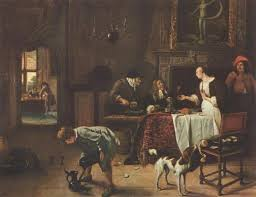
Easy Come, Easy Go (1660), Jan Steen
Subject: title is a proverb - fickle nature of fortune (one minute you are wealthy and the next you are poor), man seated at an opulent table/space, scene of temptation, surrounded by women and food
Form: prodigal son imagery and merry company scene, features himself as the protagonist, as the fool, lack of temperance and enjoying himself too much, gentleman’s club with games and drinking - gambling, oysters, alcohol, bread, scene of merriment, oriental and elaborate drapery, chandelier, large gold frame in background with a seascape showing a ship crashed and another on the water, with sculpture of Fortune - one foot is on a ball while hands hold a large drapery in win (fortune changes as quick as the wind), two cherubs (one is with a money bag, scepter, and a laurel wreath and happy while other is crying, titled, crutch under arm to show misfortune), oysters are aphrodisiac - precursor to love, young woman and old woman present, boy in foreground is pouring water into the wine jug - image of moderation, slow down the effects of no temperance, gambling leads to wrath, fights
Function: portray human fault, make the viewer think about the story, ridiculing human nature in a humorous way
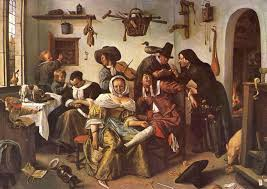
Beware of Luxury (1660), Jan Steen
Subject: scene of a merry company, filled with proverbs
Form: lot of objects and imagery being used, floor is very dirty, cards, pretzels, pipes, dishware, not an ordered piece with family interaction, reckoning board in corner to tally up drinks, wine barrel is spilling wine onto the floor, little tassels and seals on a book - important document that should not be on the floor, doorway with a fire burning and dinner has fallen into it, man and woman engaged with a book (religious figures trying to tell this group to look to the Bible and be more pious), duck on man’s shoulder is a quacker (man is member of the Quakers), father of house is disorderly and very inappropriately touching a woman who is not his wife, mother of the house is asleep, baby is dropping stuff on papers, woman in the front is drunk and offering drinks, children are disorderly and getting into trouble (little boy smoking, little girl stealing, dog is on the table, and older boy is laughing/watching while playing a fiddle), basket hanging from the ceiling - possible consequences of the behavior (crutch, sword, cards, switches, leper’s clapper), piggy in front of rose, monkey messing with clock
Function: portray human fault, make the viewer think about the story, ridiculing human nature in a humorous way, consequences of a house not run properly and an inattentive mother, woman is the key to all of these problems, opportunity makes a thief; cards, money, and women destroy a man; don’t give a rose to a swine; in foolishness time is forgotten, aping behavior/mimicking (adults are acting poorly so the children do to); young idlers, old beggars

As the Old Sing, So Pipe the Young (1660), Jan Steen
Subject: scene of a merry company, filled with proverbs, the young will imitate the elders, celebration with fun and rowdiness
Form: bagpiper in the corner looking at viewer - negative associations at this point (phallic in appearance, basest instrument of all), grandmother is front and center and engaged/smiling, holding a sheet of music that speaks to the proverb, children are smiling because the dad is teaching and encouraging his son to smoke the pipe, man is filling the wine glass of a kicked back woman (drunk motions and posture), lot of drink elements, oysters present, mother? of the house is holding a baby, unlaced, grandfather is wearing a popular hat of the time for new fathers, parrot looking down on the activity - symbol of imitation
Function: portray human fault, make the viewer think about the story, ridiculing human nature in a humorous way, Pepijn - musical and smoking pipe/ also to chirp, grandfather has to step in because the father is not stepping up, children will imitate their elders and if the elders are bad, then the children will grow up poorly
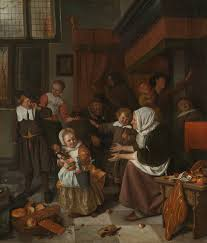
Feast of St. Nicholas (1660), Jan Steen
Subject: scene of a merry company, filled with proverbs, important festival for the Dutch (if they are good, they get toys but if they are bad, they get switches), children are joyous while others are upset and sad, delightful fun image
Form: catholic references here, little girl is very good (has lots of little toys and sweets, but wants to hide it from her mother), her mother is calling to her lovingly, oranges, waffles, special sweet bread, cinnamon sticks, little boy gets a special golf/hockey stick, making fun of his brother who got switches in his shoe, big sister is holding his shoe and making fun of him, grandfather in scene, little kids looking up the chimney for St. Nick, bed behind, grandma has a smile and beckoning to the boy who is crying,
Function: portray human fault, make the viewer think about the story, ridiculing human nature in a humorous way, family story for the children
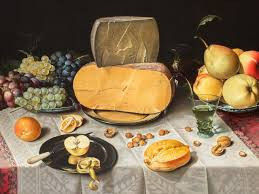
Still Life (1600), Floris van Dijck
Subject: food still life, breakfast piece, grapes, cheese, wine, apples, and bread
Form: very Baroque, plate hanging off the edge, beautiful lace covering, salmon and white colored, spread out composition, set against dark background, immediacy, reflective elements, olives in a bowl, viewing from slightly above, brings out textures and surfaces with dramatic lighting, opulence, technical mastery, dusty grapes, crusty bread, hard cheeses, cracked walnuts, lot of wine glasses, more in the background that are dark, lot of pottery and intricate designs within it
Function: scene with objects meant to sustain life, also has religious elements to it - apples (garden of Eden), wine and bread (Christ’s sacrifice), walnuts (shell, cross, meat of the nut, Christ), sustenance of physical life and spiritual life
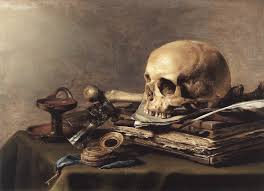
Vanitas Still Life (1630), Pieter Claesz
subject: image of vanity
form: still life image of a muted palette, light comes from top left to illuminate objects, all objects on the corner of the table, browns, greys, greens, blue, gold, blend nicely, green tablecloth, bare background, skull is obvious sign of death, bone next to it, lamp that is burnt out (smoke blends into background), rummer is tipped over and void of any content (life no longer full), gold timepiece and a key used to wind it up (classic symbol of passing of time and that it won’t be wound again), elaborate details everywhere, books in background are closed, pages are tattered a bit, quill has ink on it but not used anymore (suggests life is over, suggestion of light with a promise of better),
function: transience of our existence, earthly life will eventually end just as objects arranged here, passing of time
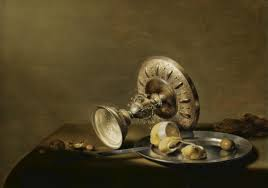
Still Life with Olive (1630), Pieter Claesz
Subject: breakfast items sitting on a table
Form: monochromatic, tonalist, still life creation that follows other still life, color palette is quiet and peaceful, softness, all tied together through the same colors (greys, browns, cool greens), corner of the table, bare of adornment, viewpoint is frontal, not many objects, light source illuminating objects, reflective qualities of light on surfaces, rummer with wine, tazza dish (great metalwork), olive sitting on a silver plate, walnuts, simple wooden table, oysters in the back, pepper in a dish, no tablecloth, repeated shapes (circular forms) to create harmony, Baroque element of plate hanging over edge of table, highlights Dutch trade success, image of wealth, pepper combined with oysters (book that taught of good health said that these combined were good to eat), knife on plate
Function: beautiful quiet display of breakfast foods that highlights the success of the Dutch
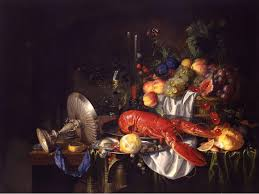
Still Life with Lobster (1640), Jan Davidsz de Heem
Subject: image of feast of food all over the place
Form: Pronk still life, little bit larger than normal, great emphasis on objects, immediacy and tempting element, pile lots of objects on top of each other, corner table, more visually interesting with a drape, cord signals a reveal of the table, variety in food, fruits everywhere, shrimp, shells, leaves, glass, blue box in background, rummer, silk covered box, Chinese porcelain, large silver pitcher, nautilus shell (very rare and coveted type of dishware), dustiness of fruit, lot of details and intricacies, huge lobster on display (center of focus), velvet drapery, oranges and lemons are seen (image of wealth and rarity)
Function: image of wealth and good standing, show beauty of objects, emphasizes feast of the eyes and excess, celebrate world abundance and trade
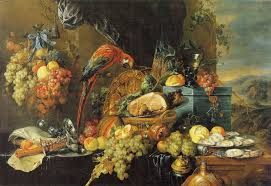
Still Life with Parrot (1640), Jan Davidsz de Heem
Subject: image of feast of food all over the place
Form: landscape in background, oysters, oranges, musical instrument, books, grapes everywhere, parrot is focus of image, gold plate, drapery has been pulled back with cord, blue box is locked up with a key in the key hole, juxtaposition of landscape and foreground, hunk of meet lots of fruit in central part of image, dishware, blue tablecloth, crumbling blank wall, wooden table, paper on table talks about His presence in all things, ivy growing over the wall, objects are fleeting and only good for so long, day is ending in the background, bread and the wine are on top of the box highlighting the Eucharist and God, placed under the ivy (evergreen plant), reflections in glassware, parrot is an image of praising God and the success of trade/exoticness
Function: image to worship God and realize that material things are fleeting and will not be present forever, including time of day and man made creations plus nature, life and the Eucharist are so precious so acknowledge the greatness in them
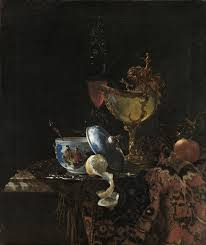
Still Life with Chinese Bowl (1660), Willem Kalf
Subject: image of great wealth and noble status
Form: corner of table, room with nondescript background, table is marble, drapery is detailed, metal, porcelain, and drapery are incredibly well rendered (show piece of ability), detailed emphasis on textures, surfaces, and the play of light on objects, elaborate metalwork, creepy monster and little figures on nautilus cup, atlas figure holding it up, lemon being peeled falling off table, venetian glass has excessive details, porcelain has three dimensional figures (Chinese porcelain, Ming Dynasty porcelain is most sought after and valuable), orange, silver plate is elaborate and textured, play of light has a magical quality to it, shows the preciousness of each object, people could not afford the real things but wanted to have them, so they had him paint these beautiful things to talk about
Function: image of great beauty and incredible wealth, want to show how good he is at rendering precious objects of several mediums, flaunting of weath
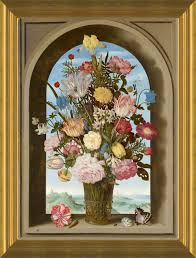
Flower Still Life (1620), Ambrosius Bosschaert
Subject: large vase placed full of flowers placed in a panoramic view of a long landscape, sits right on the ledge, little shells and bugs sit in front of the vase, imaginative piece
Form: precise, fine, accurate details, contrast between complexity of vase with flowers and the landscape, flowers are moving in different directions to create energy, immediacy, taken from real life examples, arch creates a good frame and encourages us to look into the landscape - creates significance, water droplets, glass vase with carved faces, bugs remind us of the passing of time but still can value the beauty of art/nature, lot of tulips, image of luxury as well, is within Sinnepoppen by Roemer Visscher which explains the imagery in the picture, shells represent lessons (it is odd how a fool will spend his money), lot of wonderful colors, possible substitution for nature, not a balanced composition
Function: show the beauty and complexity of nature, image of fleeting beauty
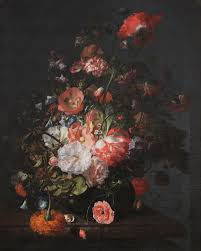
Flower Still Life (1700), Rachel Ruysch
Subject: overflowing flowers within a vase
Form: more scientific focus on portrayal of flowers and leaves, precision, crisp sharp detail, individual blooms, preserved flowers to look at them, minute details within the flowers, element of luxury, projects towards viewer, elaborate column in background, not a balanced composition, all flowers bend in different angles and speaks to nature’s unwillingness to be controlled, dramatic lighting, curving stems, less emphasis on symbolic associations, no bugs, just about the plants, lot of reds, pinks, yellows, and blues
Function: show the beauty of a scientific approach to botany