Mitosis Cytokinesis and
 Call Kai
 Learn
Learn Practice Test
 Spaced Repetition
 Match
Match Flashcards
 Knowt Play
1/32

There's no tags or description
Looks like no tags are added yet.
Name | Mastery | Learn | Test | Matching | Spaced | Call with Kai | Chat |
|---|
No analytics yet
Send a link to your students to track their progress
33 Terms
Why/when are new cells needed?
• Replaces damaged or lost cells (i.e. tissue renewal)
• Permits growth and development of an organism
• Allows for reproduction
Asexual reproduction
Achieved by budding or fragmentation.
• Takes place by
• Binary-fission in prokaryotes
• Mitosis in single-celled eukaryotes
• Results in clones - offspring genetically identical to the parental cell with the exception of mutations (relatively little genetic variation in DNA sequences compared to variation
from sexual reproduction)
Sexual reproduction
• Accomplished by the fusion of two specialized cells, gametes, which are produced by the process of meiosis.
• Results in non-identical daughter cells (and can result in considerable genetic variation)
Reproductive signals
from outside or inside the cell, stimulate cell division
DNA Replication
replication of the genetic material (i.e. the genome)
DNA segregation
one copy of each replicated DNA molecule to each new daughter
cell
Cytokinesis
division of the cytoplasm to form two daughter cells
Bacterial Cell Division: Binary Fission
nutrient concentrations
DNA Replication – begins at the origin of replication (ori)
DNA segregation - active process, prokaryotic
cytoskeleton similar to both actin (in structure) and
tubulin (in function). Ori and associated regions pulled
along this.
Cytokinesis - membrane pinches due to contractile ring
of proteins similar to tubulin (structurally) and actin
(functionally), new cell wall material deposited until
separation completed.
Remember - most prokaryotes have one chromosome, a
single molecule of DNA—usually circular.
Also remember, they can also have one or more small,
circular, extrachromosomal pieces of DNA called
plasmids. These replicate independently of the
chromosome.
Ploidy
the number of Chromosome Sets in a Cell
n =# of chromosomes in a set (1 of each chromosome)
Cells that have two sets of chromosomes,
are diploid (2n) → somatic cells
Cells that only contain a single set of chromosomes, like gametes, are haploid (n)
Meiosis
Takes place in germ cells, giving rise to the gametes
(eggs and sperm), which are
• haploid (n)
• genetically unique (i.e. meiosis contributes to
genetic variation)
Mitosis
• Takes place in somatic cells (non-gamete cells)
• Daughter cells are genetically identical to the
parental cell (i.e. mitosis does not contribute to
genetic variation)
The Organization of DNA in the Eukaryotic Cell
• A chromosome is distinct piece of DNA
• Chromatin consists of fibers of protein and DNA
• DNA associates tightly with proteins called histones
• DNA and protein are packed into discrete units called nucleosomes
Nucleosomes help fold and organize DNA in the nucleus
DNA can be condensed and decondensed
In preparation for cell division DNA will be very
highly condensed
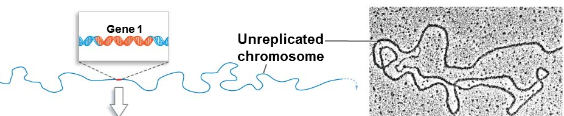
unreplicated chromosome
consists of a single, long DNA double helix wrapped around proteins
replicated chromosome
consists of two copies of the same DNA double helix

condensed replicated chromosomes
consists of DNA condensed around its associated proteins, resulting in a compact chromosome that is 10kx shorter than its og length
SISTER CHROMATIDS

Homologous chromosomes (homologs)
two chromosomes of the same
length, centromere position and staining pattern and which share the same
genes at the same location (loci)
• One is inherited from the father, the other from the mother
Humans have 1 pair of sex\ chromosomes
Presence of the Y chromosome leads to maleness.
Non-sex chromosomes are called autosomes.
The Cell Cycle
• Interphase (G1, S, G2)
• G1: preparation for DNA replication
• non-dividing cells are arrested at this stage of the cell cycle (referred to as G0)
• S phase:replication of genetic material (DNA Synthesis)
• G2: preparation for cell division
• M Phase: cell division
• Mitosis: division of the genetic material
• Cytokinesis: division of the cytoplasm
What does mitosis result in
the division of the cell nucleus
G2 of Interphase
Interphase: G1, S phase & G2
(all events in preparation for
cell division)

prophase
What’s changed?
• Duplicated chromosomes begin to condense
• Mitotic spindle begins to form
• Nucleoli disappear
• Centrosomes move towards opposite pole

prometaphase
• nuclear envelope breaks down
• microtubules penetrate nuclear region, begin to attach to kinetochores of chromosomes
• other microtubules interact from opposite poles

Metaphase
• alignment of duplicated chromosomes along the metaphase plate of the cell
• Centrosomes now at opposite poles
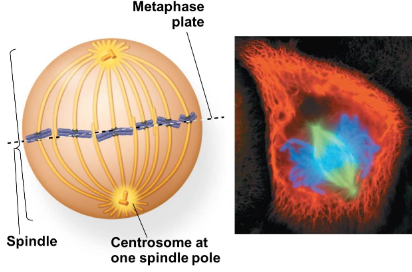
The Mitotic Spindle
Kinetochore microtubules shorten while
non-kinetochore (polar) microtubules
“push” against each other to extend the cell.
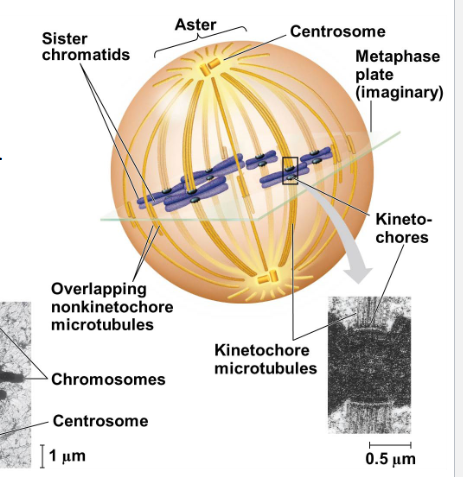
At which end to kinetochore microtubules shorten during anaphase?
• microtubules are labeled with a fluorescent dye
• “bleach” region of microtubules (via laser) to mark them
• observe shortening of microtubules relative to mark
What does this mean?
Kineticore microtubules shorten at the kineticore end.
anaphase
• Cohesins connecting sister chromatids cleaved
• microtubules mediate separation of sister chromatids and elongation of the cell

teleophase and cytokinesis
• opposite of prophase
• chromosomes decondense, nuclear envelope reforms spindle fibers disassemble, nucleoli reappear

Cytokinesis in Animal Cells
Actin microfilaments form a contractile ring at the center of the cell inside the plasma membrane
Motor proteins drive the contraction of the ring, forming a cleavage furrow which eventually fuses resulting in 2 separate cells!
Cytokinesis in Plant Cells
Vesicles transport new cell wall material to the
middle of cell
The cell plate begins to form, eventually becoming a complete cell wall separating the 2
daughter cells
1. Three Essential Roles of Cell Division
Growth and Development
Tissue Repair and Renewal
Reproduction
Meiosis – Halving the “genetic deck”
Meiosis I
Unique events in:
• Prophase I – Synapsis & crossing over
• Metaphase I – Alignment of homologs
• Anaphase I – Separation of homologs
Results in two haploid cells
Meiosis II
Separation of sister chromatids
(looks pretty much like mitosis)
Results in four haploid gametes


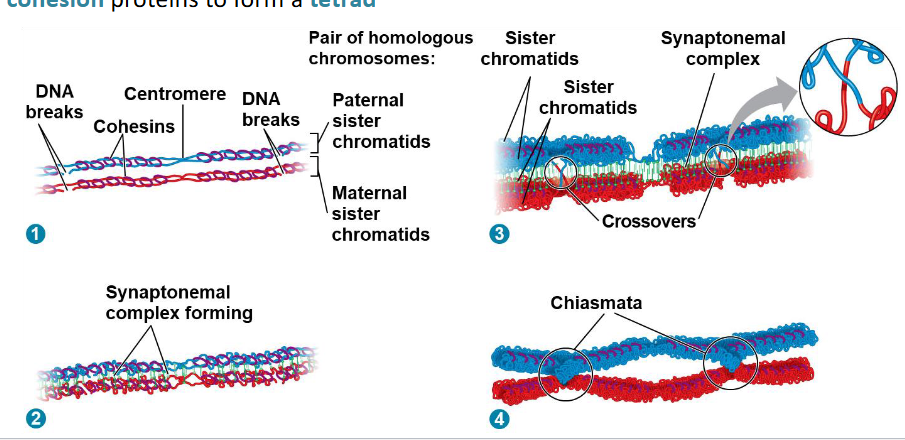
Prophase I - Crossing Over
Synapsis: homologous chromosomes
are held together along their length
by cohesion proteins to form a tetrad