ap macroeconomics unit 4
 Studied by 1 person
 Call Kai
 Learn
Learn Practice Test
 Spaced Repetition
 Match
Match Flashcards
 Knowt Play
1/124

There's no tags or description
Looks like no tags are added yet.
Name | Mastery | Learn | Test | Matching | Spaced |
|---|
No study sessions yet.
125 Terms
money
anything that can be used to purchase goods and services
wealth
accumulation of savings through the purchase of assets (with money) that occurs over time
financial assets
written claims where buyers have the right to future income from sellers
examples of financial assets
loans
bonds
stocks
physical assets
demand deposits
liquidity
how easily assets turn into cash
comparison of liquidity
how easily demand deposits, savings accounts, and bonds can be turned into cash
assets
valuable because they allow holder to accumulate wealth over time - interest makes assets grow over time - leads to growth in the aggregate economy
types of assets investors are attracted to
financial assets that have higher rates of return
speculation
when consumers hold money rather than bonds because they expect the interest rate to increase in the future
bond
number of years a holder can earn interests
after a bond comes to maturity, the bondholder gets the total face value of bond _ interest it earned overtime
relationship between bond prices and interest rates
inverse relationship between bond prices and the interest rates
nominal interest rate
rates you see when doing business with a financial institution
rates paid on loan that are not adjusted for inflation levels
real interest rates
real rate of return earned on financial assets or paid back on loans
rates that ARE ADJUSTED for inflation
fisher effect
NIR = RIR + Inflation
calculates the real rate of return
effects of when unexpected inflation occurs
real value of return on financial assets falls and the real value of financial assets falls
fiat money
a currency issued by a government that is not tied to any physical commodity like gold or silver but rather to the government's authority
example: US Dollar
real value of money isn’t set by government
set by number of goods and services it can purchase
store of value
money has purchasing power over time
other assets can also hold value
inflation decreases money’s ability to store value
result: we need to print more money
medium of exchange
money used to exchange goods and services to help economies grow faster
unit of account
a function of money that provides a standard monetary unit to measure and compare the value of different goods, services, and assets
M0 = monetary base
currency and bank reserves
M1
currency in circulation, demand deposits, and savings accounts
M2
M1 + small denomination time deposits + retail money market $
M3
M1 + M2 + larger time deposits + larger liquid assets
banking system
made of many different banks (commercial and investment)
properties of commercial banks
store your money and pay you interest
customers store money in checkings accounts - become bank’s liability
loan money and earn interest
banks use portion of customer demand deposits to make loans to individuals and businesses - bank assets
fractional reserve banking
central bank sets the percentage of customer demand deposits that a bank must hold in reserves (not loan out) - known as the reserve requirement
essentially how banks make money
bank balance sheets
show amounts of bank assets and bank liabilities each individual bank has and both sides are equal to each other
examples of assets
reserves and loans
example of liability
demand deposits
effects of changes in demand deposits
size of the bank’s required and excess reserves
required reserves
percentage of demand deposits that the banks must hold in reserves
excess reserves
percentage of demand deposits that banks choose to hold onto. these can be loaned out to individuals and businesses
commercial banks with non-zero reserve requirement can create money through
lending excess reserves to customers
individual banks can make new loans or fewer loans based on
behavior of their customers
when customer deposits $1000, there’s a change in the
demand deposits, required reserves, and amount of new loans
money multiplier
determines maximum changes to the banking system when deposits or withdrawals from demand deposits occur
formula for money multiplier
1 / (reserve requirement)
effects of customers’ withdrawing money
withdrawn from bank’s reserve (bank’s assets) and subtracted from bank’s demand deposits (bank’s liabilities)
demand deposits = liabilities
represent money owed to the depositor that can be withdrawn on demand
money market
competitive market where the good being supplied and demanded is money (M1)
also known as the liquidity preference model because of the interest rate
price in the money market =
nominal interest rates because NIR is opportunity cost of holding money
demand in the money market
represents relationship between nominal interest rate and the quantity of money demanded
3 types of demand in money market
transactions of demand
speculative/asset demand
precautionary demand
type of relationship between nominal interest rate and the quantity of money demanded
an inverse relationship
when nominal interest rate is high
the quantity of money demanded is low
when nominal interest rate is low
the quantity of money demanded is high
graph for the demand of money
downward sloping line
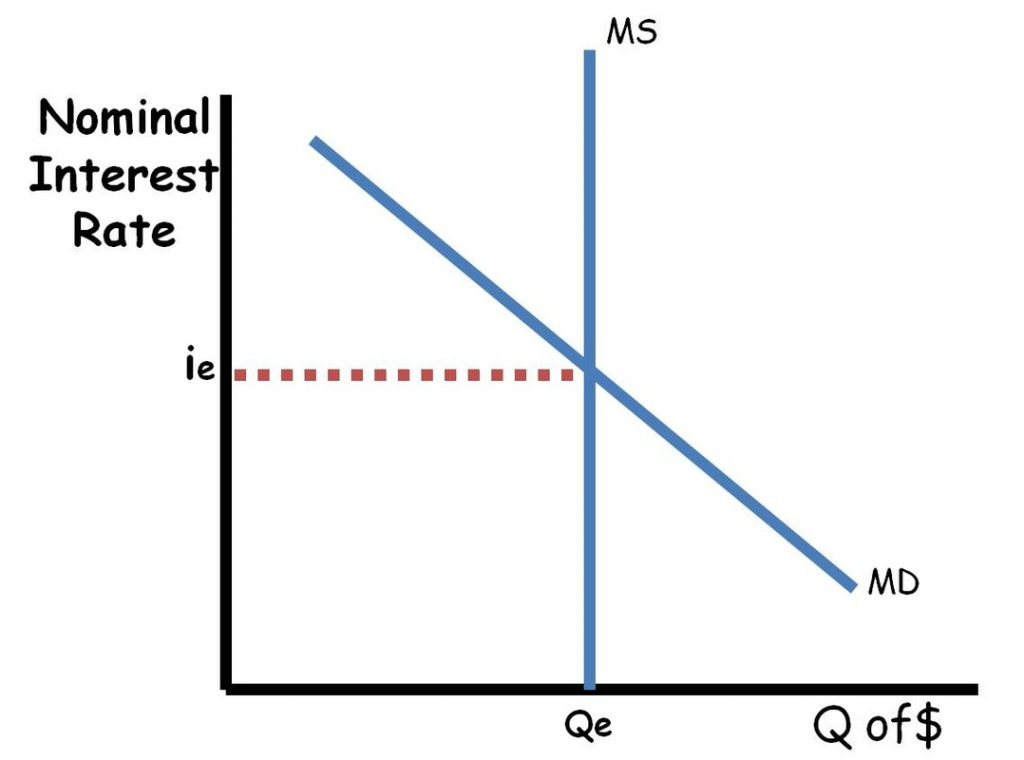
supply in the money market
amount of money that people have access to
controlled by a country’s central bank
independent of nominal interest rate
supply of money graph
look at the graph here
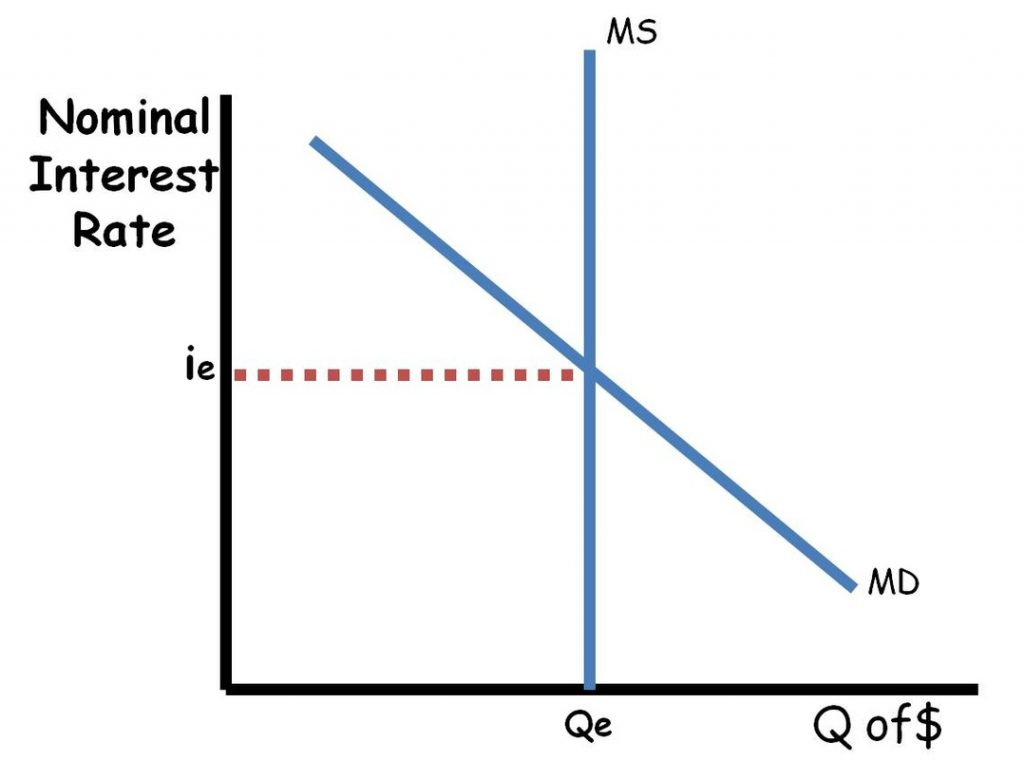
market equilibrium on money market graph
occurs when the nominal interest rate is set where the current supply of money intersects the current demand for money
in terms of supply, at higher interest rates
the surplus will drive down the interest
in terms of supply, at lower interest rates
the shortage will drive up the interest
shifters of the money demand
aggregate price level, real GDP (national income), and technology
aggregate price level
higher prices require more money to make purchases
real GDP
when national income increases, spending increases, so more money is needed
technology
the easier it is to convert less liquid assets into money, the less money is needed/demanded
availability/cost of using money substitutes (such as credit cards) affect the money demand too
factors that shift money supply
related to monetary policy as conducted by the central bank
monetary policy
central bank’s policies of influencing the nominal interest rates to help achieve macroeconomic objectives
price stability (low/stable rate of inflation)
full employment levels
interest rate changes impact
price level, real output, and unemployment through shifts in the AD
monetary policy’s target interest rate BG
when banks are unable to meet the reserve requirement they can call in loans, sell assets, borrow from central bank, and borrow from commercial banks (policy rate)
policy rate
overnight interbank lending rate
called federal funds rate in the USA
central banks often set a target range from the policy rate as a way to
guide monetary policy
expansionary monetary policy
when the central bank decreases nominal interest rates in the short run to help an economy out of a recessionary gap
lower interest rates - less expensive to borrow - more interest sensitive spending (I & C) - increase in aggregate demand
contractionary monetary policy
when central bank increases nominal interest rates in the short run to get the economy out of an inflationary gap
higher interest rates - more expensive to borrow - less interest sensitive spending - decrease in the AD
recognition lag
takes central bank time to collect and analyze the data needed to recognize problems in the economy
impact lag
takes time for economy to adjust after the policy action is taken
limited reserves framework
banking system in which reserves are not overly abundant
qualities of limited reserves framework
non-zero reserve requirement
commercial banks hold required reserves and possibly also some excess reserves
monetary policy works by changing supply of excess money/reserves - ultimately the supply of money
changing money supply results in changes to the nominal interest rate
lower NIR - expansionary because there will be no more interest sensitive spending - AD will decrease
higher NIR - contractionary because there will be less interest sensitive spending so AD decreases
central banks use their monetary policy tools
required reserve ratio - percentage of demand deposits banks MUST hold in their reserves
discount rate - interest rate commercial banks must pay to borrow from the central bank
open market operations - central bank buying and selling of government bonds (securities)
required reserve ratio
percentage of demand deposits banks must hold in their reserves
if RRR decreases, banks have more in excess reserves to lend so the MS increases (NIR falls)
if RRR increases, banks have less in excess reserves to lend to the MS decreases (NIR rises)
discount rate
interest rate commercial banks must pay to borrow from the central bank
if DR increases, banks are encouraged to lend less so MS decreases
if DR decreases, banks are encourages to lend more so MS increases
open market operations
central bank buying and selling of govt bonds known as securities
when central bank buys goods (OM purchase), banks’ excess reserves increase so MS increases
when central bank sells bonds (OM sale) banks’ reserves decrease so MS decreases
money multiplier and OMO
OMO causes changes in reserves so monetary base is also going to change
in limited reserves environment, effect of an OMO on the MS is greater than the effect on monetary base because of the MM
increases and decreases in excess reserves
increase - leads to banks making more loans - more deposits - more excess reserves - more loans
decrease - leads to banks making less loans - less deposits - less excess reserves - less loans
maximum possible value of money = 1 / RRR based on the assumptions that
banks hold no excess reserves
borrowers spend entire loans
customers hold no form of cash with them
equation for maximum change as a result of OMO
OMO amount (money multiplier)
in ample reserves framework
interest rate changes are brought about through changes to administered interest rates
ample reserves framework quality
banking system in which reserves are abundant
required reserves ratio is 0
diff monetary policy tools needed - central banks often set target ranges for their policy rates
changing MS doesn’t lead to changes in the NIR
reserve market model graph
policy rate set at the intersection of SR and DR - overnight interbank lending rate
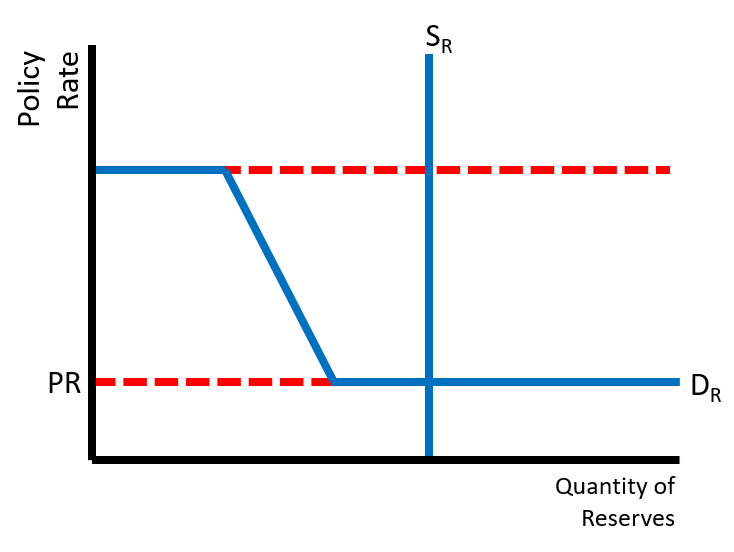
intersection in ample reserves
SR intersects lower horizontal portion of DR
maintaining ample reserves
maintained through buying bonds
monetary base increases, but there’s no real impact on the interest rates
monetary policy tools - ample reserves
interest on reserves
interest rate commercial banks earn on the funds in their reserve balance accounts with the Fed
serves a the Fed’s primary monetary policy tool
increases/decreases to IOR move up/down the lower bound on RMM graph
discount rate
interest rate commerical banks must pay to borrow from the fed
adjusted in the same manner as interest on reserves
increases/decreases to the discount rate move up/down the upper bound on reserve model graph
when will the DR move down
decrease in administered interest rates - decrease in policy rate - decrease in nominal interest rates
expansionary policy because int spending and AD will increase now
when will the DR move up
increase in administered interest rates - increase in the policy rate - increase in other nominal interest rates
contractionary policy because int spending and AD will decrease now
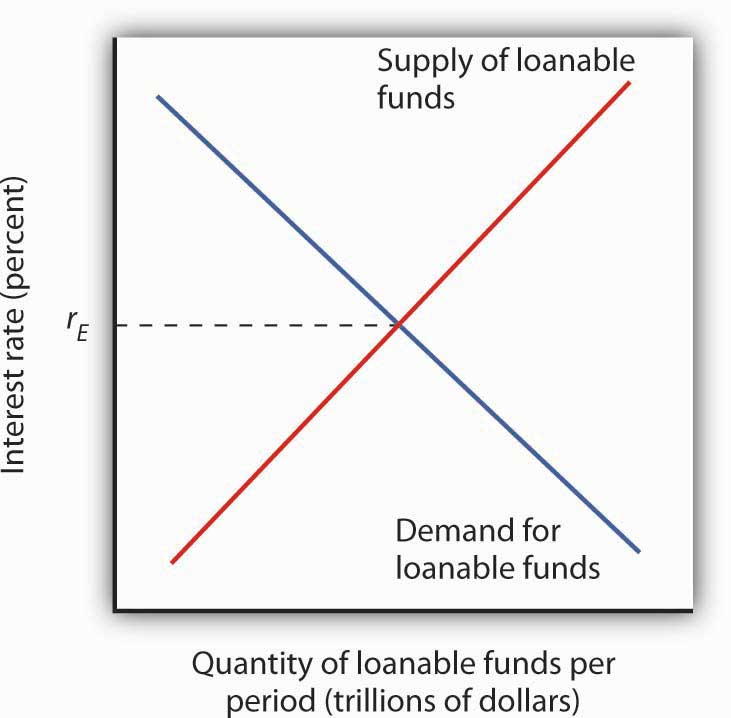
loanable funds market
how much money in the form of a loan consumers, businesses, and the government are requiring
determined by expectation of return on investment
real interest rate equals price of borrowing money
how much consumers pay for borrowing money
real interest rate = nominal interest rate - inflation
graph for demand for loans
follows law of demand
represents amount of loans demanded by consumers (mortgages), producers (business loans), government (bonds)
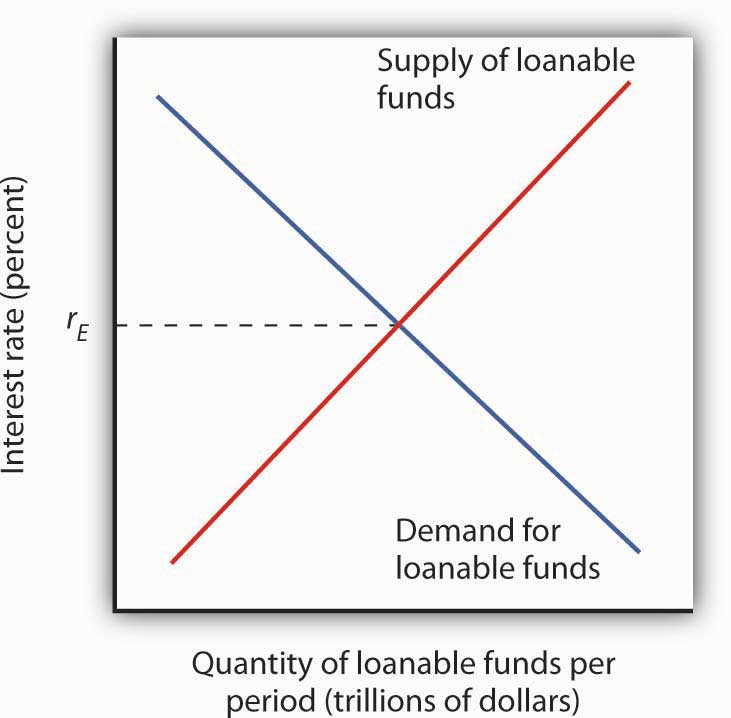
graph for supply of loans
follows law of supply
closed economy = supply equal to national savings (public + private)
open economy = supply equal to national savings + net capital flow
when economy is in a negative (recessionary) or positive (inflationary) output gap
combo of expansionary/contractionary fiscal or monetary policy will be used to restore full employment
combo of fiscal/monetary policy influences
aggregate demand, real output, price level, and interest rates
fiscal policy
manipulate AD by changing spending + taxes
monetary policy
manipulate AD by changing interest rates
recessionary gap
fiscal policy - increase spending, lower taxes - shift AD right - unemployment down
monetary policy - decrease interest rates - shift AD right - unemployment down
inflationary gap
fiscal policy - decrease spending, increase taxes - shift AD left - price level down
monetary policy - increase interest rates - shift AD left - price level down
when economy is at full employment
changes in the money supply have no effect on real output in the long run
causes of inflation/deflation
increasing/decreasing money supply at too rapid for a rate for a sustained period of time
quantity theory of money
in long run, growth rate of the money supply determines the growth rate of price level (inflation rate)