Unit 2. General Characteristics of Bacteria
 Call Kai
 Learn
Learn Practice Test
 Spaced Repetition
 Match
Match Flashcards
 Knowt Play
1/167

There's no tags or description
Looks like no tags are added yet.
Name | Mastery | Learn | Test | Matching | Spaced | Call with Kai | Chat |
|---|
No analytics yet
Send a link to your students to track their progress
168 Terms
Bacteria
unicellular organisms that lack a nuclear membrane and true nucleus
prokaryotes
having no mitochondria, endoplasmic reticulum (ER), or Golgi bodies (they only have ribosomes)
Bacterial cell wall
______________ differences provide the basis for the Gram stain
capsule
structure that helps evade phagocytosis
obscure antigenic material
variable (may or may not be present)
Gram staining
a test to initially identify bacteria into 2 major groups:
A. Gram positive
B. Gram negative
0 .25-1 μm in width
1-3 μm in length
BACTERIAL SIZE:
Most clinically relevant bacterial species range in size
T
virus = nanometer (10-9) = electron microscope
bacteria = micrometer (10-6) micrometer = brightfield microscope
T or F
Virus is smaller than bacteria.
asymmetric growth of the cell wall
Variation of size and shape within a population may also result from ________________________
Haemophilus ducreyi
smallest bacteria
causes chancroid
Bacillus anthracis
largest bacteria
causes anthrax
cocci
bacillus
coccobacilli
fusiform
curved
spirochette
pleomorphic
BACTERIAL SHAPE (7)
[NoBoyVrend] nega mga ekalal
Neisseria spp.
Branhamella spp.
Veillonella spp.
BACTERIAL SHAPE
all cocci shaped bacteria are Gram positive, except for the 3
bacillus
BACTERIAL SHAPE
rod shaped
Bacillus anthracis
Enterobacteriaceae
Escherichia coli
Shigella spp.
bacillus examples
Coccobacilli
Gardnerella spp. (normal flora in female vagina)
BACTERIAL SHAPE
ovoid
fusiform
BACTERIAL SHAPE
tapered ends
Vibrio cholerae
curved bacteria example
spirochettes
BACTERIAL SHAPE
flexous helical coil
darkfield microscopy
Leptospira interrogans - leptospirosis
Borrelia burgdorferi - lime disease
Treponema pallidum - syphilis
[LowBaT nako kaya paikot ikot ako na lang]
spirochettes example
Pleomorphic
BACTERIAL SHAPE
no defined shape
because of their cell envelope
Mycoplasma spp.
Ureaplasma spp.
ALL bacteria have cell wall, except for this 2
Staph - clusters
Strep - chains
Diplo - pairs
Tetrads
Packets of 8
Palisadin - picket-fence arrangement
Chinese characters
BACTERIAL ARRANGEMENT (7)
Staph - Staphylococcus
Strep - Streptococcus
Diplo - Neisseria gonorrhoeae, Streptococcus pneumoniae
Tetrads - Micrococcus, Pediococcus
Packets of 8 - Sarcina
Palisadin - picket-fence arrangement
Chinese characters - Corynebacterium diphtheriae
BACTERIAL ARRANGEMENT (7) & THEIR EXAMPLES
Streptococcus pneumoniae
Gram positive diplococci
Neisseria gonorrhoeae
Gram negative diplococci
[POCC]
Outer membrane
Cell wall
Periplasm
Cytoplasmic/cell membrane
CELL ENVELOPE COMPOSITION (4)
OUTER MEMBRANE
CELL ENVELOPE COMPOSITION
Function as cell’s initial barrier to the environment
primary permeability barriers to hydrophilic and hydrophobic compounds
contain essential enzymes and other proteins located in the periplasmic space
Bilayered structure
Plays a significant role in the ability of certain bacteria to cause disease (virulence)
gram-negative bacteria
CELL ENVELOPE COMPOSITION
outer membrane is found only on
lipopolysaccharide
net negative charge
CELL ENVELOPE COMPOSITION
Outer membrane is composed of _____________ Which gives the surface of gram-negative bacteria a ______________
porins
murein lipoproteins
Structures found in the outer membrane
PORINS
Structures found in the outer membrane
Protein structures scattered throughout the lipopolysaccharide macromolecules
Water-filled structures that control the passage of nutrients and other solutes, including antibiotics, through the outer membrane
Influence the extent to which various substances pass through the outer membranes of different bacteria
MUREIN LIPOPROTEINS
Structures found in the outer membrane
Facilitate the attachment of the outer membrane to the next internal layer in the cell envelope, the cell wall
bridge between outer membrane & inner structure
Cell wall / Murein Layer / Peptidoglycan
CELL ENVELOPE COMPOSITION
Gives the bacterial cell shape and strength to withstand changes in environmental osmotic pressures that would otherwise result in cell lysis
Protects against mechanical disruption of the cell and offers some barrier to the passage of larger substances
Cell wall
CELL ENVELOPE COMPOSITION
the part that is stained in Gram staining
Disaccharide-pentapeptide subunits
CELL ENVELOPE COMPOSITION
cell wall is composed of
N-acetyl-D-glucosamine (NAG)
N-acetyl-D-muramic acid (NAM)
Structures in the cell wall
Alternating sugar components (moieties),with the amino acid chain linked to N-acetylmuramic acid molecules
Layers of these sheets are cross-linked with one another, forming a multilayered, cross-linked structure of considerable strength
peptide bridges
peptidoglycan sheets
Murein sacculus/ sack
Structures in the cell wall
Polymers of NAM & NAG Polymers cross-link to one another by means of __________ to form ____________
this is referred to as _________________, this peptidoglycan structure surrounds the entire cell
mycolic acid (glycolipid + fatty acid)
a waxy cell wall contains _______________ that gives the bacteria a weak or ghost stain
Acid-Fast Staining
Instead of gram staining, this is used for bacteria that have high amounts of mycolic acid in their cell wall
Mycobacteria
Nocardia
Legionella micdadei
Tsukamurella
Gordonia
Rhodococcus
[MNL ToGetheR]
bacteria that have mycolic acid and is best stained using AFS
carbol fuchsin
primary stain used in AFS
red stain
color of AFS positive result
Acid-fast bacilli
term used to call bacteria that are positive for AFS
Gram-positive cell wall
Gram + or -
Composed of a very thick protective peptidoglycan (murein) layer
Consists of glycan (polysaccharide) chains of alternating N-acetyl-d- glucosamine (NAG) and Nacetyl-d-muramic acid (NAM)
cephalosporins (e.g., penicillin)
antibiotics that are effective against gram-positive organisms act by preventing synthesis of peptidoglycan are called
most effective against gram-positive bacteria
cell wall
The appendages like flagellum and pili are anchored by ________, it provide also support for the flagella and pili of bacteria
Teichoic acid
Lipoteichoic acid
Teichuronic acid
Structures in the GRAM POSITIVE cell wall
enumerate the 3 acids
TEICHOIC ACID
Structures in the GRAM POSITIVE cell wall
anchored to the peptidoglycan (N-acetylmuramic acid)
glycerol or ribitol phosphate polymers combined with various sugars, amino acids, and amino sugars
LIPOTEICHOIC ACID
Structures in the GRAM POSITIVE cell wall
anchored to the PM (plasma membrane)
linked to the next underlying layer, PM or cellular memebrane
TEICHURONIC ACID
Structures in the GRAM POSITIVE cell wall
similar polymers, but the repeat units include sugar acids (eg, N-acetylmannosuronic or d-glucosuronic acid) instead of phosphoric acids
synthesized in place of teichoic acids when phosphate is limiting
Outer membrane
Inner peptidoglycan layer (cell wall)
Structures in the GRAM NEGATIVE cell wall
composed of two layers:
proteins
phospholipids
lipopolysaccharides (LPS)
[LipPPtolelat]
Outer membrane contains (3)
O-specific polysaccharide
Core polysaccharide
Lipid A (endotoxin)
[LPS → GPS: LOC]
LPS THREE REGIONS:
O-specific polysaccharide
LPS THREE REGIONS:
antigenic
causes immune respone
can be used for serotyping
Core polysaccharide
LPS THREE REGIONS:
ketodeoxyoctanoic acid (KDO) and heptose
for viability of bacteria
Lipid A
LPS THREE REGIONS:
inner, major constituents
released when bacteria lyses → activates T cells → activates other immune cells → procudes fever and shock hence, an ENDOTOXIN
consists of phosphorylated glucosamine disaccharide units to which are attached a number of long-chain fatty acids
binary fission
mode of reproduction of bacteria
spherical
rod-shape
filamentous
Gram positive bacteria shapes
spherical
oval
straight or curved
helical or filamentous
Gram positive bacteria shapes
chemoorganoheterotrophic
Gram positive bacteria metabolism
Chemoorganoheterotrophic
Chemolitoautotrophic
Phototrophic
Gram negative bacteria metabolism
Present in some
Clostridium spp.
Bacillus spp.
Gram positive bacteria endospore
absent
Gram negative bacteria endospore
PERIPLASMIC SPACE
CELL ENVELOPE COMPOSITION
Bounded by the internal surface of the outer membrane and the external surface of the cellular membrane encompassing the thin peptidoglycan layer
Contains the murein layer, consists gellike matrix containing nutrient-binding proteins that assist in the capture of nutrients from the environment
PERIPLASMIC SPACE
CELL ENVELOPE COMPOSITION
Contains several enzymes involved in the degradation of macromolecules and detoxification of environmental solutes, including antibiotics that enter through the outer membrane
gram-negative bacteria
periplasmic space is found only on
Acid-fast cell wall
Have a gram-positive cell wall structure
Contain a waxy layer of glycolipids and fatty acids (mycolic acid) bound to the exterior of the cell wall
More than 60% of the cell wall is lipid
Mycolic Acid
Major lipid component in acid-fast cell wall
Strong “hydrophobic” molecule that forms a lipid shell around the organism and affects its permeability
Makes Mycobacterium spp. difficult to stain with the Gram stain
CYTOPLASMIC/ CELL (INNER) MEMBRANE
CELL ENVELOPE COMPOSITION
Present in both gram-negative and gram-positive bacteria
deepest layer of the cell envelope
Consist of phospholipid bilayer, various proteins (70%), including a number of enzymes vital to cellular metabolism
Serves as an additional osmotic barrier
CYTOPLASMIC/ CELL (INNER) MEMBRANE
CELL ENVELOPE COMPOSITION
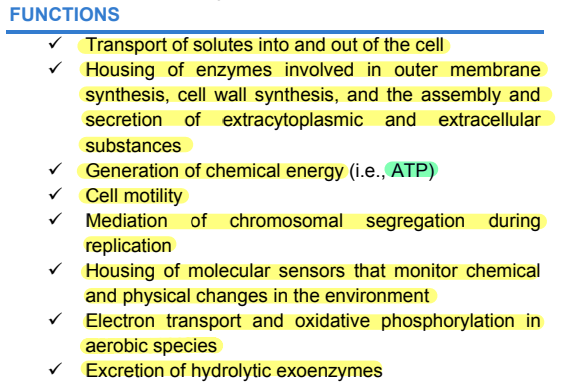
Ribosomes
Genome
Plasmid
Inclusion bodies
Endospores/Asexual Spores
[Ritz Gumabay cutiPIE]
CYTOPLASMIC STRUCTURES (5)
Ribosomes
CYTOPLASMIC STRUCTURES
Site of protein biosynthesis and give the cytoplasm a granular structure
RNA + proteins
70S size
50S subunit
30S subunit
CYTOPLASMIC STRUCTURES
ribosome size & subunits
Streptomycin
Gentamicin
This antibiotic/s attach to the 30S subunit and interfere with protein synthesis
Erythromycin
Chloramphenicol
This antibiotic/s attach to the 50S subunit and interfere with protein synthesis
Genome
CYTOPLASMIC STRUCTURES
codes for all bacterial cell processes
Appears as diffused nucleoid or chromatin body that is attached to a mesosome (sac-like structure)
single, circular chromosome
CYTOPLASMIC STRUCTURES
bacterial genome structure
Nucleoid
CYTOPLASMIC STRUCTURES
Feulgen positive
Consists of a single continuous circular molecule ranging in size from 0.58 to almost 10 million base pair
Borrelia burgdorferi
Streptomyces coelicolor
All bacteria have a single continuous circular nucleoid except
Vibrio cholerae
Brucella melitensis
Few bacteria have dissimilar chromosomes like
Plasmid
CYTOPLASMIC STRUCTURES
Extrachromosomal, double-stranded element of DNA that is associated with virulence
Not essential for bacterial growth so a bacterial cell may or may not contain this
Sometimes disappears during cell division and it can make bacteria (mostly Gram-neg) pathogenic
antibiotic resistance and toxin production
CYTOPLASMIC STRUCTURES
Plasmid in the cytoplasm serves as a site for the genes to code for ________________________________
Large plasmid
Small plasmid
2 kinds of plasmid
large plasmid
2 kinds of plasmid:
responsible for the production of B-lactamase that provide resistance to B-lactam antibiotics (penicillin and oxacillin)
Small plasmid
2 kinds of plasmid:
Resistant to tetracyclines and chloramphenicol
INCLUSION BODIES
CYTOPLASMIC STRUCTURES
Serve as the energy source or food reserve of the bacteria or as a reservoir of structural building blocks
Composed mainly of polysaccharides
lessen osmotic pressure
glycogen
cyanophysin
poly-Bhydroxybutyrate granules
carboxysomes (cyanobacteria, nitrifying bacteria, and thiobacilli)
gas vacuoles (cyanobacteria, halobacterium, and thiothrix)
polyphosphate granules (volutin and metachromatic granules)
CYTOPLASMIC STRUCTURES
example of inclusion bodies
glycogen
polyphosphate granules
Two common types of cytoplasmic granules
glucose
Two common types of cytoplasmic granules
Two common types of cytoplasmic granules
Polyphosphate granule
Two common types of cytoplasmic granules
Storage form of inorganic phosphates
Source of phosphate for nucleic acid and phospholipid synthesis
Babes-Ernst bodies = Corynebacterium diphtheriae
Bipolar bodes = Yersinia pestis, Burkholderia pseudomallei, Aggregatibacter spp.
Much granules = Mycobacterium tuberculosis
Halberstaedter–Prowazek bodies = Chlamydia trachomatis
Levinthal–Cole–Lillie bodies = Chlamydia psittaci
[HaLa BBM!]
Examples of inclusion bodies in bacteria
(PHB) Poly-B-Hydroxybutyric acid
INCLUSION BODIES
Lipid like compound consisting of chains of B-hydroxybutyric acid units connected through ester linkages
Produced when the source of nitrogen, sulfur, or phosphorous is limited and there is excess carbon on the medium
PHB & Glycogen
INCLUSION BODIES
Carbon source when protein and nucleic acid synthesis are resumed
Sulfur Granules
INCLUSION BODIES
Hydrogen sulfide and thiosulfate
Endospores/ Asexual spores
CYTOPLASMIC STRUCTURES
Small, dormant structures located inside the bacterial cell
Aid in the survival of bacteria against external conditions
Produced within vegetative cells of some Gram-positive bacteria
Responsible for perpetuation, but not multiplication
dipicolinic acid + calcium ions = calcium cipicolinate
CYTOPLASMIC STRUCTURES
endospores are made of
Bacillus
Clostridium
Bacteria-producing endospores
Terminal spore
Subterminal spore
Central spore
Types of Spores according to location (3)
Terminal spore = Clostridium tetani
Subterminal spore = Clostridium botulinum (canned good bacillus)
Central spore = Bacillus anthracis
Types of Spores according to location and their examples
top-head
lollipop
tennis-racket
Types of Spores according to location:
terminal spore morphology/appearance
bamboo pole appearance
Types of Spores according to location:
central spore morphology/appearance