All Units - Psych
 Studied by 0 people
 Call Kai
 Learn
Learn Practice Test
 Spaced Repetition
 Match
Match Flashcards
 Knowt Play
1/541

There's no tags or description
Looks like no tags are added yet.
Name | Mastery | Learn | Test | Matching | Spaced |
|---|
No study sessions yet.
542 Terms
Historically, were early psychologists worried if we could scientifically study the topic of memory? Why? What were the 3 concerns?
1) Worries about being able to control for individual experience-linked differences
2) Questions about how to explore the questions involved
3) Questions about the accuracy of memories reported
Who was the scientist that sought to prove if we could examine the concept of memory scientifically? (Free Recall Test) What years was he active?
Hermann Ebbinghaus (1850-1909)
What was Hermann Ebbinghaus’s goals? What did he “sought to prove?”
Sought to prove that we could examine the concept of memory scientifically
Hermann Ebbinghaus: What was his controls for individual differences and stimulus differences?
Used Himself (Control for Individual Differences)
Used Nonsense Syllables (Control for Stimulus Differences)
Hermann Ebbinghaus: What was his research meant to apply to?
His research was meant to apply to a “normal” individual
Hermann Ebbinghaus: What was the focus of his work?
Determine how we can “acquire” and “forget” information
Hermann Ebbinghaus: What 4 varied items did Ebbinghaus Study?
1) Varied List Sizes
2) Varied Time after “Learning” Material
3) Varied Time after reading Material
4) Varied Number of Reads
Hermann Ebbinghaus: After his 4 varied item studies, what did he discover (2 things)?
1) Information about memory capacity (7 ± 2 items)
2) Learning and forgetting curves
Hermann Ebbinghaus: Why did Ebbinghaus’s work lead to? What did it conclude (1) and what did it provide information on (2)?
1) Showed us that we could scientifically study the topic of memory
2) Gave us information on memory capacity and the malleability of our minds
Hermann Ebbinghaus: What 4 things did his work NOT explore?
1) Our ability to display memory of information when we are asked to reproduce it in approach
2) Different types of memory that potentially exist
3) If memory capacity changes for meaningful information
4) If and how we alter our memory of information
What is Ebbinghaus’s test now called?
Free Recall Test
What happens during a Free Recall Test?
In a free recall test, participants are asked to recall as many of the studied items as they can, in any order they choose
What happens during a Cued recall test?
Cued recall refers to retrieving information from long-term memory using aids or cues
-Example: Recalling US States Example
What happens during a Recognition Test?
The recognition test asks whether an item that had been presented recently now appears familiar
Example: Naming Dwarves Activities
What happens during a Savings Test?
A person learns a list of items (e.g., nonsense syllables or facts) until they can recall it perfectly.
After some time passes, they try to relearn the same list.
The savings is the reduction in time or number of repetitions needed to relearn the material compared to the first time.
Ex: Elemental Table test - you might not remember the periodic table right now but if you study it again you’ll relearn it faster than the first time
What happens during an Implicit Memory Test?
A memory test that elicits nonconscious memories by instructing participants to respond with whatever first comes to mind.
(Unconscious retention revealed through behavior or performance)
Implicit Memory Test Example: Stimulus/Response Pairs
What kind of topic is this also?
Classical Conditioning
Implicit Memory Test Example: Learned Motor Task Example
What kind of topic is this also?
Anterograde Amnesia
*a neurological condition characterized by the inability to form new memories”
What are the 3 steps that psychologists studying memory say we undergo when we display it?
1) ENCODING
2) STORAGE
3) RETRIEVAL
How Something Is Remembered: What is the Encoding Stage out of the 3 Steps?
STEP 1) ENCODING
Process of converting information to a form that will allow us to retrieve that information later
How Something Is Remembered: What is the Storage Stage out of the 3 Steps?
STEP 2) STORAGE
Process of retaining critical information for later use
How Something Is Remembered: What is the Retrieval Stage out of the 3 Steps?
STEP 3) RETRIEVAL
Process of accessing the stored information we have encoded in order to use it in a situation
What are the 4 parts of the Temporal Memory Stages?
External Events → Sensory Memory → Short-Term Memory → Long Term Memory
Temporal Memory Stages: What does the conversion from External events to Sensory memory require?
Sensory Input
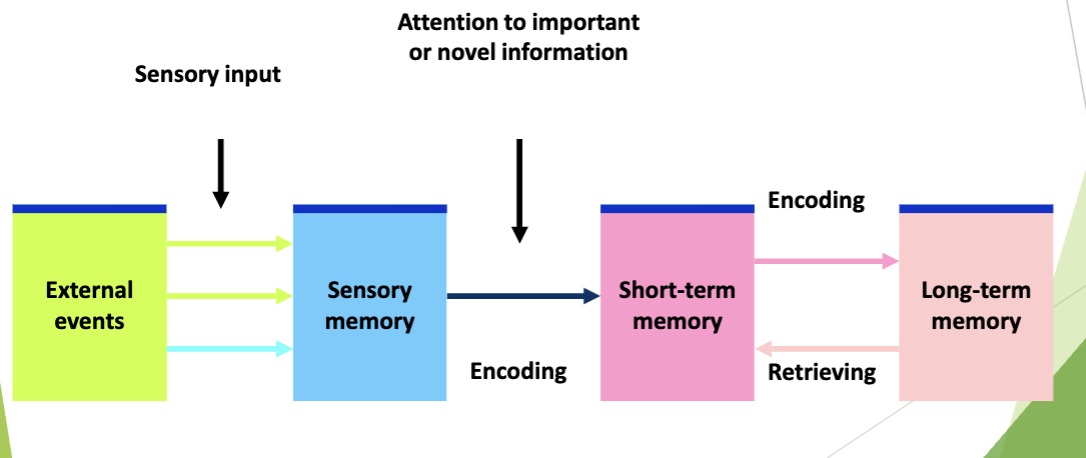
Temporal Memory Stages: What is the conversion from Sensory memory to Short-term memory require? What is this process called?
-Attention to important or novel information
-Called Encoding
Temporal Memory Stages: What is the process from Short-Term memory to Long-Term memory called?
ENCODING
Temporal Memory Stages: What is the process from Long-Term memory to Short-Term memory called?
RETRIEVING
What was Sensory Memory considered for many years?
Considered a hypothetical stage of memory
How many senses does Sensory Memory use?
Involves ALL our senses
How long does Sensory Memory say information lasts in our memory? Which parts do we even remember?
-Most of this information is said to only last in our memory for a fraction of a second
-After this fraction of a second, you attend to/remember only the information deemed important
How big is the capacity for sensory memory?
Infinite capacity (or at least large)
What are the 3 steps in Sperling’s Sensory Memory Expeirment?
1) Stimulus array flashed on screen for 0.05 seconds
2) Medium Tone within the next 0.3 seconds indicates which row to speak
3) Participant says the Correct Row
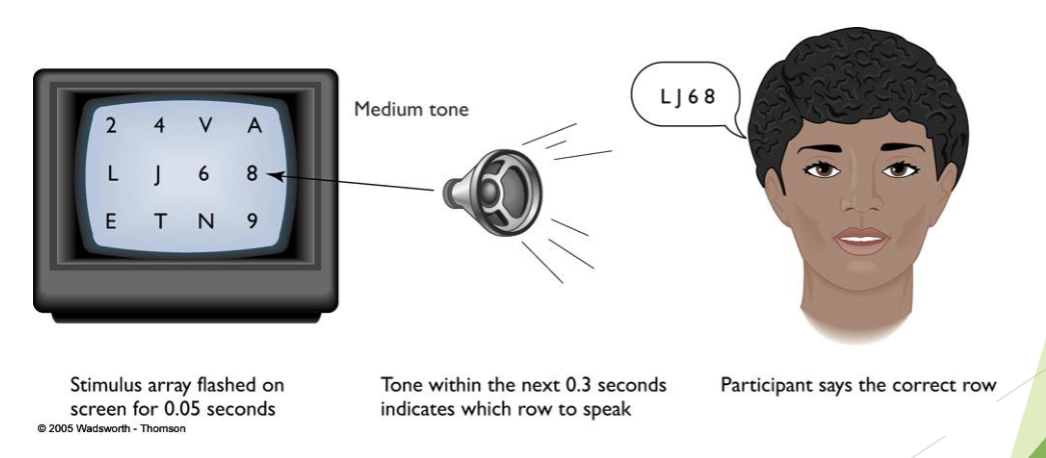
Which psychologist did the Sensory Memory Experiment in 1960?
George Sperling
Short Term Memory: How big is the capacity? What does this say about nonsense syllables?
-Has a capacity of 7 ± 2 items
-Nonsense syllables confirmation
Short Term Memory: What information is contained? Involves Past or New information?
-Contains information that we deemed relevant (at least at the time)
-Both past and new information
Short Term Memory: How long is information stored?
Anywhere from 10 seconds to a few days
Short Term Memory: What are memories stored as after (2 outcomes)
1) Forgotten (Information not regarded as important/worth saving)
2) Placed in our long-term memory store
Long Term Memory: What information does it contain (2)?
1) Information from STM that we deemed important to store
2) Information we had the ability and time to store
Long Term Memory: How complex is the information in this memory? What is it suspectible to?
-Information in part of this memory is very complex
-Susceptible to distortions and complete fabrications
What aspect of Long Term memory is controversial?
Debate if whether or not we actually ever forget information once it’s stored on long term memory
What are the 2 kinds of Long Term Memory? Describe them.
1) Declarative Memory (Things you know that you can tell others)
2) Non-declarative (Procedural) Memory (Things you know that you can show by doing)
What are the 2 Kinds of Long Term Memory → Declarative Memory? Describe examples
*Declarative Memory: Things you know that you can tell others
1) Episodic: Like remembering your first day at school
2) Semantic: Like knowing the capital of france
What are the 3 Kinds of Long Term Memory → Nondeclarative (Procedural) Memory? Describe examples
*Nondeclarative Memory: Things you know that you can show by doing
1) Skill Learning: Like knowing to ride a bike
2) Priming: Being more likely to use a word you recently heard
3) Conditioning: Salivating when you see a favorite food
What is the Serial Order Effect? What 2 effects does it combine?
The Serial Order Effect refers to the tendency for people to remember the first and last items in a list better than the middle items
Combines Primary Effect and Recency Effect
What is the Primacy Effect?
The ability to remember information at the beginning more easily
What is the Recency Effect?
The ability to remember information at the end more easily
What is the Interference Effect? What 2 interferences does it combine?
The Interference Effect refers to the phenomenon where information can be loss or less accurate due to an overlap of similar information
Combines Proactive and Retroactive Interference
What is Proactive Interference?
New material is lost (not easily stored) due to old material
Example: New names of classmates after a few weeks of school
What is Retroactive Interference?
Old material is lost (forgotten) due to new material
Example: Old lock combinations
What is the Reconstruction Effect?
-Though our memory can improve when we tie topics together, we tend to include inaccurate information into our memories to “fill in the gaps” or “fix the errors”
-Can lead us to recall things that never occured
What kind of bias does the Reconstruction Effect include?
Hindsight bias: Hindsight bias is the tendency to believe, after an event has occurred, that we “knew it all along.”
How do we Improve Our Learning? (Think of Levels of Processing, which Psychologist attests to this?)
-Levels of Processing - Successful conversation of information from STM to LTM is highly impacted by your approach to make sense of the information
-By Craik & Lockhart
How do we Improve Our Learning: Compare Deep v. Shallow Memory.
Deep: Broad connections, More assessment, Attempt to Explain
Shallow: Narrow or no connections, Rote learning, No assessment or attempts to explain
What questions can be asked on Shallow Learning (3)?
-More time spent on information?
-More retrieval cues are available?
-More effort/attention put into original processing?
Memory Dependence Work: Where are we more likely to recall information?
We are more likely to recall information when in a condition that resembles the condition that we were in when we learned the information
Memory Dependence Work: What are 3 considerations of Memory Dependence Work?
a) Language Studies
b) Situation Dependency
c) State Dependency (Caffeine v Alcohol)
Memory Dependence Work: What are 2 classroom specific memory tricks?
1) Increased Number of Learning Sessions:
-Allows to sustain deeper processing efforts
-Increases number of primary and recency effects
2) Mnemonic Devices: Encoding/Storage techniques that aid in process of information retrieval
-Acronyms
-Phrases
-Chunking (By item or concept)
-Method of Loci
Is it easy to define intelligence? What should be considered when studying the topic?
-Defining intelligence is difficult
-When studying the topic, as many possible aspects of intelligence should be considered and as many should be incorporated into the definition
What is the debateable definition of Intelligence? What is missing the from the definition?
The ability to solve problems and adapt and learn from the environment
Missing: Interpersonal skills, memory, vocabulary usage, novelty
What was Spearman’s work on?
Psychometric approach to find the “g” factor
Describe Spearman’s psychometric approach to find the “g” factor
-One specific level of intelligence - (g) general factor common to all tasks
-Could be the result of outside factors (e.g. health)
What was Sternberg’s work on?
Triarchic Theory of Intelligence
Describe Sternberg’s Triarchic Theory of Intelligence
-3 main levels of intelligence (analytical, creative, practical)
-These factors tend to correlate with each other
What was Gardener’s work on?
Theory of multiple intelligences
Describe Gardner’s Theory of Multiple Intelligences
-Intelligence isn’t one general mental capacity but rather a set of distinct types
-8/9 Different Kinds
What are Intelligence Tests?
Established techniques that allows researchers to compare an individual to their age and culture equivalent peers in order to determine how much more or less “intelligent” a person is
Who did the first intelligence Test? Who was his Student?
ALFRED BINET (1857-1911)
Student: Theodore Simon
Who was Alfred Binet? What was his work on?
-One of the first psychologists to scientifically explore intelligence
-1904, tasked by the French Ministry of Education to find a way to help children that couldn’t “profit” from a traditional education
What did the first intelligence test ask? (Alfred Binet)
Examined basic mental skills:
-Sentence Generation
-Naming Body Parts
-Remembering Number Strings
What was the Binet-Simon Test scored: How was the original scales set? Have these scales changed at all since their creation?
Goal of the test was achieved by comparing children of different ages in how well they performed the basic and more complex skills
-Used 50 “average” children (10 per age group) to set up original scales
*Scales were revised number of times as samples grew larger
What 3 factors *(mainly 2) did the Binet-Simon Test examine?
-MENTAL AGE (MA): Age that child’s responses were most indicative of
-CHRONOLOGICAL AGE (CA): Actual Age of Child
-IQ?
After the Binet-Simon test became popular, what was there a PUSH and an AIM for?
-PUSH for more tests for aid in heritability/eugenics debate
-AIM to compare adults and focus on “average” or “intelligent”
Who worked on the Stanford-Binet IQ Test?
Designed by Lewis Terman at Stanford
What was the difference between the Stanford-Binet IQ Test and the Binet-Simon Test?
-Looked at a wider range of ages
-More complex questions
-Measured more topics (fluid reasoning, knowledge, quantitative reasoning, visual-spatial reasoning, and working memory)
-Included the “Intelligence Quotient” (IQ) = MA/CA * 100 (There is Debate on this)
What is the Stanford-Binet’s “Intelligence Quotient” Equation?
“Intelligence Quotient” (IQ) = MA/CA * 100 (There is Debate on this)
What was the overall perspective on the Stanford-Binet IQ Test? (What concept was it used to point towards)
Touted as a measure of a person’s inborn ability to learn (Terman and Eugenics)
How was the Stanford-Binet IQ Test Updated? By WHO?
-David Wechsler (1896-1981)
-Standardized the scoring system (Average = 100, Standard Deviation = 15)
-Came in 2 forms:
1) WAIS: Wechsler Adult Intelligence Scale (16 and Up)
2) WISC: Wechsler Intelligence Scale for Children
What were the 2 different forms the Wechsler Scales introduced to change the Stanford-Binet IQ Test?
-Came in 2 forms:
1) WAIS: Wechsler Adult Intelligence Scale (16 and Up)
2) WISC: Wechsler Intelligence Scale for Children
What kind of questions did the Wechsler Scales have and what 3 dimensions did it break it down into? What did it try to minimize? Is it still used today?
-Contained a series of questions and tasks that broke down intelligence into different dimensions:
1) Verbal Skills
2) Non-verbal/Performance Based Skills
3) General v. Categorical Intelligence to debate revisited
-Attempted to minimize cultural and language biasing in some dimensions
-Used today in clinical psychology
What 4 new tests have examined the cultural and language issues that have often been ignored by early psychometricians?
1) Raven’s Progressive Matrices Tests (Geometric patterns, one piece missing, what fits the pattern)
2) Kohs Block Design Tests (Recreate the pattern with blocks as quickly and accurately)
3) Cultural Variations in Tests
4) Controlling for Cultural Bias
Define Heritability
Proportion of characteristic that can be attributed to biology and genetics
What is the difference between Nature and Nuture?
-NATURE: Amount of characteristic that can be attributed to our biology (HIGH)
-NURTURE: Amount of characteristic that can be attributed to our environment (LOW)
What do sibling studies reveal about the genetic heritability in the area of intelligence?
-Reveal very high genetic heritability in the area of Intelligence
→ Evocation and control concerns
→ Trends from childhood to adulthood
What do recent studies conclude about heritability? What can be a big factor? What research has been done in which areas to conclude this?
Research studies conclude that environments, especially ones that are significantly different, can also play a role in intelligence
→ Research on “impoverished” learning environments
→ Research on “enriched” learning environments
→ Schooling lapses and declines in intelligence findings
What is the Flynn Effect?
Flynn Effect: worldwide increases in intelligence test performances over several decades, reflects environmental changes that enhance cognitive performance
*Note on slowing or reversal of this effect
Who is considered the leader in Cognitive Development Research?
Jean Piaget (1896-1980)
Why did Jean Piaget became interested in working in cognitive development? Who were his first subjects?
-While earning his education, Piaget began assessing the work of Alfred Binet and other researchers trying to generate of intelligence tests
-As he studied these tests, Piaget became convinced about some interesting concepts related to the cognitive development of children
-Bgan his research by observing the development of his children: Laurent, Lucienne, and Jacqueling
What were some of Piaget’s conclusion about how children develop?
-From his observations, Piaget was able to establish his own terminology and theories of how “normal” children behave cognitively
-Believed that children are constantly adapting to their environment through the demands that are put on them
What is Schema? What are the 2 possible cognitive states of minds of Schema?
SCHEMA: Concept or mental framework that organizes and interprets information in the world
→ EQUILIBRIUM: Cognitive state of mind that comes from HARMONY between a child’s environment and present schema
→ DISEQUILIBRIUM: Cognitive state of mind caused when new information contradicts current schemas
When encountering Disequilibrium: What 2 Choices do children have? What is Equilibration?
*DISEQUILIBRIUM: Cognitive state of mind caused when new information contradicts current schemas
1) Assimilation: Interpreting One’s New Experience in terms of one’s existing schema
2) Accommodation: Adapting One’s Current Schemas to incorporate new information
Equilibration: Shifting from one frame of mind to the next
What does the Process of Equilibration look like? (4 different stages-ish)
a) Children develop in a consistent manner that causes them to start noticing different cognitive schema conflicts in a similar pattern (A→ B→ C)
b) When a child researches a certain stage, they start to recognize certain conflicts within their current schema (A1, A2, A3…)
c) After multiple exposures, children begin to alter their schema until the conflict subsides
d) Once that happens, they reach a temporary stage of equilibrium until they enter the next stage of development
What are the 4 proposed stages of Cognitive Development? (Piaget)
Age Ranges?
1) SENSORIMOTOR STAGE (0-2 Years)
2) PREOPERATIONAL STAGE (2-7 Years)
3) CONCRETE OPERATIONAL STAGE (7-11 Years)
4) FORMAL OPERATIONAL STAGE (11-15 Years)
Describe the Sensorimotor Stage (0-2), What 2 challenges may they occur?
-Focuses on learning different outcomes through the senses and learning the ways to increase the frequency of desirable outcomes
-Other cognitive challenges appear: Object permanence & Sense of Self
Describe the Preoperational Stage (2-7), What 2 challenges may they occur?
-Learning pretend play
-Learning symbolism
→ Vocabulary (“why”)
-Overcoming egocentrism & conservation
What is Conservation?
Conservation: Ability to better understand the properties of shapes and environments
-Child points to the left flask has having more liquid when in fact the 2 flasks contain the same amount of liquid
-Inability to use a mental operation and understanding conservation of liquid amounts is lacking at this stage
Describe the Concrete Operational Stage (2-7), what 3 things do you learn?
-Metacognition: Ability to think about your thinking
-Able to do operations; Mentally reverse actions that were first done physically
-Analogies, like Run → Walk
Describe the Formal Operational Stage (11-15), what main thing do we focus on? What is a side effect? Any skepticism on this stage?
ABTRACT REASONING:
-Focus on ideal and hypothetical
-Easy recognition of logic problems
-Move toward hypothetical-deductive reasoning: “If I do this, the more likely outcome will be…”
SIDE EFFECT: Adolescent Egocentrism
Heightened state of self-consciousness
-Imaginary Audience: Perception of being the constant center of attention
-Personal Fable: Perception of being unique and invisible
*Skepticism about this stage occurring for everyone and if everyone experiences it the same way
Describe Imaginary Audience and Personal Fable - Part of Adolescent Egocentrism. Who introduced this concept?
David Elkind
SIDE EFFECT: Adolescent Egocentrism
Heightened state of self-consciousness
-Imaginary Audience: Perception of being the constant center of attention
-Personal Fable: Perception of being unique and invisible
Overall, what does Piaget’s Theory of Development Say?
-Children go through different, set stages of development as they progress towards adulthood
-Stages are distinct, age specific, internally based, and cannot be sped up through adult help