CIVL2131 Formulas, Units, Constants and Variables
 Call Kai
 Learn
Learn Practice Test
 Spaced Repetition
 Match
Match Flashcards
 Knowt Play
1/15

There's no tags or description
Looks like no tags are added yet.
Name | Mastery | Learn | Test | Matching | Spaced | Call with Kai | Chat |
|---|
No analytics yet
Send a link to your students to track their progress
16 Terms
Q=UA
Discharge or Volume Flow Rate (m3/s) = Velocity x
F=ma
Force = mass x acceleration
F=ρQΔU
Force = Density (mass/volume) x Flow Rate (m³/s) x Velocity (m/s)

Kinetic Head = Velocity² / 2 * gravity
The height a column of fluid would rise if all it’s kinetic energy were converted into potential energy → Represents the energy a fluid possesses due to its motion.

Pressure Head = Pressure / {rho} * gravity
It’s the pressure that must be overcome to move fluid from one place to another. It is the static head (vertical distance the fluid must be pushed against gravity) + friction head (resistance caused by fluid rubbing against insides of pipes, valves and fittings).
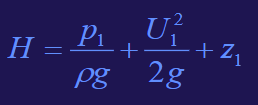
Total Head = Pressure Head + Kinetic Head + Potential Head
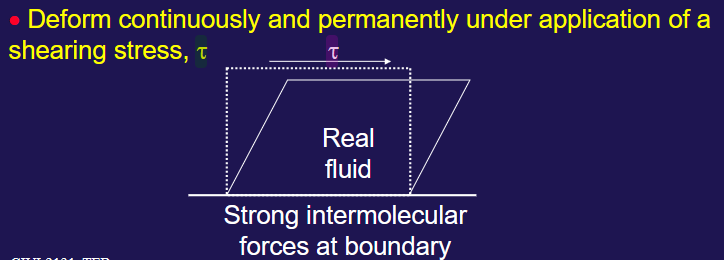
τ
Shear Stress
The force per unit area exerted on the fluid by the boundary and vice versa is the shear stress.
μ
Dynamic Viscosity, (Ns/m²)
A measure of how easily a fluid flows.
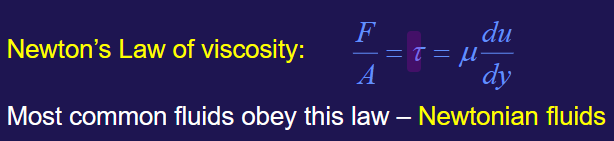
F/A=mu⋅du/dy
Newton’s Law of Viscosity
Fluids that don’t obey this are Non-Newtonian fluids, which change their viscosity depending on amount of force or pressure applied. They act like a fluid at rest and solid when struck or squeezed.
σ
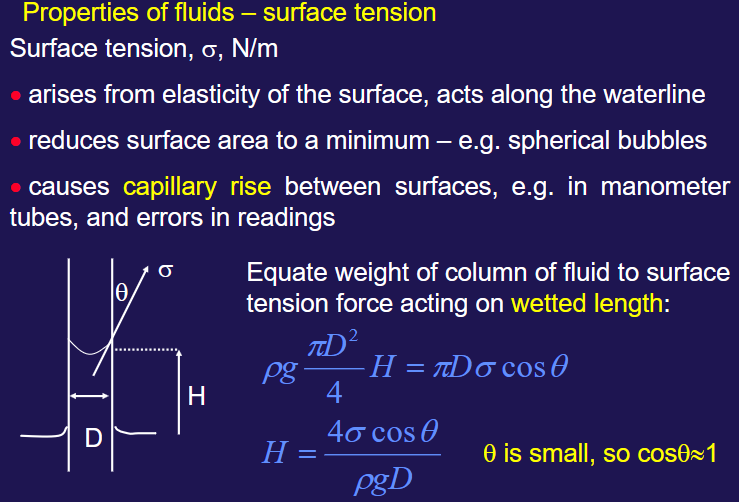
Surface Tension (N/m)
Arises from the elasticity of the surface and causes capillary rise in tubes. (You then have to measure the meniscus (bottom of the round bit))
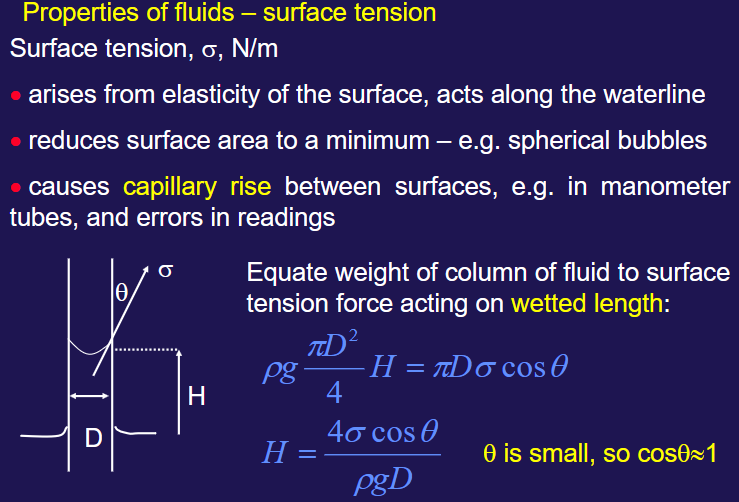
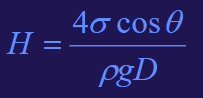
Wetted Length
Equating weight of column of fluid to surface tension force acting on wetted length
Flow Variations
Describes flow variation with time and space
Temporal variation:
Steady Flows - Velocity and Depth constant with time
Unsteady Flows - Velocity and Depth vary with time
Spatial variation:
Uniform - Flow properties constant in flow direction
Non-Uniform - Flow properties vary in flow direction
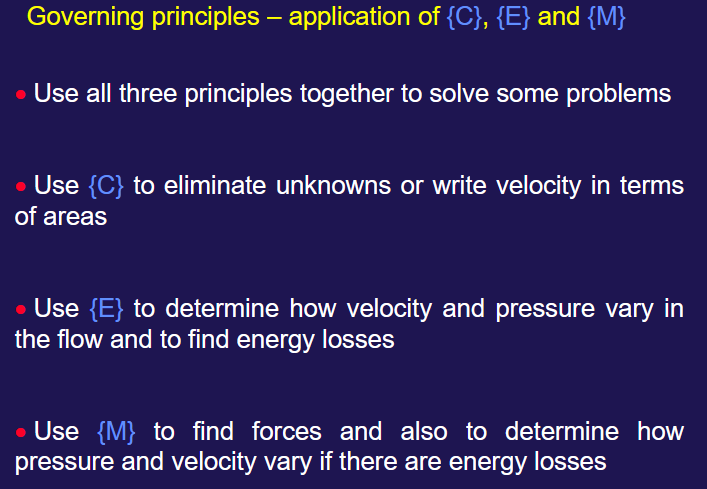
Governing Principles
Continuity
Momentum
Energy
Continuity
Conservation of Mass
ρQ1=ρQ2
or for incompressible fluids / no change in density:
Q1=U1A1=U2A2=Q2
Momentum
Conservation of Momentum (Newton’s 2nd Law)
Rate of change of momentum = sum of forces
Momentum flux (or rate at which momentum passes through a cross-section) is the mass flow rate x velocity
ρQU=(ρUA)U
The rate of change between cross-sections is ρQΔU
This requires a resultant force F in the direction of motion.
Momentum equation
∑F=ρQΔU=ρQ(U2−U1)
Energy
Total head (or head), H
Sum of three forms of energy
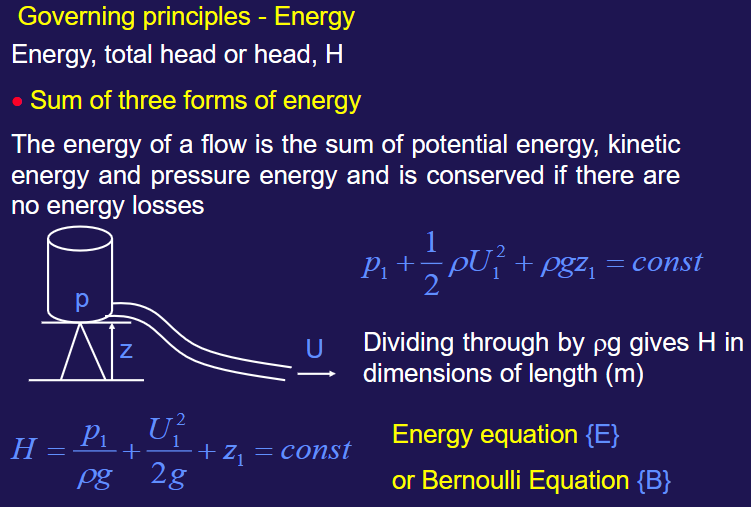
The energy of a flow is the sum of potential energy, kinetic energy and pressure energy and is conserved if there are no energy losses.
p1+21ρU12+ρgz1=const ← Energy equation {E}
Considers all energy inputs, losses and changes
H=ρgp1+2gU12+z1=const ← Bernoulli equation {B}
Simplified version of energy equation that only applies to ideal, frictionless flows where no energy is added or removed