Astronomy Assessment 1
 Call Kai
 Learn
Learn Practice Test
 Spaced Repetition
 Match
Match Flashcards
 Knowt Play
1/82

There's no tags or description
Looks like no tags are added yet.
Name | Mastery | Learn | Test | Matching | Spaced | Call with Kai | Chat |
|---|
No analytics yet
Send a link to your students to track their progress
83 Terms
Cosmic Address Sequence
Earth → Solar System → Milky Way → Local Group → Virgo Supercluster → Laniakea →Universe
Earth’s Position
3rd planet from the sun. Earth takes 24 hours to rotate and 365 days to orbit the Sun.
Size of Earth
Size of the Solar System
Size of the Milky Way
Size of the Virgo Supercluster
About 8,000 miles.
About 2ly
About 100,000ly
About 110,000,000ly
Planets from the Sun
Sun→Mercury→Venus→Earth →Mars→Jupiter→Saturn →Uranus → Neptune →Pluto
Three Large Galaxies in the Local Group
The galaxy
The Andromeda Galaxy
The Triangulum Galaxy
Light Years
The measurement of light and the distance light travel in a year. how long it takes light to travel in a year. NOT based on time
Speed of Light
C= 300,000 km/s
1 AU
The average distance from the Earth to the Sun.
Speed
is how fast something can travel in sometime.
Velocity
speed or direction
Acceleration
change in speed and/or direction
Gravity
The invisible force that pulls objects down to earth or pulls any two objects with mass toward each other.
Earth’s Gravitational Acceleration
All objects accelerate at g=9.8 m/s² regardless of mass
Momentum
is a property any moving object with mass has. The equation is mass X velocity.
Momentum is essentially the inertia of a moving object, meaning it is the thing/property that makes a moving object want to stay in motion unless acted on by an external net force. Momentum is the reason your body leans out as your car goes around a curve, or momentum is the reason a truck smashing through a wall will continue to move forward even after breaking through the wall. It still has momentum, so it will keep moving forward. It is a type of energy, so it can be transferred via collisions. If the wall is thick enough, the truck can smash against it without breaking through, therefore losing all of its momentum to a different form of energy.
Net force
is the sum of all forces acting on an object. The sum of all forces acting on an object; a nonzero net force causes acceleration because there is either a change in speed or direction, or both.
Net Force would be Net Force = Force of friction + Force of air resistance + force that is making the object move in the first place. Now, force of friction and force of air resistance will pretty much always be opposite to the direction of motion, meaning that they will be negative, so they will be fighting against the force that’s moving the object. So you essentially subtract them from your net force. Here’s a diagram to hopefully help describe this (imagine just pushing or pulling on a block, and no other forces involved):

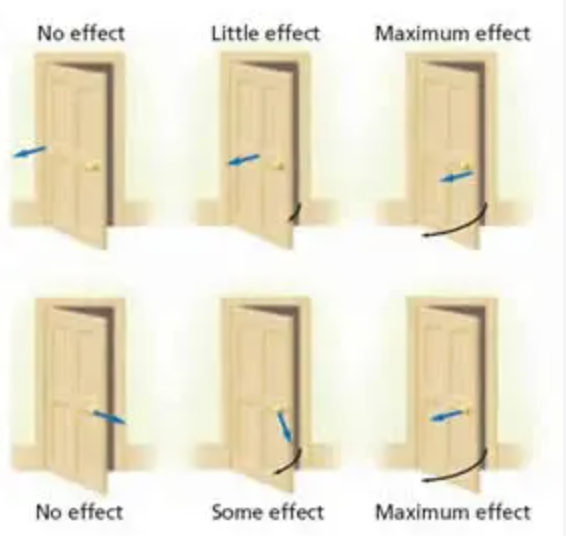
Torque
A special kind of force that changes angular momentum, depending on force magnitude (how much force is being applied) and the application point (toward the toque harder to push but further torque easier to push)
mass
Mass is the amount of matter in your body. The matter in a persons body.
Weight
Weight depends on mass and gravity.
International Space Station Free Fall
The international Space Station stays in space because it is still in Earth’s gravitation pull, it is constantly falling and missing Earth due to its high speed.
Newton’s First Law
An object moves at constant velocity (speed and direction) if there is no net force acting on it. An object will stay in motion unless a force acts upon it.
Newton’s 2nd law
Force=mass X acceleration (rate of change in momentum)
Newton’s 3rd Law
For any force, there is always an equal and opposite reaction force. Every object an an equal and opposite reaction force.
conservation of Angular Momentum
Angular momentum cannot change as long as no external torque is applied.
Kinetic Energy
The energy an object has due to motion, such as walking, falling, or meteors.
Potential Energy
Stored Energy held by an object because of relative position, electric charge, or internal stress. ex. battery
Mass-Energy Equivalence
E=mc²; a small amount of mass contains a massive amount of potential energy.
Universal Law of Gravitation
This is an equation that decribes how strong gravity is. t depends on the mass of the objects (Earth and Moon) and the distance between the centers of the objects. it also says that the strength of gravity falls off quickly as distance between the objects increases d²

Bound
objects will continue to orbit (Earth orbiting the Sun)
Circle shape and Ellipse more of oval shape
Unbound
object will pass by and will then fly ogg into space
Parabola and Hyperbola
Kepler’s Second Law
An imaginary line jpining a planet and a star sweeps out equal areas in equal amounts of time

Kepler’s 3rd law
p² = a³
p² = orbital period (how much time it takes for an object to complete one orbit around the word
a³ = is the “semi-majot axis” or radius
This is an equation that relates the orbital period to the average distance between orbiting objects.


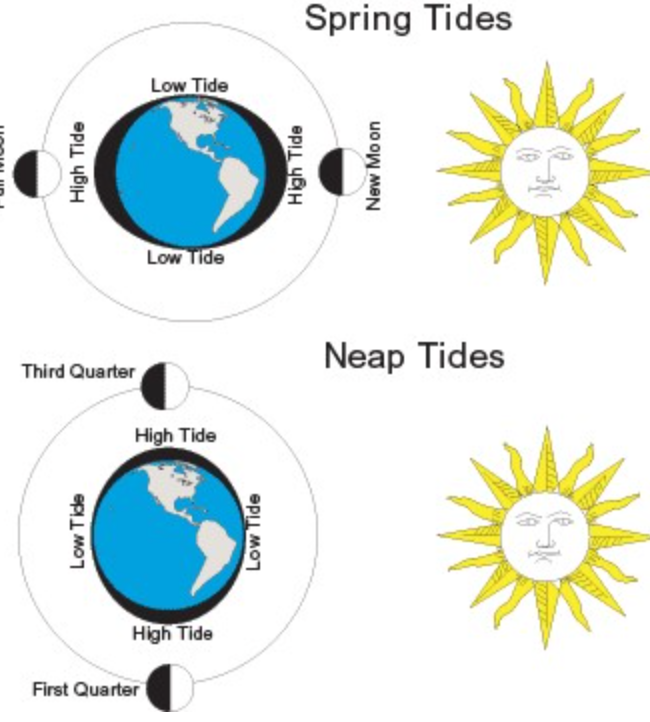
Tidal Forces
differences in moon’s gravitational pull across Earth physically stretch it, creating two tides per day and two low tides.
Moon’s Synchronous Orbit
The moon rotate once per orbit around the Earth.
The Moon rotates once per orbit, meaning the same side of the Moon always faces Earth.
Thermal Energy
Kinetic energy of particles
• All particles always have some kinetic energy
• Related to temperature • Higher temperature (hotter) means particles are moving faster
• Temperature and Thermal Energy are not the same thing!
• Measured in Kelvin (K)

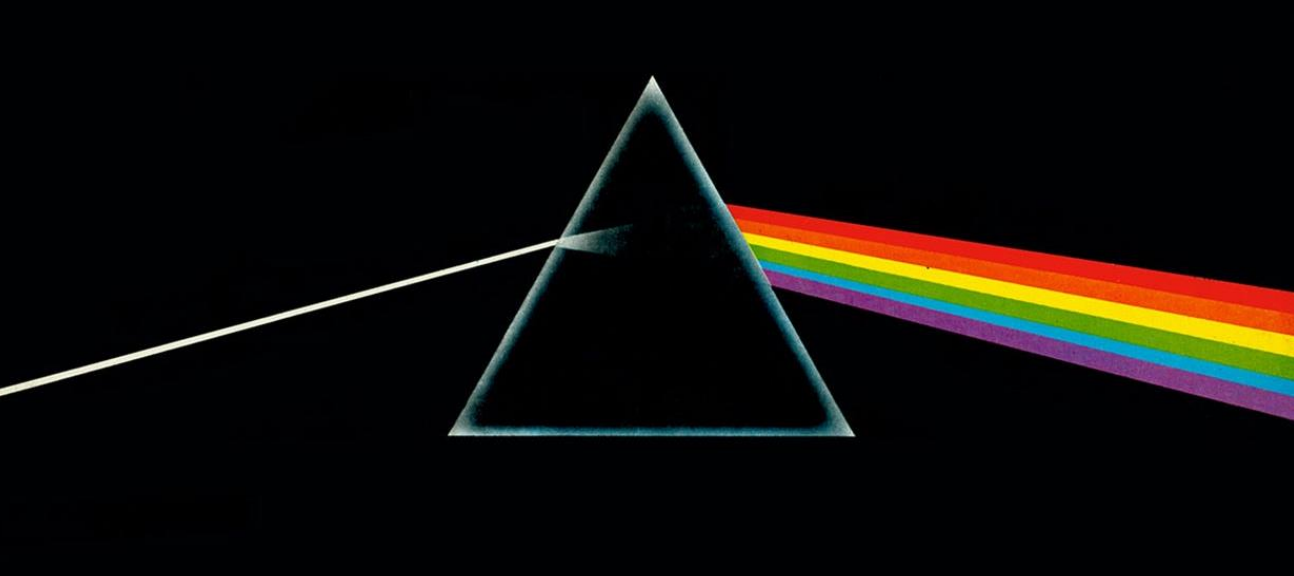
Colors of Light
White light contains all colors of visible light.
White= rainbow
White light is made up of all the colors of visible light.
How do we Expereince light?
Warmth =energy
Emission (glow in the dark)
Absorption (absorb all the other colors)
Transmission (transparent objects transmit light)
translucent -only some light (water bottle)
opaque objects block (absorb light (black out curtain)
Reflection/Scattering
Why does an object have color?
The appearance of objects depends on how light interacts with matter. A red rose is red because it reflects red light and absorbs all the other colors of light. INTERACTIONS BETWEEN LIGHT AND MATTER DETERMINE THE APPEARANCE OF EVERYTHING AROUND US!
What is light?
light has a wave-particle duality, meaning it is both a wavelength and a particle. The particle of light is called a photon.
Waves
A wave is a pattern of motion that carries energy without carrying matter.
Wavlength
the distance between two corresponding points on a wave. measured from peak to peak or trough to trough
Frequency
Number of times per second that a wave vibrates
If light is both a particle and a wave then what kind of wave is it?
Light is an electromagnetic wave.
Electromagnetic waves consist of:
An electric field
A magnetic field
the electro and magnetic feild travel together and are 90 degrees apart from each other

Photons
A photon is a particle of light. Think of a photon as a packet of energy.
Important facts:
Photons are particles of light.
They are packets of energy.
A photon has a wavelength and frequency.
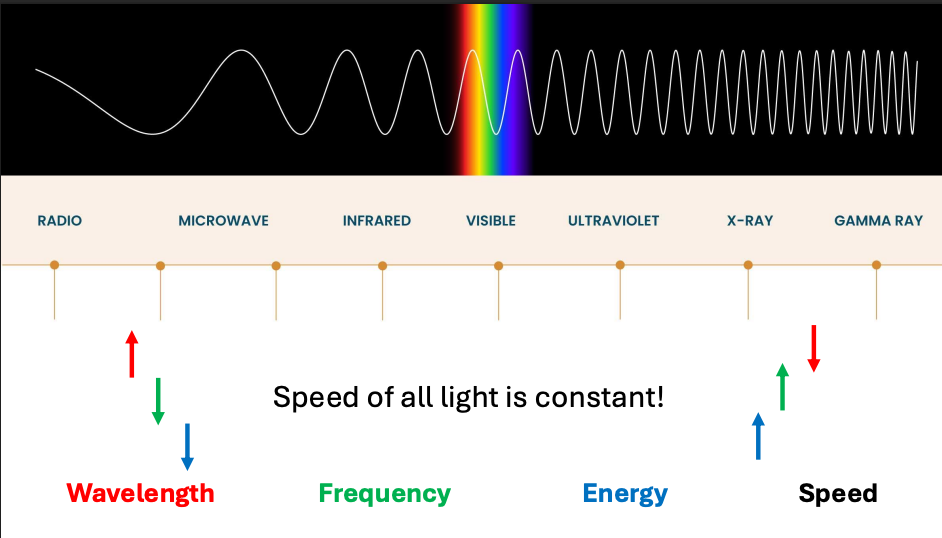
Photon energy depends on its frequency.
short wavelength = higher frequency = higher energy
longer wavelength = lower frequency = lower energy
The Electromagnetic Spectrum
From longest wavelength / low frequency/ lowest energy to shortest wavelength / high frequency/ highest energy:
Radio → Microwave → Infrared → Visible → Ultraviolet → X-ray → Gamma ray
Polarization
Polarization describes the direction of vibration of light.
Linear polarization
Circular polarization
Elliptical polarization
reflection can change polarization.
Polarized sunglasses
Polarized sunglasses block light except for a particular polarization.
Infrared Light
Infrared (IR) is electromagnetic radiation beyond visible red light. This light has a longer wavelength = lower frequency = lower energy.
It is strongly associated with thermal radiation/heat:
The lecture asks you about:
How objects look in infrared
How hot and cold objects appear
What animals look like in IR
Which objects are transparent (black bagO/opaque (glass) to IR
Why astronomers care about what IR light can pass through.
Important to astronomy idea: Different wavelengths allow astronomers to see different things. Something that blocks visible light may allow some infrared light to pass through.
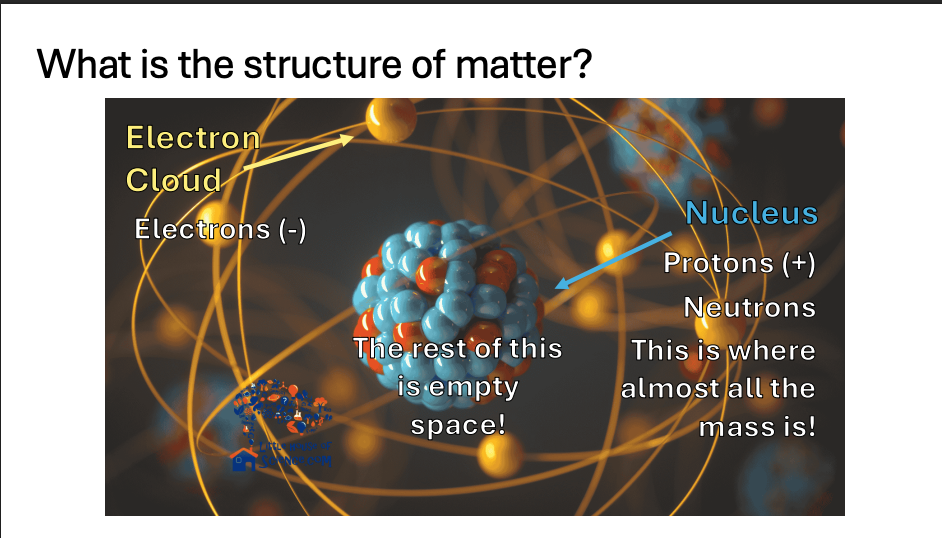
Structure of Matter
An atom contains:
Nucleus
contains:
Protons (+)
Neutrons
Almost all of the atom's mass is in the nucleus.
Electron cloud contains:
Electrons (-)
The majority of an atom's volume is essentially empty space.
Atomic Number
Atomic number = the number of protons in the nucleus
This is one of the most important definitions.
Atomic mass number
Atomic mass number = protons + neutrons
Neutral Atoms
Same number of protons and electrons.
Example:
10 protons + 10 electrons = neutral.
Molecules
A molecule contains two or more atoms.
Example:
He = helium atom
h2= dihydrogen = molecular hydrogen
02= dioxygen = molecular oxygen
Ions
An ion has the same number of protons but a different number of electrons. This happens when an atom gains or losses electrons.
Isotopes
Isotopes have:
same number of protons
different number of neutrons
because they have the same number of protons, they are the same element.
Changes of Matter
Ionization
stripping electrons from atoms. this can change atoms into plasma.
Dissociation
Breaking molecules into individual atoms.
Evaporation
This lecture describes this in terms of breaking flexible chemical bonds.
Melting
This lecture describes this as breaking rigid chemical bonds and changing a solid into a liquid

Energy Levels in Atoms
This VERY important for spectra.
Electrons in atoms are restricted to certain energy levels. They cannot have just any energy. Energy changes happen by moving: from one energy level to another
rather than moving continuously between levels
Electron Moving DOWN = EMISSION (glowing gas)
When an electron moves from a higher energy level to a lower energy level:
It releases energy.
This energy is released as a photon.
Therefore:
Downward transition → photon emitted → emission line
Electrons MOVING UP = ABSORPTION
When an electron moved from: lower energy level to higher energy level it must absorb energy.
Therefore:
Upward transition → photon absorbed → absorption line
Three Basic Types of Spectra
Continuous Spectrum
A continuous Spectrum contains all wavelengths without interruption. The spectrum of a common (incandescent) lightbulb spans all wavelengths, without interruption
Example:
A common incandescent lightbulb produces a continuous spectrum.
🌈 continuous rainbow
Emission Line Spectrum
A thin/low (HOT) density cloud of gas emits light at specific wavelengths. this produces: Bright lines
Absorption Line Spectrum
A cloud of gas between us and a lightbulb can absorb light of specific wavelengths, leaving dark absorption lines in the spectrum.

Chemical Fingerprints
Every atom has q unique set of energy transitions.
Each transition corresponds to a specific:
Energy
Wavelength
Frequency
gives each element a unique spectral pattern, like a fingerprint.
Downward transitions emit photons, so produce emission lines
Upward transitions absorb photons. so produce absorption lines
Why is this important?
By observing the spectrum of an astronomical object, astronomers can determine what chemicals/elements are present.
Molecules have more energy Levels
Molecules are more complicated than individual atoms.
Molecules can:
rotate
vibrate
Therefore, molecules have many additional energy levels. There are a large number of rotational and vibrational energy levels
This makes molecular spectra very complex.
Many molecular transitions occur in the infrared.
Thermal Radiation 2 Laws
All objects emit thermal radiation
This spectrum depends only on an objects temperature. Extremely hot = red/white and cooler = purple
Hotter objects emit more light at all frequencies per unit area.
Hotter objects emit photons with a higher average energy.
Hotter = more radiation + higher-energy photons
Doppler Shift
Doppler Shift allows astronomers to determine the motion of distant objects because of the wave nature of light.
Moving toward you
wavelength becomes:
shorter
light appears:
blue shifted
Toward us = blue shifted
Moving away from you
wavelength becomes:
longer
light appears:
redshifted
Easy memory trick:
BLUE = coming toward YOU
RED = moving AWAY
Measuring Doppler Shift
Astronomers generally measure Doppler shifts using spectral lines.
The amount of the shift → tells us the speed of the object
The direction of the shift → tells us the direction of motion
Measuring the shift:
Tells us only about the part of the object's motion that is toward ot away from us. It does not tell us the object’s complete motion.

Rotating Objects
Different parts of a rotating object move toward or way from us.
This causes Doppler shifts on different sides.
Slower object rotates = thinner lines. A spectral line from Star A is narrow because light from different parts is shifted only slightly from the center.
Faster objects rotates = wider lines. A spectral line from Star B is broad because light from different parts is shifted further from the center.

double-slit experiment
The double-slit experiment is one of the best demonstrations of wave-particle duality, which connects directly to your lecture's statement that light can act as both a wave and a particle.
Basic Setup
You have:
Light source → two narrow slits → screen
Light passes through the two slits.
If light behaves like a wave, the waves from the two slits interact with each other.
This creates interference.
Constructive Interference
When waves meet in phase, they reinforce each other.
Result: ➡ Bright band
Destructive Interference
When waves meet out of phase, they cancel each other.
Result: ➡ Dark band
So instead of seeing just two bright spots behind the two slits, you get a pattern of:
Bright → Dark → Bright → Dark → Bright
This is called an interference pattern
Special Relativity
Relativity involving high-speed motion
General Relativity
Relativity involving gravity
Special Relativity: First Postulate of Special Relativity
The laws of nature are the same for everybody.
Special Relativity: Second Postulate of Special Relativity
The speed of light is the space for everybody
Special Relativity: Time dilation
the phenomenon where time appears to pass more slowly in a moving object.
ex. space shift moving really fast only 25yrs old. twin stayed on earth and is 30 yrs old
Special Relativity: Length contraction
Fast-moving objects appear shorter in the firection of motion

Special Relativity: Mass increase
A force applied to a rapidly moving object produces less acceleration due to an effective mass increase. Rapid motion makes acceleration harder.
Spacetime
A 4D combination linking space and time together. Special relativity showed that space and time are not absolute meaning they are different based on who is observing
General Relativity: The equivalence Principle
The principle stating that the effects of acceleration are exactly equivalent to those of gravity.
General Relativity: Weightless in free-fall
Someone who feels weightless may be in free-fall
General Relativity: feels force
Someone who feels a force may be hovering in a gravitational field
General Relativity: Gravity
Result of curved space time. mass of sun makes everything curved
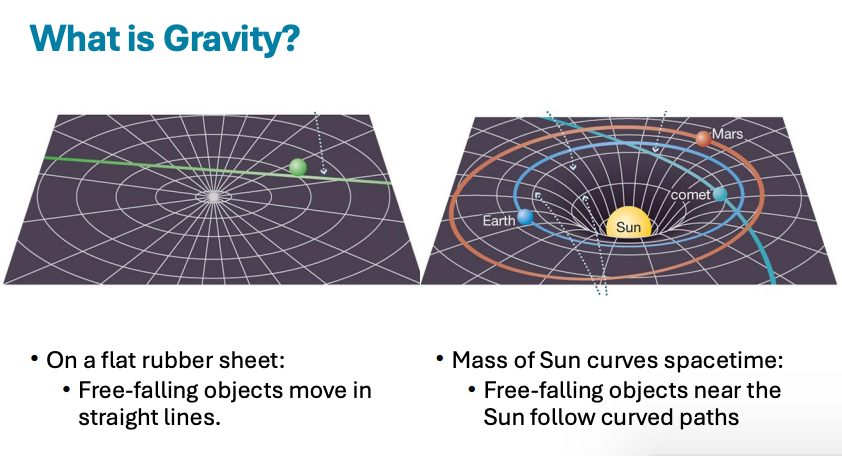
Rubber Sheet Analogy for Gravity
Mass curves spacetime. Heavier mass cause a even greater dip in the sheet.
Event Horizon
The point in no return near a black hole where spacetime is so curved that nothing can escape.
Gravitational Time Dilation
higher altitudes = weaker gravitational field = time moves faster
low altitudes = stronger gravitational field = time moves slower
Gravitational Lensing
The bending of light by curved spacetime, causing apparent positions of background objects to shift.
Einstein ring
Ring of light produced by gravitational lensing or when the gravity of a foreground galaxy bends light fron an object directly behind it.
Gravitational Waves
Ripples in spacetime produced by yhe movement of massive objects