EAns General C
 Call Kai
 Learn
Learn Practice Test
 Spaced Repetition
 Match
Match Flashcards
 Knowt Play
1/25

There's no tags or description
Looks like no tags are added yet.
Name | Mastery | Learn | Test | Matching | Spaced | Call with Kai | Chat |
|---|
No analytics yet
Send a link to your students to track their progress
26 Terms
Key words PPC
Quantity / Quality of __ -> ability to produce G&S increase
Underemployment -> economy will not be operating at the highest possible level of output given its resources and technology -> point inside PPC
SG healthcare subsidies
Public healthcare institutions in Singapore are run as “private” companies
They receive an annual government subsidy for the provision of subsidised medical services to the patients
Depending on one’s ward choice and monthly household income, Singaporeans will enjoy a tiered level of subsidies ranging from 50% to 80%
Allow the government to provide more targeted assistance to help the lower- and middle-income Singaporeans with their medical bills
Why oligopoly
Natural and artificial BOE
EOS and network effects
2-sided network effects
An increasing number of consumers attracts more merchants and drivers, which attracts even more consumers in a self-reinforcing cycle
This massive expansion in user base allows platforms to operate at a large transaction volume
Homogenous but differentiated: differentiate themselves through…
Mutually independent
MC pricing = price ceiling
Maximum price or price ceiling is a legally permissible price set by the government on the highest price a seller is allowed to charge
Constraints of small domestic market -> rely on FDI and implements R&D subsidies to improve price competitiveness (X-M) -> susceptible to external shocks
Give macro examples
Iranian war led to a spike in global oil prices causing a global energy crisis after Iran blockaded the Strait of Hormuz
SEA Economies (aka Asian Tigers) enjoyed rapid (double digit) economic growth in the early 1990s -> attracted many foreign (western) firms to invest and redirect production to the region
US used to have CA in manufactured goods -> underinvestment into manufacturing infrastructure in the USA led to a loss of productivity -> greater input for same output -> UCOP increase -> loss in CA compared to China
USA have accused China of devaluing their currency in 2019 which caused the USD to appreciate relative to the Chinese Yuan -> large trade deficit of $854.4 Billion in 2019 as China is the largest trade partner for the USA
Oil price -> electricity bill increase -> UCOP increase
Internal factors: loss of CA, external factors: depreciation of other country
GLOBAL economic confidence -> foreign household income increase -> increase willingness to buy G&S -> DDx increase
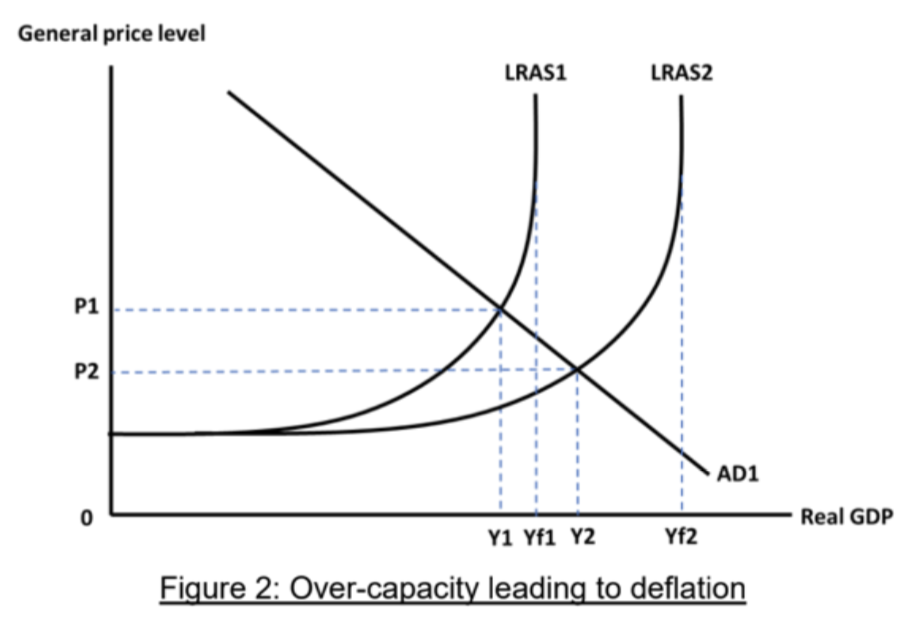
Over-capacity meaning
LRAS increase faster than AD
Increase I -> LRAS increase -> assuming AD constant, China’s manufacturing capacity increased and exceed demand for goods -> resources are underutilised -> available of excess resources leads to fall in wages -> GPL galls -> deflation
FDI is NOT affected by interest rates! (IR only affects domestic investment)
Increase LRAS -> reduce DD-inflation (AND vice versa!)
AQI
AQI is based on measurement of particulate matter (PM2.5 and PM10)
AQI is color-coded, with ranges like “Good” (0-50), “Moderate” (51-100), “Unhealthy” (151-200), and “Hazardous” (over 300)
Suggests that EG that is achieved is at the expense of the environment -> negative long-term growth (Eg. Poor air quality -> fall in labour productivity)
Effect of strong EG on BOT
Assuming higher relative EG growth rates compared to other countries
Foreign EG -> increase DDx
Domestic EG -> increase DDm
Since domestic income rise relatively faster, increase M > increase X -> BOT worsen
Eval: Depends on size of MPM
SG has limited resources and lower ability to produce a wide variety of domestic consumer goods -> MPM larger as rely more on imported goods to satisfy material needs and wants -> larger BOT deficit
Unsustainable growth
link to -ve externalities
Since external costs not regarded by producers -> tendency for market to overproduce -> allocative inefficiency and market failure
DD-inflation: firms only continue to produce extra output if can be sold at higher prices
Indlation effect of -ve outlook on economy
Inflation -> distorts price signals -> EROR falls -> assuming that inflation is prolonged and severe such that it will cause a significant fall in I -> AD falls by a large extent such that there is spare capacity in the economy (because inflation has no spare capacity!)

Deflation effects
Deflation -> assume the economy is experiencing SS deflation (deflation has become expected) and is operating at spare capacity -> if the deflation is prolonged, consumers cut C AND Increase real IR (real IR = nominal IR - inflation)
Other country IR increase -> SG IR increase -> reduce DD-pull inflation AND cost-push inflation (cheaper imports)
Natural rate of UN = S-UN and F-UN
BOT deficit -> X falls = DD domestic falls AND M increases = SS domestic increases -> depreciation
If BOT improve because of price stability -> movement along AD as price factor (NOT shift in AD)
Compare X VS X+M
X / GDP: whether a country is export-oriented (SG: 175% 2020) VS X+M / GDP: indicates how trade dependent a country is (SG: slightly above 300%)
Conflict for SSP: fiscal sustainability
Expansionary ER policy = depreciation
Policies to address rising cost of living (daily necessities)
SSP (subsidise domestic production capabilities)
Increasing property tax
Effect of excessive fiscal debt
Increase likelihood of sovereign default (cannot fulfill loan obligations) -> -ve outlook on economy -> hot money outflow and fall in FDI -> capital flight (Eg. Sri Lanka)
NOTE: US has fiscal debt but has other factors preventing -ve outlook
Austerity (decrease social spending) measures example
Eg. Greece
From 2010 to 2018, Greece had steep public wage cuts and tax hikes in exchange for €330 billion in bailout loans
Caused a 25% economic contraction, UN-rate above 27% and mass emigration
QE
A type of monetary policy
Use as a EVAL
Buy future financial assets (Eg. Bonds) -> used due to liquidity trap
Reducing income inequality
WR increase -> (finish MAP!) Qd for labour falls and Qs increases until new equilibrium is reached with higher wage rate W
Dynamic CA R&D
R&D -> increase productivity -> produce pharmaceuticals at lower opportunity cost than SG -> India new PPC3 has gentler slope than SG PPC1