Unit 1 Bio Test (Mods 0-5)
 Call Kai
 Learn
Learn Practice Test
 Spaced Repetition
 Match
Match Flashcards
 Knowt Play
1/86

There's no tags or description
Looks like no tags are added yet.
Name | Mastery | Learn | Test | Matching | Spaced | Call with Kai | Chat |
|---|
No analytics yet
Send a link to your students to track their progress
87 Terms
inductive reasoning
a logical process where specific observations and patterns are used to form a broad generalization or probable conclusion
deductive reasoning
start with general rules and apply them to reach a specific certain conclusions.
Which bond or interaction would be difficult to disrupt when compounds are put into water
covalent bonds between carbon atoms
chemical equilibrium
forward and reverse reactions continue with no net effect on the concentrations of the reactants and products
What takes place as an ice cube cools a drink
Kinetic energy in the liquid water decreases
What is a hydrogen bond?
A weak force between a molecule with partially positive hydrogen atoms and another neighboring molecule with high electronegativity.
What are hydrocarbons?
any organic compound made entirely of two elements: hydrogen (H) and carbon (C)
A salamander relies on hydrogen bonding to stick to various surfaces. Therefore, a salamander would have the greatest difficulty clinging to a _____.
surface full of hydrocarbons. This is because hydrocarbons are nonpolar and do not have any charge, which is required for hydrogen bonds.
What are two electronegative atoms frequently involved in hydrogen bonding?
Oxygen and nitrogen
What are the 6 unique properties of water?
Cohesion, adhesion, high surface tension, ice less dense, high specific heat, solvent (it can dissolve almost anything)
Difference between adhesion and cohesion
cohesion- water molecules stick to each other, adhesion - water molecules stick to materials other than itself.
What type of bonds give water it’s unique properties'?
hydrogen bonds
Why is water’s specific heat important for living organims?
It is important for living organisms because their cells reject variations in temperature.
What is the polarity of water? and describe how it enables hydrogen bonding
oxygen molecules is negatively charged, hydrogen molecules are positively charged. those regions are attracted to other regions of other molecules with opposite charges
Is water good at dissolving hydrophobic molecules? Why or why not?
No. Hydrophobic molecules are repelled by water. In terms of polarity, nonpolar molecules, which are hydrophobic, do not have regions of positive or negative charges, so they cannot connect to the water molecules, who have sections that are either positively or negatively charged. Due to that, hydrophobic molecules orient themselves in a way that minimizes contact with water molecules.
ACID: Donates or accepts H+?, Numerical range on pH scale, 2 examples
Donates H+, less than 7, lemon juice and vinegar
BASE: Donates or accepts H+?, Numerical range on pH scale, 2 examples
Accepts H+, greater than 7, antacids and baking soda
What is cohesion responsible for?
Surface tension
What is adhesion responsible for?
Capillary Action
Mean, Median, Mode, Range
Mean is the average, median is the middle, mode is the most reoccurring number, range is the difference between the highest and lowest numbers
What are the major elements of life?
Carbon, Hydrogen, Oxygen, Nitrogen
What kind of bond bonds H2O?
A nonpolar covalent bond
Place the terms organism, gene, genome, and cell in order from largest to smallest
Organism Cell Genome Gene
where are the protons, neutrons, and electrons located in the cell
electrons around, protons and neutrons inside
atomic number vs atomic mass vs mass number
Atomic number = number of protons, atomic mass = weight of the element, mass number = total number of protons and neutrons
Difference between 14 N and 15 N?
14 N shows that it has a mass of 14 and has seven neutrons, while 15 N shows that it has a mass of 15 and has 8 neutrons.
Difference in how energy vs matter flows
energy flows in one direction while matter cycles and can be reused.
What is an isomer and what are the different types?
Emergent property — molecules with the same molecular formula but different structures
Structural: same formula but different order
Cis-Trans: same formula but different positioning around a double bond
Enantiomers: Same formula, mirror-image positioning about a central carbon
Which atoms are in carbs?
CHO
Monomer of carb
monosaccharide
Example of a polysaccharide
Cellulose
How is celulose linked?
Beta linked (1-4 link of beta glucose monomers/ alternates)

What bonds bond monosaccharides
glycoside bonds (links Hydrogen 1 on one monomer and hydrogen 4 on the other)
How is starch and amylose linked?
Alpha linked (1-4 link of alpha glucose monomers, meaning that carbon 1 is linked to carbon 4 of each glucose monomer)


What is this?
amylose/starch

What is this?
Cellulose
Why is cellulose different from starch/amylose?
Starch is alpha linked, cellulose is beta linked
What is the most common monosaccharide?
Glucose
During dehydration synthesis, what happens?
Water is removed as two molecules are covalently bonded
Why can humans digest starch but generally cannot digest cellulose?
Humans lack enzymes capable of breaking the beta linkages in cellulose
Cellulose is especially important in:
Plant cell walls
Plants primarily store excess glucose in the form of
Starch
Which molecule would most likely be found as a ring-shaped six-carbon sugar?
glucose
Which is NOT one of the three major groups of lipids?
polypeptides
A triglyceride consists of
one glycerol and three fatty acids
a fatty acid consists of
a long hydrocarbon chain attached to a carboxyl group

esther linkages (—COO-) form when
a carboxylic acid reacts with an alcohol (happens when fatty acids bind to glycerol to create triglycerides)
Saturated fatty acid
Hydrocarbon chain with no double bonds, butter
unsaturated fatty acid
hydrocarbon chain with double bonds, kink, oil
the amphipathic nature of phospholipids means they
have both hydrophilic and hydrophobic regions
steriods are characterized by (add ex)
4 fused carbon rings, cholesterold

what are triaglycerols
glycerol joined to 3 fatty acids
what is glycerol
3-carbon molecule with hydroxyl groups attached to each carbon

function of lipids?
long term energy storage + insulation
function of carbs?
short term energy sotrace, energy source, structural compound
which type of linkage can humans digest?
humans can digest alpha linkage, not beta linkage
What are the atoms for lipids
C,H,O
What are the three main groups of lipids?
Triglycerides, phospholipids, steroids
Atoms for proteins
C, H, O, N, (sometimes S)
Monomer and polymer for proteins
amino acids, polypeptides
What is the structure of proteins?
Alpha carbon (middle), amino group (NH2), carboxyl group (OH, polar, Oxygen is much more electronegative than carbon and hydrogen), hydrogen (linked to alpha carbon)
Do R groups of basic amino acids gain or lose a proton?
gain (H+)
Do R groups of acidic amino acids gain or lose a proton?
lose (H-)
What makes an amino acid nonpolar?
lots of carbon and hydrogen in the side chain/ rings
what makes an amino acid polar?
lots of electronegative atoms like nitrogen and oxygen
what is a disulfide bond and when is it formed
covalent bond that can connect different parts of the same or different proteins, a disulfide bond forms when two cysteine are close together (S—S)
what bond links amino acids? explain the bond
peptide bonds - links the carbon from the carboxyl group and the nitrogen from the amino group
Directionality of a peptide
N terminus (amino group side) to C terminus ( carboxyl)
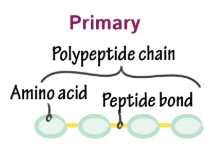
What is primary structure?
the sequence of amino acids
What is secondary structure?
Different stretches of amino acids connect

What are the two types of secondary structures?
Alpha helix and beta pleated sheet
What is tertiary structure?
three-dimensional shape of a polypeptide chain

What are the interactions/bonds needed to maintain a tertiary structure?
disulfide bridge, hydrophobic interactions, hydrogen bonds, ionic bonds
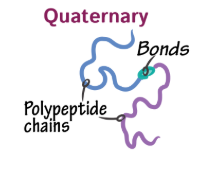
What is a quaternary structure?
Two or more polypeptide chains
What is the backbone of a polypeptide made up of
a repeating sequence of nitrogen, alpha carbon, and carbonyl atom
Atoms of nucleic acids
C H O N P
Monomer and polymer of nucleic acids
Nucleotides and polynucleotides
what is the function of a nucleic acid
Store, transmit, and help express hereditary information
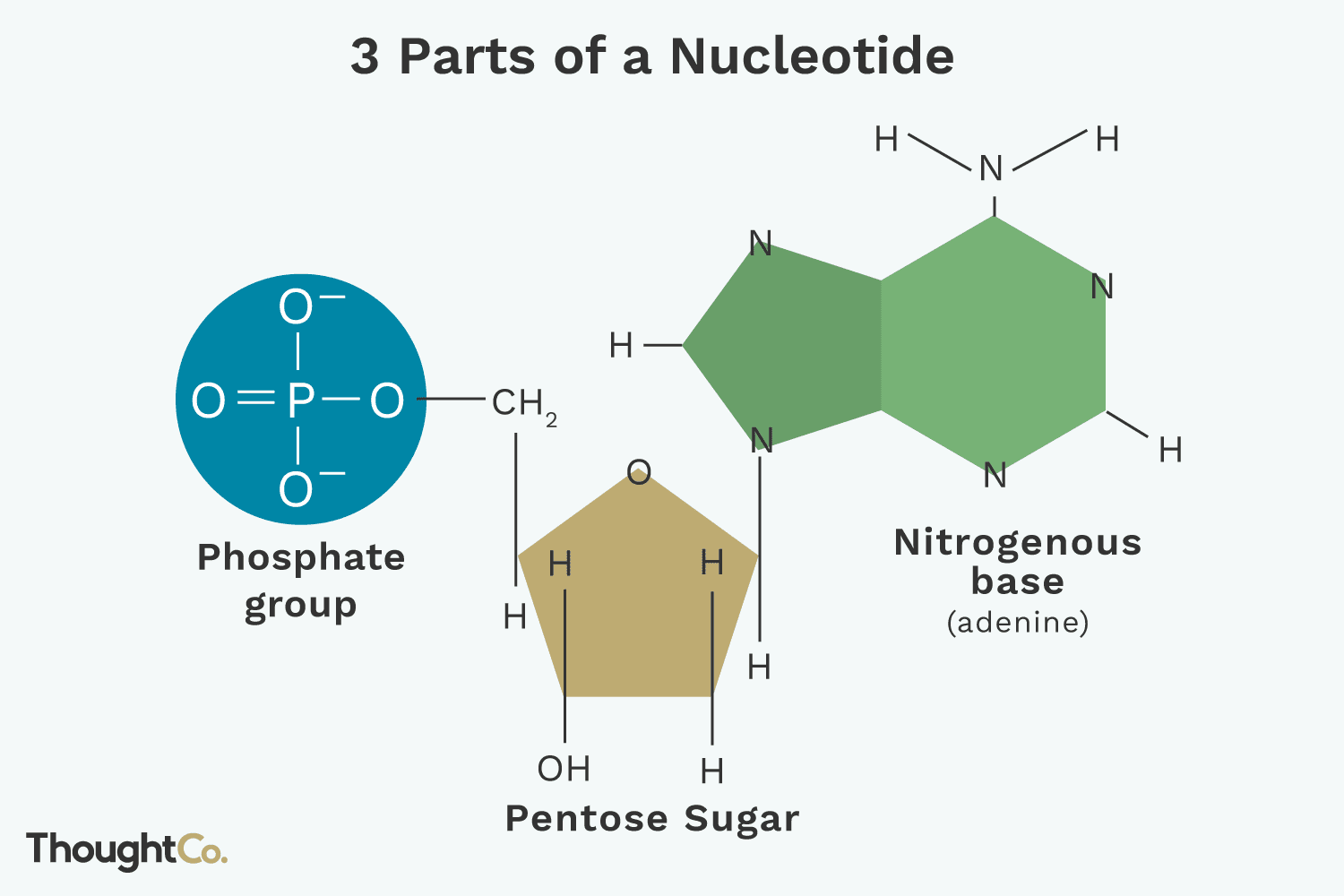
What is the structure of a nucleotide?
A nitrogenous base, pentose (5-carbon sugar), and a phosphate group
What is the directionality of a polynucleotide?
5’ end: end of the polumer that has a phosphate attached to the 5’ carbon sugar
3’ end: end with the hydroxyl group and 3’ carbon sugar
pyrimidines
cytosine, thymine, uracil— base with a single ring structure

purines
base with double ring structure, 9 atoms total, 2 nitrogen atoms

DNA
Deoxyribose sugar
Directionality applies (one strand one direction, other strand the other direction)
double strands
complimentary
RNA
ribose sugar
one strand
shorter length
protein synthesis
2 carbon sugar always has O ONLY
how many bonds does carbon, hydrogen, and oxygen form
carbon forms 4, hydrogen forms 1, oxygen forms 2
When is a biomolecule acidic
when it has a carboxxyl group (— COOH-)
When is a biomolecule basic
when it has a amino group (NH2)