Cardio Exam 3: Simplified Tsu (AFib)
 Call Kai
 Learn
Learn Practice Test
 Spaced Repetition
 Match
Match Flashcards
 Knowt Play
1/35

There's no tags or description
Looks like no tags are added yet.
Name | Mastery | Learn | Test | Matching | Spaced | Call with Kai | Chat |
|---|
No analytics yet
Send a link to your students to track their progress
36 Terms
Abnormal Heart Rhythms
Bradycardia → ______
Supraventricular arrhythmias → ______
Ventricular arrhythmias → ______
AV Blocks, AFlutter, AFib, and SVT, VTach, Torsades de Pointes, and Asystole
______ Degree AV block
Impulse conduction ______ (______ block) at AV node for a ______ interval
Usually ______
AV nodal blockers (______, ______, ______)
stimulates the ______ (e.g. vasovagal reflex)
______ conduct through (followed by QRS complex)
1st, slowed, partial, fixed, asymptomatic, BBs, non-DHP CCBs, Digoxin, PNS, All P waves
______ Degree AV block
Mobitz type 1 (______)
Conduction ______ slows at AV node, and then ______ to follow
Which means ______ → ______
Usually ______
Can be due to ______ (AV node blockers) or ______
Mobitz type 2
Block is ______ the AV node
______ rate is ______
Can be ______
PR interval = ______ + ______ are dropped
Note in Mobitz type 1, it’s a ______ dropping of QRS complexes, whereas here it is ______ timing
2nd, Wenckebach, progressively, QRS complex fails, lost ventricular contraction, decreases CO, asymptomatic, drugs, PNS, below, atrial, regular, symptomatic if bradycardia, constant, random QRS complexes, predictable, random
______ Degree AV Block
______
“AV” dissociation: atrium + ventricles are ______
______ are conducting
Ventricle = 30-40 BPM when it is not receiving input from SA node so patients are generally ______ due to the ______
Requires ______ to control the ______ rate
3rd, complete heart block, independent, No p waves, symptomatic, bradycardia, pacemaker, ventricular
______
______, ______ firing of SVT automaticity focus
~______ → ______ rate with ______ or ______
Non-pharm therapy
Mild-Moderate Sxs
______ techniques: ______, ______, ______
Severe Sxs (eg. ______, ______, ______)
______
Pharmacological therapy
Increase vagal tone → ______
Slow, Ca-dependent tissue → ______
Fast, Na-dependent tissue → ______
Paroxysmal SVT, sudden, rapid, 150-250, fast, absence of P waves, abnormal-looking P waves, Vagal, Carotid Sinus massage, valsalva maneuver, ice water facial, syncope, angina, HF, Direct Current Cardioversion (DCC), Digoxin, Adenosine, BBs, and Non-DHP CCBs, Quinidine, Procainamide, Disopyramide, and Flecainide
QT interval
QT interval varies with ______
A prolonged QT interval can predispose patients to the formation of dangerous rhythms (e.g. ______)
Males: >______ msecs
Females: >______ msecs
Highest risk of TdP >______ msecs
HR, torsades de pointes, 450, 460, 500
______ is the most common sustained atrial arrhythmia
Two main issues to treat
______ with ______
Treatment of ______ with ______
Calculate this score in all pts with ______ to determine their risk of ______, and therefore if they need ______
Structural HD that causes atrial distension
______
______
______
~______ bpm
Rhythm describe as “______ be accompanied by ______
______ firing at ______ rates
AFib, stroke prevention, anticoags, Tachyarrhythmias Sxs, rate and rhythm control, AFib, stroke, anticoags, MI, Valvular HD, Congenital abnormalities, 350-450, irregularly irregular with no discernable P waves, Rapid Ventricular Rate, Atrial foci, rapid
______
faster than ______ impulses
______ BPM
Appears as a “______” pattern on ECG
Rhythm is ______ (unlike ______) – “______”
Occurs ______
______ ectopic focus
AFlutter, SA node, 220-350, sawtooth, regular, AFib, regularly irregular, less frequently than AFib, single
Treatment of AFib
Stroke (and systemic thromboembolism) prevention
Stratify risk by CHA2DS2-VASC score
______ → 1
______ → 1
Age (> ______y/o) → 2
______ → 2
______ (prior episode) → 2
______ (______) → 1
Age (______ y/o) → 1
______ Category (______) → 1
______ in Men OR ______ in Women → No anticoag + ASA has no benefit
______ in Men OR ______ in Women → Anticoag may be considered
______ in Men OR ______ in Women → Oral anticoag RECOMMENDED (______, ______)
______ preferred over ______, EXCEPT in ______ or ______
Congestive HF/LV Dysfunction, HTN, 75, Diabetes, Stroke/TIA/Thromboembolism, Vascular Disease, PAD, HA, CAD, and aortic plaque, 65-74, Sex, Female, 0, 1, 1, 2, 2 or more, 3 or more, Warfarin with INR 2-3, DOACs/NOACs, DOACs, Warfarin, mitral stenosis, mechanical heart valve
Treatment of AFib
Treatment of tachyarrhythmia
______: ______ then ______ to maintain NSR
______: ______
Rhythm Control, cardioversion, antiarrhythmic drugs, Rate Control, rate-control meds
Thromboembolism Risk
______ can form in ______ due to ______
Highest risk in ______
Most common thromboembolic event is ______, NOT ______
Thrombus, atrium, blood pooling, left atrial appendage, ischemic stroke, PE or MI
Dosing of DOACs in AF
Note that some dosing and renal adjustment is different than for VTE indication
Dabigatran (______®) ______ mg PO ______
CrCl ______ mL/min: ______ mg PO ______
Pradaxa, 150, BID, 15-30, 75, BID
Dosing of DOACs in AF
Note that some dosing and renal adjustment is different than for VTE indication
Rivaroxaban (______®) ______ mg PO ______
CrCl ______ mL/min: ______ mg PO ______
Xarelto, 20, QD, 15-50, 15, QD with food
Dosing of DOACs in AF
Note that some dosing and renal adjustment is different than for VTE indication
Apixaban (______®) ______ mg PO ______
If 2 of 3 are met (age ______, weight ______ kg, Scr ≥ ______): ______ mg PO ______
Eliquis, 5, BID, >80, <60, 1.5, 2.5, BID
Dosing of DOACs in AF
Note that some dosing and renal adjustment is different than for VTE indication
Edoxaban (______®) ______ mg PO ______
Savaysa, 60, QD

Anticoagulant DDIs
KNOW IMAGE
Rate Control Meds
______
______
______
BBs, Non-DHP CCBs, Digoxin
Rate Control Meds
BBs
______: ______, ______, and ______
______
HF with low EF, Carvedilol, Metoprolol Succinate, Bisoprolol, CAD
Rate Control Meds
Non-DHP CCBs
If ______ use is limited → ______, severe reactive ______
BB, Acute HF exacerbation, airway disease
Rate Control Meds
Digoxin → ______, ______, and Sedentary
Only ______, NOT during exertion
Is BP neutral?
______ time for full effect than other rate control options
______
______ → in ______
Systolic HF, Hypotension, slows HR at rest, longer, renally-excreted, NTI, ng
Acute management of AFib with Rapid Ventricular Response (RVR)
______ if hemodynamically ______
Medication options (______)
______
Most commonly used except in ______
______
______
______
______
Cardioversion, unstable, stable but high HR, IV Non-DHP CCBs, HF, IV BBs, Metoprolol and Esmolol, Digoxin, Amiodarone

KNOW IMAGE
Rhythm Control
______
______
______ (only if undergoing ______ for another reason)
Meds, Catheter Ablation, Surgery, cardiac surgery
Rhythm Control strategy
Goal: restore and maintain ______ (NSR)
______
______ cardioversion (DCCV)
______ cardioversion
Efficacy: ______ 80-90% compared to ______ 40-60%
normal sinus rhythm, Cardioversion, Direct Current, Pharmacological, DCCV, pharmacologic
______ Cardioversion
______
Electric “shock” attempt to restore ______
Indications
Emergent (Urgent)
______
Elective
______ NOT effective
______ patients (______ y/o)
______ & ______ tolerance with rate control
Electrical, DCCV, NSR, Hemodynamically unstable (SBP <90), Rate control, younger, <60, Physically active, poor exercise
AADs for pharmacological cardioversion
Medications can also be used to attempt to restore NSR
______ effective than DCCV
Proven efficacy (ADIFP)
______
______
______
______
______
Less, Amiodarone, Dofetilide, Ibutilide (IV only), Flecainide, Propafenone
Anticoagulation for Cardioversion
Risk of thromboembolism (______) if pt has ______ >______
______ Echocardiogram (TEE)> Transthoracic Echocardiogram (TTE) in visualizing ______
If thromboembolism seen, need anticoag for at least ______ to dissolve clot
Anticoagulate for at least ______ cardioversion
REMEMBER → HEMODYNAMICALLY UNSTABLE = ______
stroke, AFib, 2 days, Transesophageal, atrium, 3 weeks, 4 weeks after, SBP <90
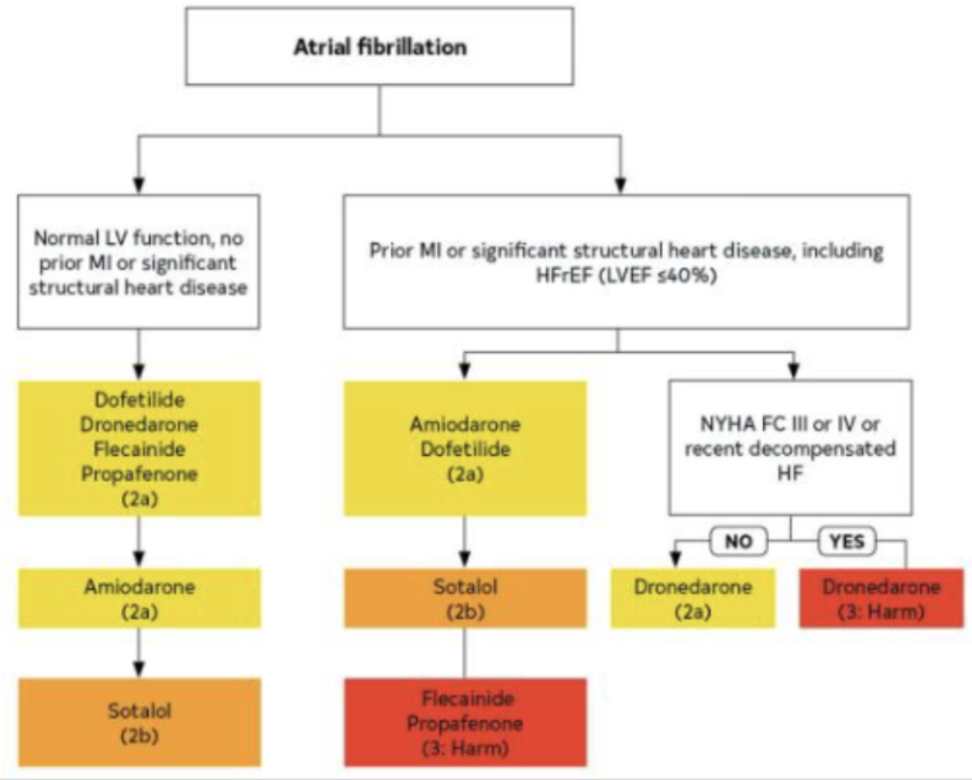
AADs for Maintenance of Normal Sinus Rhythm
KNOW IMAGE
Rhythm Control Meds
______ (Tambocor and Rythmol)
______ (Cordarone, Pacerone)
______ (Tikosyn)
______ (Multaq)
______ (Betapace AF)
Flecainide and Propafenone, Amiodarone, Dofetilide, Dronedarone, Sotalol
Flecainide & Propafenone (______)
______ for ______, ______ or significant ______
______ in patients with ______
“Pill-in-the-pocket” approach → ______ med → episode of ______
______ options for ______ patients, BUT should NOT be used in ______
Tambocor and Rythmol, 1st line, Normal LV function, no prior MI, structural HD, C/I, structural HD (MI/HF and increases risk of death), Oral, AFib, 1st line, HF, structural HD
Amiodarone (______)
______ for ______ or Significant ______ (______ < ______)
______ (use after Dofetilide, Dronedarone, Flecainanide, Propafenone) for ______, ______ or significant ______
______ but ______
Extremely ______ (for ______)
______, ______ conduction, and ______ conduction
Most ______ (not 1st line bc of associated with ______)
Used in ______
Eyes (eye exam), thyroid (hypo- and hyperthyroidism), liver (liver injury/toxicity), skin, neurological
______ most serious toxicity
Symptoms: ______
DDIs: Extensive → always run an interaction check
______ (thyroid function tests, EKG, LFTs) to ensure pt doesn’t develop SEs
Cordarone, Pacerone, 1st Line, Prior MI, Structural HD (HFrEF w/LVEF, 40%, 2nd Line, normal LV dysfunction, no prior MI, structural HD, most effective, more toxic, prolonged half-life, months, Slows HR, AV node, intracardiac, effective AAD, toxicities, elderly or older adults, Pulmonary fibrosis, cough and dyspnea, order baseline tests
Dofetilide (______)
______ for ______, ______ or significant ______
______ (after Amiodarone) for ______ or Significant ______ (HFrEF w/ LVEF <40%)
______ for pts ______
Highest risk of ______ (______) → required hospitalization for ______
Can be used for ______ and ______
Monitoring
______
______
Drug interactions (______)
Tikosyn, 2nd 1st Line, Normal LV Function, no prior MI, Structural HD, 1st line, prior MI, structural HD, 1st line AAD, w/ or w/o structural HD, Torsades de Pointes, renal dysfunction, first 5 doses, cardioversion, maintenance of NSR, Renal Function, QT interval, increases QT interval
Dronedarone (______)
______ for ______, ______ or significant ______
______ for ______ or Significant ______
Monitor ______
______ lipophilic, ______ t1/2
______: Increased risk of death with ______ or ______
Multaq, 2nd 1st line, Normal LV function, no prior MI, structural HD, 1st line, Prior MI, Structural HD AND NO recent decompensated HF, LFTs and QT interval, Less, shorter, BBW, decompensated HF, permanent AFib
Sotalol (______)
______ for ______, ______ or significant ______
______ for ______ or Significant ______
______ used for ______ or ______
Avoid in ______
Monitoring
______
______
Betapace AF, Last line, Normal LV function, no prior MI, structural HD, 2nd line, Prior MI, Structural HD, NOT, HTN, rate control, systolic HF, Renal Function, QT prolongation
Catheter Ablation
______ isolation
Can be curative for ______
______ based on risk assessment
______ ablation
______
______ → continue ______
Indications
If ______ are ineffective, C/I, or not tolerated
______ in ______ pts with few comorbidities to ______ + ______
Pulmonary Vein, AFib Sxs, anticoag, AV Node, permanent pacemaker, AFib persists, anticoag, anti-arrhythmic meds, 1st Line, younger, improve Sxs, prevent AFib progression

KNOW IMAGE