Lipids 3.1.3
 Call Kai
 Learn
Learn Practice Test
 Spaced Repetition
 Match
Match Flashcards
 Knowt Play
1/4

Earn XP
Description and Tags
Name | Mastery | Learn | Test | Matching | Spaced | Call with Kai | Chat |
|---|
No analytics yet
Send a link to your students to track their progress
5 Terms
Roles of lipids
Energy supply, structural component (cell membranes), waterproofing (insoluble), insulation, protection (of delicate organs).
Fatty acids
Consist of a carboxyl (COOH) group and a hydrocarbon chain (R group). They can be either saturated (no carbon-carbon double bond and have higher melting points) or unsaturated (contain at least 1 carbon-carbon double bond causing the chain to kink, and have lower melting points).
Test for lipids
Emulsion test:
Add ethanol, shake and add water. If lipids are present, a milky white emulsion will form.
Triglycerides
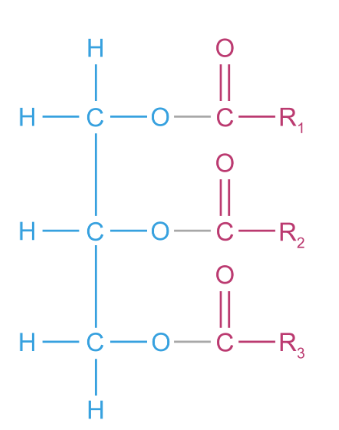
An energy store consisting of a glycerol attached via ester bonds to 3 fatty acid tails - which can be saturated or unsaturated.
Glycerol + 3 fatty acids ←→ Triglyceride + 3 water (condensation and hydrolysis)
Phospholipids
A structural component of cell membranes made up of a phosphate group, a glycerol and 2 fatty acids. The hydrophilic head (containing glycerol and phosphate) attracts water and the hydrophobic tail (fatty aids) repels water - this causes a phospholipid bilayer (hydrophilic heads facing out and hydrophobic tails facing in) to form when phospholipids are placed in water, meaning water-soluble substances cannot pass through.