1. Fundamental Biology
 Call Kai
 Learn
Learn Practice Test
 Spaced Repetition
 Match
Match Flashcards
 Knowt Play
1/50

There's no tags or description
Looks like no tags are added yet.
Name | Mastery | Learn | Test | Matching | Spaced | Call with Kai | Chat |
|---|
No analytics yet
Send a link to your students to track their progress
51 Terms
Characteristics of living organisms
MRS GREN C
movement
Respiration
Sensitivity
Growth
Reproduction
Excretion
Nutrients
Control
MRS GREN C : M
Movement : ability to change position in ways such as tilting, walking or swimming
MRS GREN C : R
Reproduction : ability to have children/offspring and pass genes down to them
MRS GREN C : S
Sensitivity : ability to take in information from surroundings
MRS GREN C : G
Growth : abiltiy to use nutrients that they have taken in to get larger
MRS GREN C : R
Respiration : ability to use nutrients that they’ve taken in to produce energy for movement, keeping warm and other bodily processes
MRS GREN C : E
Excretion : abiltiy to get rid of waste products
MRS GREN C : N
Nutrition : abiltiy to take in nutrients by eating or absorbing
MRS GREN C : C
Control : abiltiy to control internal conditions (e.g temperature, water levels, chemical balance)
Single celled organism VS multi-celled organism
Single : just one cell
Multi : multiple cells that have different systems for exchanging and transporting materials (AT)
Cell Organisation
Cells → Tissues → Organs → Organ System → Organism

Cell
Basic functional and structural units in a living organism
Tissue
Groups of cells of similar structure working together to perform a particular function (can include more than one type of cell)
Organ
Group of different tissues working together to perform a certain function
Organ system
A group of organs working together to perform a particular function
Organism
Different organ systems working together
How to observe cells under a microscope
Pull inner layer off
Place layer in the centre of slide
Place 2 drops of iodine on to the slide
Lower the cover slip
Observe under the microscope
Conversion between cm, mm, and µm

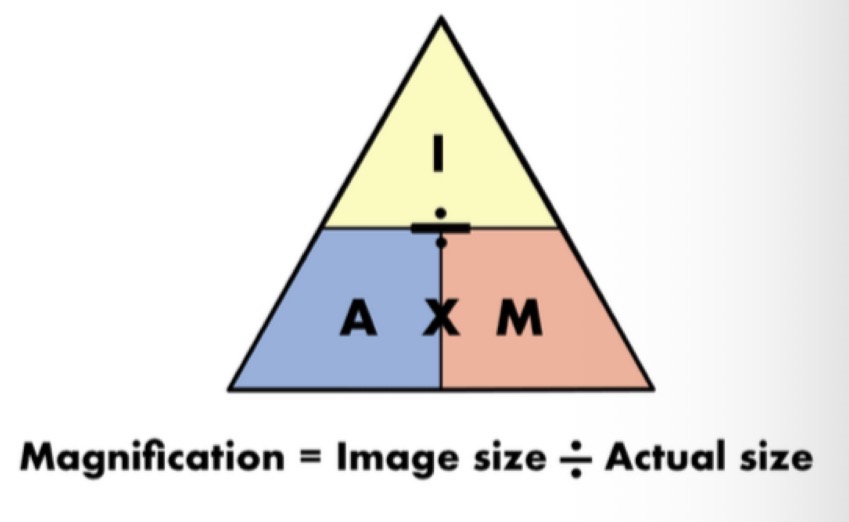
Magnification formula
Magnificat = image size / actual size
Subcellular structures in animal cells :
Nucleus
Cytoplasm
Cell membrane
Mitochondria
Ribosomes

Subcellular structure in a plant cell
Nucleus
Cytoplasm
Cell membrane
Mitochondria
Ribosomes
Cell wall
Permanent vacuole
Chloroplasts

Function : nucleus
Contains genetic material that controls activities of cell
Function : cytoplasm
Gel-like substance where most of the chemical reactions happen - has enzymes that control these reactions
Function - cell membrane
Holds the cell together and controls what goes in and out
Function : mitochondria
Where most of the reactions for aerobic respiration take place
Function : ribosomes
Where protein synthesis occurs (protein is made)
Function : cell wall (plant)
Made of cellulose and supports the cell and strengthens it
Function : permanent vacuole (plant)
Stores cell sap, a weak solution of sugar and salts and helps maintain the rigidity of the cell
Function : chloroplasts (plant)
Contains chlorophyll (which absorbs light needed for photosynthesis), where photosynthesis occurs
Respiration
≠ breathing (mechanical process)
The process of transferring energy from the breakdown of glucose to cells in the body
Aerobic respiration
Respiraiton using oxygen, the most efficient way to transfer energy from glucose and occurs inthe mitochondria
Glucose + oxygen → Carbon Dioxide + water
C6H12O6 + 6O2 → 6CO2 + 6H20
Anaerobic respiration
Without the presence of oxygen and is an incomplete breakdown of glucose, making lactic acid. This makes less energy than aerobic respiration as glucose isnt fully oxidised
Glucose → Lactic Acid
C6H12O6 → C3H6O3
Anaerobic respiration in plants and yeast
Glucose → ethanol + carbon dioxide
C6H12O6 → 2C2H5OH + 2CO2
When respiraiton occurs, what is produced
ATP, which provides energy for cells
CP 7 : respiration, heat
Investigate the heat production in respiring cells

CP 7 : respiration, carbon dioxide
Investigate the production of carbon dioxide in respiring cells using hydrogen carbonate indicator solution

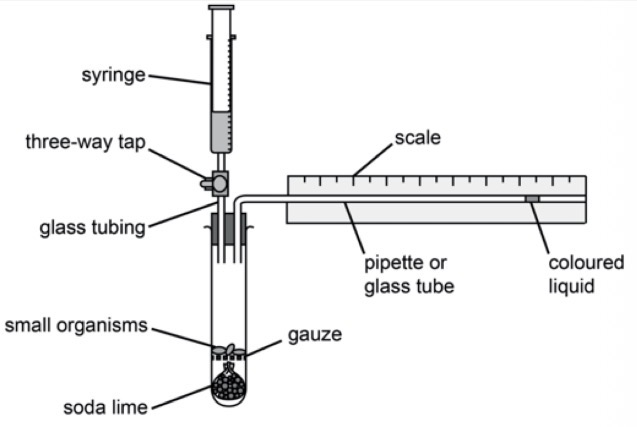
CP 7 : respirometer
Set up the respirometer as shown in the diagrem
Use the syringe and 2 way tap to move the coloured liquid
Make sure the bung is pushed in securely
Record the start position and start a timer for 5 min
Record the end position of the coloured liquid
Calculate rate of respiration through : Volume of oxygen used /time
Anaerobic Respiration Practical
Use 600cm cubed beaker to make a water bath at 40°
Fill one boiling tube with limewater qnd the other with 2.5g of yeast and 25ml of 10% glucose solution
Stir and wait 1 minute
Place the boiling tube of yeast and glucose into the water bath and match the temperature to what is appropriate
Use a pipette to add enough cooking oil to cover the surface of the yeast glucose mixture
Fix the delivery tube to the boiling tube with limewater, start the clock and count the number of bubbles produced in 1 minute
Change the temperature and repeat the steps to test different temperature

What is downward displacement
Using a water filled measuring cylinder rather than counting bubbles to measure the volume of gas

Anaerobic respiration in yeast cells is known as..
Fermentation
Yogurt production
Milk is pasteurised at 85-90°C for 15-30 min to kill existing disease or microorganism
Milk is homogenized (breaking down fat globules into smaller particles to prevent cream from separating)
Milk is cooled to 40-45°C and lactobacillus is added (avoid killing lactobacillus and reaching the optimum temperature)
The mixture is incubated for a few hours and the lactobacillus digests the lactose found in the milk into lactic acid
The yogurt thickens and is cooled
Features of a plant
Multicellular
Have cell walls made of cellulose
Have chlorophyll in chloroplasts
Can photosynthesise (autotrophs) and store glucose as starch/sucrose in chloroplasts
No nervous coordination, meaning they cant move from 1 place to another on their own
Features of animals
Multicellular
Do not have a cell walls made, chlorophyll, chloroplasts
Cannot photosynthesize, so rely on feeding (heterotrophs) to store glucose as glycogen
Have nervous coordination
Can move from one place to another on its own
Role of yeast in making bread
The yeast respires anaerobically and produces carbon dioxide and ethanol. The carbon dioxide gets trapped in the dough causing it to rise (and have pockets)
Role of yeast in beer production
The yeast respires anaerobically, reacting with the glucose (from barley), forming ethanol and carbon dioxide
Diffusion
The movement of particles from an area of high concentration to an area of low concentration
occurs in both gases and solutions

What affects rate of diffusion and osmosis
Temperature
Concentration gradient
Surface area to volume ratio
Distance
Osmosis
Movement of water from an area of high water potential (low concentration) to an area of low water potential (high concentration) through a semi-permeable membrane

Hypertonic, isotonic, hypotonic solutions and cells
Hypertonic : high solute concentration/low water potential : cells become flaccid/shriveled
Isotonic : the same concentration : cells remain normal
Hypotonic : a low solute concentration/high water potential : cells become turgid (and could pop)/lysed

Active Transport
Movement of particles through protein pumps/carriers from a region of lower concentration to higher concentration against a concentration gradient, using energy from respiraiton
E.g : root hair cells, in the gut

What is visking tubing
A tube that has microscopic holes (that let some molecules like water to pass through but not larger molecules), making it partially permeable