Introduction to nerve cells and excitability 2: Action potentials
 Studied by 0 people
 Call Kai
 Learn
Learn Practice Test
 Spaced Repetition
 Match
Match Flashcards
 Knowt Play
1/29

There's no tags or description
Looks like no tags are added yet.
Name | Mastery | Learn | Test | Matching | Spaced | Call with Kai |
|---|
No analytics yet
Send a link to your students to track their progress
30 Terms
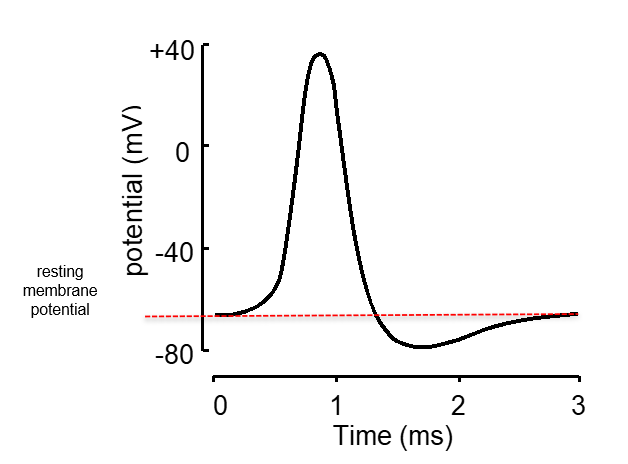
What is meant by action potential?
Defined as a brief change in the voltage across the membrane due to the flow of certain ions into and out of the neuron
Graph at which action potential is presented
Action potentials are also known as spikes, nerve impulses and nerve discharges
What is meant by the all or nothing principal?
The action potential is always a full response, no such thing as a “strong” or “weak” action potential
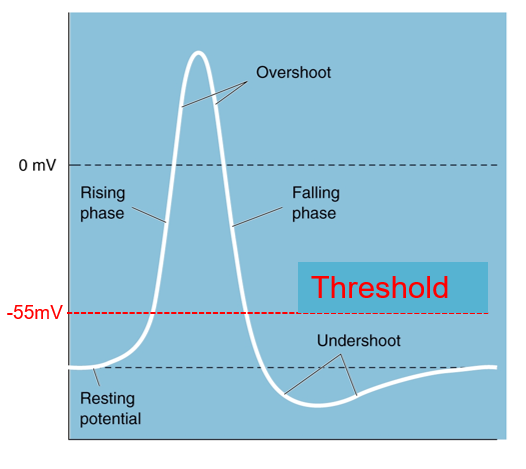
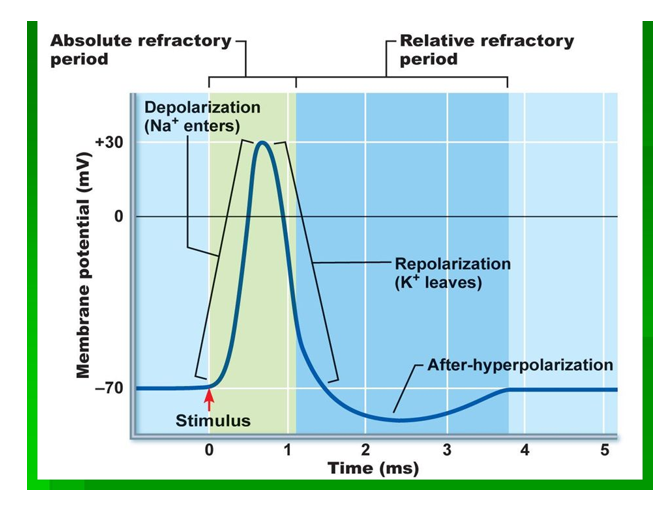
Phases of action potential graph
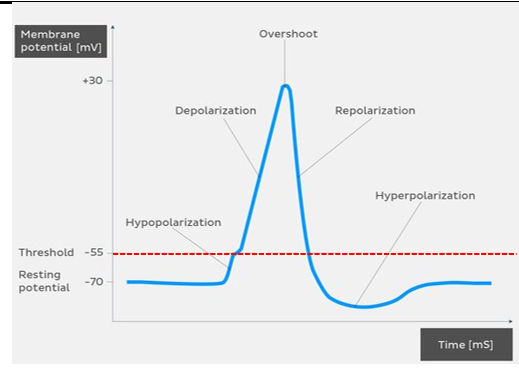
What is meant by hyperpolarisation?
Depolarisation begins when the membrane potential becomes less negative and reaches threshold for activation
What is meant by depolarisation?
Potential moving from RMP to less negative values
What is meant by overshoot?
Peak of the action potential is reached at about +40 milivolts
What is meant by repolarisation?
Potential moving back to the RMP (-70mV)
What is meant by hyperpolarisation/undershoot?
Potential moving away from the RMP in a more negative direction
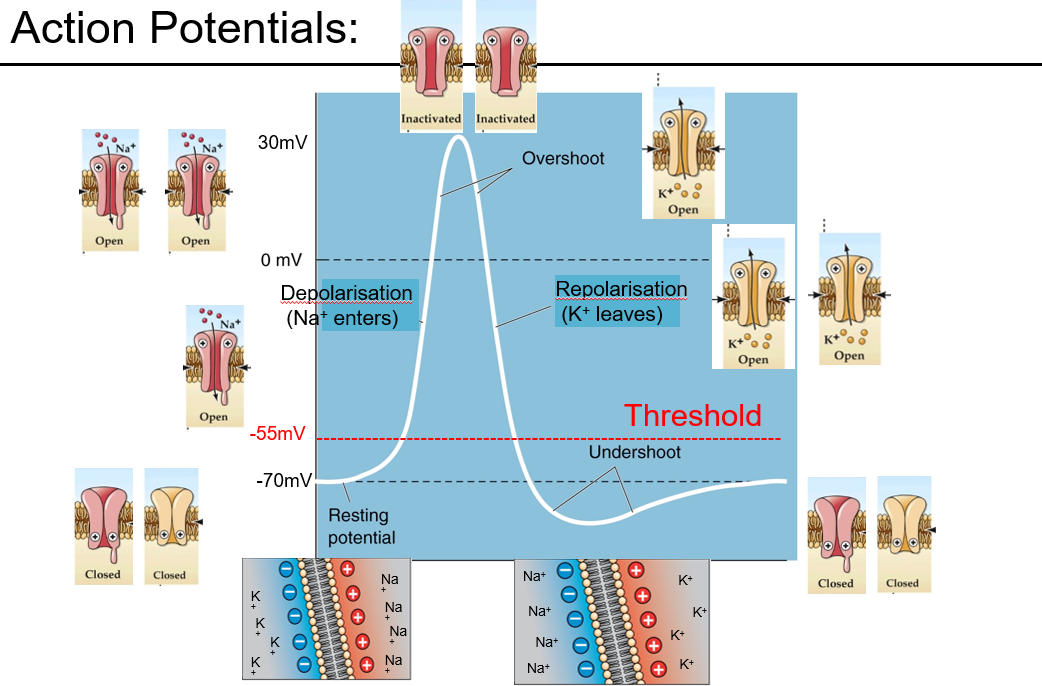
What 2 ion channels are involved in action potentials?
Voltage gated sodium and potassium channel
At what mV does the sodium gated ion channel open?
-55
At what mV does the potassium gated ion channel open?
+30
Graph of ion channels during an action potential
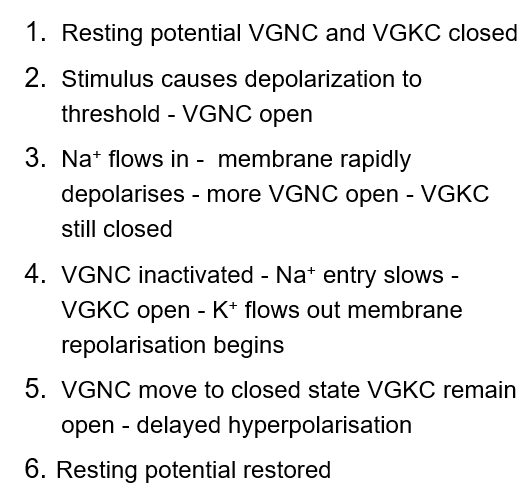
What is the sequence of events in action potential
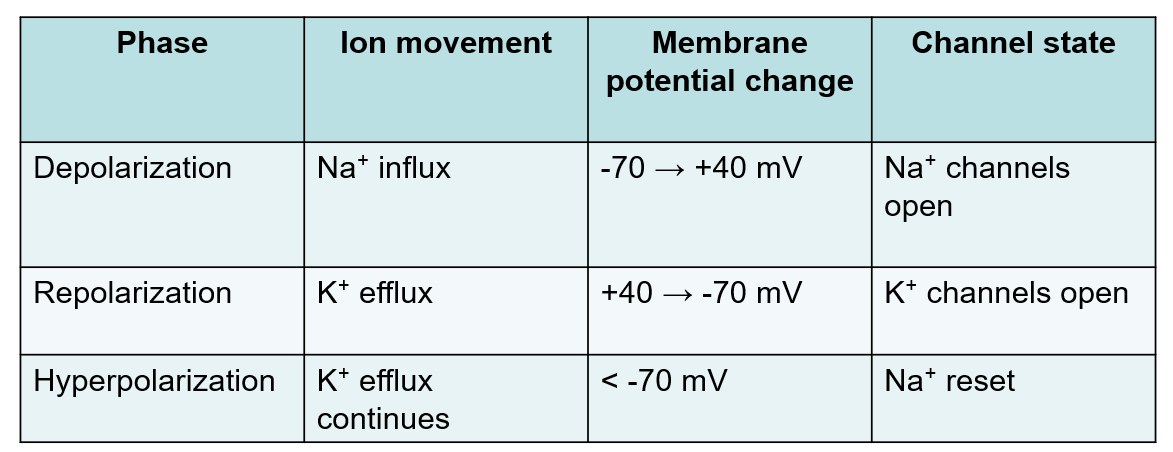
Summary table of the different phases in an action potential
What is meant by the absolute refractory period?
A period where a new action potential can’t be produced due to the sodium voltage gated channel being in an inactive state
What is meant by relative refractory period?
Will need a strong stimulation as it has a much more negative membrane compared to the start
Graph showing both refractory periods
ensure one way transmission
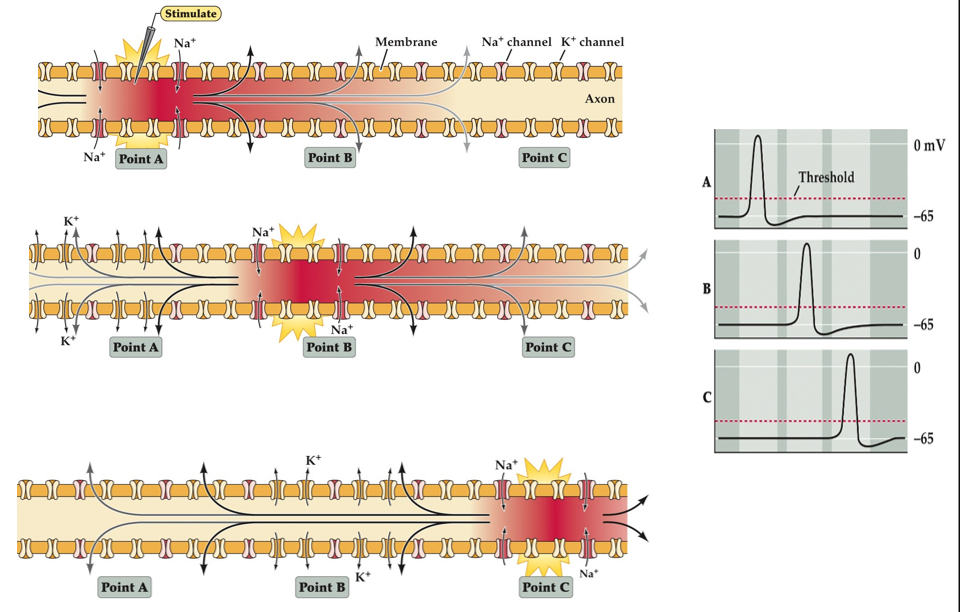
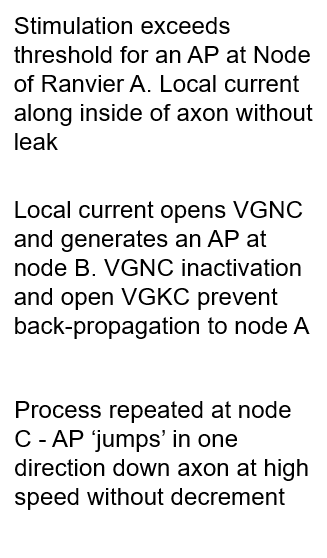
What happens during unmyelinated conduction?
Stimulation at A exceeds threshold for an AP so local current spreads further along the axon opening VGNC and generates an AP at B. VGNC inactivation leads to VGKC opening to prevent back propagation. Local current speed repeats and process at point C allowing AP to flow in one direction
What does the velocity of an action potential propagates depend on?
Axon diameter (size) and myelination
Why are myelin sheaths required?
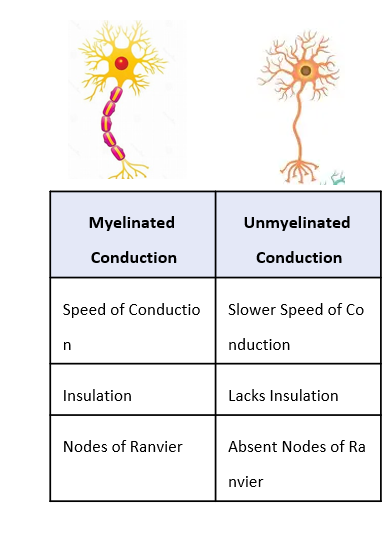
As large axons offer less resistance to local current so the larger the diameter the faster the propagation. Myelin electrically insulates large areas of axon allowing local currents to spread further and faster increasing speed of propagation which is known as Saltatory conduction (thickest = fastest) DOESNT CHANGE W LENGTH
Nodes of ranvier contains and does not contain?
VGNC and VGKC, doesn’t contain myelin sheath!
What happens during myelinated saltatory conduction?
same pic as unmyelinated conduction
Differences between myelinated and unmyleinated conduction
What are the slowest and fastest signals in our body?
Pain and touch
How does local anesthesia work?
Contains lidocaine which blocks Na+ channels which prevent AP initiation
How do anti-eliecptic drugs work?
Prolong Na+ inactivation which reduces hyper excitability
What are 2 demyleination diseases? And what they lead to
Guilian-Baree syndrome: Destructive of schwann cells in the PNS
Multiple sclerosis (MS): Caused by loss of oligodendrocytes (in the brain and spinal column
Both leads to muscle weakness and numbness or tingling
What are graded potentials?
Can be positive or negative so can be excitatory (AP) or inhibitory which can be strong or weak
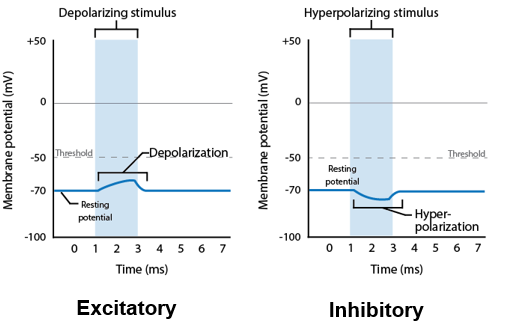
Types of graded potential
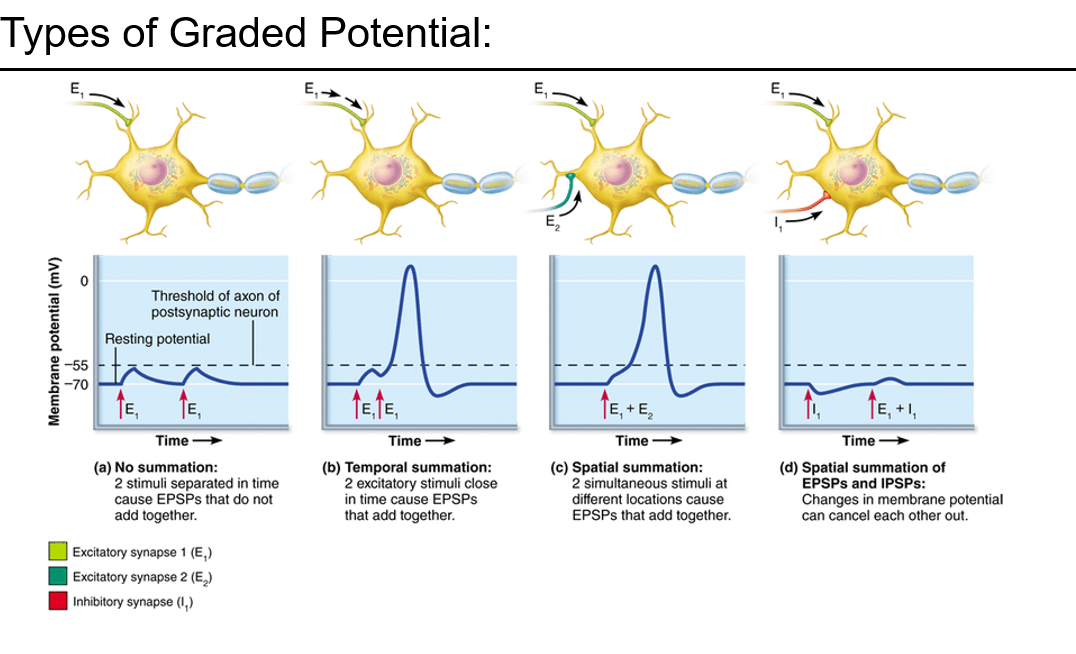
 Note
Note  Flashcards (142)