Philippine Wildlife
 Call Kai
 Learn
Learn Practice Test
 Spaced Repetition
 Match
Match Flashcards
 Knowt Play
1/515

Earn XP
Description and Tags
This shit is so ass
Name | Mastery | Learn | Test | Matching | Spaced | Call with Kai | Chat |
|---|
No analytics yet
Send a link to your students to track their progress
516 Terms
Wildlife
any living organisms that are undomesticated and are free-ranging, living in places that are untouched, untampered with, and have no interaction with human activity
Dipterocarp Forest
The primary type of tropical rainforest formation in the Philippines
(Shorea, Parashorea, Dipterocarpus species)
Dipterocarpaceae family
Pine Forest
Pure or dominant stands of gymnosperms adapted to fire and sandy/acidic soils.
Montane Forest
Transition zone between lowland dipterocarp forest and high elevation
Has low temperatures and great cloud coverage that encourage the growth of epiphytes such as ferns, orchids, and lichens
Oak (Lithocarpus)
Laurel (Laureaceae)
Ferns and Epiphytes
Trees in the montane Forest
Molave Forest
Lowland forest that develops on limestone or calcium-rich soils in regions with distinct wet and dry seasons.
Vitex parviflora (Molave)
Leucaena leucocephala (Ipil)
Species that Dominate the Molave Forests
Mossy (Cloud Forest)
Persistent mist, cool temperatures, and high humidity. Trees are stunted, gnarled, and heavily shrouded in thick carpets of mosses, liverworts, and epiphytes.
Mount Pulag, Mount Banahaw, and Mount Kitanglad
Examples of Mountains with mossy forests
Mangrove Forest
Intertidal coastal zones and brackish estuaries Consists of salt-tolerant trees
Sus cebifrons
Sus philippensis
Sus oliveri
Sus ahoenobarbus
The four endemic pigs of the philippines
Sus cebifrons
Visayan warty pig
Sus philippensis
Philippine warty pig
Sus oliveri
Mindoro warty pig
Sus ahoenobarbus
Palawan bearded pig
Sus cebifrons
Critically Endangered and native to the West Visayan Islands (Panay & Negros)
Prominent snout warts and distinct hair tufts
Sus philippensis
Vulnerable Native to Luzon, Mindoro, Samar, Leyte, and Mindanao
Sus ahoenobarbus
characterized by dense white bristles on its snout and cheeks.
Bubalus mindorensis
Tamaraw
Pithecophaga jefferyi
Philippine Eagle
Hydrosaurus pustulatus
Philippine Sailfin Lizard
Tragulus nigricans
Mouse Deer
Platymantis sp.
Philippine Forest Frog
Platymantis sp.
Has no tadpole stage but lays its eggs in leaf litter or moss that become froglets when hatched.
Order Anura
Frogs and Toads Order
Order Caudata
Salamanders
Order Gymnophiona
Caecilians (Limbless amphibians)
Crocodylus mindorensis
Freshwater Crocodile
Crocodylus porosus
Saltwater Crocodile
Order Testudines
Turtles
Order Squamata
Snakes, Lizards,
Suborder Amphisbaena
(Worm lizards)
Suborder Serpentes
Snakes
Suborder Sauria
Lizards Suborder
Birds
Most diverse groups of animals in the Philippines
Biogeography
It is defined as the study of the distribution of now existing and fossil organisms based on past and present areas
Sierra Madre
Longest Mountain Range
Cordillera Central
Tallest and Largest Mountain Range
Caraballo
Connects Cordillera and Sierra Madre
Zambales
West Bay of Luzon from Pangasinan to Bataan
Cagayan to Northern Quezon
Location of Sierra Madre
South Central Luzon
Location of Cordillera Central
Southern Luzon
Location of Caraballo
Panay
Negros
Masbate
Cebu
Leyte
Samar
Major Islands in Visayas
Lieven Ferdinand de Beaufort
Posited the Zoogergraphic regions of the World
Zoogeographic Regions
divisions of the Earth that are based on the geographic distribution of animal species;
Nearctic
Palearctic
Neotropical
Ethiopian
Oriental
Australasian
six zoogeographic realms according to de Beaufort
Nearctic Realm
Includes North America and Greenland.
Nearctic Realm
The Blue one
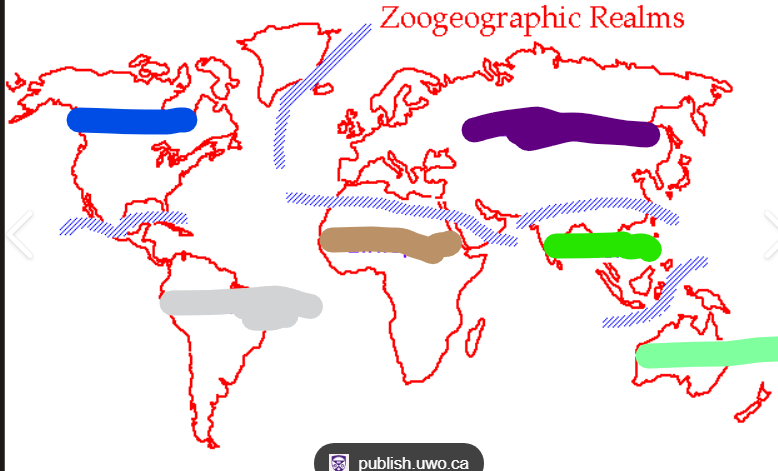
Palearctic Realm
Covers Europe, Asia north of the Himalayas, and northern Africa.
Palearctic
The violet one

Neotropical Realm
Includes Central America, South America, and the Caribbean. It is known to be the most biodiverse
Neotropical
The grey one

Afrotropical (Ethiopian) Realm
Comprises most of Africa, excluding the northern regions.
Afrotropical (Ethiopian) Realm
the brown one
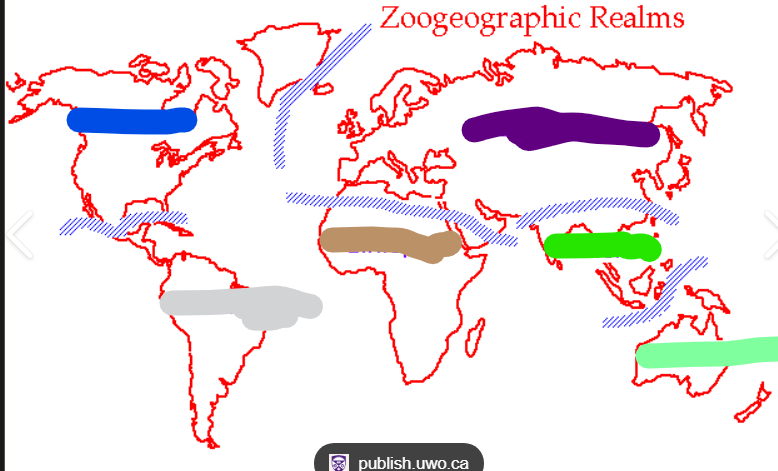
Oriental Realm
Includes South Asia and Southeast Asia.
Oriental
The green one

Australasian Realm
Covers Australia and parts of New Guinea and Tasmania
Australasian
The light green ome
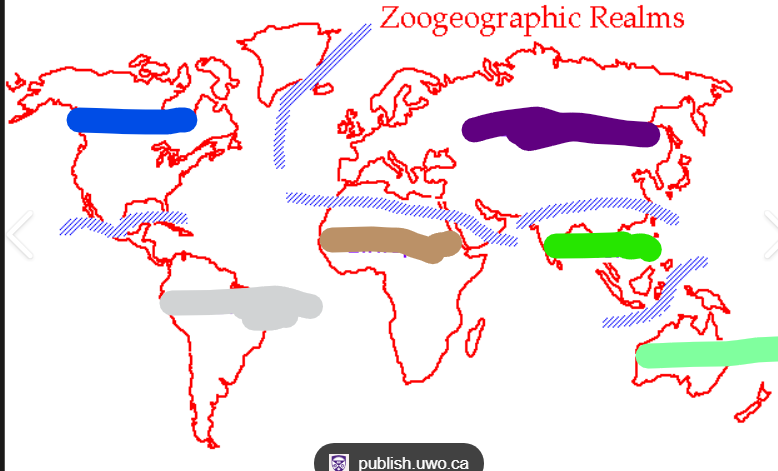
Climatic factors
cause species to originate more quickly in tropical regions
Temperate areas were () leaving less time for species to originate and accumulate in these regions
colonized more recently,
ancient origins of many groups in the tropics
Inability of most tropical species to tolerate variable temperatures of temperate areas
Evidence of why there are more species in the tropics
The Wallace Line
imaginary line that separates the Oriental Region (West) and the Australo-Papuan Region (East)
Oriental Region (West) and the Australo-Papuan Region (East)
what does the wallace line separate
Islands of Bali and Lombok, Borneo and Celebes, and south of the Sulu Islands and Mindanao
The wallace line is a line between _______and between _________ and then ______
Alfred Russel Wallace
posited the wallace line
Huxley
who modified the wallace line
Balabac-Palawan-Calamianes chain
Huxley included what in the Wallace line
Webers Line
What separates the Oriental and Australian Regions
Oriental and Australian regions
What does the Webers Line Separate
East Timor, West of Buru Island, and then west of Ternate
Location of the Wallace Line
Borneo via Palawan and Mindanao
The majority of the existing native species or their ancestral stocks colonized the Philippines from? via?
Taylor, Asiatic
According to ___ he relationships of the fauna, for the most part, seem to be with the_____
Leviton, Malayan and Indonesian in affinities
________observed that the Philippine snakes are predominantly____
Endemism
It is the degree of how many Endemic wildlife species there are in a geographic area
naturally restricted to a specific
geographic area and is not found elsewhere in the wild.
A species is considered endemic when it is
continental Asia and the Australian region.
The Philippine archipelago occupies a strategic position between the?
Pleistocene Epoch
In the _______ fluctuations in sea level repeatedly connected and isolated islands through land bridges, facilitating the dispersal, isolation, and diversification of many organisms.
Sundaic (Indo-Malayan) Region
influenced the fauna of Palawan and Calamian Islands, which were connected to Borneo through the Sunda Shelf
Palawan and Calamian Islands, Borneo, Sunda Shelf
Sundaic (Indo-Malayan) Region influenced the fauna of_____ which were connected to _____ through the_____
Borneo and Peninsular Malaysia
Many mammals, reptiles, and birds inhabiting Palawan share close evolutionary relationships with species in _______
oceanic islands
Luzon, Mindanao, Samar, Leyte, and the Visayan islands are considered ____that have never been connected to mainland Asia.
Sulawesi, New Guinea, and Australia
Wildlife communities in the eastern Philippines share historical faunal exchange with_____
Eastern Philippines
Wildlife communities in the_____share historical faunal exchange with Sulawesi, New Guinea, and Australia
Siberia, China, Korea, Japan,
Palearctic region
East Asian–Australasian Flyway
millions of migratory birds originating from _____ and other parts of the ______ annually utilize the Philippines as an important wintering ground and stopover site along the________
Pleistocene Aggregate Island Complexes
120
These are landmasses that got connected and separated after the repeated glacial and interglacial cycles that caused global sea levels to rise and fall by as much as ____ meters from 2.6 million to 11,700 years ago
Greater Luzon
Greater Mindanao
Greater Mindoro
Greater Negros-Panay
Greater Sulu
Greater Palawan
major PAICs that are commonly recognized for terrestrial vertebrates
Luzon, Catanduanes, Marinduque, and the Polillo Islands
Islands within Greater Luzon
Mindanao, Samar, Leyte, Bohol, Dinagat, Siargao, Biliran, and Basilan
Islands within Greater Mindanao
Negros, Panay, Cebu, Masbate, and Guimaras
Islands within Greater Negeros-Panay
Palawan, the Calamian Islands (Busuanga, Coron, Culion), Balabac, and the Cuyo Archipelago.
Islands within greater Palawan
Tawi-Tawi, Jolo (Sulu), and smaller surrounding islands of the Sulu Archipelago.
Islands within Greater Sulu
Non-native
organisms introduced by humans to regions where they do not naturally occur, and some can become invasive
Native
organism that naturally occurs in a specific region or ecosystem without human introduction
Endemic
organisms that are found naturally in a specific geographic area
Non-endemic/Resident
lives, feeds, and breeds year-round in a given geographic region but naturally occurs across multiple other regions or continents worldwide
Relict
is a surviving member of a once widespread or diverse group, now restricted to a limited area or population
More than 60%
% of amphibians in the Philippines are endemic