Chapter 1: Introduction to Microbiology
 Call Kai
 Learn
Learn Practice Test
 Spaced Repetition
 Match
Match Flashcards
 Knowt Play
1/84

There's no tags or description
Looks like no tags are added yet.
Name | Mastery | Learn | Test | Matching | Spaced | Call with Kai | Chat |
|---|
No analytics yet
Send a link to your students to track their progress
85 Terms
_____ is the system that classifies and groups organisms into taxa (categories).
Taxonomy
Microbial classification is based on similarities and differences in _____ and _____.
genotype; phenotype
Phenotypic classification tests _____ or _____ characteristics and compares them with established databases.
metabolic; molecular
In epidemiology, bacterial species may be further subdivided to help follow the _____ of bacterial infections.
spread
Subdivision of a species based on:
phenotypic differences = ___
serologic (antigenic) differences = ___
biochemical test-result differences = ___
subspecies; serospecies; biovariety
Genotypic classification can use _____ gene sequencing to demonstrate genetic relatedness.
ribosomal RNA (rRNA)
The three cellular domains listed in the objectives are _____, _____, and _____.
Eubacteria, Eukarya, and Archaea
_____ includes the typical bacterial species encountered in clinical settings.
Eubacteria
_____ includes fungi, protozoa, algae, animals, and plants.
Eukarya
_____ includes thermophiles, halophiles, and anaerobic methanogens and is not associated with human disease.
Archaea
Prokaryotes include the domains _____ and _____.
Eubacteria; Archaea
In the taxonomy analogy,
family = _____ name
genus = _____ name
species = _____ name
clan; last; first
A _____ consists of organisms of the same species that have varying characteristics.
Ex. Two S. aureus isolates with different penicillin susceptibilities can represent different strains of the ___ species.
strain; same
In bacterial nomenclature, the first letter of the _____ is capitalized and the species name is _____.
It must also be ___ OR printed and ___. Abbreviations must be formatted as: G. species
genus; lowercase
italicized; underlined
_____ are unicellular organisms that lack a membrane-bound nucleus and membrane-bound organelles.
Prokaryotes
_____ have a membrane-bound nucleus and membrane-bound organelles.
Eukaryotes
The prokaryotic nuclear body is called the _____ and is not membrane-bound. Prokaryotic cells have _____ membrane-bound organelles.
nucleoid; no
Ribosomes are the site of _____ synthesis.
protein
In prokaryotes, ribosomes may be free in the _____ or attached to the cytoplasmic _____.
cytoplasm; membrane
Prokaryotic cytoplasmic granules are _____ deposits that may consist of polysaccharides.
storage
Cytoplasmic granules can be visualized with _____ blue stain.
methylene
Bacterial spores appear as highly _____ bodies and as _____ areas on a Gram stain because of their thick protein coat.
refractile; unstained
_____ ER is covered in ribosomes and is a site of protein synthesis.
Rough
_____ ER synthesizes phospholipids.
Smooth
The _____ apparatus modifies and packages proteins and lipids sent to it by the ER.
Golgi
Mitochondria contain DNA and an electron transport system that produces energy in the form of _____.
ATP
The prokaryotic plasma membrane contains _____ sterols - in contrast to eukaryotes.
no
The prokaryotic plasma membrane acts as an _____ barrier and is the location of the electron transport chain.
osmotic
In prokaryotes, the ___ ___ ___ is where energy is generated in the plasma membrane.
electron transport chain (ETC)
The eukaryotic plasma membrane contains _____, which stabilizes the membrane and helps keep it fluid.
cholesterol
The bacterial cell wall is _____ and maintains cell structure.
rigid
Bacterial cell walls may be classified as Gram-positive, Gram-negative, or ___.
acid-fast
The genera _____ and _____ contain a waxy layer that causes poor Gram staining and makes an acid-fast stain more useful.
Mycobacterium; Nocardia
When present, a eukaryotic cell wall provides _____ and strength.
rigidity
A fungal cell wall may contain _____, which differs from the composition of bacterial cell walls.
chitin
Most eukaryotes ___ ___ have a cell wall; a cell wall is a distinct characteristic of fungi.
do not
A bacterial _____ helps a pathogen evade phagocytosis.
capsule
Prokaryotic cell appendages include _____, _____, and _____.
flagella; pili; fimbriae
Eukaryotic motility structures are _____ and _____.
cilia; flagella
Gram-positive bacteria have a _____ peptidoglycan (murein) layer and stain _____.
thick; purple
Antimicrobial agents such as penicillin can act against Gram-positive organisms by preventing synthesis of _____.
peptidoglycan
Gram-positive cell walls contain _____ acid and _____ acid.
teichoic; lipoteichoic
Gram-negative bacteria have _____ cell-wall layers with an inner _____ peptidoglycan layer.
two; thin
Gram-negative bacteria stain _____ on a Gram stain.
pink
The outer membrane of Gram-negative bacteria contains proteins, phospholipids, and _____.
lipopolysaccharides (LPS)
LPS is very _____; if it is present in blood, the immune system will be triggered.
immunogenic
The _____ stain is the most common stain and differentiates Gram-positive from Gram-negative bacteria.
gram
The primary stain in the Gram-stain procedure is _____ violet.
crystal
The Gram-stain mordant/fixative is _____.
iodine
The Gram-stain decolorizer is _____.
acid-alcohol
The Gram-stain counterstain is _____.
safranin
The Gram-stain timing in the objectives is crystal violet _____, iodine _____, acid-alcohol a quick rinse, and safranin _____. (Rinse with water between each step)
1 min; 1 min; 30 secs
Acid-fast stains are used for bacteria whose cell walls contain high amounts of _____ and _____.
lipid; wax
The primary stain used in an acid-fast stain is _____.
carbolfuchsin
In the _____ method, heat is used to allow dye penetration into acid-fast cell walls.
Ziehl-Neelsen
In the _____ method, a detergent is used to allow dye penetration into acid-fast cell walls.
Kinyoun
The acid-fast decolorizer listed in the objectives is _____ and the counterstain is ___ ___.
alcohol; methylene blue
Acid-fast bacteria retain the primary stain and appear _____.
pink
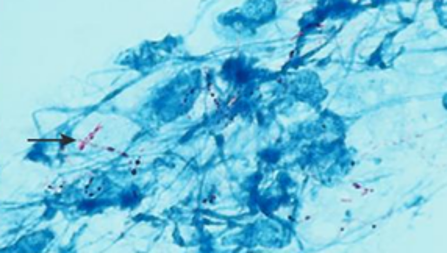
_____ orange is a fluorochrome dye that stains both Gram-positive and Gram-negative bacteria, living or dead.
Acridine
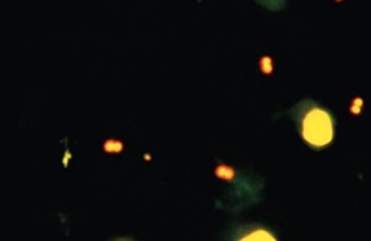
_____ white is a fluorochrome that binds to chitin in the fungal cell wall.
Calcofluor
_____ blue is used to visualize metachromatic granules in C. diphtheriae.
Methylene
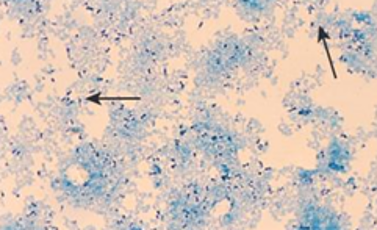
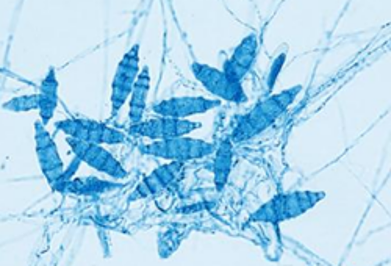
_____ cotton blue is used to visualize the cell walls of medically important fungi.
Lactophenol
___ ink is used to visualize capsules around yeast.
India
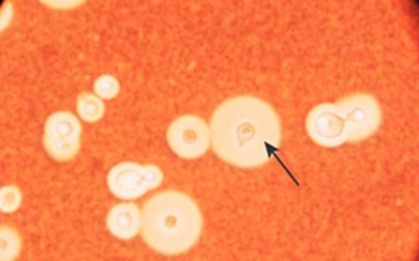
The three major nutritional requirements for bacterial growth are a _____ source, a _____ source, and an _____ source.
carbon; nitrogen; energy
A carbon source is needed for bacterial ___ ___
cellular constituents
A nitrogen source is needed to make _____ and _____ acids.
proteins; nucleic
The bacterial energy source is _____ and is used for cellular functions.
ATP
_____ use carbon dioxide as their carbon source and obtain energy through photosynthesis or oxidation of inorganic compounds.
Autotrophs
_____ require an organic carbon source such as glucose and obtain energy by oxidizing or fermenting organic substances. All ___ that inhabit the human body are these!
Heterotrophs; bacteria
The three environmental factors that influence bacterial growth rate are _____, _____, and the gaseous composition of the atmosphere.
pH; temperature
Most pathogenic bacteria grow best at a _____ pH.
Bacterial media are usually adjusted to a final pH of approximately _____ to _____.
neutral
7; 7.5
_____ grow best in cold temperatures of about 10–20°C.
_____ grow best at moderate temperatures of about 20–40°C.
_____ grow best in hot temperatures of about 50–60°C.
Psychrophiles; Mesophiles; Thermophiles
_____ (nutritive) media contain nutrients that support the growth of most nonfastidious organisms.
Nonselective
_____ media contain added growth factors such as blood, vitamins, or yeast extract and allow fastidious organisms to grow.
Enriched
_____ media inhibit the growth of some bacteria but allow others to grow.
Selective
_____ media allow visualization of metabolic differences between groups or species of bacteria.
Differential
_____ media are used when there is a delay between specimen collection and culturing.
Transport media are designed to preserve microorganism _____ without allowing _____.
Transport
viability; multiplication
A fastidious organism can be thought of as a _____ organism with special growth requirement.
picky
Obligate ___ requires oxygen for growth; While ___ cannot grow in the presence of oxygen.
Aerobes; anaerobes
_____ anaerobes can grow with or without oxygen. But they grow ___ in presence of oxygen than without it.
Facultative; faster
_____ bacteria grow best when enriched with extra carbon dioxide, about 5%–10%.
Capnophilic
_____ organisms require a reduced level of oxygen for growth.
Microaerophilic
Optimizing atmospheric growth requirements helps ensure recovery and _____ of pathogenic organisms from clinical samples.
isolation
Bacteria replicate by _____ fission, in which one cell divides into two.
binary
Generation or doubling time is the time required for one bacterial cell to _____.
Bacterial generation time may range from about _____ minutes to _____ hours or more.
divide
20; 24