Cell and Molecular Bio Ch.2
 Call Kai
 Learn
Learn Practice Test
 Spaced Repetition
 Match
Match Flashcards
 Knowt Play
1/45

There's no tags or description
Looks like no tags are added yet.
Name | Mastery | Learn | Test | Matching | Spaced | Call with Kai | Chat |
|---|
No analytics yet
Send a link to your students to track their progress
46 Terms
covalent bonds
bonds between atoms in which electrons are shared
molecule
stable combinations of atoms held together by covalent bonds
compound
molecules with more than one type of atom
polar molecules
asymmetrical distribution of electrical charge
nonpolar molecules
lack asymmetrical electrical charge
what are the two biological molecules with both polar and nonpolar regions
proteins and phospholipids
how many kilocalories does it take to break a covalent bond
shared electrons stay closest to the atom with the greatest (blank)
electronegativity depends on what
80-100
electronegativity
the number of protons in the nucleus and the distance of the shared electrons from the nucleus
how do ions form
anions
cations
ions form when strongly electronegative nuclei capture electrons
have extra electrons
have lost electrons
free radical
unstable atoms or molecules with unpaired electrons
formed during normal metabolism
may play a role in aging
highly reactive and damages macromolecules such as DNA
antioxidants
molecules that defend the body from free radicals
prevent and repair damage done by free radicals
donate electrons to free radicals to neutralize them and stop the oxidation process
superoxide dimutase (SOD)
enzyme that destroys the superoxide radical (O₂⁻)
protects cells from damage
extends the life of laboratory animals that overproduce superoxide
two other enzymes that can help destroy free radicals
catalases and glutathione peroxidases
calorie restriction
extends lifespan of experimental animals
results in decreased production of free radicals
reduced DNA damage
attractive bonds that are weaker than covalent bonds
chemical energy needed to break non-covalent bonds
weak bonds are (blank) then (blank)
non-covalent
1-5 kilocalories
broken, reformed
types of non-covalent bonds and how they form
ionic bonds: attractions between charged atoms that are weakened by water (i.e. NaCl)
Hydrogen bonds: form when a hydrogen atom is covalently bonded to an electronegative atom and thus adopts a partial positive charge and attracts to another electronegative atom of another molecule (determine the structure and properties of water)
hydrophobic interactions: nonpolar molecules associate and minimize their exposure to polar molecules
Van der waals: transient dipole formationin nonpolar molecules
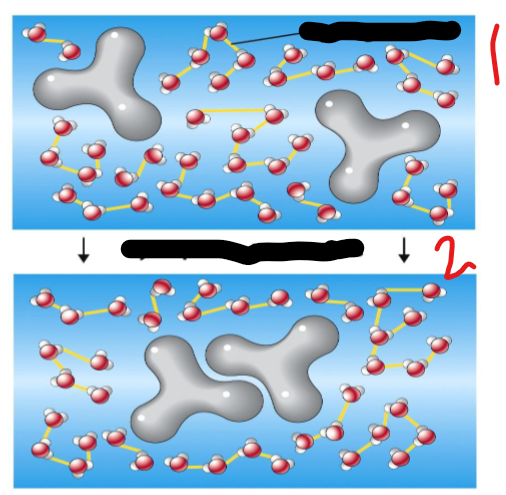
hydrogen bond
hydrophobic interaction
(blank) forms four covalent bonds and is essential to life
(blank) containing molecules produced by living organisms are called (blank)
carbon
carbon, biochemicals
hydrocarbons
contain only carbon and hydrogen
vary in the number of carbons and number of bonds between carbons
macromolecules
large structural and functional molecules in cells
name the four macromolecules and their monomers
Proteins: amino acid monomer
Lipids: fatty acid monomer
Polysaccharides/Carbohydrates: sugar monomer
Nucleic Acids: nucleotide monomer

what are the 7 functional groups (answers to picture not in order)
Methyl (CH₃)
Hydroxyl (OH)
Amino (NH2)
Carboxyl (COOH)
Carbonyl (CO)
Sulfhydryl (SH)
Phosphate (PO3H2)
Carbohydrates include simple (blank) and (blank)
Lipids are a diverse group of (blank) molecules. how are fats made?
Proteins are polymers of (blank)
nucleic acids are the polymers of (blank) which store and transmit (blank)
sugars, sugar polymers
nonpolar, fats are made by bonding a glycerol molecule to 3 fatty acid chains via 3 esther linkages
amino acids
nucleotides, genetic information (DNA and RNA)
Carbohydrates function as (blank)
What is the general formula for a carbohydrate
what is a polysaccharide
glycogen
starch
energy storage
CH2O
polymers of sugars joined by glycosidic bonds
animal product made by branched glucose polymers
plant product made up of both branched and unbranched glucose polymers
what are fatty acids
what does it mean if a fatty acid is saturated or unsaturated
fatty acids are unbranched hydrocarbons with one carboxyl group (COOH), making them amphipathic
a fatty acid is saturated if it does not contain any double bonds between the carbons of the hydrocarbon chain; it is unsaturated if it contains a double bond between the carbons and thus, the max amounts of hydrogen are not able to bond
are unsaturated fatty acids solid or liquid at room temp
are saturated fatty acids solid or liquid at room temp
liquid
solid
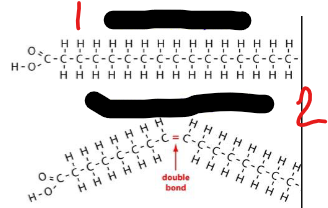
saturated fatty acid
unsaturated fatty acid
what are the components of an amino acid
how are amino acids joined together
what are the 3 things an R-group could be
an amino group, a carboxyl group (COOH), a phosphate group, and an “R” group, which varies among amino acids
peptide bonds which bond amino acids into a polypeptide chain to make proteins
polar charged, polar uncharged and nonpolar
what are the polar charged amino acids (His Glue Lysis the ArG ASaP)
Histidine
Glutamic Acid
Lysine
Arginine
Aspartic Acid
properties of polar charged r groups
act as strong acids or bases and can form ionic bonds
form ionic bonds due to charges
histidine is usually only partially charged at pH 7 and can gain or lose a proton in physiologic pH ranges
polar uncharged r-groups (SAGTT)
serine
asparagine
glutamine
threonine
tyrosine
properties of polar uncharged r-groups
make weak acids or bases
not fully charged at pH 7
can form H bonds due to partial positive or negative charge
nonpolar r-groups
Alanine
Valine
Leucine
Isoleucine
Phenylalanine
Tryptophan
Methinonine
properties of nonpolar side chains
hydrophobic
pack tightly into protein core
cannot interact with water or form electrostatic bonds
what are the special properties associated with glycine, cysteine and proline
glycine has a side chain that only contains a hydrogen atom and can fit in both hydrophilic and hydrophobic environments
cysteine has a side chain with a sulfhydryl group, which forms disulfide bonds
proline has a hydrophobic side chain that creates kinks in polypeptide chains and disrupts secondary structure
Proteins
primary structure
secondary structure
tertiary structure
quaternary structure
sequence of amino acids in the polymer
alpha helixes or beta pleated sheets formed by bonds between adjacent amino acids (hydrogen bonds form between the carboxyl group of one amino acid and the amino group of another)
Confirmation of the entire polymer stabilized by non-covalent bonds (disulfide bonds, ionic bonds, van der Waals, hydrophobic interactions) creates fibrous or globular proteins
proteins composed of subunits
protein domains
dynamic changes within proteins
form when a protein is composed of one or two distinct regions (each domain is a functional region)
Conformational changes are non-random movements triggered by the binding of a specific molecule
multiprotein complex
different proteins become physically associated to form a multiprotein complex
explain how a change at the DNA level leads to effects at the organismal level with sickle cell disease
a change in the DNA sequence leads to the sickle cell mutation
at the protein level, the mutation changes the shape of the hemoglobin molecule, allowing it to clump together
at the cellular level, red blood cells carrying the mutant hemoglobin are deprived of oxygen and become sickle shaped, which hinders blood flow
leads to pain and fatigue at the organismal level
NOTE: carriers of the sickle cell allele are resistant to malaria because the parasites are killed in sickled blood cells
Alzheimer’s disease (AD)
involves misfolded proteins that accumulate in the brains of affected individuals
amyloid precursor protein (APP), which is a membrane-bound protein in brain neurons, is cleaved by two secretase enzymes
in individuals predisposed to AD, this cleavage results in Aβ42, a protein that misfolds and associates into amyloid plaques
Creutzfeld-Jakob Disease (CJD)
results from misfolded protein in the brain
Healthy brains contain the normal protein PrPc
CJD brains have PrPsc which is misfolded
causes kuru and mad cow disease
Gleevec
drug used for treatment of rare cancers that used computer simulations of protein binding sites that allowed to test drug effectiveness
proteome
proteomics
entire inventory of an organism’s proteins
uses advanced technologies to perform large-scale studies on diverse proteins
proteins are separated using
proteins are identified using
gel electrophoresis
mass spectometry and high speed computers
nucleic acids are polymers of (blank) that store and transmit (blank)
two types of genetic information
how are nucleotides connected
nucelotides, genetic information
DNA (all organisms and some viruses), RNA (viruses)
3’-5’ phosphodiester bonds between the phosphate group of one nucleotide and the number 3 carbon of the next
3 components of a nucleotide
purine nitrogenous bases
pyrimidine nitrogenous bases
phosphate group, 5-carbon sugar, nitrogenous base
Adenine, guanine
cytosine, thymine, uracil
RNA is usually (blank) and DNA is usually (blank)
RNA may have (blank) activity, such molecules are called (blank)
single stranded, double stranded
catalytic, ribozymes
Note: RNA may fold on itself to make complex 3D structures as in ribosomes