Part 2.1 - Autonomic Drugs - Anatomy and Physiology of the ANS
 Call Kai
 Learn
Learn Practice Test
 Spaced Repetition
 Match
Match Flashcards
 Knowt Play
1/37

Earn XP
Description and Tags
Proverbs 16:3
Name | Mastery | Learn | Test | Matching | Spaced | Call with Kai | Chat |
|---|
No analytics yet
Send a link to your students to track their progress
38 Terms
e. b and c
Autonomic nervous system:
a) Subdivision of peripheral EFFERENT nervous system
b) Control involuntary activity
c) Composed of neurons outside of the CNS
Autonomic nervous system:
a. Subdivision of peripheral afferent nervous system
b. Control involuntary activity
c. Composed of neurons outside of the CNS
d. a and b
e. b and c
f. All
c. Both true
Afferent Neurons: Sensory- enter the CNS
Efferent Neurons: Motor- leave the CNS
Types of neurons in the peripheral nervous system:
a. Afferent or sensory neurons carry stimulus from sensory organs to brain.
b. Efferent or motor neurons carry response from brain to effector organ.
c. Both true
d. Both false
c. I, II, III, IV
Autonomic nervous system
I) 2-neuron system - CNS & Effector
II) Composed of pre-ganglion (1st neuron), and post- ganglion (2nd neuron)
III) Contains ganglion which is exclusive to ANS
IV) Carries impulses towards the organs that are independent or involuntarily moving such cardiac muscles, smooth muscles and exocrine glands
Autonomic nervous system
I. 2-neuron system
II. Composed of pre-ganglion (1st neuron), and post- ganglion (2nd neuron)
III. Contains ganglion which is exclusive to ANS
IV.Carries impulses towards the organs that are independent or involuntarily moving such cardiac muscles, smooth muscles and exocrine glands
a. I, III
b. II, IV
c. I, II, III, IV
d. II, III, IV
e. I, II, III
a. Pre-ganglion
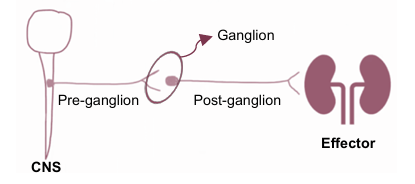
Ganglion of ANS near the brain.
a. Pre-ganglion
b. Post-ganglion
b. Post-ganglion
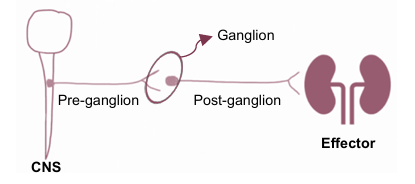
Ganglion of ANS near the effector organ.
a. Pre-ganglion
b. Post-ganglion
b. False - Ganglion is exclusive to ANS
Ganglion is exclusive to CNS.
a. True
b. False
f. All
Site where ANS can be found:
a. Smooth muscles
b. Cardiac muscles
c. Exocrine glands
d. a and b
e. b and c
f. All
a. Synapse (between 2 neurons; between a neuron and an effector)
Spaces between two neurons.
a. Synapse
b. Cleft
c. Mid-neuron
d. All
f. I, II, IV
III) CONTAIN enzyme for metabolism of neurotransmitters.
Pre synapse:
I. Sending cell
II. Site for the synthesis, storage and release of neurotransmitter
III. Do not contain enzyme
IV. Contain autoreceptors which are inhibitory receptors
a. I, III
b. II, IV
c. I, II, III, IV
d. II, III, IV
e. I, II, III
f. I, II, IV
e. None
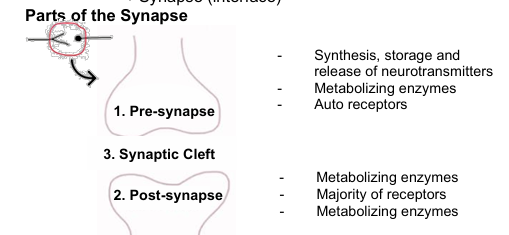
Occur in pre-synapse except:
a. Synthesis of NT
b. Storage of NT
c. Release of NT
d. Metabolism of NT
e. None
f. All
c. Both true
Pre-synapse:
a. Storage of enzyme in pre-synapse is through vesicle.
b. Release of enzyme from pre-synapse is through exocytosis.
c. Both true
d. Both false
a. True
Synaptic cleft contains enzyme for metabolism of neurotransmitters.
a. True
b. False
d. a and b
Post synapse:
a) Receiving cell
b) Contains enzyme for metabolism of NT
c) Majority of enzyme are for STIMULATORY response
Post synapse:
a. Receiving cell
b. Contains enzyme for metabolism of NT
c. Majority of enzyme are for inhibitor response
d. a and b
e. b and c
f. All
a. True
Synaptic transmission describe the mechanism of impulse across the synapse.
a. True
b. False
b. Neurotransmitters
___carries information from the pre-synaptic-sending-neuron to the post-synaptic-receiving-cell
a. Hormones
b. Neurotransmitters
c. Enzymes
d. Platelets
a. Cell body or dendrites
Synapses are usually formed between nerve terminals and the ________ of the receiving neuron.
a. Cell body or dendrites
b. Cell wall
c. Nucleus
d. Ribosomes
b. Branches
A single axon can have multiple branches, allowing it to make synapses on various postsynaptic cells.
A single axon can have multiple ________.
a. Membranes
b. Branches
c. Nuclei
d. Vesicles
c. Presynaptic-sending-neurons
A single neuron can receive thousands of synaptic inputs from many different ________.
a. Axon terminals
b. Postsynaptic cells
c. Presynaptic-sending-neurons
d. Cell membranes
b. Synaptic vesicles
Inside the axon terminal are many ________.
a. Mitochondria
b. Synaptic vesicles
c. Ribosomes
d. Lysosomes
c. Neurotransmitter
Synaptic vesicles are filled with ________ molecules.
a. Protein
b. Lipid
c. Neurotransmitter
d. Glucose
b. Synaptic cleft
The small gap between neurons is called the ________.
a. Axon terminal
b. Synaptic cleft
c. Dendrite
d. Cell body
c. 45632178
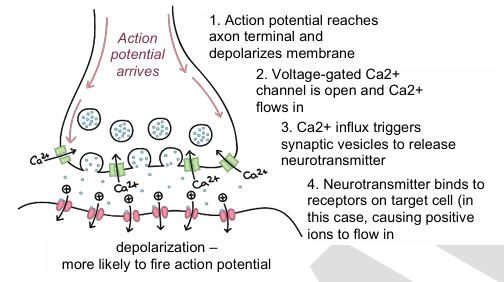
Synaptic transmission process:
1- Neurotransmitter is released via exocytosis
2- Vesicles move to membrane and dock
3- Ca2+ signals to neurotransmitter vesicle
4- Action potential arrives at axon terminal.
5- Voltage-gated Ca2+ channels open.
6- Ca2+ enters the presynaptic neuron.
7- Neurotransmitter bind to receptors.
8- Signal is initiated in postsynaptic cell.
a. 45631278
b. 45631287
c. 45632178
d. 45632187
c. calcium
When an action potential, or nerve impulse, arrives at the axon terminal, it activates voltage-gated __________ channels in the cell membrane.
a. sodium
b. potassium
c. calcium
d. chloride
b. neurotransmitter
The Ca2+ allows synaptic vesicles to fuse with the axon terminal membrane, releasing __________ into the synaptic cleft.
a. oxygen
b. neurotransmitter
c. glucose
d. protein
c. ion
Activation of postsynaptic receptors leads to the opening or closing of ion channels in the cell membrane. This may be depolarizing make the inside of the cell more positive or hyperpolarizing make the inside of the cell more negative depending on the ions involved.
Activation of postsynaptic receptors leads to the opening or closing of __________ channels in the cell membrane.
a. water
b. lipid
c. ion
d. protein
c. I, II, IV, V
Sympathetic Autonomic Nervous System:
I) Thoracolumbar Nervous System
II) Thoraco: T1-T12 and Lumbar:L1-L5
III) SHORTER pre-ganglion, LONGER post-ganglion
IV) Ganglion is near the CNS
V) Contains ACh betwen pre- and post-ganglion.
VI) Contains NE betwen post-ganglion and effector organ
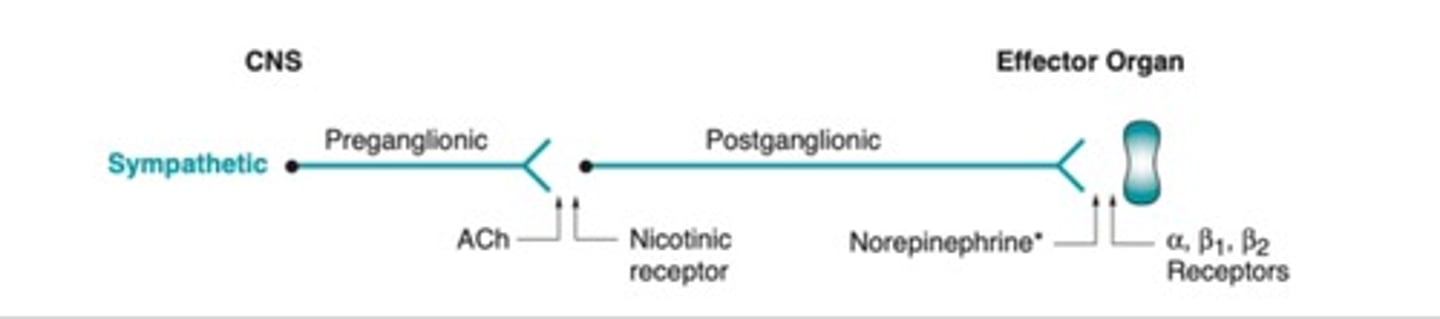
Sympathetic Autonomic Nervous System:
I. Thoracolumbar Nervous System
II. Thoraco: T1-T12 and Lumbar:L1-L5
III. Longer pre-ganglion, shorter post-ganglion
IV. Ganglion is near the CNS
V. Contains ACh betwen pre- and post-ganglion.
VI. Contains ACh betwen post-ganglion and effector organ
a. I, III
b. II, IV
c. I, II, IV, V
d. II, III, IV, VI
e. I, II, III, IV, V, VI
f. I, II, IV
b. Parasympathetic nervous system
Craniosacral nervous system
CN: 3,7,9,10 and Sacral: S2-S4
a. Sympathetic nervous system
b. Parasympathetic nervous system
b. Parasympathetic nervous system

Longer pre-ganglion, shorter post-ganglion
a. Sympathetic nervous system
b. Parasympathetic nervous system
b. Parasympathetic nervous system
Ganglion is near the effector organ.
a. Sympathetic nervous system
b. Parasympathetic nervous system
b. Parasympathetic nervous system
Contains ACh betwen pre- and post-ganglion and also betwen post-ganglion and effector organ.
a. Sympathetic nervous system
b. Parasympathetic nervous system
a. Nicotinic Neural (NN)
Same lang Nicotinic ang Sympathetic NS at Parasympathetic NS
Receptor at the ganglion of sympathetic neurons.
a. Nicotinic Neural (NN)
b. a1
c. b1, b2
d. Muscarinic
e. b and c
f. a and c
a. Nicotinic Neural (NN)
Receptor at the ganglion of parasympathetic neurons.
a. Nicotinic Neural (NN)
b. a
c. b1, b2
d. Muscarinic
e. b and c
f. a and d
f. b, c and d
Receptor at the effector of sympathetic neurons.
a. Nicotinic Neural
b. a
c. b1, b2
d. Dopa
e. Muscarinic
f. b, c and d
g. a and d
f. a and d
Receptor at the effector of parasympathetic neurons.
a. Nicotinic Neural
b. a
c. b1, b2
d. Muscarinic
e. b and c
f. a and d
f. All
Sympathetic NS
a. Adrenergic NS
b. Dominates during stress
c. Fight and flight
d. a and b
e. b and c
f. All
f. All
Parasympathetic NS
a. Cholinergic NS
b. Dominates basal
c. Rest and digest
d. a and b
e. b and c
f. All
f. I, III, IV, V, VI
Effects of activated sympathetic NS
I) Heart: Tachycardia
II) Eyes: MYDRIASIS
III) Bronchi: Reduced tone, Dilation
IV) GIT: Ileus (loss of peristalsis)
V) Urinary bladder: Urinary retention
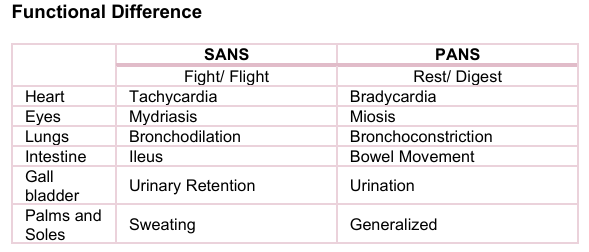
VI) Sweat glands: Apocrine, sweating of palms and soles
Effects of activated sympathetic NS
I. Heart: Tachycardia
II. Eyes: Miosis
III. Bronchi: Reduced tone, Dilation
IV. GIT: Ileus (loss of peristalsis)
V. Urinary bladder: Urinary retention
VI. Sweat glands: Apocrine, sweating of palms and soles
a. I, III
b. II, IV
c. I, II, IV, V
d. II, III, IV, VI
e. I, II, III, IV, V, VI
f. I, III, IV, V, VI
e. I, II, III, IV, V, VI
Effects of activated parasympathetic NS:
I) Heart: Bradycardia
II) Eyes: Miosis
III) Bronchi: Increased tone, constriction
IV) GIT: Bowel movement, diarrhea
V) Urinary bladder: Urination, micturition, enuresis
VI) Sweat glands: Eccrine, generalized sweating for thermoregulation
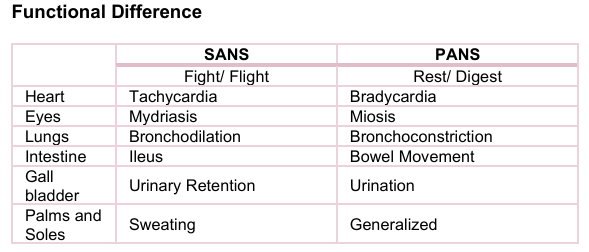
Effects of activated parasympathetic NS:
I. Heart: Bradycardia
II. Eyes: Miosis
III. Bronchi: Increased tone, constriction
IV. GIT: Bowel movement, diarrhea
V. Urinary bladder: Urination, micturition, enuresis
VI. Sweat glands: Eccrine, generalized sweating for thermoregulation
a. I, III
b. II, IV
c. I, II, IV, V
d. II, III, IV, VI
e. I, II, III, IV, V, VI
f. I, III, IV, V, VI