🧱 Materials
 Call Kai
 Learn
Learn Practice Test
 Spaced Repetition
 Match
Match Flashcards
 Knowt Play
1/35

There's no tags or description
Looks like no tags are added yet.
Name | Mastery | Learn | Test | Matching | Spaced | Call with Kai | Chat |
|---|
No analytics yet
Send a link to your students to track their progress
36 Terms
What is density?
Mass per unit volume
ρ=vm
What Hooke’s Law?
The extension of a material is directly proportional to force applied
F=KΔL
K= spring constant/stiffness
L= Extension
When obeying to Hooke’s law when does object reach equilibrium?
Once the wire stops stretching- Up=Down
What is it called when force is no longer proportional to change in extension on graph?
Limit of proportionality
Hooke’s Law no longer applies
How to test for extension?
Set up clamp and clamp stand and place spring in clamp. Then add weight (force)
Record extension
Keep adding weight and recording total extension,
Draw F again E graph
What is UTS?
Ultimate tensile stress- maximum stress a material can withstand

What is the limit of proportionality?
(P) After this point force is no longer proportional to extension
Hooke’s law no longer applies

What is the elastic limit?
(E) beyond this the material no longer returns to original shape when force is removed.

What happens when springs attached in series?
The force applied to both is same and extension is total length
KT1=K11+K21

What happens when springs attached in parallel ?
The spring have some extension (assuming K is the same) but force is split between them
KT=K1+K2

What is a tensile force?
A force which stresses an object/opposite of compressive force
What is tensile stress?
σ=AF,Pa=m2N
What is tensile strain?
ξ=LΔL,no.unit
What is young modules?
Young modules = Stress/Strain
E=AΔLFL
How to get Youngs modules from Force against Extension graph?
Rearrange this:
E=AΔLFL
On a graph of tensile stress against tensile strain what is the gradient?
Youngs modules
What is area under stress stress strain graph?
Energy per unit volume
What is the yield point?
The point at which a material will contain to stress with no extra load
What is area under force extension graph?
It is the energy stored


Does this graph obey Hooke’s Law?
No, as force is not proportional to extension

It this material elastic?
Yes, as it returns to its original length with no permanent extension as shown by it going back to the origin
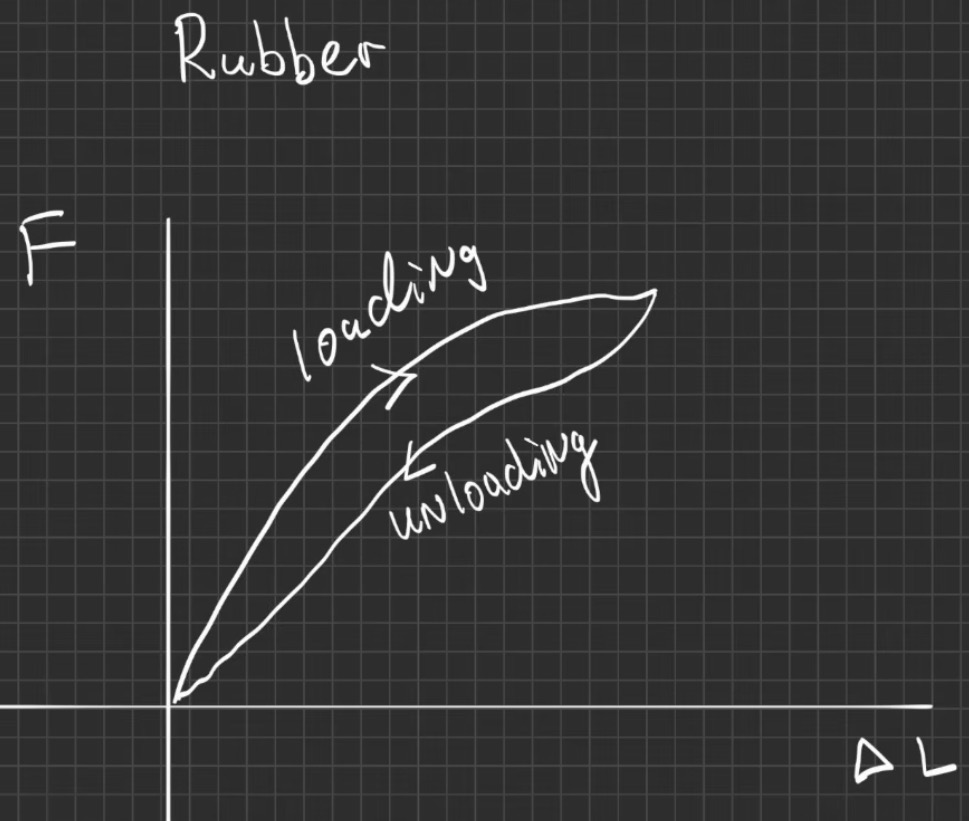
It the work done when starching material the same as as gained by extending?
No as more work done when stretching, the difference is due to energy lost to heat and can be found by area between them

Why is there difference in energy between loading and unloading curve?
The difference is due to energy lost to heat and can be found by area between them
What is plastic deformation?
The after elastic limit the material will no longer return to original length

What will happen after a material plastically deforms enough?
It will reach it breaking stress where a fracture will occur
How does a brittle material behave?
It initially obeys Hooke’s Law and force is proportional to extension.
Then (sometimes) a very short region where which force is not proportional to force. (Curve)
Fracture occurs

What are examples of carbon material?
Carbon fibre
Chocolate
What is elastic strain energy equation?
Same as kinetic energy
E=21Kx2,E=21FΔL
What is he change of energy stores in spring?
Change in Kinetic energy= Change in potential energy (GPE and Elastic strain)
Object stretch (Elastic strain energy)
When end of spring releases go up (KE)
Then do down do to mass (GPE)
What can ration of Xa to Xb also be written as?
XbXa
What is energy to deform?
Energy to deform:
Energy put in (total work done by you)
Area under loading curve
it includes energy that can be lost as heat
What is Elastic strain energy?
Elastic strain energy:
energy stored
recoverable energy (energy that is stored in material that can be converted back into other useful forms of energy when the deforming force is removed)
area under unloading curve
is the useful energy only
When can energy to deform and elastic strain energy be the same?
Only when the material:
Follows hooke's law
Is perfectly elastic
No energy is dissipated
(Basically ideal)
What is the law of conservation of energy?
(1) Energy cannot be created or destroyed
(2) It can only be transferred from one form to another
In this equation F=KΔL what is Force proportional to?
Extension
Why are brittle materials brittle?
Because they have a rigid structure and therefore when a tiny cracks forms it becomes bigger as the atoms can’t move until it completely breaks called brittle fracture