Biobased materials: Part I
 Call Kai
 Learn
Learn Practice Test
 Spaced Repetition
 Match
Match Flashcards
 Knowt Play
1/23

There's no tags or description
Looks like no tags are added yet.
Name | Mastery | Learn | Test | Matching | Spaced | Call with Kai | Chat |
|---|
No analytics yet
Send a link to your students to track their progress
24 Terms
Biomass vs biobased materials vs biodegradable polymers
biomass
organic substances produced in nature based on carbon fixation (CO2) through photosynthesis
biobased chemcicals:
organic functional materials made from biomass as carbon source
but almost all carbon found in products made by chemical industry are fossile based
biodegradable polymer
polymeric material that is readily degradable under regular composting conditons
But their is a difference between home composting and industrial composting
industrial composting is much harser and more efficient than ordinary environmental degradation
so it may be called biodegradable because it degrades under controlled conditions but does not degrate in normal outdoor environments
renewable and sustainable
renewable
resoruce can be regenerated on the human timescale; biomass is renewable because plants can regrow and fix new CO2. fossil sources are not because they take millions of years to form
Sustainable
broader term
material or process can be maintained long-term with acceptable environmental, economic and social impact including its full life cycle.
preparation of biobased materials
They can be prepared by normal organic chemsitry or via bioprocesses:
enzymatic synthesis = using well defined isolated enzymes
synthesis is assisted by enzymes that were isolated and might even be immobilized on solid support to facilitate recovery
but expensive: excraction, purification, immobilization
fermentation
uses whole cells
let bacteria do the job for us, but they only produce the product in low amounts and also produce a lot of other stuff
this leads to a complicated mixture and leads to a difficult purification
the name matters
biobased does not mean biodegradable
biobased plastic can still be persistent in the environment
biobased does not mean sustainable
bioethanol is made from sugar which compets with food supply which is not always acceptable
biodegradabledoes not mean sustainable
biodegradable is not necessarily advantageous
biodegradable cars wouldn’t be a good thing
renewable does not mean sustainble
production of bioethanol is can only be considered sustainable in certain parts of latin america, since they can harvest sugarcane from the same piece of land 2 times a year.
so reneawable sources can still be used in an unsustainable way, if biomass causes deforestation, high water use, high energy consuption, competition with food industry,…
biobased does not mean sustainable
only 5% of fosile oil is used as carbon source for chemicals
although additionla E used in the process should be accounted for as well
the rest is burned for energy
So much more efficient to generate biomass for energy production than replacing fossile fuel based chemicals
biomass needs to be grown
limited surface on land to grow biomass and not all land is suitable for agriculture
biomass can also be grwon in the sea like algea (this are in some cases rich in vegetable oils which can be usefal as biofule for planes)
greening of aviatory travel is difficult, electric flying is limited by the weight of batteries, so biofules might be an easier green alternative
Need fertilizers and pesticides
comes with large environmental impact and lowers sutainability
Waste streams should be efficiently used
although for some high value crops this is justified
eg. limited amount of crops can be used to exctract sucrose, so production of waste streams for its extraction can be justified for the production of chemicals
Factors determining Biodegradability (5)
FG’s in backbone
esters and amides are readily cleaved by enzymes
if only C-C bonds in backbone there’s limited biodegradability
polythioesters although less stable than ester, are less common in biology and are less readily cleaved by enzymes
copolymer composition
if copolymer = PET, these regions have dense packing due to stifness of the chains and pi-pi stacking
this limits access for enzymes, leading to almost no biodegradability
whil for aliphatic polyesters, are much less densely packed and are more readily cleaved
chain fleixibility Tg
Tg is a measure of chain flexiblity and mobility
introducting side chains lowers flexiblity, increasing Tg and lowers the biodegradability

crystalinity
nylon 6 and nylon6,6 can form stable crystal structure due to amide H-bond formation
but still faster degradation than PET
molecular weight
the higher the molecular weight the more difficult biodegradation becomes because less bioavailable
above 20,000 g/mol becomes more difficult
Use of biomass

= closed circle for materials but not for energy
it contains a lot of steps so it can be advantageous to shorten it (green arrows)
directly turn plant constituents into polymer materials
or even use biomass directly as polymer material
Wood for instance is a polymer material
need to use more wood in construction:
construction requires a lot of E and involves a lot of CO2
concret from cement industry - a lot of CO2
Steel production also has high CO2 emission
—> solution
can use biofules for these processes, but there still is a limited capacity of it
can use more wood in construction, this can lead to an overall negative CO2 output (as wood is biomass made from CO2)
composition of biomass and biopolymers
biomass
cellulose
regular and well defined
other carbohydrates
starch
lignin
polymer of aromatic building blocks, more diverse and branched so more difficult to process
others
fats, proteins
biopolymers
cellulose
hemicellulose
short-chain, branched, substituted polymer of sugars
more irregular nephew of cellulose
lignin
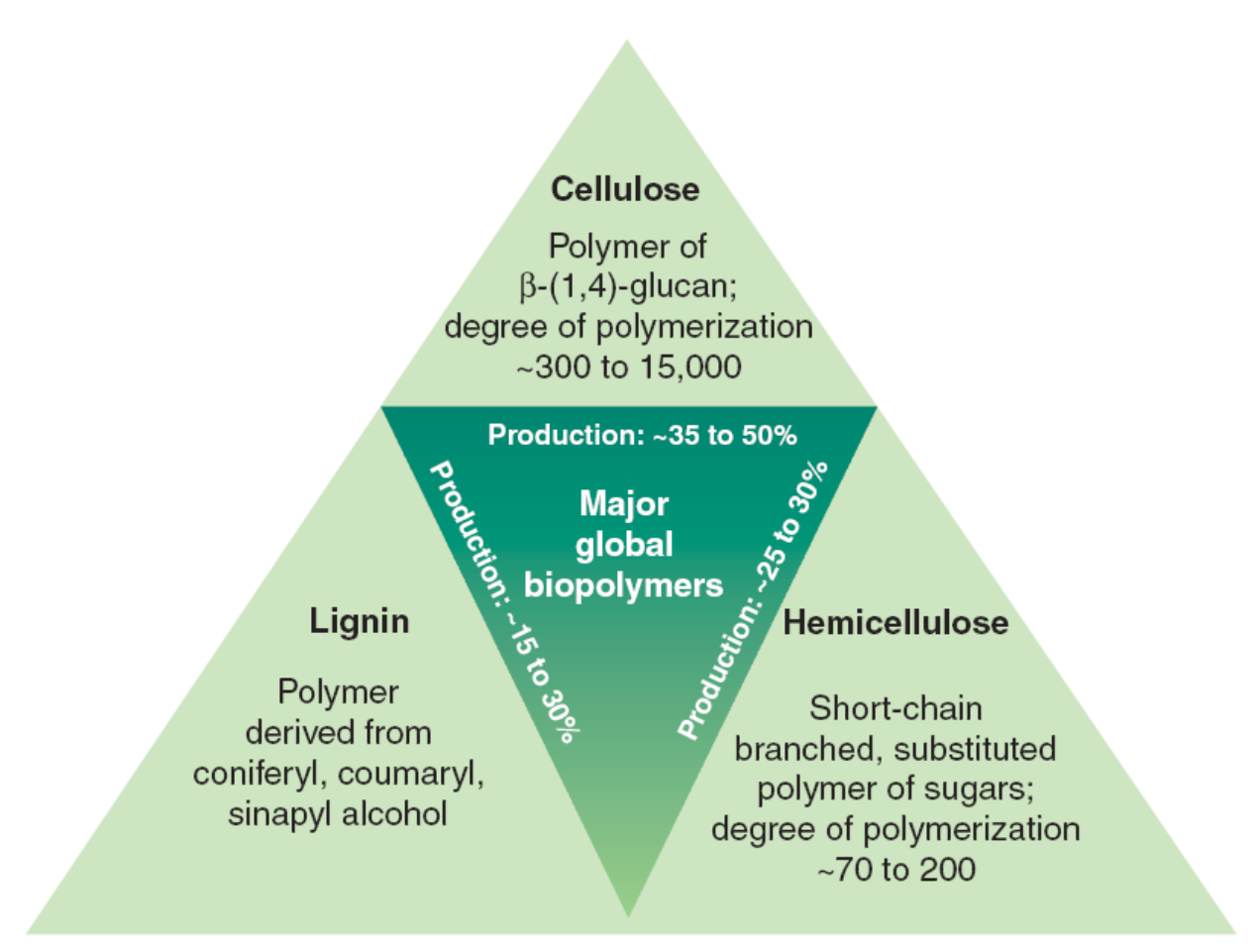
traditional use of some major biopolymers
Cellulose
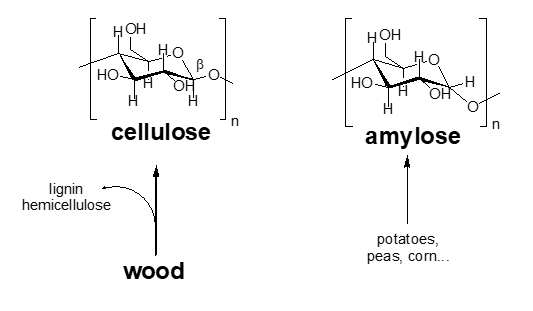
extracted from wood
having hemicellulose and lignin as side products
drawback
very low solubility in common solvents
due to strong h-bonds difficult to break down or chemically modify
only creatures able to digest it are cows or related animals through their microbiome (bacteria living in their gastrointestinal tract)
amylose
extracted form patatoes, corn, peas
only difference from cellulose is configuration of the anomeric carbon
it is water soluble, easily degradable and digested
‘Direct’ conversion of cellulose
(direct refers to the shortened biomass cycle)
90% of cellulose is used to make paper
paper is a biobased biodegradable polymer
can enhance properties by making a composite material eg. with PE increases strength and water resistance but not biodegradable anymore
Viscose process

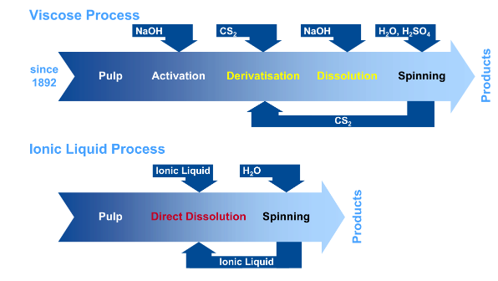
chemical reprecipitation of cellulose
cellulose is treated with NaOH and CS2, the free OH’s attack on CS2 forming anionic charges
if this occured to a certain extent, the charges repel, H-bonds are broken and it becomes soluble
cellulose solution is pumpted through spinneret (a lot of tiny holes)
in acidic medium it will be insoluble and reprecipitate as fine viscose fibers that are collected washed and assembled into clothes
disadvantages: high HSE cost
CS2 highly toxic and flammable
need equiv amount of NaOH, which is harmful and requires a lot of energy to produce
need equiv amount of H2SO4
this all leads to a lot of aqueous waste which is worse than organic solvents becaue organic solvetns can be burned to recover energy
treatment with HNO3 forms nitrate esters formign plastics
treatmetn whith acetic anhydride forms acetyl groups, making it soluble and from which biobased plastics can be made
Alternative solvents for cellulose
NMO = N-methylmorpholin-N-oxide
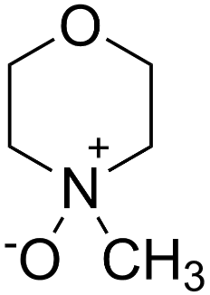
need a strong H-bond acceptor to break the cellulose intramolecular H-bonds
NMO does this with the negatively charged O
so NMO can dissolve cellulose without the need of additional chemical modification
spinning from NMO/cellulose solution into water as a non solvent produces tencel or lyocell
similar yarns to viscose but doesn’t have the disadvantages of the viscose process
NMO can be recovered quite efficiently
but still rather hazardous due to irritating character
ionic liquids as alternative solvents for cellulose
= liquids consisting entirely of ions
most compounds known consisting ions are high metling crystal solids (NaCl)
due to strong attraction between the ions and thus stable crystal packing
Thus need lower attraction between ions, disrupting crystal lattice and leading to lower melting points:
make ions larger
make charge delocalised
include irregular shapes (further disrupts crystal packing)
Some combinations of cations and ions are able to dissolve cellulose such as EMIM (1-ethyl-3-methylimidazolium) or EEIM with acetate
How? acetate with negatively charged oxygen is a better H-bond acceptor than the alcohols in cellulose —> disrupted
Pro’s and cons of ionic liquids
advantages:
designer solvents
practically infinite combinations of cations and anions
can tailor solvent properties for a specific application by combining the right cations and anions
thus you can use solvent to optimize the process = good for sustainability
low volatility (due to strong attraction between cations and anions)
no inhalation (major cause of toxicity of organic solvents)
not flammable (Et2O eg. is so flammable due to its high volatility)
minimizes losses due to evaporation
disadvantages
still rather toxic
difficult to recover and purify
organic solvents can be easily recovered and purified by desitlation (due to low bp) and requires less E
purificaton of ionic liquids requires a lot of E and is complicated
due to high T needed
and E need for high vacuum
—> high cost and not sustainable
purification of ionic liquids
= short path distillation:
a screw is heated in a strong vacuum chamber surrounded by a cooling mantel
the contaminated liquid is injected onto the screw
the ionic liquid vapourizes and quickly condenses onto the wall due to cooling liquid
very short path between hot evaporation surfacse and cold condensor due to low volatility so vapoour does not have to travel far
also reduces time of compounds spent at high T limiting decomposition
the ionic liquid are collected
the less volatile or decomposed impurities stay behind on the screw as impurities
are ionic liquids really ‘green’ solvents?
Contra:
stil rather toxic
LD50 = dose (mg/kg bodyweight) at whcih 50% of the animals on which it is tested on die
lower LD50 is more leathal
some combinations are very leathal
although EMIM OAc which can be used as solvent for cellulose has a higher LD50
Pro
sustainability involves optimization of current chemistry
this is possible with ionic liquids using different ion combinations
cellulose is one of the most abundant biomasses available but insoluble
ionic liquids can solubilize it
can replace viscose process
no toxic CS2, base, acid or aqueous waste
only need ionic liquid
and water is added to dilute the ionic liquid, so the polymer will precipitate again
However to recover ionic liquid, you have to distill excess water which is hard and energy demanding
but this viscose replacement has been scaled up and under research for industrial apllicability

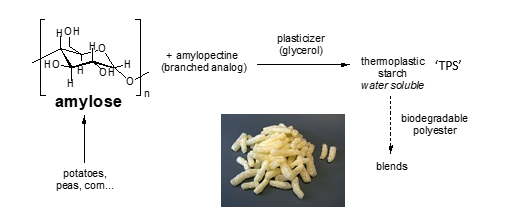
Direct conversion: Use of Amylose
= one of the main components of starch
amylose
linear polymer of glucose
amylopectine
brached amylose variant
not interesting for material chemistry which prefers linear polymers
these are more likely to entangled and these entanglements are the main cause for plastic polymer properties
the mixture is treated with a plasticizer (glycerol)
glycerol inserts between starch chains and disrupts the H-bonds this makes it more processable and turns it into a thermoplastic starch (TPS) which is water soluble
glycerol has high bp so will not evaporate upon mixing with amylopectine
TPS can be blended with biodegradable polyesters to improve properites
applications: biodegradable packaging (cheeto like packaging foam)
Engineered biomass
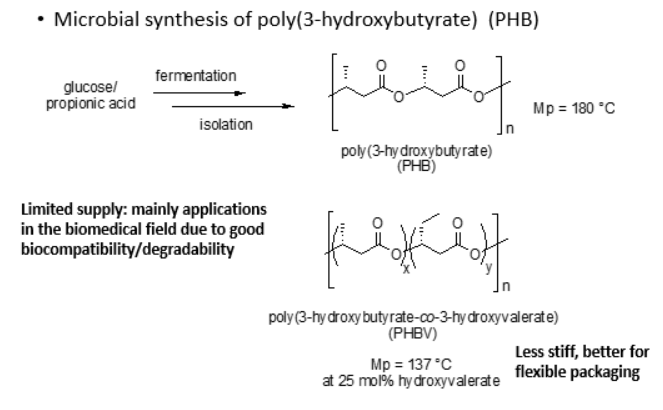
= biomass produced by living organisms like bacteria that have been genetically engineered to increase the yield of the polymer produced
example: PHB
high Tm, biocompatible —> good for flexible materials
could be made better by making it more flexible and decreasing its Tm —> copolymerization
feed the bacteria a second monomer that will be copolymerized
This creates PHBV which is a high value polymer with high cost for high value application:
than be used for surgical threads (that degraded over time)
not for packaging (too expensive)
Synthesis of poly(lactic acid) (PLA)
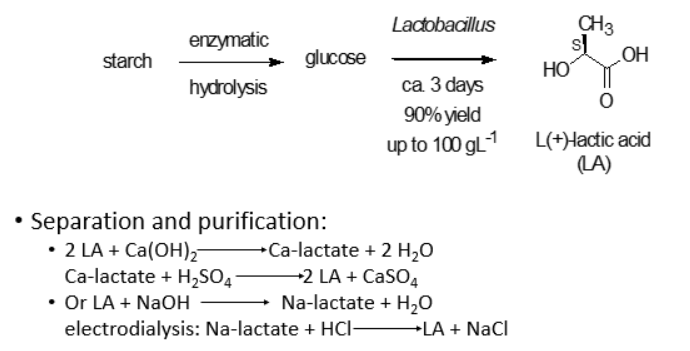
= very common biopolymer, and a polymer of polylactic acid obtained from bacterial fermentation
glucose is obtained from enzymatic hydrolysis of starch which is fed to bacetria (Lactobacillus) and produce enantiomerically pure LA (efficiently 90% yield)
this is important as the polymer composed of pure (S)-LA has much better material properties than form a entionmeric mixture
But
bacetria produce LA in complicated mixture of other fermentation products, which is a difficult and energy intensive separation
Separation:
treatment with Ca(OH)2 producing Ca-lactate, which is liberated by treatment with sulfuric acid
this produces CaSO4, not a useful side product (gypsum)
treatment with NaOH is better productin Na-lactate salt
ca(OH)2 is produced from CaCO3 + heat —> CaO + CO2 / CaO + H2O —> Ca(OH)2
= energy intensive an liberates CO2
NaOH can be obtianed from electrolysis of aqueous NaCl, producing NaOH and Cl2 = both useful products and requires less E
LA is then liberated by electrodialysis +HCl
Polymerization of PLA
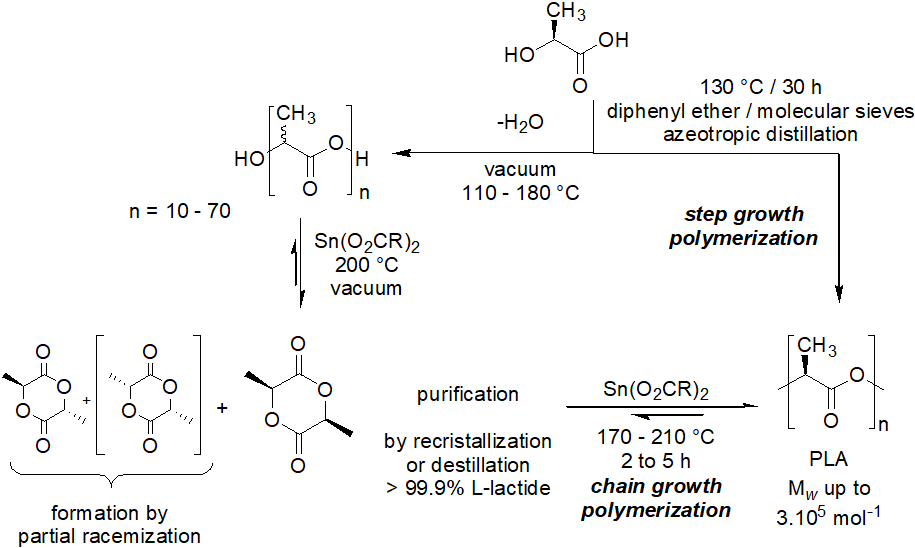
Step growth polymerization:
1 step
requires high T and long reaction time
so a lot of energy
because of high T, need high boiling solvent
use diphenyl ether (not green solvent)
need high T for azeotropic removal of water to shift the equilibirum towards high Mw polymers
without water removal, small polymers with bad material properties
Chain growth polymerization:
mulitple steps
but this approach is still aplied in industry due to higher Mw and less E demand
LA is polymerized by increase of T to short prepolymers
these are cyclised to lactide dimers under Sn catalysis
uses Sn catalyst which is rather toxic and bad for sustainability
it is not removed, so it stays in the polymer material and ends up with the consumer and it is also not recovered
Sn is a lewis acid which can cause epimerization
3 isomers are produced, only need L-lactide so need additional purification step - via recrystallization (much more E- efficient than destilation)
L-lactide is then polyerized with a Sn catalyst to PLA
still high T needed but for shorter time, so much less E needed
higher molecular weight
energy balance PLA vs PE
PLA
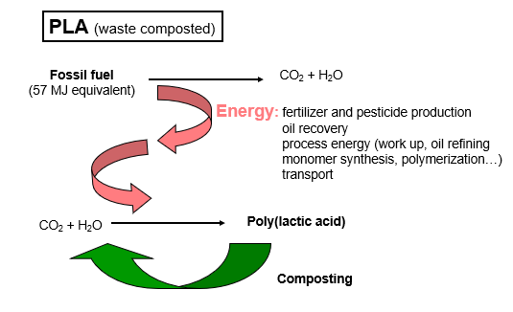
Also requires E from fossile fuels
monomer synthesis, purification, plymerization
transport
insecticedes and fertilizers needed to grow the biomass where we get the starch from
assuming the polymer is fully biodegradable it converts to CO2 and H2O (if it is fully composted)
it cannot be burned to recover internal energy so this is lost
in total 57 MJ equivalents of E
PE
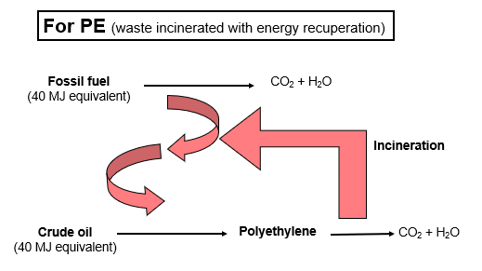
polymer is made from crude oil
40 MJ for production
also uses fossile fuels for the production
40 MJ
polymer can be incinerated to recover internal energy which has ben taken into account
80 MJ in total
more than PLA when ONLY foccusing on E-demand and assuming internal E of PLA is not recovered
BUT MORE DETAILS AER NECESSARY
More detailed analysis
Cradle to gate (mostly done)
consider only the production of the material until the moment it leaves the production plant
Cradle to grave
also consider use and disposal phase
take into behavior of consumer with respect to disposal after use
becomes more difficult
Cradle to Cradle
also consider reuse (plastic bags) of the material and take recycling into account
now really complicated
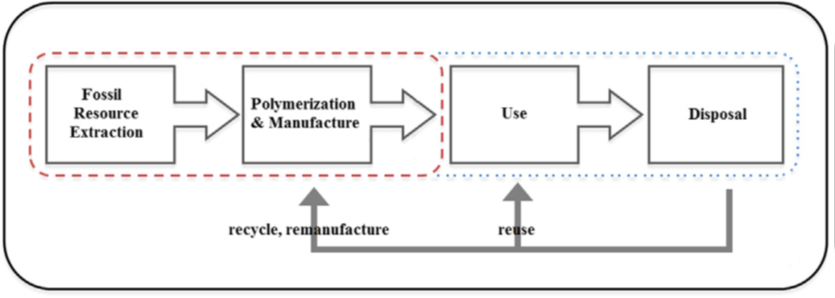
The results of such an analysis will depend on assumption you make that will strongly influence the outcome
—> have to be clear about the assumption you make
is PLA better compared to other plastics
Cannot answer question, more research necessary
main message
how you decide to look at a problem strongly influences the outcome - people will try to convince you their approach is better, and it is our job to decide to that’s true
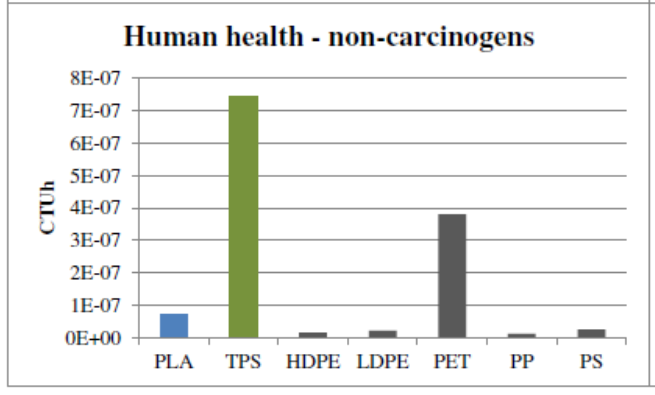
concusionf of graphs
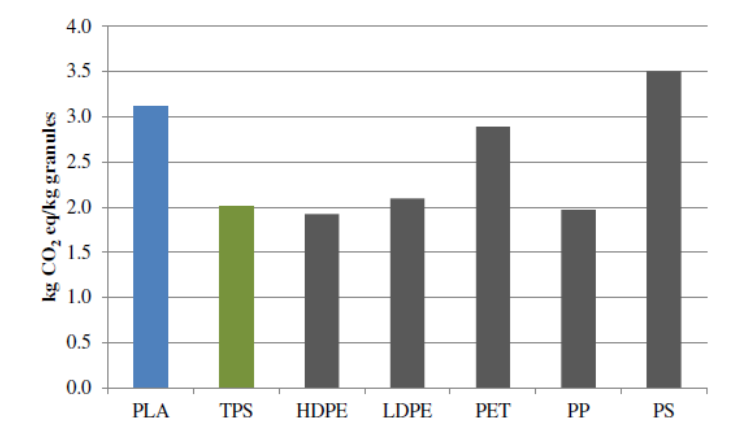
These graphs are the result of cradle to gate analysis
PLA second to worst compared the 5 most common petroleum based plastics in terms of CO2 emission
due to high energy demand
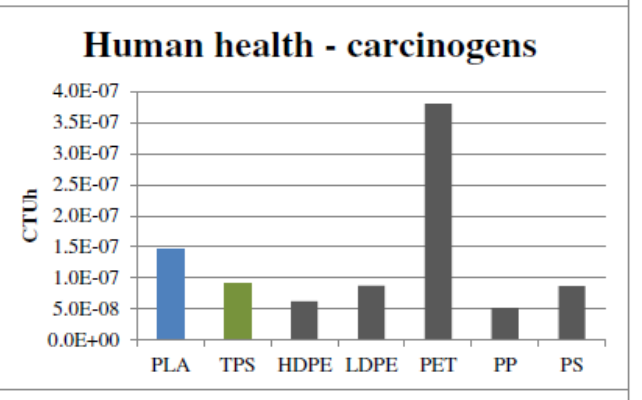
PET carcinogenic
polyethylene part is made from ethylene glycol which is made from oxiranes which are mutagenic
TPS (thermoplastic starch) is bad for human health (not considering carcinogens)
considers environmental impact of the plants grown needed to provide the starch