Measuring Economic Activity
 Call Kai
 Learn
Learn Practice Test
 Spaced Repetition
 Match
Match Flashcards
 Knowt Play
1/25

Earn XP
Name | Mastery | Learn | Test | Matching | Spaced | Call with Kai | Chat |
|---|
No analytics yet
Send a link to your students to track their progress
26 Terms
National Income Statistics
Measured by the GDP or GNP
Value of the final g/s produced by residents of a country in a given time period.
Gross Domestic Product
market value of all final g/s produced using FoP’s in a country over time.
g/s produced by:
Residents and foreigners using FoPs in the country
Gross National Product (GNP)
Total market value of all final g/s produced by the residents of a country, irrespective of whether the FOP’s are located in the country or not, in a given time period.
g/s produced by:
Residents who use FoPs from domestic and foreign countries
GNP formulas
(GNP)
GDP + property/factor income from abroad - property/factor income paid abroad
or
GDP + NET property/ or factor income from abroad
Nominal National Income
Valued at current prices and is not adjusted for inflation.
nominal GDP is market value of all final g/s produced using FoP’s located in country over a year, measured at current prices.
Real National Income
Valued at constant prices and is adjusted for inflation
real GDP is market value of all final g/s produced using FoP’s located in a country over a year, measured at constant base year prices.
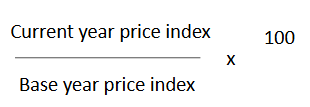
Gross Domestic Product Deflator
measures the current year level of prices relative to the level of prices in the base year:
Gross Domestic Product per capita
measures on the average, how much g/s a person consumes in country in a given year.

Uses of National Income Statistics
Measuring the changes in country’s economic performance.
overtime
percentage change to look for a value in answers/questions

Uses of National Income Statistics
Formulative Government Policies.
overtime
by expenditure approach.
shows the contributions to GDP by different components of country’s expenditure eg. investments and domestic consumptions.
if investment is main contributor to the GDP, country is reliant on csmrs to generate national income. It is a less “open” economy and relies more on national trade for economic growth.
Governments carry out policies to boost domestic consumption
Uses of National Income Statistics
Formulative Government Policies.
overtime
by income approach.
shows contribution to GDP via factor incomes earned by each FoP.
government estimate the amnt of taxes collected from each factor income
helps governments with budgeting; macroeconomic policies.
Uses of National Income Statistics
Formulative Government Policies.
overtime
by output approach.
shows the contribution to GDP via output produced by the primary, secondary and tertiary sectors.
IF any sector is shrinking, this signals a loss in global competitiveness. The govt. may carry out policies to boost sector or to slow down the rate of decline.
IF the govt. shift its competitiveness in another sector, they may carry out policies to increase the quality of goods OR productivity.

Uses of National Income Statistics
Planning production and Investment
overtime
the firm can anticipate if sectors are expanding or contracting over time:
if contracting:
firms adjust production to minimize wastage of resources
if expanding:
overseas; firms increase production to maximize profits
Uses of National Income Statistics
Standard of Living indication
overtime
The real GDP per capita is usually used to measure the material standard of living.
Indicates the actual value of output consumed by one person in the country since the nominal value of the output has been adjusted for inflation.
Limits to using National Income Statistics
Data Collection Inaccuracies
overtime
Low literacy rates
Political corruption
Inaccessible areas for data collection
Improper accounting practices
Limits to using National Income Statistics
Presence of unrecorded activities
overtime
Illegal and undeclared transactions
Transactions where g/s’s themselves are illegal (drugs)
or
TRANSactions that are legal but not declared for tax purposes
eg. “moonlighting”, where people do extra work after normal jobs but don’t declare income for tax purposes.
Limits to using National Income Statistics
Non-market economy
overtime
DIY works or other homebased activities
GDP statistics understate the true level of production in the economy
Limits to using National Income Statistics
Composition of Output
overtime
A country’s GDP may rise, only depending on where the increase in output is, but due to this the SoL may not actually be increasing.
Measuring material SoL is focused on current consumptions of g/s rather than the projected increase in consumption from an increase in investment.
Limits to using National Income Statistics
Negative Externalities
overtime
GDP does not consider the negative externalities from production.
If the increase in real GDP is accompanied by a rise in neg. externalities, SoL may not increase because more hrs. of work are exerted to achieve said higher GDP.
Indv. have less leisure time, leads to deteriorating health
Limits to using National Income Statistics
Leisure Hours
overtime
GDP does NOT consider amnt. of breaktime that is sacrificed to pdce. the final g/s’s.
If the increase in real GDP is accompanied by a fall in leisure hours, the SoL may NOT increase
Evaluation of National Income Statistics:
Differences in non-marketed economic activities and unrecorded activities
overspace
Developing economies
Developing:
low literacy rate
activities are non-monetized
illegal activities are prevalent
leads to understated national incomes
Evaluation of National Income Statistics:
Differences in non-marketed economic activities and unrecorded activities
overspace
Developed economies
high rates of literacy
activities are transacted and more monetized
size of illegal economy is monitored
nation income is more accurate
Limitations of National Income Statistics:
Difference in currencies
overspace
countries could, convert their national income to a common currency through prevailing market exchange rate.
national income is measured in local currencies of different countries, so its hard to draw comparisons in SoL between countries.(there are varing domestic price levels)
limits in market exchange rates:
inconsistent in comparing SoL between countries, when mkt. exchange rates fluctuate all the time.
not accurately reflecting domestic price levels across countries; the national income at current mkt. exchange rates do not reflect the real national income