BKAT ICU Post Test
 Call Kai
 Learn
Learn Practice Test
 Spaced Repetition
 Match
Match Flashcards
 Knowt Play
1/139

There's no tags or description
Looks like no tags are added yet.
Name | Mastery | Learn | Test | Matching | Spaced | Call with Kai | Chat |
|---|
No analytics yet
Send a link to your students to track their progress
140 Terms
Nitroprusside purpose
decreases preload and afterload by vasodilation (mainly afterload)
Dobutamine mechanism of action
contractility
Dopamine at a low-end dose "renal dose"
0.5-4mcg/kg/min
increases renal and mesentric perfusion
Dopamine at a mid-range dose
4-10mcg/kg/min
increases contractility and heart rate
Dopamine at a high-range dose
greater than 10mcg/kg/min
vasoconstriction and increases BP
Dopamine and Levophed infiltration
leads to tissue necrosis
Dopamine antidote
regitine (phentolamine)
TpA monitor for
bleeding-hemorrhagic CVA
diltiazem (cardizem) works by?
(calcium channel blocker) slows ventricular rate by slowing conduction through the SA and AV node
Diltazem (cardizem) biggest effect on which hemodynamic
hypotension
diltazem is used for patients with
a-fib or a-flutter
amiodarone (Cordarone) is a
antiarrythmic
prolongs the cardiac duration
You MUST use a __________ when using amiodarone infusion
0.22 micron filter
Watch out for ____________ in patients on a amiodarone infusion
hypotension, prolongation of QT interval and bradycardia
amiodarone is used for patients with
a-fib, a-flutter and VT
how much amiodarone is given to a stable VT with a pulse and a unstable pulseless VT/VF?
150mg over 10min for VT with pulse
300mg push; repeat x1 at 150mg
Epinephrine has what effect on the body?
increases HR, BP, and contractility
what is the first line drug for pulseless arrest?
Epinephrine
What rhythms are considered fatal?
V-fib, Vtach (pulseless), and asystole
Epinephrine is also given for?
anaphylaxis and as a vasopressor for hypotension
Heparin is used for? Antidote is?
anticoagulant
Protamine Sulfate
What is the osmotic diuretic of choice to decrease intracranial pressure?
mannitol
How does mannitol work?
pulls fluids into intravascular space to be excreted by the kidneys to reduce intracranial pressure
what insulin is given IV?
What is the peak?
Regular insulin can only be given IV
2-4 hr peak time
Which insulin has a peak of 8-14 hrs?
NPH
Atropine is ineffective in which heart rhythms types?
high degree AV blocks: 2nd degree type2 and 3rd degree
Atropine works by?
increasing heart rate-increasing conduction through SA node
Atropine is given to treat?
symptomatic bradycardia
Dilantin is given to treat
seizure disorders
DO NOT give __________ with dilantin because ________ will happen.
DO NOT give with dextrose containing solutions because it will crystalize
Which corticosteroid is usually given in insufficient adrenal activity or hypersensitivity/inflammation reactions?
Cortisone
If chronically using cortisone be sure to _____ to prevent _____.
If chronically using cortisone be sure to taper the medications to prevent acute adrenal insufficiency
This medication is a cardiac glycoside that increases contractility.
Digoxin
Digoxin increases contractility by
slowing the heart rate which decreases conduction through the AV node
What should be monitored in patients taking Digoxin?
hypotension, bradycardia, and symptoms of toxicity
Signs/Symptoms of Digoxin toxicity
nausea, yellow vision/halo, paroxysmal atrial tachycardia (PAT with block).
True/Flase:
Digoxin WILL NOT cause rapid AV conduction or hypertension
True
what medication is a antiarrhythmic that suppresses automaticity and depolarization?
lidocaine
Lidocaine is used to treat?
ventricular dysrhythmias
lidocaine toxicity sign
mental confusion/change in LOC
Monitor serum levels with _________
Lidocaine
DO NOT give _______ medications to patients with suppressed respirations
Narcotics (morphine, dilaudid)
What changes on a EKG would you expect to see on a patient with a acute MI?
ST elevation
normal QRS:
Prolonged QRS indicates:
Distinguishing V-fib
fibrillatory waves with no recognizable pattern
Defib the Vfib
Distinguishing V-Tach
atrial rhythm and rate cannot be identified
"Tombstones"
First degree block interpretation
looks like sinus rhythm but the PR is longer than normal. there will be 1 p for every qrs, but the PR interval will be greater than 0.20 sec
Type 1 second degree block interpretation
"Wenckebach"
"Longer, Longer... drop" prolonged PR intervals and the missing QRS
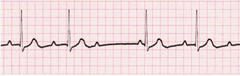
Type 2 second degree block interpretation
PR interval is constant...QRS is missing
"2 small p waves right after each other"
give atropine, dopamine, or epi to increase HR is symptomatic bradycardic
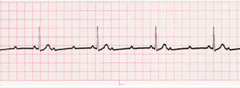
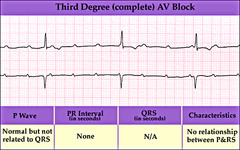
Third degree AV block interpretation
a strip of p-waves laid independently over a strip of QRS complexes. Note that the p wave doesn't conduct the QRS complex that follows it.
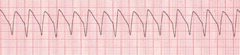
A-flutter interpretation
abnormal p-waves that produce a saw-tooth appearance

Failure to Capture interpreation
spike without a complex
Failure to Pace interpretation
no pacemaker activity or spike at the set rate on an ECG. usually caused by battery or circuit failure, cracked or broken pacing leads, loose connections, oversensing, or the pacing output is too low--->can lead to asystole
Failure to Sense
undersensing: giving help when not needed; spikes occur on the ECG where they shouldnt
Pacemaker ECG rhythms
failure to capture: spike without a p wave or QRS complex following it
failure to pace: no spike on ECG at the rate set
failure to sense:
spike when intrinsic activity already present (undersensing)
no spike when patient needs it
(oversensing)
Which ventricular stimulus is dangerous
R on T phenomenon
Indications for a pacemaker?
symptomatic bradycardia
higher AV blocks (2nd degree type 2 or Complete)
what is not a treatment for higher degree AV blocks
atropine
because of the impaired conduction through the AV node
A-flutter happens because?
an irritable spot of the atrium fires rapidly
A-flutter can cause _______
an increase in ventricular rate
A-flutter is treated by:
antiarrhythmics (cardizem, beta blockers)
cardioversion
What do you do if you notice a lethal rhythm on the monitor (VT/VF)?
check the patient first
-establish unresponsiveness
call for help
-begin CPR if needed
When defibrillating VT/VF use _____ joules for biphasic defibrillator or _____ joules for monophasic.
200
360
Normal PR interval is
0.12-0.20 seconds
Patient presents with anginal pectoris. what is initial management?
allow rest, amdinister oxygen, nitroglycerin, etc.
Causes of elevated cardiac enzymes
MI, pericarditis, closed chest trauma, cardiac surgery
Goal of treatment for cardiogenic shock (any shock)
increase the patient's cardiac output
A patient exhibits depression after their recent MI, you should
encourage the patient to verbalize their concerns and allow interaction with family
How does a cardiac tamponade occur
blood or fluid accumulates in the pericardial space
what does a cardiac tamponade do to the heart
prevents the heart to pump effectively (impaired ventricular filling and contraction)
S/S of cardiac tamponade
pulsus paradoxus, decreased BP, JVD, tachycardia, muffled heart sounds
PAP values
Systolic: 15-25
Diastolic: 8-18
PAOP (wedge)
6-12
PA Catheter waveforms
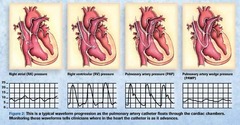
PAOP (wedge) reflects pressures in the
left ventricle
An elevated PAOP may indicate
left ventricular failure
If you notice a continual PAOP wave form is present you should
ensure the balloon is deflated, reposition the patient and try have the patient cough
You should not do what to PA catheter if a continual wedge pressure is present
Flush the line
What reading reflects the right atrium
CVP
An elevated CVP may indicate
fluid overload, right ventricular failure, pulmonary HTN, cardiac tamponade
Eventually ______ sided heart failure will lead to an elevated _______.
right sided HF will eventually lead to increased CVP
decreased CVP can be from
hypovolemia
True/False
Medication can be administered through an a-line
False: no medications are to be given via a-line
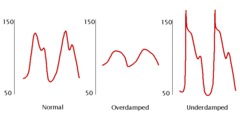
Arterial line waveform:
-Overdampened
-Underdampened
-dicrotic notch on the downslope
-overdampened: air bubbles, blood clots, kinked tubing, loose connections
-underdampened:excessive tubing length or too many stopcocks
How long should pressure be held when removing an a-line
5-10 minutes
Why would a ventilators high pressure alarm be sounding
increased secretions or mucus plugs
patient biting on the tube
coughing or trying to talk
pulmonary edema
*anything that would cause decreased airway compliance
Why would a ventilators low pressure alarm be sounding
not enough air moving through the ventilator circuit
*most commonly due to disconnection of tubing
You have a patient that just received thoracic surgery.
-You should observe/assess for?
-how much is considered excess drainage output for this patient post op
-how do you know it is working properly
-you should never.....
-assess for air leaks, chest tube drainage quality, breath sounds
-anything greater than 150ml/hr is excessive drainage
-the water seal chamber should fluctuate with respiration, but there should not be bubbles
-never raise the chest tube drainage system above the level of the chest
in a chest tube what breath sound would indicate atelectasis
diminished
After a patient is intubated you should?
get an x-ray to confirm placement and confirmed by a physician
RN should listen for bilateral breath sounds
When caring for patients with ETT or trach always assess
placement and cuff function
Your patient with an ETT is making audible sounds (or can be a trach without a passy-mauir valve) it is most likely related to....
the cuff is deflated which allows air to pass through the vocal cords
In a patient with any kind of chest trauma ALWAYS assess for symptoms of
pneumothorax
impaired gas exchange, SOB
S/s of tension pneumothorax
deviated trachea, acute respiratory distress
trauma patients are at risk for developing _____ embolisms, especially those with long bone fractures.
fat
S/s of fat embolus
may develop after surgery
SOB, tachycardia, petechiae over upper body
Your patient has diminished breath sounds and you notice limited movement of their chest. This can indicate possible atelectasis due to ____________
hypoventilation
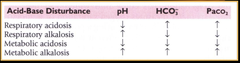
ABG Interpretation
pH: 7.35-7.45
PaCO2: 35-45
HCO3: 22-26
(ROME)
What antibiotics are given to TB patients
INH, Rifampin, Rocephin
What antibiotics should be renal-dosed
Vancomycin, gentamycin, and tobramycin