bio 202 unit 2
 Call Kai
 Learn
Learn Practice Test
 Spaced Repetition
 Match
Match Flashcards
 Knowt Play
1/12

There's no tags or description
Looks like no tags are added yet.
Name | Mastery | Learn | Test | Matching | Spaced | Call with Kai | Chat |
|---|
No analytics yet
Send a link to your students to track their progress
13 Terms
the cytoskeleton
a network of fibers extending throughout the cytoplasm
it organizes the cell’s structures and activities, anchoring many organelles
it is composed of 3 types of molecular strucutres
microtubules
microfilaments
intermediate filaments
provides structrual support to the cell, allows cells to maintain shape
it interacts with motor proteings to produce cell motility
intracellular transport: inside the cell, vesicles and other organelles can use motor proteins to travel along track
microtubules
are the thickest of the 3 components of the cytoskeleton
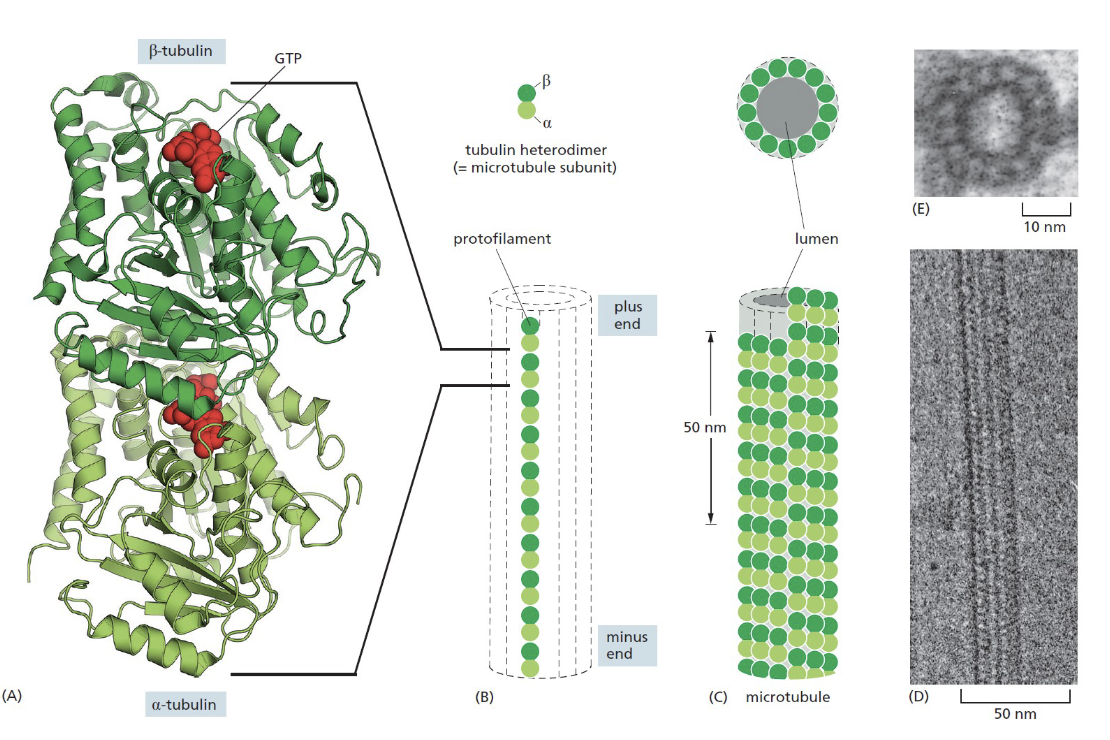
are hollow, tube-shaped rods made from tubulin proteins
each tubulin unit is a dimer composed of one α-tubulin and
one β-tubulin polypeptide.α- and β-tubulin units create a strong cylindrical structure
tubulin dimers assemble together to form the wall of the microtubule
about 25 nm in diameter and about 200 nm to 25 microns long
are constructed of dimers of tubulin
functions:
shaping the cell
guiding movement of organelles
separating chromosomes during cell division
resist compression
microfilaments
also called actin filaments, are the thinnest component
solid rods about 7 nm in diameter, built as a twist double chain of actin subunits
a network helps support the cell’s shape
they form a cortex just inside the plasma membrane to help support the cell’s shape
bundles make up the core of microvilli of intestinal cells
ones that function in cellular motility contain the protein myosin in addition to actin
cells move along the surface by extending pseudopodia (cellular extensions) and moving toward them
cytoplasmic streaming (in plant cells) is a circular flow of cytoplasm within cells, driven by actin-myosin interactions
intermediate filaments
built from fibrous proteins rather than globular ones
range in diameter from 8 to 12 nm, larger than microfilaments bu smaller than microtubules
they support cell shape and fix organelles in place
are more permanent cytoskeleton fixtures than the other 2 classes
the nuclear lamina is made up of these filaments
gives the nucleus strength, stability, and elasticity to withstand mechanical stress
microtubules and microfilaments built from globular protein
centrosomes and centrioles
in animal cells, microtubules grow out from a centrosome near the nucleus
the centrosome has a pair of centrioles, each with nine triplets of microtubules arranged in a ring
other eukaryotic cells many organize micro-tubules in the absence of centrosomes
plants do not have centrioles
cilia and flagella
microtubules control the beating of flagella and cilia, microtubule-containing extensions that project from some cells
many unicellular protists are propelled through water by cilia or flagella
motile cilia are found in large numbers on a cell surface, whereas flagella are limited to one or a few per cell
structure of cilia and flagella
contain a core of microtubules arranged in a 9 + 2 pattern: nine outer microtubule doublets surround 2 central microtubules
radial spokes and cross-linking proteins help organize/stabilize microtubules
dynein is the motor protein
uses ATP to generate sliding between neighboring microtubule doublets, which is converted into the bending motion of cilia and flagella
cell junctions
neighboring cells in tissues, organs, or organ systems often adhere, interact, and communicate through direct physical contact
cell junctions in animal cells
3 types of cell junctions are common in epithelial tissues
tight junctions: membranes of neighboring cells are pressed together, preventing leakage of extracellular fluid
desmosomes (anchoring junctions) fasten cells together into strong sheets
gap junctions (communicating junctions) provide cytoplasmic channels between adjacent cells
tight junctions in animal cells
membranes of neighboring cells are pressed together, preventing leakage of extracellular fluid
seal neighboring cells together and are connected to actin filaments
desmosomes (anchoring junctions) in animal cells
fasten cells together into strong sheets
strong anchoring junctions that connect cells to intermediate filaments
gap junctions (communicating junctions) in animal cells
provide cytoplasmic channels between adjacent cells
protein channels that connect neighboring cells; allow passage of ions between adjacent cells
plasmodesmata in plant cells
channels connecting adjacent plant cells that pass through the cell wall and create direct connections between neighboring cells
allow water, ions, sugars, signaling molecules, and some proteins/RNAs to move from one cell to another without crossing the plasma membrane each time
help coordinate cell-to-cell communication and transport, allowing groups of plant cells to function as an interconnected system
the endoplasmic reticulum extends through the plasmodesma as a narrow central tube called the desmotubule, creating continuity between the ER of adjacent plant cells