Unit 1 Psychology
 Call Kai
 Learn
Learn Practice Test
 Spaced Repetition
 Match
Match Flashcards
 Knowt Play
1/29

Earn XP
Description and Tags
3.7 3.8 3.9
Name | Mastery | Learn | Test | Matching | Spaced | Call with Kai | Chat |
|---|
No analytics yet
Send a link to your students to track their progress
30 Terms
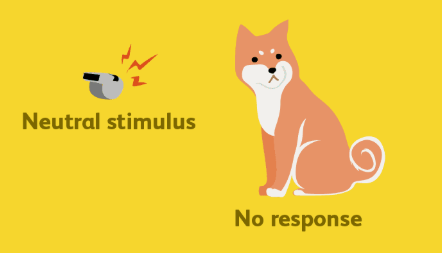
Neutral stimulus
A stimulus that initially does not elicit any specific response but can become associated with an unconditioned stimulus to produce a conditioned response.
Ex: Whistle, does not affect the dog

Unconditioned stimulus
A stimulus that naturally and automatically triggers a response without any prior learning/conditioning
Ex: Dog food, naturally causes a response from the dog

Unconditioned response
A natural response to an unconditioned stimulus
Ex: Drooling, to the presence of dog food
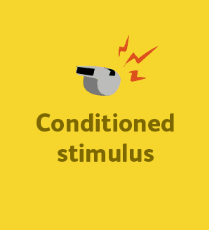
Conditioned stimulus
An originally neutral stimulus that, after association with an unconditioned stimulus, comes to trigger a conditioned response
Ex: A whistle, which the dog has been trained to signal as food

Conditioned response
A learned reaction to a cue that previously meant nothing, created by pairing it repeatedly with a natural stimulus.
Ex: Drooling, after paring the whistle with the dog food repeatedly
Acquisition
Initial stage when the learner links a neutral stimulus and an unconditioned stimulus
Ex: The acquisition phase is the time when the dog learns to connect the sound to the food and begins to salivate at the sound alone
Stimulus Generalization
The tendency for a conditioned or learned behavior to occur in the presence of new, similar stimuli that were not part of the original training
Ex: Different whistle, similar response from the dog
Stimulus discrimination
The learned ability to distinguish between a stimulus the indicates a response and similar stimuli that do not signal the coming of a response
Ex: Different whistle but no response, only with the same whistle repeatably paired with the dog food
Extinction
A learned behavior gradually stops when it no longer gets a reward or a matching trigger
Ex: No more food when whistle is blown
Ivan Pavlov
This psychologist is known for his experiment on dogs that introduced the principles of classical conditioning
John B Watson
This psychologist is known for the Little Albert Experiment
Spontaneous recovery
The reappearance, after a pause, of a previously extinguished conditioned response
Ex: Drooling again, after some time to the dog food
High order conditioning
A classical conditioning process where a previously established conditioned stimulus is paired with a new neutral stimulus, causing the new stimulus to trigger the conditioned response without ever being paired with the original unconditioned stimulus
Ex: After repeating the whistle-and-bell routine, your dog starts to salivate when it hears the whistle alone, even though the bell was never paired with food.
B. F skinner
He developed the famous behavioral technology known as skinner box, it manipulates to obtain a reinforcement (treat)
Associative learning
A psychological process where an organism learns to connect two distinct stimuli or an action and its consequence
Positive reinforcement
You add a pleasant or desirable stimulus after a behavior to make that behavior more likely to happen again
Ex: TV, attention, candy, treat
Negative reinforcement
Strengthens a behavior by removing or avoiding an unpleasant stimulus
Ex: The beeping sound is removed when you put on the seat belt
Positive Punishment
Adds an unpleasant consequence to decrease the chance of an unwanted behavior happening again
Ex: Parents scream at you, a parking ticket
Negative punishment
The likelihood of an unwanted behavior by removing a desirable or preferred stimulus
Ex: Time out from privileges such as TV, or revoked driver license, playtime
Operant conditioning
A type of learning where voluntary behavior is shaped by its consequences, such as reinforcements or punishments
Fixed Ratio
Reinforces a response only after a specified number of responses (you can predict when you receive the reward)
Fixed interval
Reinforces a response only after a specified time has elapsed. So you know your reward and the reinforcement. For example you have to run 10 min but you have to run not walk but you decide to run slowly.
Variable ratio
Reinforces a response after an unpredictable number of responses (cannot predict when you get the reward)
Variable interval
Reinforces a response at unpredictable time intervals. For example you have to run until someone says stop so the number is unknown you decide to run slow.
Intrinsic motivation
The drive to do an activity for its own inherent satisfaction and enjoyment rather than for any separable external reward or pressure
Extrinsic motivation
Behavior driven by external rewards, such as money, grades, praise, or the avoidance of punishment
Cognitive mapping
An internal mental representation that helps an individual acquire, store, retrieve, and decode information about the relative locations, attributes, and spatial layout of their environment
Latent learning
Knowledge that a person or animal stores without trying or receiving a reward, but does not show until they have a reason or incentive to use it
Insight learning
the sudden, clear realization of a solution to a problem without relying on trial and error
Observational learning
The process of acquiring new behaviors, skills, and attitudes by watching someone else, called a "model," rather than through direct experience or trial and error