Genetic Analysis & Recombinant DNA Technology: Key Concepts and Applications
 Call Kai
 Learn
Learn Practice Test
 Spaced Repetition
 Match
Match Flashcards
 Knowt Play
1/25

There's no tags or description
Looks like no tags are added yet.
Name | Mastery | Learn | Test | Matching | Spaced | Call with Kai | Chat |
|---|
No analytics yet
Send a link to your students to track their progress
26 Terms
What is recombinant DNA technology?
Deliberately removing genetic material from one organism and combining it with that of a different organism.
What is the role of restriction endonucleases?
They cut DNA at specific sequences, producing restriction fragments.
What are restriction fragment length polymorphisms (RFLPs)?
Differences in the cutting pattern of specific restriction endonucleases that produce fragments of differing lengths.
What is the purpose of gene probes?
To detect specific nucleotide sequences in unknown samples for the diagnosis of pathogens.
What is the CRISPR-Cas9 system used for?
To precisely edit genes in any organism by cutting DNA at specific locations.
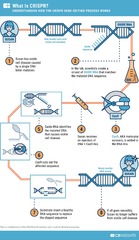
What is the significance of the 2020 Nobel Prize in Chemistry?
Awarded to Dr. Jennifer Doudna and Dr. Emmanuelle Charpentier for developing the CRISPR-Cas9 gene editing system.
What is the function of polymerase chain reaction (PCR)?
To rapidly increase the amount of DNA in a sample without complex purification techniques.

What are the three main steps of PCR?
Denaturation, Priming, and Extension.
What is complementary DNA (cDNA)?
DNA synthesized from RNA using reverse transcriptase, lacking introns.
What is the role of ligase in recombinant DNA technology?
To seal sticky ends of DNA fragments together, rejoining phosphate-sugar bonds.
What are plasmids?
Small, well-characterized DNA molecules used as vectors to transfer genetic material into host cells.

What is a desirable feature of a microbial cloning host?
Rapid turnover and fast growth rate.
What is gene therapy?
Repair or correction of a faulty gene to cure diseases.
What is somatic cell gene therapy?
A type of gene therapy where changes are permanent for the individual but not heritable.
What is germline therapy?
Gene therapy that introduces changes into an egg, sperm, or early embryo, making them heritable.
What is the function of reverse transcriptase?
To convert RNA into DNA.
What is the purpose of electrophoresis in genetic analysis?
To separate DNA fragments based on size using an electrical gradient.
What is the significance of annealing in DNA processes?
It refers to the re-connection of DNA strands after they have been heat-denatured.
What are the applications of CRISPR technology?
Repairing genetic mutations and potentially transferring fixes to future generations.
What are diagnostic probes used for?
To isolate DNA from samples and hybridize with specific sequences for pathogen detection.
What is the first engineered protein approved for human use?
Human insulin.
What is the role of gene cloning?
To create genetic clones by excising and inserting genes into vectors.

What is the significance of antibiotic resistance markers in plasmids?
They allow for the selection of successfully transformed host cells.
What is the importance of the origin of replication (ORI) in cloning vectors?
It ensures that the vector DNA is replicated in the cloning host.
What is the main application of the CRISPR-Cas9 system?
To cut foreign DNA in various organisms at precise locations.
What is the main benefit of gene therapy?
It offers a potential permanent cure for genetic diseases by repairing defects.