Numbers
 Call Kai
 Learn
Learn Practice Test
 Spaced Repetition
 Match
Match Flashcards
 Knowt Play
1/40

There's no tags or description
Looks like no tags are added yet.
Name | Mastery | Learn | Test | Matching | Spaced | Call with Kai | Chat |
|---|
No analytics yet
Send a link to your students to track their progress
41 Terms
Latency of pursuit system
100 msec (+ 5 msec)
What is the typical range for closed-loop pursuit gain in a normal system? What does this indicate?
0.90 to 0.95 - high degree of accuracy for target velocities up to 30-40o/sec
At what point does eye velocity saturation typically occur during pursuit?
after 100o/sec
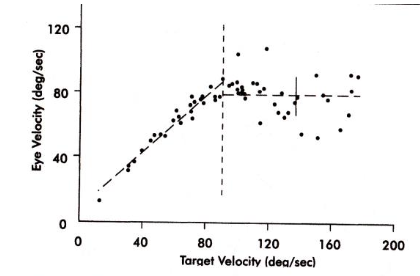
At what threshold does retinal-image motion typically reduce the effective resolution of a target?
when there is a sustained retinal velocity error of >3o/sec
What is the typical limit for presaccadic pursuit acceleration?
50o/sec2 (this is somewhat dependent on target velocity)
By how much does closed-loop gain decrease with age?
25%
By how much is the Initial Acceleration of pursuit reduced with age?
30%
By how much does visual info processing time increase with age per year?
1 msec/year
The eye can faithfully tracks upto ______ before the gain reduces.
The eye can faithfully tracks upto 1 Hz before the gain reduces.
Researchers found the training or learning was best when a
smoothly movable target had a frequency and amplitude of …
Freq = 0.3 Hz
Amplitude = 5o
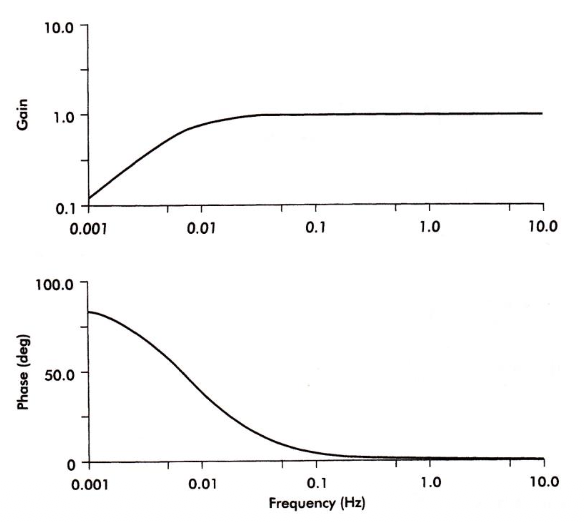
For the frequency range of most natural head rotations (0.5 to 5.0 Hz), what is the gain and phase shift?
GAIN = 1.0
PHASE shift = 0o
What is the latency of the translational vestibulo-ocular response (TVOR)?
35 msec (total latency)
What is the VOR gain and phase difference for head rotation frequencies ranging from 0.5 to 5.0 Hz?
VOR gain = 1.0
Phase difference = 180o
How does the VOR gain and phase difference change for head rotation for low frequencies (0.01 Hz)?
VOR gain = ↓
Phase difference = ↑
What is the typical VOR gain and phase during normal activities?
Gain = close to 1.0 with minimal phase changes
What is the VOR latency?
16 msec
What is the VOR time constant in adults?
10 secs
What is the VOR time constant in infants?
6 seconds (less precise ocular compensation for head movements in infancy)
What is the magnification factor of (-) vs (+) lens?
(-) lenses = 0.66
(+) lenses = 1.33
What is the rotational magnification factor?
2.5% / D
How long did it take to adapt after spectacles (minus/plus) were removed
30 mins
What is the latency of the OKN response?
140 msec (starts later than the VOR to prevent retinal image degredation)
What is the gain for torsional OKN?
0.03
By how much is Nasalward OKN gain greater than temporal?
by 0.05
By how much is scotopic OKN gain less than photopic?
by 0.1
When does asymmetric OKN found in newborns (reduced motor response
for N → T motion) found to decrease by? When does it reach adultlike levels?
Decrease by 2-3 months, adult-like levels by 6 months
By how much does OKN maximal velocity decreases with age?
1 deg/sec per year
What is the OKAN time constant?
~5 to 50 sec
When is the OKN response fully developed by?
6 months
What is the latency for a Retinal blur stimuli?
200 msec
What is the latency for a Retinal disparity stimuli?
80-160 msec
What is the latency for vergence (Convergence/Divergence)?
160 msec (2x fast as accomodation)
What is the time constant of vergence movements?
150–200 msec
What are the approximate maximum and slow velocities of vergence movements?
Maximum velocity: ~21°/second
Slow velocity: ~10°/second (slower than maximum velocity)
What is the latency for a Saccade?
160-200 msec
What is the mean velocity for saccades?
300o/sec
What is the maximum velocity for saccades?
1000o/sec
What is the latency for Smooth Pursuit?
100 msec
What is the normal AC/A ratio range?
3-5
What is the normal CA/C ratio range?
0.1-0.15
What percent of the general population vs specialized population has Strabismus?
General = 5%
Specialized (cerebral palsy, neuromuscular disorders) = 55%