Histology 1 identify
 Call Kai
 Learn
Learn Practice Test
 Spaced Repetition
 Match
Match Flashcards
 Knowt Play
1/148

There's no tags or description
Looks like no tags are added yet.
Name | Mastery | Learn | Test | Matching | Spaced | Call with Kai | Chat |
|---|
No analytics yet
Send a link to your students to track their progress
149 Terms

What is this
Integral protein
Components of cell
Cytosol Organelles Deposits Cytoskeleton (CODC) (Components Of Da Cytoplasm)
The cytosol takes up what percentage of overall cell volume?
55%
The cytosol consists of what?
75-90% water
Large organic molecules (proteins, carbohydrates, and lipids) (suspended by electrical charges)
Small organic molecules (simple sugars and ions) (dissolved)
Inclusions (large aggregates of one material) (lipid droplets and glycogen granules)
What is the function of the cytosol
The site of production of ATP, synthesis of building blocks
What are ribosomes composed of, and what is their purpose?
Composed of rRNA, they can be free or attached, and their purpose is protein synthesis
Rough ER function
Has attached polyribosomes that synthesize and process proteins for export
Smooth ER function
Synthesizes phospholipids, steroids, fats, detoxifies harmful substances and stores calcium
Golgi complex function
Processes and packages proteins produced by rough ER
Mitochondria function
Generates ATP. Has an outer and inner membrane. Also has matric which is the site of DNA and RNA
Lysosomes function
Primary and secondary. Digest foreign substances and digest intracellular contents and recycles own organelles.
Centrosome function
Found near nucleus. Formation site for mitotic spindle and microtubules. Consists of 2 centrioles 90 degrees to each other. Each centriole has 9 clusters of 3 microtubules
Cytoskeleton
Cell support and shape, gives cell movement. Consists of actin filaments, intermediate filaments and microtubules
Nuclear envelope
Pores and double membrane
Nucleolus
Produces and organizes ribosomal subunits and exports them to cytoplasm
Nucleus
Houses genetic material which directs and regulates cellular activities and structures
Chromatin
Non-dividing nuclei; different degrees of uncoiling
Heterochromatin
(dark) type of chromatin, has less DNA SA
Euchromatin
(light) type of chromatin that has abundant DNA SA for transcription to occur
Chromosomes
Helical DNA wraps twice around 8 histone proteins to form a bead, and linker DNA holds beads together. Chromatin fiber folds again and again to form sister chromatids if cell is dividing

What is this?
Euchromatin
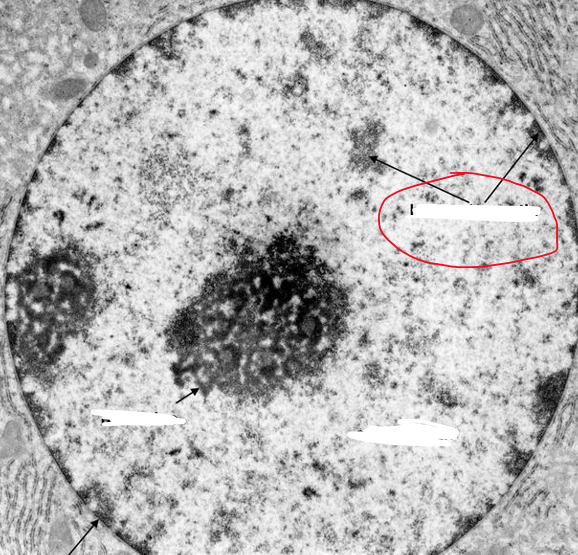
What is this?
Heterochromatin

What is this?
Nucleolus
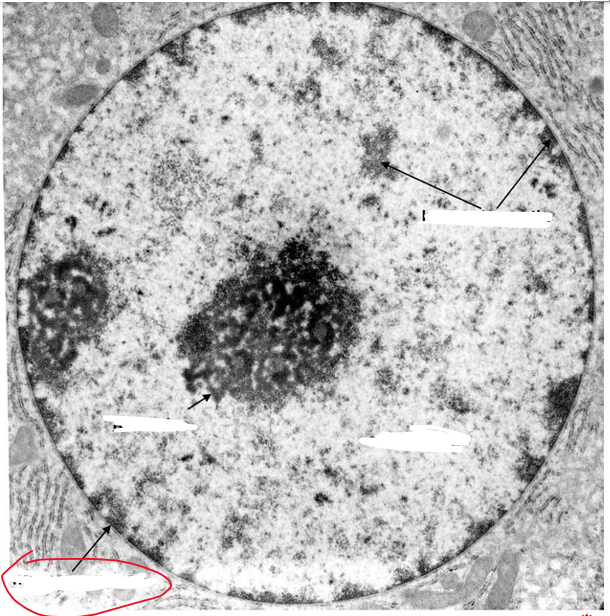
What is this?
Nuclear envelope
Mitosis Phases
Prophase, Metaphase, Anaphase, Telophase, Cytokinesis
Interphase
The cell grows, performs routine life processes, and prepares to divide
Prophase
Chromosomes are visible, nuclear membrane breaks down, spindle fibers begin to form
Metaphase
Sister chromatids line up at center of cell
Anaphase
Sister chromatids are pulled apart and move to opposite poles of the cell
Telophase
Spindle fibers breakdown, nuclear membrane forms, and chromosomes begin to uncoil and form chromatin
Cytokinesis
Cytoplasm splits in two and the cell divides
Epithelial Tissue
Covers surfaces. Lines hollow organs, cavities and ducts.
Connective Tissue
Material found between cells, supports and binds structures together, stores energy as fat, provides immunity to disease
Epithelial cells can form ___ or ___
glands that secrete or sheets
For epithelial cells, the base sits on ___
Basement membrane (faces connective tissue)
The upper surface for epithelial cells is called the ____
apical surface
Are epithelial cells vascular or avascular
Avascular
How do epithelial cells receive nutrients?
Diffusion from underlying connective tissue
Main functions of epithelial tissue
Cover, line, protect surfaces, absorption, secretion
Basal surface sits on ___
Basal lamina
What attaches basal lamina and epithelium to underlying connective tissue?
Type IV collagen fibers
Reticular lamina
deep to basal lamina and superficial to connective tissue. Secreted by connective tissue cells and consists of reticular fibers
The basement membrane is made up of ___
Basal lamina and reticular lamina
Microvilli
Part of cell membrane, increases SA, and looks like a brush border
Stereocillia
Part of cell membane, increases SA, longer than microvilli, branched clumps, only found in men in epididymis
Cilia
Long, larger than microvilli, motile and non-motile types, 9 pairs of microtubules surrounding 2 central microtubules
Zonula Occludens
Tight junction
Zonula Adherens
Adherens Junction
Macula Adherens
Desmosome
Hemidesmosome
Integrins
Nexus
Gap junctions
Tight junction functions
Seals adjacent cells to one another, controlling passage of molecules between them; separates apical and basolateral membrane domains
Adherens junction functions
Provides points linking the cytoskeletons of adjacent cells; strengthens and stabilizes nearby tight junctions

Whats this?
Peripheral protein

Whats this?
Glycolipid

Whats this?
Glycocalyx

Whats this?
Glycoprotein
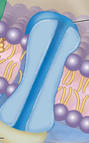
Whats this?
Integral protein

What’s this?
Epithelium

Whats the orange
Basal lamina
Whats the yellow
Reticular lamina

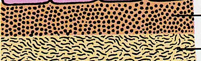
What do both of these make up
Basement membrane

What’s on the apical surface?
Microvilli
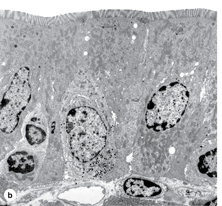
What’s on the apical surface?
Microvilli

What is this?
Microvilli
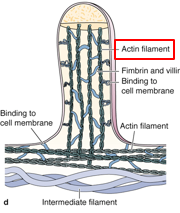
What is this?
Microvilli
Microvilli purpose
Increase SA
What can microvilli on the top?
glycocalyx
Microvilli are a part of what?
Cell membrane

Whats this
Stereocilia
Stereocilia are a part of what
Cell membrane
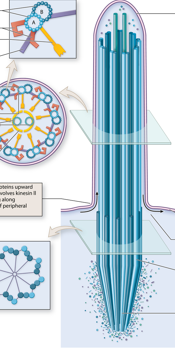
Whats this
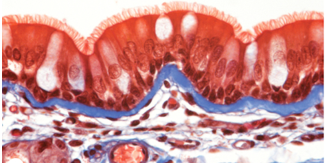
Whats on the apical surface
Cilia

What does the red represent
Zonula Adherens (Adherens junction)

What does the red represent
Macula Adherens (desmosome)

Whats the red represent
Nexus (gap junctions)

Whats the red
Hemidesmosome (anchoring junction)

Whats the red
Zonula Occludens (tight junction)

Whats this
Gap junction (nexus)
Epithelia Define
Specialized layers that may COVER or LINE the INTERNAL SRUCTURES or the EXTERNAL SURFACE of the body
What tissue does this consist of? Epidermis of skin
Epithelia
What tissue does this consist of? Lining of blood vessels and ducts
Epithelia
What tissue does this consist of? lining respiratory, reproductive, urinary and GI tract
Epithelia
What tissue does this consist of? thyroid, adrenal and sweat glands
epithelia
Epithelium functions
Transcellular transport - diffusion, protein mediated transport, vesicle mediated transport
Absorption
Secretion
Selective permeability
Protection (skin)
Pseudostratified epithelium
Single layer of cells where all cells don’t reach apical surface. Nuclei found at different levels
____ is the indicator of cell shape and layering
Cell nucleus

What type of epithelial cell
squamous

What type of epithelial cell
Cuboidal

Identify
Simple squamous epithelium

Identify
Simple Squamous epithelium

Identify
Simple squamous epithelium
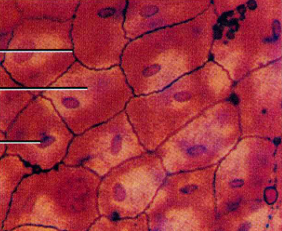
ID
Simple squamous epithelium
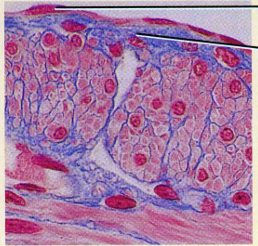
ID
Simple squamous epithelium

ID
Simple cuboidal

ID
Simple cuboidal

ID
Simple cuboidal

ID
Simple Cuboidal
Simple cuboidal epithelium function
Absorption or secretion
Simple squamous epithelium function
Diffusion, allows transport of gases or fluids