Biochem 2: A oxygen
 Studied by 0 people
 Call with Kai
 Learn
Learn Practice Test
 Spaced Repetition
 Match
Match Flashcards
 Knowt Play
1/63

There's no tags or description
Looks like no tags are added yet.
Name | Mastery | Learn | Test | Matching | Spaced | Call with Kai |
|---|
No study sessions yet.
64 Terms
important properties of protein structure
size, shape, charge, hydrophobicity/hydrophilicity
in proteins sequence determines ___ which determines _____
structure, function
protein function is influenced by interactions with?
other molecules
protein interactions can be either?
stable or transient
dynamic molecules
molecules with a large range of motion
proteins are what kind of molecules?
dynamic
stable interactions
stay the same for a long period of time
transient interactions
stay the same for a short period of time
stable interactions include what type of group?
prosthetic
transient interactions include what type of group?
ligand
prosthetic groups
molecules that are permanently associated with a protein and are required for its function
ligands
molecules that are bound reversibly by a protein
binding site
region of a protein surface that interacts with a ligand
binding sites are complementary to the ligand in which properties?
size, shape, charge, hydrophobicity/hydrophilicity
induced fit
structural adaptation between protein and ligand
conformational change makes binding sites more?
complementary
induced fit example
Conformational change in hexokinase induced by binding of D-glucose
enzymes
special cases of protein ligand interactions
substrates
molecules changed by an enzyme
catalytic site or active site
binds substrate and facilitates its chemical transformation
what are the four key properties of protein-ligand interactions?
reversibility, specificity, conformational change, regulation
oxygen (biochem facts)
poorly soluble in aqueous solutions and does not diffuse well through tissues
porphyrin properties
four pyrrole rings, connected by methine bridges, conjugates c=c double bond system
how is the type of porphyrin defined?
by substitutions at the ‘X’
in heme does Fe2+ bind O2. If yes how?
yes, reversibly
in heme does Fe3+ bind O2. If yes how?
no
what prevents the irreversible oxidation of Fe2+ by O2 in heme containing proteins?
the heme is buried within the protein, and one coordination bond is occupies by a side chain N of a his residue
what type of group is heme?
prosthetic
what reduces the tendency of free iron to promote the formation of highly reactive O2 species
the incorporation of iron into heme
what is O2 complexed with?
transition metals with high affinities for O2
what transition metals have high affinities for oxygen?
iron and copper
Heme is made up of?
protoporphyrin IX + Fe2+
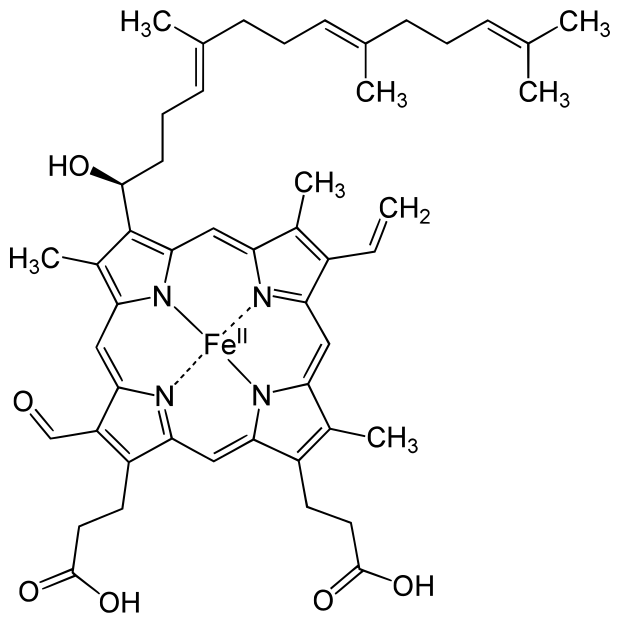
what is this?
heme
if oxygen occupies two coordination bonds, what would happen to the iron?
it would go from Fe2+ to Fe3+
myoglobin
monomer, binds and stores O2 in muscle
hemoglobin
tetramer; 2 alpha-globin’s and 2 beta-globin’s, O2 transporter
Leghemoglobin
sequesters O2, protecting O2 sensitive bacteria in N2-fixing bacteria
where is leghemoglobin found?
leguminous plants
where is myoglobin found?
muscles and tissues
where is hemoglobin found
blood
what is the carboxyl (C) terminus in a globin?
final end of the globin proteins amino acid chain, terminating in a free carboxyl group
what is the amino (N) terminus in a globin?
the beginning of the polypeptide chain, marked by a free amino group
what is the His F8 in globins?
proximal His, His93
what is the His E7 in globins?
distal His, His64
myoglobin’s heme binding pocket?
formed by E and F helices
myoglobin’s heme binding pocket, role of F8 and E7
F8 is directly bonded to Fe2+, E7 is close but not bonded to heme
On what side of the heme atom does O2 bind?
E7 (distal) side
what is the purpose of the E7 histidine?
interacts with O2 molecules and forms H-bond
what is conserved in the sequences of myoglobin, alpha hemoglobin, and beta hemoglobin?
proximal and distal histidine residues
binding of O2 in myoglobin depends on?
structure, flexibility, breathing
how can you measure O2-binding by globin’s?
measure the light absorption, when O2 is bonded the conjugated double bonds absorb less light
oxy heme absorbs more?
blue light
deoxy heme absorbs more?
red light
arterial blood is?
red
venous blood is?
blue