Foodborne Diseases and Microbial Sampling
 Call Kai
 Learn
Learn Practice Test
 Spaced Repetition
 Match
Match Flashcards
 Knowt Play
1/15

There's no tags or description
Looks like no tags are added yet.
Name | Mastery | Learn | Test | Matching | Spaced | Call with Kai | Chat |
|---|
No analytics yet
Send a link to your students to track their progress
16 Terms
What is the difference between food poisoning and food infection?
Food poisoning, also known as "food intoxication”, is a disease that results from the ingestion of foods already containing toxins. The toxins could be:
Bacterial toxins
Chemical contaminants
Heavy metals
Naturally-occurring poisons in certain plants and animals
The key point is that the toxin is already present in the food. The bacteria itself is not the thing causing you harm; it’s the toxin it left behind that causes harm.
Examples: Staphylococcus aureus, Clostridium perfringens, Clostridium botulinum
Food infections occur when you consume pathogen-contaminated food. These pathogenic microbes survive in your stomach and then proliferate inside your intestinal tract and other tissues.
Examples: Salmonella, Campylobacter, Listeriosis, Escherichia coli
Can pathogenic organisms be on fresh food?
Yes, pathogenic microorganisms can be present and thrive on fresh food.
Presently, rapid detection methods have been developed to look for the presence of common foodborne pathogens (e.g., E. coli). These tests are molecular and immunology based.
Foodborne outbreaks are reported to the CDC. Typically, widespread disease is traced back to processing plants and/or food distribution centers.
Staphylococcus aureus
Gram-positive, mesophile cocci bacteria
Staphylococcus aureus (S. aureus) is the common culprit of bacterial food poisoning.
Can grow in many foods
Some strains can produce several thermostable toxins
S. aureus produce seven different enterotoxins
Produce exaggerated T-cell immune response
Gastroenteritis (inflammation of the GI tract and stomach lining) occurs within a few hours of consumption, causing diarrhea, nausea, and vomiting.
Foods impacted by S. aureus include:
Custard/cream-filled baked goods
Poultry
Meat
Egg salad
Salad dressing
Clostridial food poisoning
Clostridial bacteria are anaerobic, gram-positive bacteria that produce incredibly heat-stable endospores that do not die during the cooking/canning process.
There are two important types of Clostridial bacteria responsible for serious food poisoning:
(1) Clostridium perfringens (C. perfringens)
The most commonly reported form of food poisoning (>248,000 annual cases)
Food poisoning from this strain requires you to eat a large quantity of C. perfringens in contaminated food.
After consumption, C. perfringens survives the stomach and sporulates in the intestine. Around the same time, enterotoxins are released in the gastrointestinal tract 6-15 hours after consumption.
Causes gastroenteritis
C. perfringens can be detected in feces via an ELISA analyzer.
(2) Clostridium botulinum (C. botulinum)
Causes botulism, a severe and often fatal food poisoning that occurs following the consumption of food that contains C. botulinum exotoxins.
16% of cases are fatal
The C. botulinum toxin is a neurotoxin that causes flaccid paralysis of muscles, and can affect the autonomic nerves that control respiration and heart beat.
Most cases of foodborne botulism are caused by eating foods that are not cooked after processing (food eaten straight out of the can).
C. botulinum can be diagnosed through testing a patient’s blood serum.
What is an enterotoxin?
Enterotoxins are a protein exotoxin released by a microorganism that targets the intestines; causes gastroenteritis.
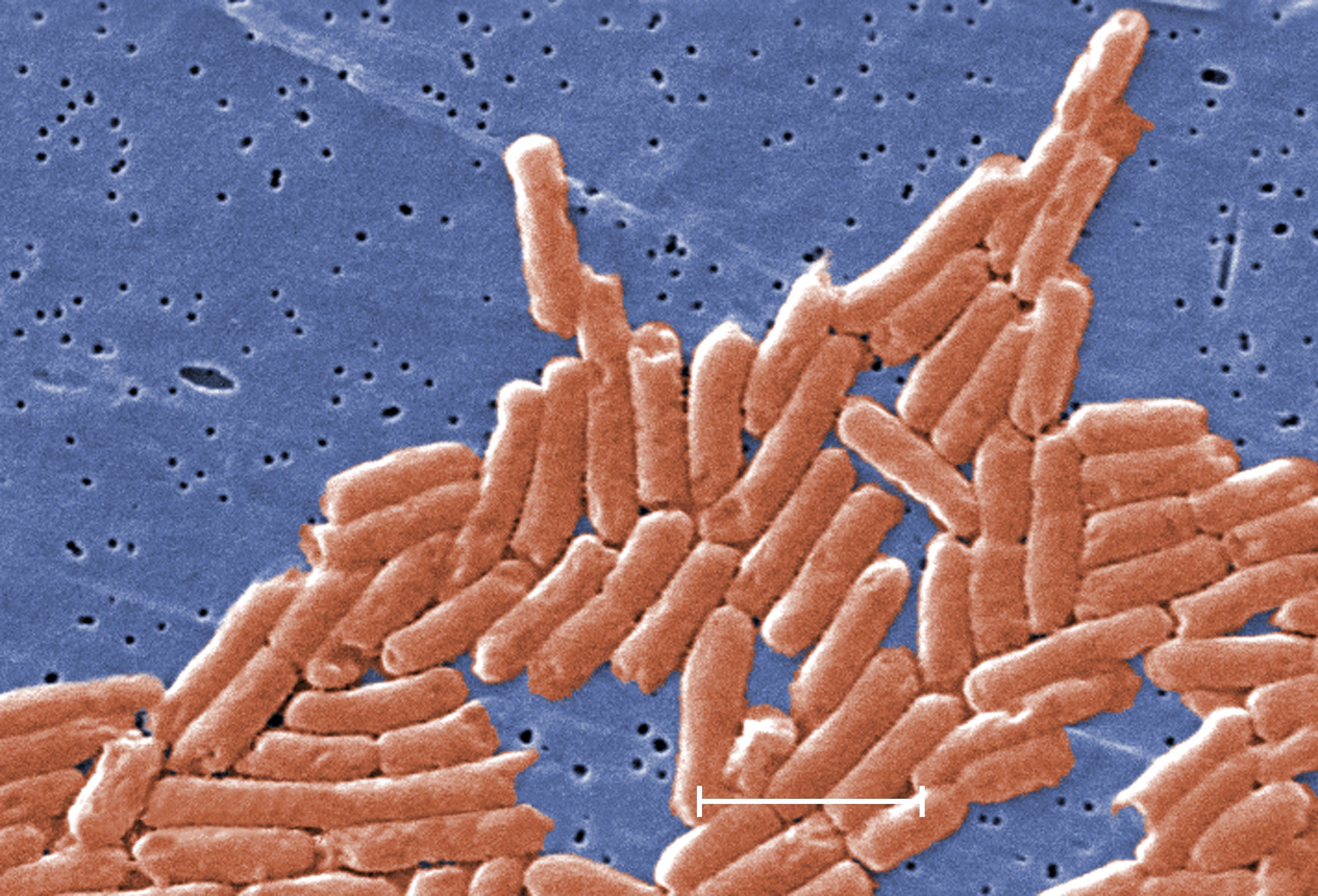
Salmonella
Salmonellosis is a gastrointestinal disease caused by foodborne Salmonella infections.
There are 40,000-45,000 documented cases of Salmonellosis annually.
Poultry and pork carry the greatest risk of Salmonella contamination.
Diagnosis can be derived from a feces culture, symptom history, and food consumption history.
Salmonella Pathogenesis
Salmonella pathogenesis occurs when the bacterium is ingested.
Salmonella is a mesophilic bacterium that has an acid tolerance response that enables it to survive the stomach and pass on to the gastrointestinal tract, where it will adhere to and actively invade phagocytes.
This bacteria then lives as an intracellular pathogen.
Causes enterocolitis (inflammation of the GI tract)
Escherichia coli
Escherichia coli (E. coli) are gram-negative, rod-shaped, facultative bacterium.
Most E. coli strains are nonpathogenic
There are four types of pathogenic E. coli:
(1) Shiga toxin-producing E. coli
Produces an enterotoxin called the Shiga toxin, which causes bloody diarrhea and kidney failure
E. coli O157:H7 is a well-documented strain that has had several reported outbreaks in the United States
This strain grows in the intestines (entero-) and can be consequently found in feces.
Knowing this, E. coli O157:H7 is both a water and foodborne gastrointestinal disease.
(2) Enterotoxigenic E. coli
Primarily causes diarrhea
Children in developing nations often contract diarrheal disease from this strain.
Also known as “traveler’s diarrhea”
(3) Enteropathogenic E. coli
Causes diarrhea in infants and small children
(4) Enteroinvasive E. coli
Causes an invasive disease of the colon, producing watery diarrhea
Pathogenic E. coli causes horrible, horrible diarrhea.
Ground meat, unpasteurized milk, and certain raw leafy greens are vulnerable to E. coli.
The best preventative measure is to make sure you cook all foods well done.
Campylobacter
Campylobacter is THE MOST common culprit of bacterial foodborne infections in the United States.
>2,000,000 cases of bacterial diarrhea per year
Commonly transmitted though contaminated food, including:
Poultry
Pork
Raw shellfish
Campylobacter pathogenesis starts when a person ingests a Campylobacter-contaminated food. Campylobacter then travels down to the small intestine, proliferates, invades the epithelium, and causes inflammation
Symptoms include: high fever, headache, malaise, nausea, abdominal cramping, and bloody stool
A diagnosis can be found through feces cultures and immunological assays
A treatment could include a round of antibiotics
Listeria monocytogenes
Listeria monocytogenes is a gram-positive, coccobacillus that is non-spore-forming and facultatively aerobic.
Food infection
Can be found in soil and water
Psychrotolerant
No food product is safe from contamination; ANYTHING could become contaminated
In severe cases, L. monocytogenes can cause listeriosis, a gastrointestinal disease that may lead to bacteremia and meningitis.
Mortality rate of 20%
Can be diagnosed by culturing L. monocytogenes from the blood or spinal fluid
IV antibiotic treatment is recommended for the invasive disease.
Yersinia enterocolitica
Y. enterocolitica causes foodborne infections from contaminated meats and dairy products.
Food infection
Can cause life-threatening enteric fever
Bacillus cereus
B. cereus grows in food that is cooked and left to cool slowly.
Food poisoning
Produces enterotoxins that induce diarrhea and vomiting
This could literally be any food in a pot that you leave on a stove. Be careful!
Shigella species (spp.)
Shigella species cause severe foodborne invasive gastroenteritis called shigellosis.
Vibrio species (spp.)
Vibrio species cause food poisoning in people that consume contaminated shellfish.
What causes the largest number of foodborne infections?
Viruses. The most common causes of foodborne viruses are norovirus, hepatitis A, and astrovirus.
Protists
Protists are eukaryotic microorganisms that are not animals, plants, or fungi.
These fuckers can be pathogenic (parasitic) and cause foodborne infections like:
Giardia lamblia
Cryptosporidium parvum
Cyclospora cayetanesis
All THREE of those parasitic infections cause diarrhea.
Since all three parasitic infections cause diarrhea, protist infections can be spread in foods contaminated by fecal matter in water used to wash, irrigate, or spray crops.
Fresh fruit are often the source of these infections.
Toxoplasma gondii causes toxoplasmosis, which can be transmitted from eating undercooked/raw meat or coming into contact with infected cat poop.
Prions
Prions are proteins that adopt novel conformations that inhibit normal protein function an cause neural tissue degeneration.
Misfolded proteins
A foodborne prion disease that can infect humans is called “new variant Creutzfeldt-Jakob disease” (nvCJD)
Linked to the consumption of beef contaminated with bovine spongiform encephalopathy (BSE), colloquially known as “Mad Cow’s Disease”
As a public health preventative measure, brains of slaughtered animals are routinely tested for BSE