Comparing TCP and UDP
 Call Kai
 Learn
Learn Practice Test
 Spaced Repetition
 Match
Match Flashcards
 Knowt Play
1/8

There's no tags or description
Looks like no tags are added yet.
Name | Mastery | Learn | Test | Matching | Spaced | Call with Kai |
|---|
No analytics yet
Send a link to your students to track their progress
9 Terms
Transport Layer Protocols
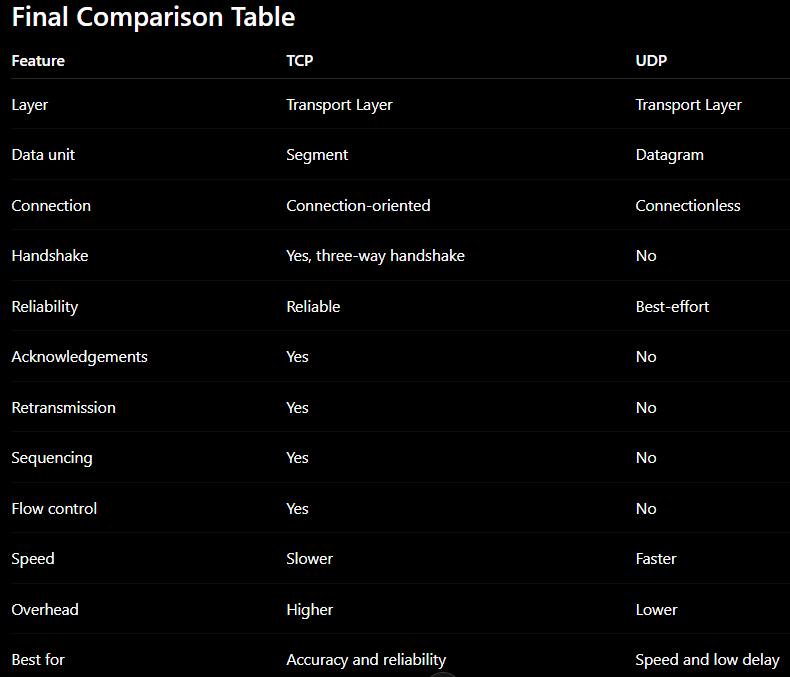
Both TCP and UDP are transport layer protocols (Layer 4)
Both transport data between applications using port numbers
Connection Type
TCP is connection oriented (must have connection then can send data) and uses a three-way handshake
UDP is connectionless meaning it sends data immediately without setting up a connection first
Reliability
TCP is reliable, it checks whether data was received. If missing TCP can retransmit it.
UDP is unreliable, it does not acknowledge if data is received and does not retransmit data
Sequencing
TCP uses sequence numbers to make sure data is sequenced in the right order
UDP does not sequence data, if packets arrive out of order, UDP itself does not fix it
Flow Control
TCP uses flow control to prevent the sender from overwhelming, it uses the window size field
UDP does not use flow control, it sends data without checking if the user can handle it
Speed and overhead(extra non-payload data such as headers)
TCP has more features so it has higher overhead and slower than UDP
UDP has less features, so it has lower overhead and its faster
Error Handling
TCP provides error handling. If data is lost or corrupted, TCP can request transmission\
UDP has a checksum for error detection, but it does not recover from errors
Uses of TCP and UDP
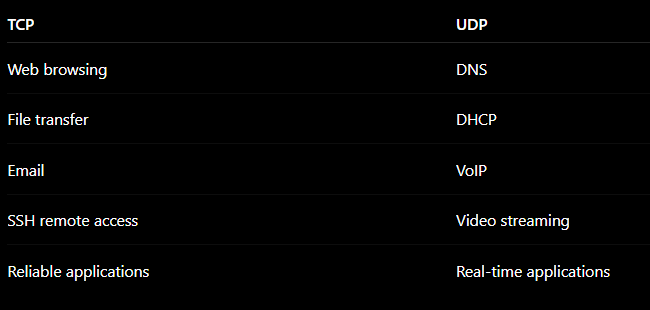
Summary