Carbohydrates 3.1.2
 Call Kai
 Learn
Learn Practice Test
 Spaced Repetition
 Match
Match Flashcards
 Knowt Play
1/9

Earn XP
Description and Tags
Name | Mastery | Learn | Test | Matching | Spaced | Call with Kai | Chat |
|---|
No analytics yet
Send a link to your students to track their progress
10 Terms
Roles of carbohydrates
Energy supply for cells.
Energy storage.
Structural components.
Cellular recognition (glycoproteins).
Alpha and beta glucose structures
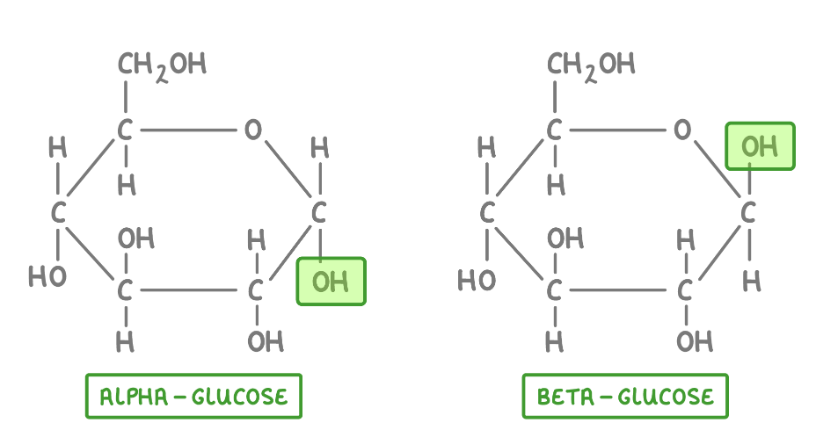
Properties of glucose
Glucose is the primary energy source in animals and plants. It is soluble - the hydroxyl group can form H+ bonds with H2O so can be transported around organisms. Its bonds store lots of energy - which is releases when are broken.
Disaccharides
Glucose + Glucose → Maltose
Glucose + Fructose → Sucrose
Glucose + Galactose → Lactose
Joined via condensation and the formation of a glycosidic bond. Broken via hydrolysis and the release of energy.
Starch
A polysaccharide used as an energy store in plants. Is both branched and unbranched. It is made of many alpha glucose monomers joined via 1-4 and 1-6 glycosidic bonds. Made of amylose (coiled) and amylopectin (branched).
Insoluble (does not affect water potential), large (cannot diffuse out of cells), branched (lots of ends to be hydrolysed to release energy), coiled (compact) and releases alpha glucose monomers when hydrolysed (which are used in respiration).
Glycogen
A polysaccharide used as an energy store in animals. Is highly branched. Made up of many alpha glucose monomers joined via 1-4 and 1-6 glycosidic bonds.
Insoluble (doesn’t affect water potential), compact, highly branched, large, releases alpha glucose monomers when hydrolysed.
Cellulose
A polysaccharide that provides structural support in plant cell walls. Made up of many beta glucose monomers joined together by glycosidic bonds, with every other beta-glucose inverted so they form long straight chains. Hydrogen bonds form between the chains to create microfibrils and macrofibrils.
Long, straight, unbranched chains (provide rigidity), hydrogen bonds (join chains for strength), microfibrils (strength).
Test for starch
Iodine test:
Add a couple drops of iodine solution to food sample and gently shake. If starch is present, the solution will turn from orange to blue-black.
Test for reducing sugars
Benedict’s test:
Add an equal volume of Benedict’s reagent and food sample to a test tube. Heat in a water bath for 5 minutes. If a reducing sugar is present, the mixture will change from blue to a brick red precipitate. The strength of the colour change indicates the concentration of reducing sugars.
Test for non-reducing sugars
Benedict’s test twice:
Carry out the test for reducing sugars, if the result is negative, add an equal volume of dilute hydrochloric acid and heat in a water bath for 5 minutes (this will hydrolyse disaccharides into monosaccharides). Neutralise the mixture by adding sodium hydrogencarbonate. Now, do the test for reducing sugars again. If non-reducing sugars were present at the start, a brick red precipitate will form.