Newton's Laws
 Call Kai
 Learn
Learn Practice Test
 Spaced Repetition
 Match
Match Flashcards
 Knowt Play
1/14

There's no tags or description
Looks like no tags are added yet.
Name | Mastery | Learn | Test | Matching | Spaced | Call with Kai | Chat |
|---|
No analytics yet
Send a link to your students to track their progress
15 Terms
Newton’s First Law
A body at rest remains at rest, or, if in motion, remains in motion at a constant velocity unless acted on by a net external force
Newton’s Second Law
The acceleration of a system is directly proportional to and in the same direction as the net external force acting on the system, and inversely proportional to its mass
Newton’s Third Law
Whenever one body exerts a force on a second body, the first body experiences a force that is equal in magnitude and opposite in direction to the force that it exerts
force formula
F=ma, units: N
apparent weight of body in stationary lift
N= mg, units: N
apparent weight of body in lift accelerating upwards
N= m(g+a)
N > mg, you feel heavier
apparent weight of body in lift accelerating downward
N = m(g-a)
N < mg, you feel lighter
acceleration of combined contact (pushing) force on blocks
a = F/ (m1+m2+m3)
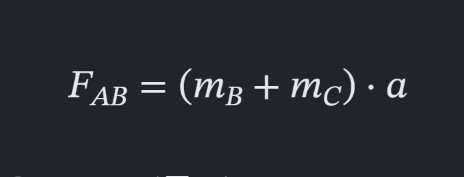
contact (pushing) force of 1 on 2
F = (m2+m3) a
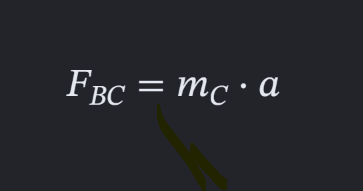
contact (pushing) force of 2 on 3
F = (m3) a
acceleration of combined contact (pulling) force on blocks
a= F/ (m1+m2+m3)
tension force of string between 1 and 2
F= (m2+m3)a

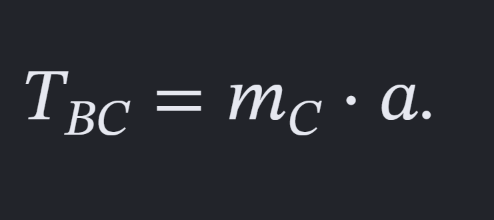
tension force of string between 2 and 3
F= (m3)a
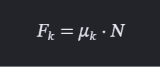
kinetic friction force
coefficient of kinetic friction by normal force
maximum static friction
coefficient of static friction by normal force