Lecture 3.5: Citrate Cycle
 Call Kai
 Learn
Learn Practice Test
 Spaced Repetition
 Match
Match Flashcards
 Knowt Play
1/46

There's no tags or description
Looks like no tags are added yet.
Name | Mastery | Learn | Test | Matching | Spaced | Call with Kai | Chat |
|---|
No analytics yet
Send a link to your students to track their progress
47 Terms
The citrate cycle occurs in the _____ ______
Mitochondria matrix
What are the other names for the citrate cycle
Cirtic acid cycle (CAC), Krebs cycle, tricarboxylic acid cycle (TCA)
How many electrons are captured per Acetyl-CoA
4 pairs of electrons (8 electrons)
What is the fuel for the citrate cycle
Acetyl-CoA
What is the exhaust of the CAC
CO2
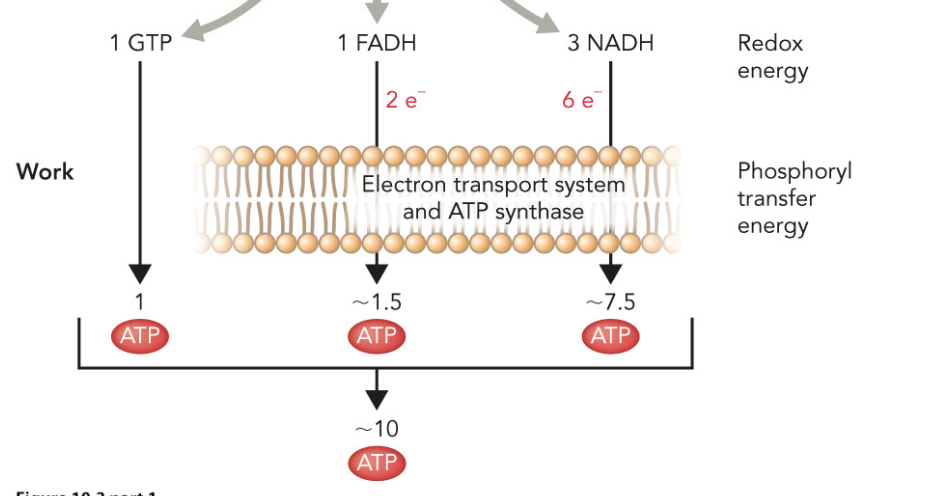
How many FADH are created and how many electrons come from it
1 FADH & 2 electrons
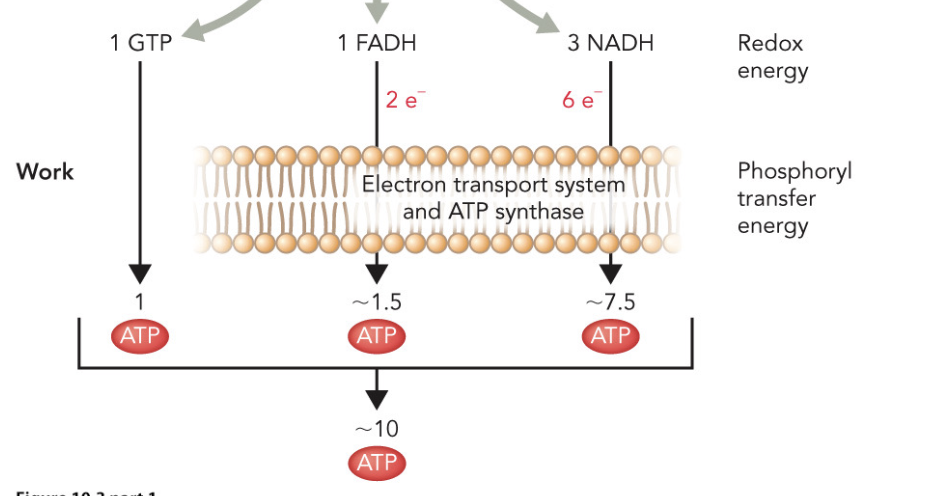
How many NADH are created and how many electrons come from it
3 NADH & 6 electrons
How many steps are in the CAC
8 enzyme-catalyzed reactions
(T/F) Oxygen is an aerobic pathway
False — the citrate cycle is oxygen dependent but does not use O2. The CAC depends on NADH and FADH to be oxidized and regenerated. However, they cannot be oxidized without the use of O2 at the final electron acceptor within the ETC
(T/F) Increasing the concentration of one intermediate within the CAC does not effect the following intermediate concentrations
False — increasing the concentration of one intermediate increases the concentrations of all 8 intermediates
Explain how the final step of the CAC is energetically possible
Since step 1 of the CAC is highly exergonic and the CAC is a cycle. This allows for the highly endergonic, step 8 to push forward
Which of the following statements regarding the citrate cycle are TRUE?
Select an answer and submit. For keyboard navigation, use the up/down arrow keys to select an answer.
a) There is net synthesis of intermediate molecules such as citrate.
b) The first step of the pathway requires two substrates: acetyl CoA and citrate.
c) The pathway is O2 dependent and use O2 to regenerate electron carriers.
d) If pathway intermediates are siphoned off and used for other pathways the cycle can not continue running.
e) There are 10 steps - two of which are decarboxylation reactions.
d) If pathway intermediates are siphoned off and used for other pathways the cycle can not continue running.
For each acetyl CoA that enters the Citrate Cycle, ______ pairs of electrons are captured _____ NADH is/are generated _____ FADH₂ is/are generated _____ GTP/ATP is/are produced by substrate-level phosphorylation
4; 3; 1 ;1
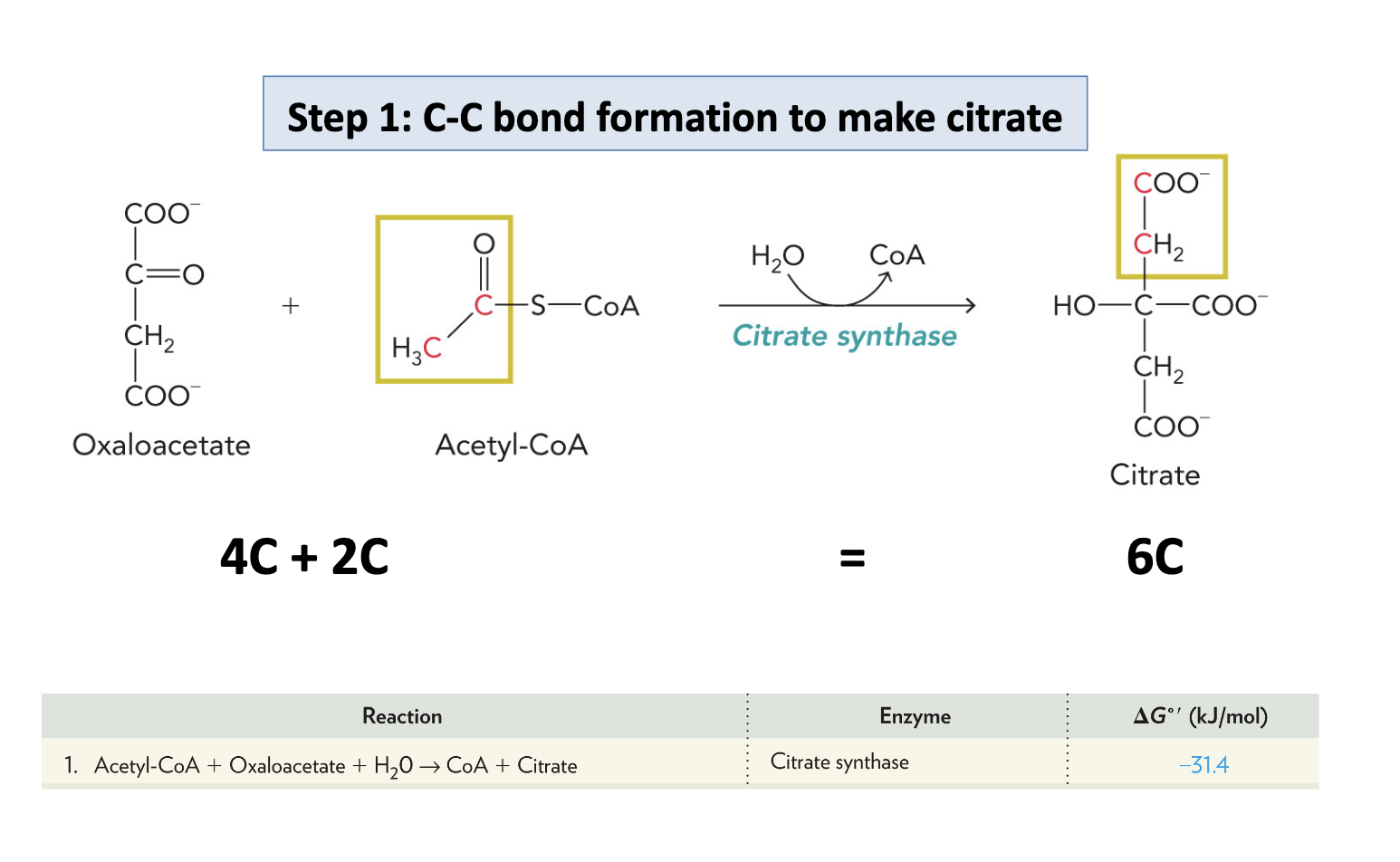
What is step 1 of the CAC
Citrate synthase catalyzes the irreversible condensation of acetyl-CoA with Oxaloacetate
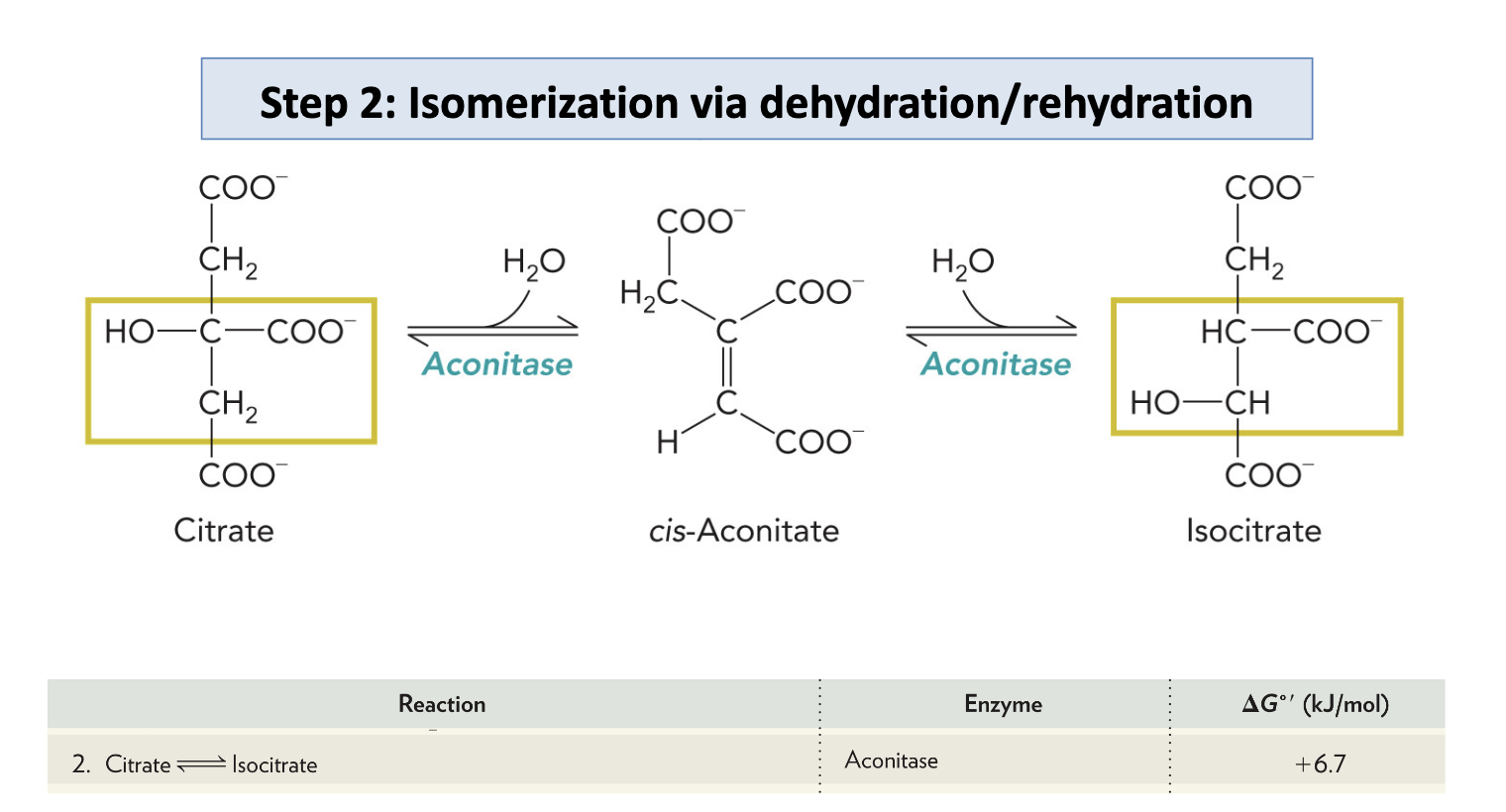
What is step 2 of the CAC
Aconitase catalyzes the reversible isomerization of citrate to isocitrate
What is step 3 of the CAC
NAD+ dependent isocitrate dehydrogenase catalyzes te first oxidative decarboxylation
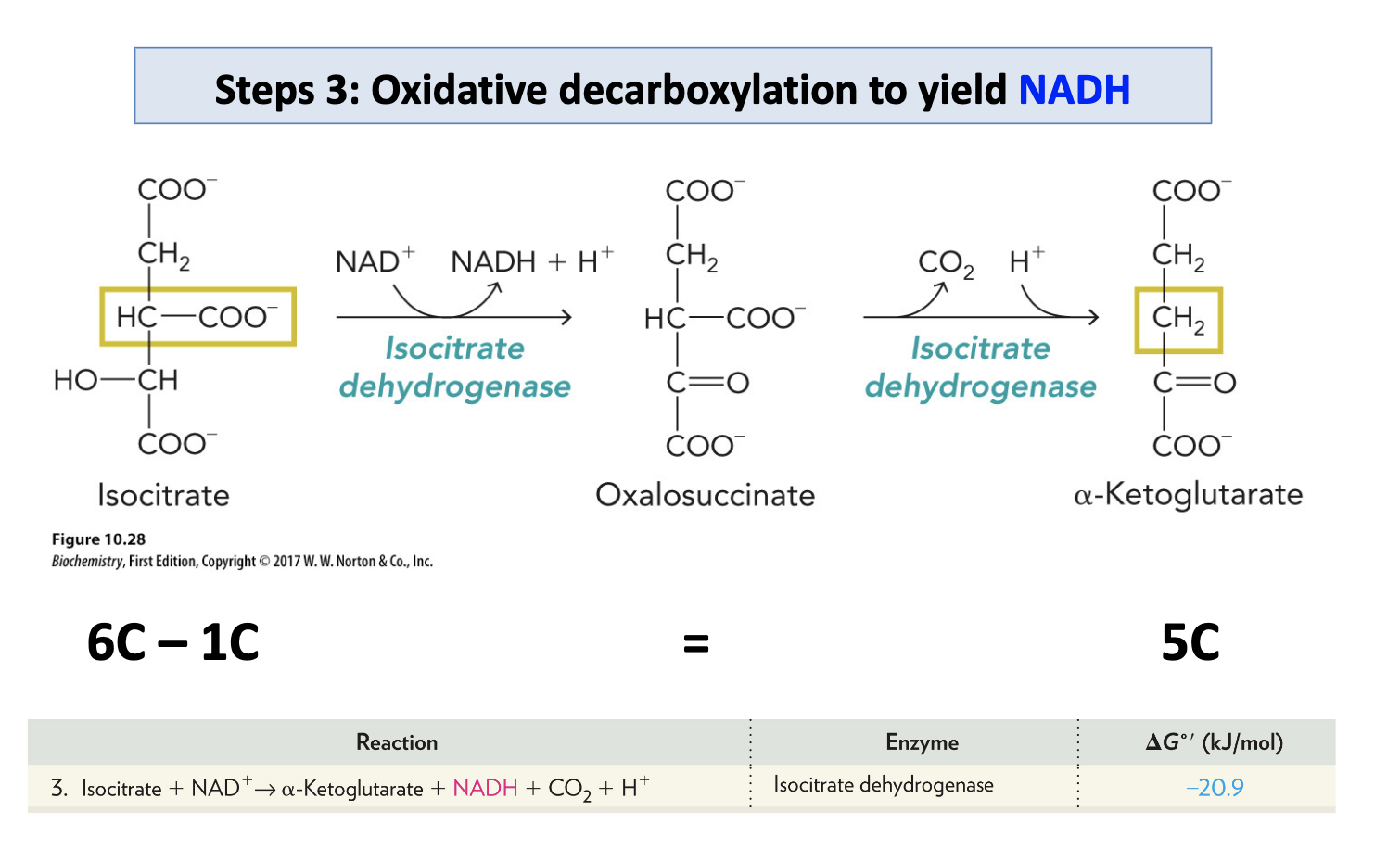
What is step 4 of the CAC
a-ketoglutarate dehydrogenase catalyzes the second oxidative decarboxylation
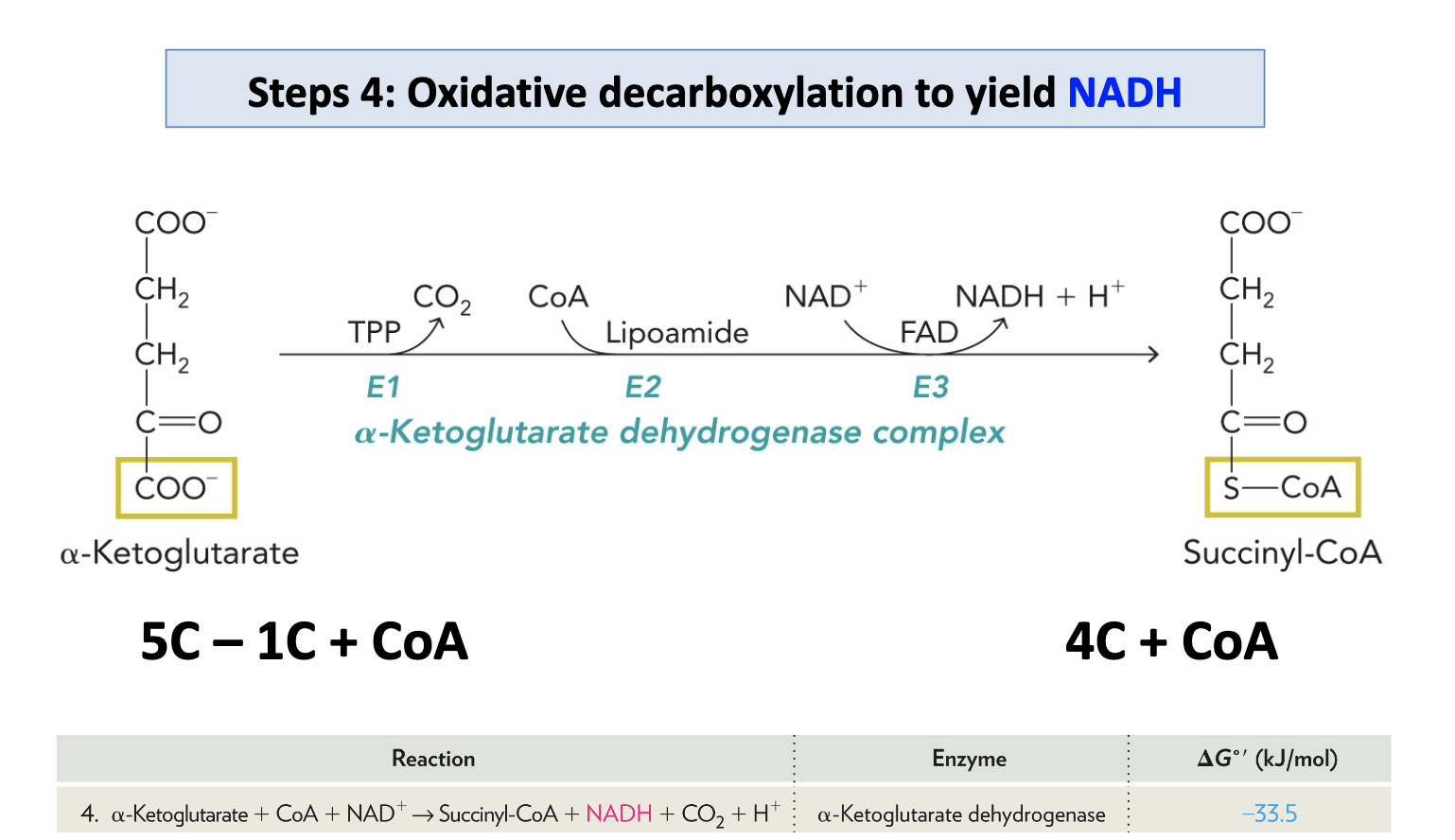
What is step 5 of the CAC
Succinyl CoA synthetase catalyzes substrate level phosphorylation to produce GTP or ATP
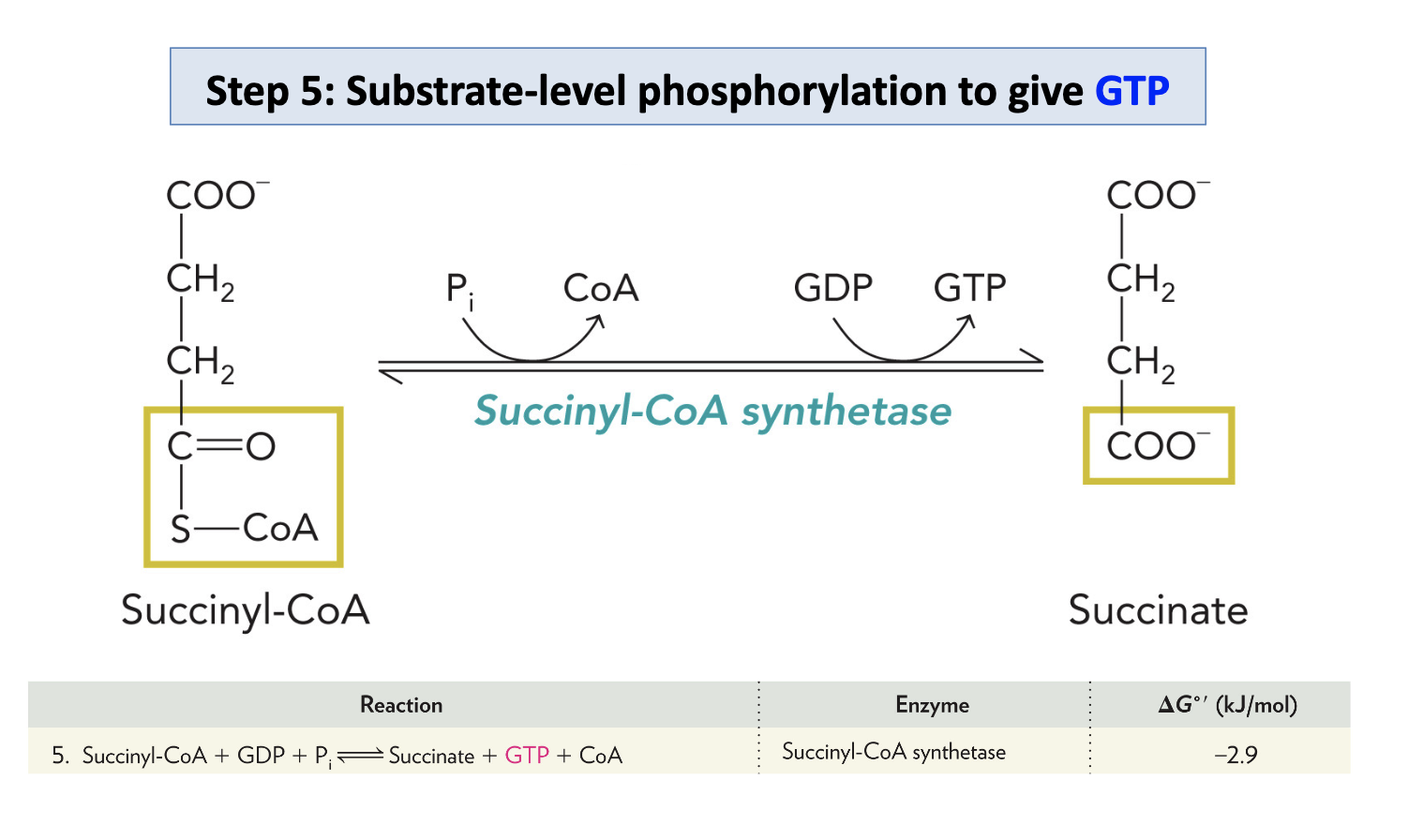
Which step is a condensation reaction?
1
Describe the condensation reaction in the citric acid cycle, specifying the number of carbons in the molecules involved.
During step 1, the acetyl group of acetyl-CoA (a 2-carbon unit) condenses with oxaloacetate (a 4-carbon molecule) to form a new carbon-carbon bond. This first produces an intermediate called citryl-CoA (still attached to Coenzyme A).
Citryl-CoA is then hydrolyzed, releasing free CoA-SH and yielding citrate, a 6-carbon molecule
What type of reaction does Aconitase catalyze?
Select an answer and submit. For keyboard navigation, use the up/down arrow keys to select an answer.
a) reduction
b) condensation
c) isomerization
d) decarboxylation
e) phosphorylation
c) isomerization
Which steps release carbon dioxide? Select all that apply.
Steps 3 and 4
Which step is catalyzed by an enzyme that uses TPP as a prosthetic group?
4
Which step generates ATP or GTP?
5
Which step uses Coenzyme A as a cosubstrate?
4
What is citrate synthase regulated by
Inhibition: Succinyl-CoA, Citrate, NADH, & ATP
Activation: ADP
What is isocitrate dehydrogenase regulated by
Inhibition: ATP
Activation: Ca2+ & ADP
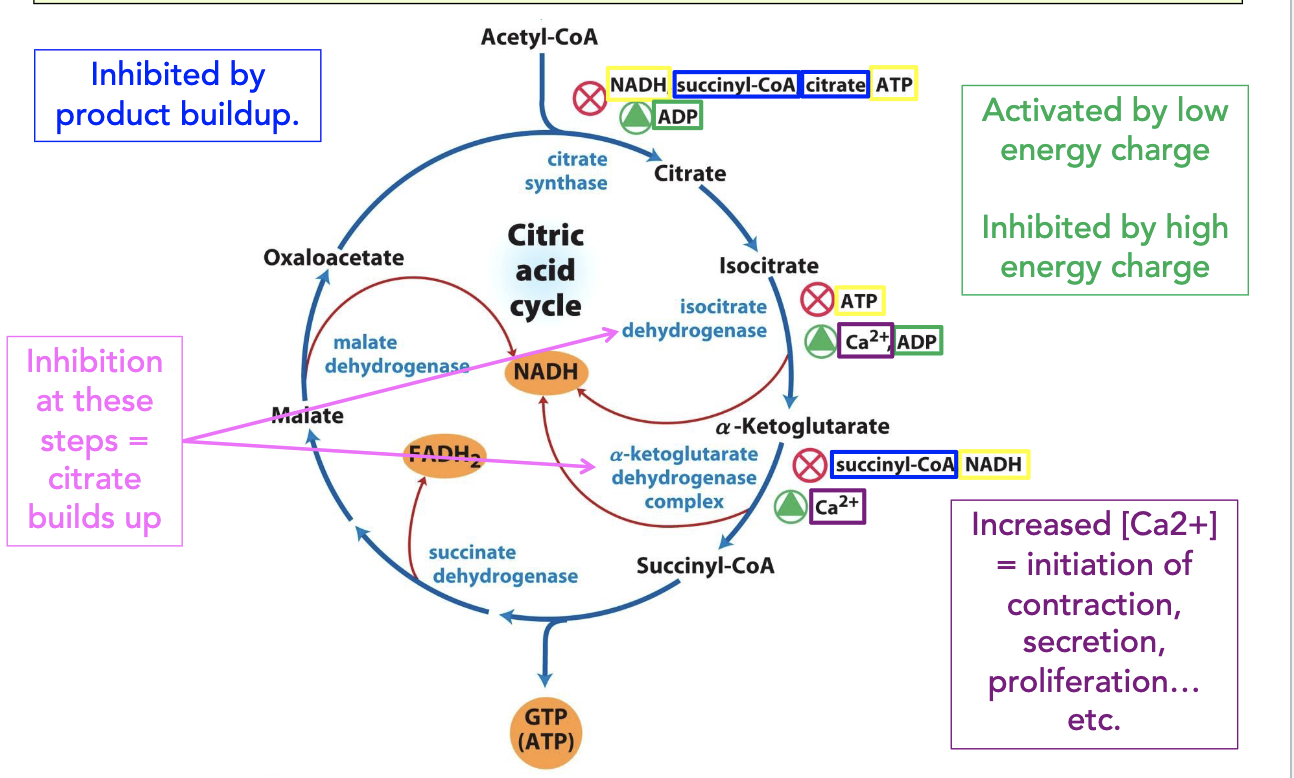
What is a-ketoglutarate dehydrogenase complex regulated by
Inhibition: Succinyl-CoA & NADH
Activation: Ca2+
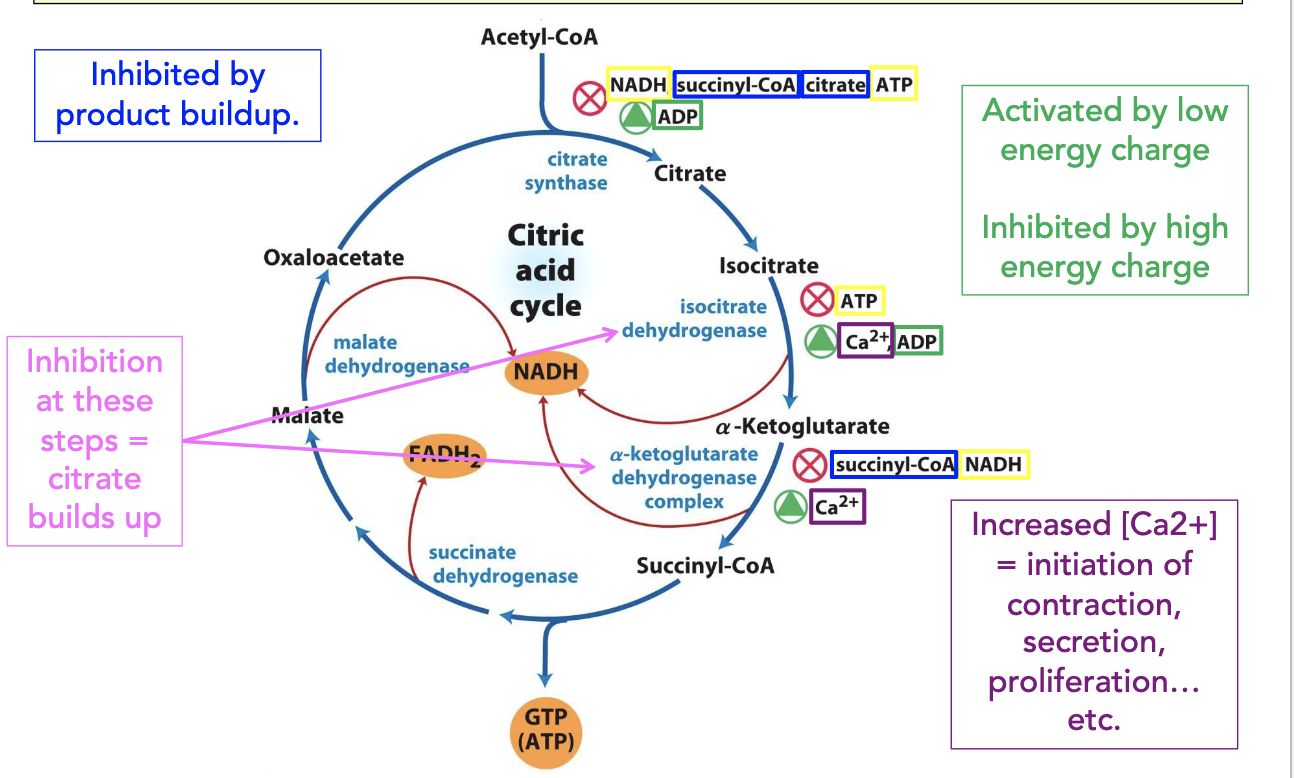
The citrate cycle is primarily regulated at ____ allosteric enzymes
3
Which steps are catalyzed by regulatory enzymes?
1, 3, & 4
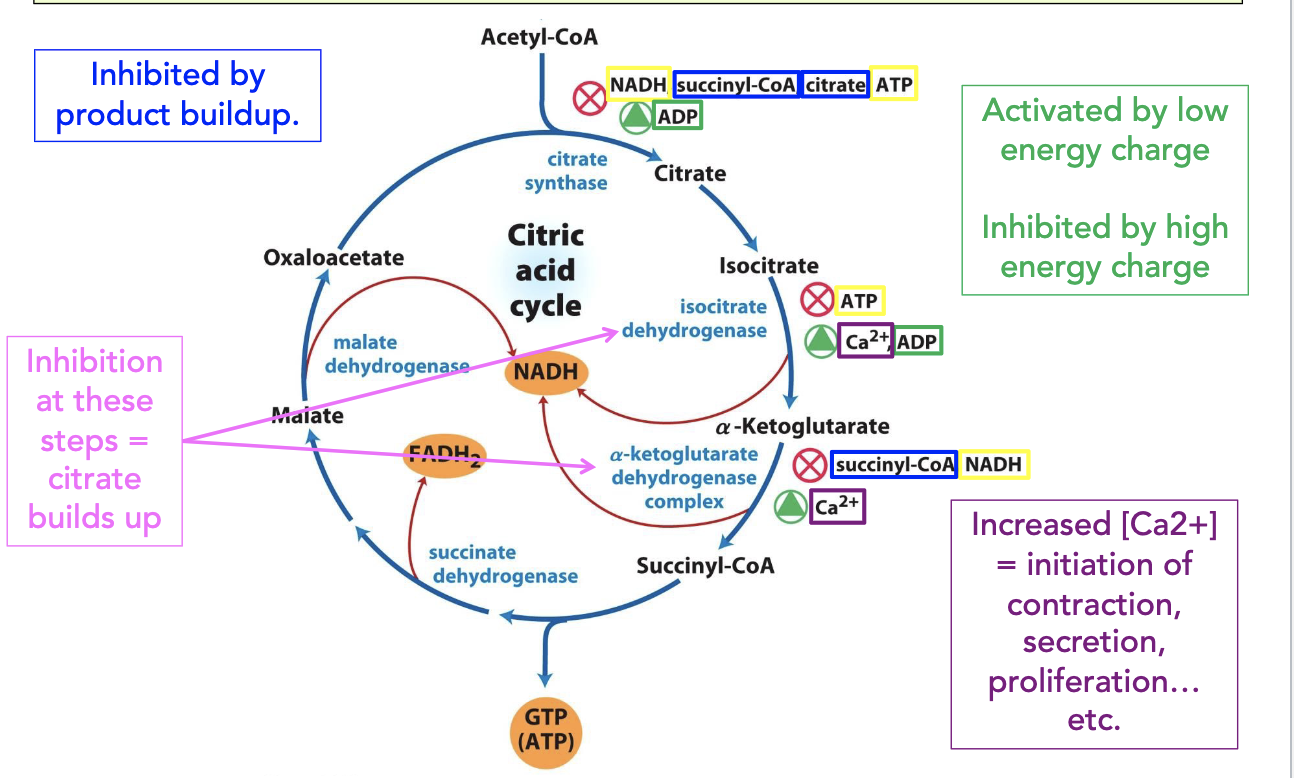
A high concentration of which molecule would inhibit citrate synthase in the citrate cycle?
a) AMP
b) ADP
c) NAD+
d) ATP
d) ATP
Which steps are activated by increased intracellular Calcium?
Steps 3 & 4
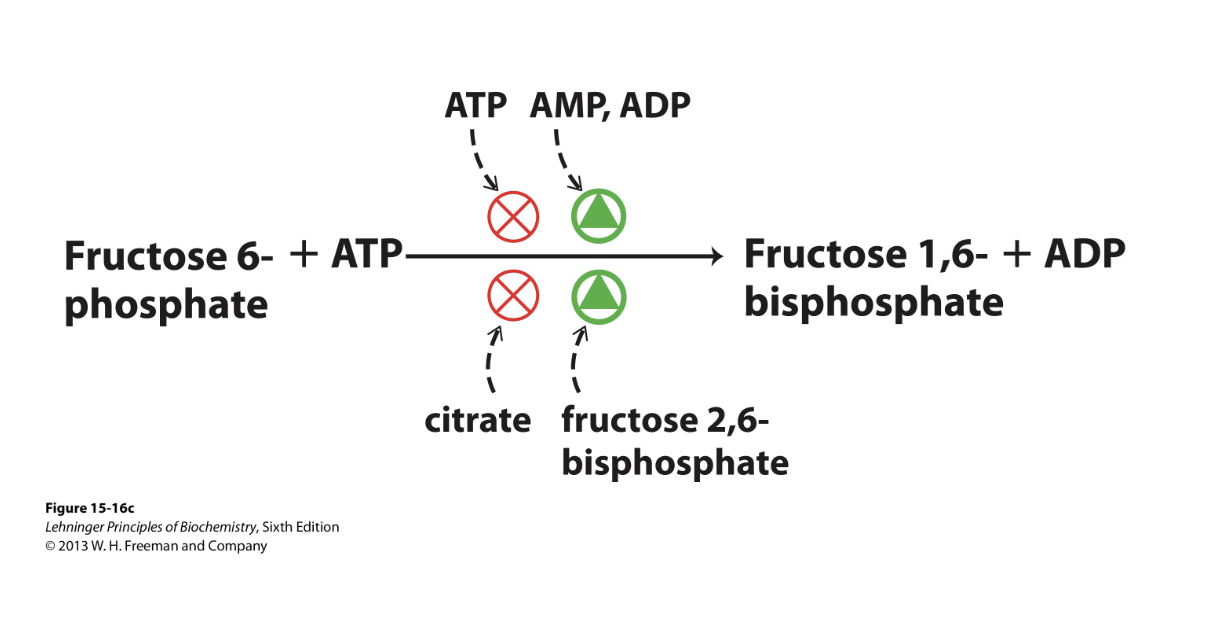
The type of inhibition where citrate inhibits citrate synthase and PFK-1 is called _________ inhibition
Feedback
What are the final products of the CAC
2 CO2, 4 pairs of e-, 3 NADH and 1 FADH , 1 GTP/ATP made
A pathway that serves in both anabolic and catabolic processes is called a(n) _______ pathway
amphibolic
What is the role of pyruvate carboxylase?
a) It converts amino acids into oxaloacetate.
b) It generates acetyl-coA from pyruvate.
c) It converts succinyl-CoA into heme.
d) It generates oxaloacetate from pyruvate.
e) It converts the amino acid glutamate into α-ketoglutarate
d) It generates oxaloacetate from pyruvate.
Identify the specific term that describes the type of reactions catalyzed by pyruvate carboxylase.
________________ reaction
anaplerotic
Define an anaplerotic reaction
An anaplerotic reaction is a reaction that replenishes the intermediates of a metabolic cycle — specifically, in this context, the intermediates of the citric acid cycle (CAC).
What molecules is citrate used to make
fatty acids & sterols
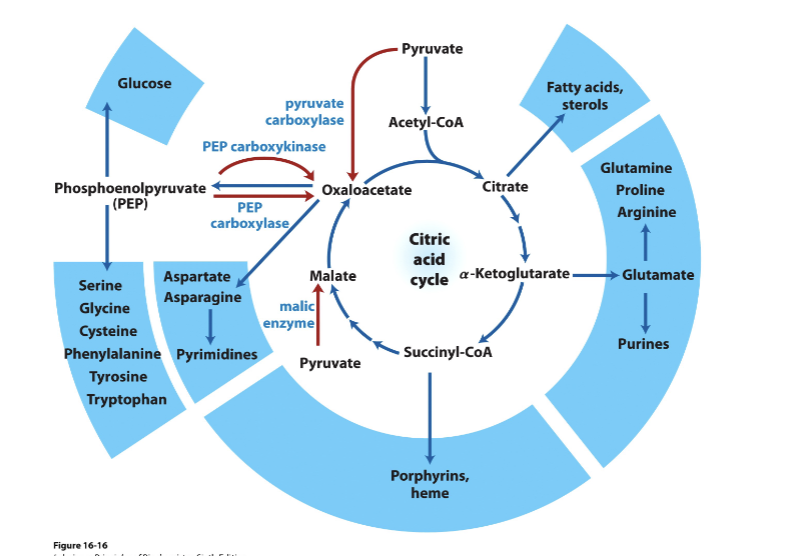
What molecules is a-ketoglutarate used to make
Directly: Glutamate
Indirectly: purines, glutamine, proline, arginine
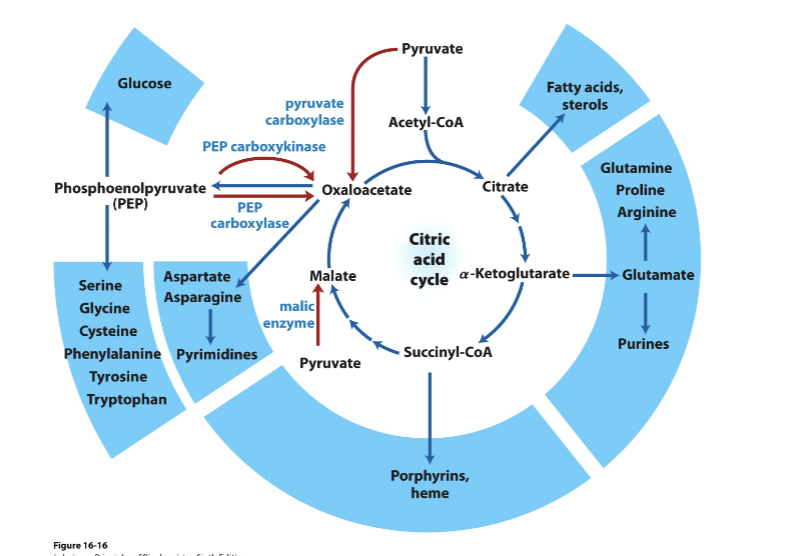
What molecules is Succinyl-CoA used to make
porphyrins, heme
What molecules is oxaloacetate used to make
Directly: Aspartate, asparagine,
Indirectly: pyrimidines
Directly: phosphoenolpyruvate
Indirectly: glucose, serine, glycine, cysteine, phenylalanine, tyrosine, tryptophan
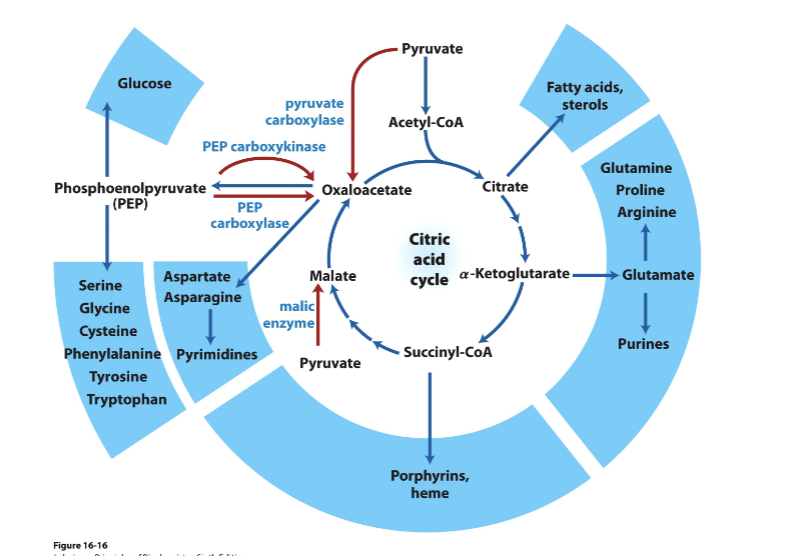
What is the role of malic enzyme
to covert pyruvate to malate
What is the role of PEP carboxylase
To convert PEP to Oxaloacetate
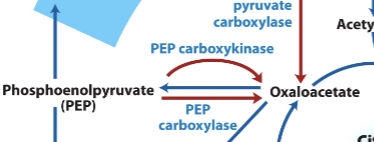
What is the role of PEP carboxykinase
To convert Oxaloacetate to PEP
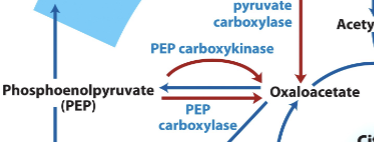
What is the role of pyruvate carboxylase
To convert pyruvate to oxaloacetate