FEA Final
 Call Kai
 Learn
Learn Practice Test
 Spaced Repetition
 Match
Match Flashcards
 Knowt Play
1/184

Earn XP
Description and Tags
Name | Mastery | Learn | Test | Matching | Spaced | Call with Kai | Chat |
|---|
No analytics yet
Send a link to your students to track their progress
185 Terms
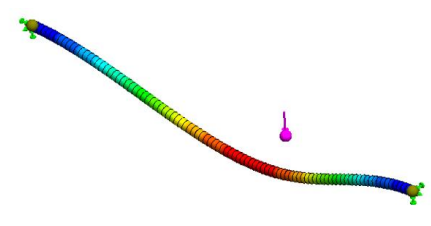
What type of element is the structure meshed with?
a. Solid
b. Shell
c. Beam
d. Truss
c
The number of rigid body motions is equal to:
a. The element order used
b. The number of unknowns that need to be found to define the position of a body in 3D space
c. Number of rotational degrees of freedom only
d. Number of translational degrees of freedom only
b
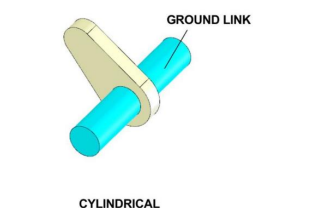
How many degrees of freedom does the following cylindrical kinematic pair have?
a. 0
b. 1
c. 2
d. 3
c
What is the relationship between strains and displacements?
a. Stains are derivatives of displacements
b. Strains are integrals of displacement
c. Strains are linear multiples of displacements
d. None of the above
a
How many DOFs does each node of a solid element have?
a. 1
b. 2
c. 3
d. 4
c
First order elements have …
a. Linear Stress and Linear Displacement
b. Constant stress and Displacement
c. Constant Stress and Linear Displacement
d. Linear Stress and Constant Displacement
c
Convergence error …
a. Is the difference between results produced by a discrete model with a finite number of elements and results that would be products by a hypothetical model with an infinite number of infinitesimally small elements.
b. Is a way to express discretization error.
c. Is the difference between the two consecutive mesh refinements or element order upgrades
d. b and c
d
Which of the following statements is correct about h adaptive process?
a. The name h comes from the polynomial function describing the displacement field
b. Element order is increased
c. Element size is reduced
d. None of the above
c
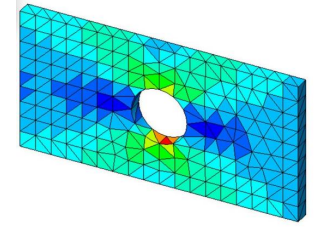
What does the plot below show?
a. Nodal Stress
b. Element Stress
c. Displacement
d. Temperature
b
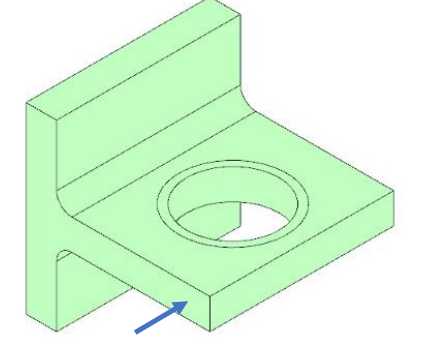
What type of symmetry can be used on the following model?
a. Circular
b. Mirror
c. Axis Symmetry
d. None of the above
d
Which of the following is true about static large displacement formulation?
a. Loads can be following only
b. Loads can be non following only
c. Loads can be non conservative only
d. None of the above
b
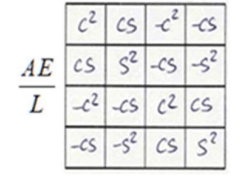
What does the following matrix represent?
a. 1D Spring Stiffness Matrix
b. Beam Stiffness Matrix
c. 1D Spring Displacement Matrix
d. Truss Stiffness Matrix
d
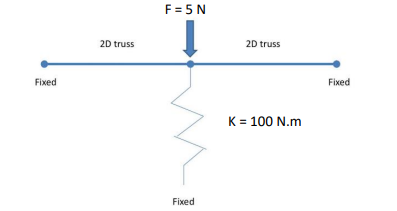
What is the displacement of node 2 in the following diagram?
a. 500 mm
b. 50 mm
c. 10 mm
d. The following model is incorrect
b
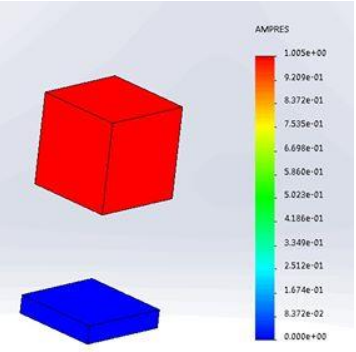
What do the numbers shown below (results from a frequency analysis plot) mean?
a. The maximum Frequency is 1.005 Hz
b. The maximum displacement is 1.005 mm
c. The values are meaningless, and the frequency analysis is purely qualitative
d. The average stress is 0.6 MPa
c
Which of the following is the structural analysis analogous of temperature gradient in thermal analysis?
a. Stress b. Strain c. Load d. Displacement
b

What does the following symbol represent in SolidWorks?
a. Plane Stress b. Beam element c. Truss Element d. Plane Strain
d
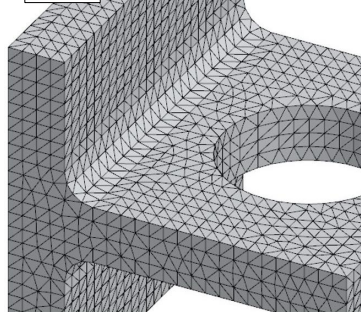
What is the element order of the following mesh?
a. 1 st Order b. 2 nd Order c. 3 rd order d. None of the above
a
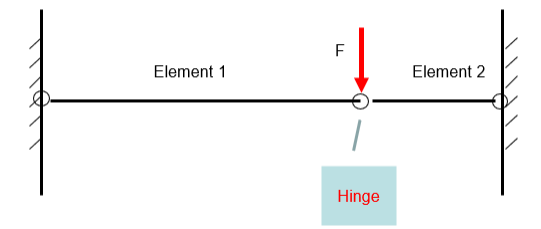
What is the size of the stiffness matrix of the following system (each element is a 2D beam)?
a. 4x4 b. 6x6 c. 8x8 d. 10x10
c
Why does large deformation require nonlinear analysis? Choose the best statement
a) Because the material property changes during material yielding, thus nonlinear analysis must be used
b) As the material deforms, the geometry changes thus the direction of the load need to change to match with the new geometric properties
c) Because it is usually nonlinear force that causes large deformation, thus nonlinear analysis must be used
d) Because force is large to cause large deformation and to analyze such large forces and its impacts, we use nonlinear analysis
b
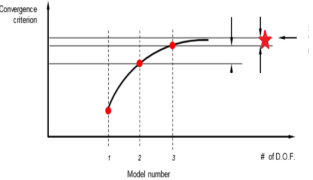
Which error is denoted by the star in the above graph? Choose the best answer
a) Discretization error
b) Convergence error
c) Mathematical error
d) Solution error
d
Choose the best statement that describes stress singularity
a) Caused by sharp re-entrant edges that have an infinite theoretical stress
b) discretization error during the conversion process from the math model to FEA model
c) it is the result of validation error
d) it is the result of verification error
a
Which statement is true about nonlinear analysis? Choose the best statement.
a) The nonlinear analysis used only because of nonlinear geometry
b) Nonlinear is only required if material yield under load
c) Nonlinear analysis is always used wherever possible because it is more accurate than linear analysis
d) Nonlinear analysis is not needed if the change in stiffness during loading is negligible
d
What is buckling? Choose the best statement?
a) Buckling refers to sudden large displacements due to compressive loads. Slender structure subject to axial loads can fail due to buckling at load levels lower than those required to cause material failure
b) Buckling is when the width is 1/100 times smaller than the length
c) Buckling as a failure mode can be modeled using material and geometric properties, much like yielding
d) Buckling only occurs for long, slender rods
a
Why do we have to proceed with caution when interpreting linear buckling analysis? Choose the best statement
a) because buckling failure is catastrophic
b) Because buckling is often nonlinear
c) Because linear buckling analysis disregards any imperfection and nonlinear effects that exist in real structures and often significantly lowers the buckling load. Thus, the results of linear buckling analysis must be interpreted with caution.
d) because buckling happens very fast and even with a very small increase in loads
c
What is true about beam elements?
a) used to model structures in which one dimension (the thickness) is significantly smaller than the other dimensions and the stresses in the thickness direction are negligible
b) Beam elements are used to model components in which one dimension (the length) is significantly greater than the other two dimensions and only the stress in the direction along the length of the beam is significant.
c) They have no resistance to bending. Therefore, they are useful for modeling pin-jointed frames
d) can be used as an approximation for cables or strings (for example, in a tennis racket)
b
Why does the difference between nodal vs. element stress decrease with mesh refinement?
a) Nodal stress is the stress located at a node. Element stress is calculated by averaging the stresses located in the nodes that form the element. Refining the mesh increases the total nodes in the model and thus moves them closer together. As the distance between the nodes decreases so does the difference between the node values and the average nodal values for the element decreases as well.
b) Mesh refinement decreases element size and the nodal as well as element stress approach theoretical stress, which is often lower.
c) Mesh refinement decreases discretization error and results in smaller differences nodal and element stress.
d) Element stress is calculated by averaging the surrounding Gauss points. And with mesh refinement, stresses at Gauss points decrease.
a
Why does mesh refinement have a greater effect on von Mises stress than max displacement?
a) Von mises stress is more sensitive in general as the stress ranges usually varies much greater than of displacement
b) The main reason why mesh refinement is much greater for von Mises stress is that the mesh refinement uncovers areas of higher stress concentrations. The closer and smaller the elements get to the location of the highest stress concertation factor due to the geometry of the model the higher the von Mises stress becomes.
c) Because von Mises is not signed stress so it is impacted more severely
d) Mesh refinement only affects the stress and does not affect the overall displacement much
b
Choose the statement that best describes a solution error.
a) the difference between results produced by a discrete model with a finite number of elements and results that would be produced by a hypothetical model with an infinite number of infinitesimally small elements. To estimate the solution error, one has to assess the rate of convergence.
b) is the difference between the two consecutive mesh refinements or element order upgrade.
c) FEA model incorrectly represents the reality from the perspective of the intended use of the model. It checks if results correctly describe the real-life behavior of the analyzed object.
d) Error when a mathematical model is not correctly discretized and solved.
a
Choose the most correct statement.
a) Accurate stress analysis at sharp re-entrant edges require extremely small, fine mesh
b) Stress results in a singular location are complement depends on mesh size
c) Stress singularities are caused by discretization error
d) Stress singularities are caused by point supports, where the reaction stress at the point is infinite
b
Compare nonlinear to linear analysis. Choose the best statement.
a) Nonlinear analysis max stress results are significantly lower than linear and will fail earlier at lower loads
b) Nonlinear analysis max stress results are significantly higher than linear and will fail later at higher loads
c) The nonlinear analysis produced the same results as linear analysis, only the deformation shape is changed
d) Nonlinear analysis should always be used because in reality there are many nonlinear factors causing linear analysis to be inaccurate.
a
Compare nonlinear to linear analysis. Choose the best statement.
a) Soft springs used when very small k is required
b) Soft springs are mostly used to stabilize model and eliminate RBM
c) Soft springs are used to avoid the effect on natural frequency and vibration
d) Soft springs are a novelty and used to give a smooth movement to objects
b
What is true about using the Finite Element Method to solve a system?
a) It is used because it is a faster way to solve a system
b) FEA is often used because it can easily handle: irregularly shaped bodies, load conditions, different materials, and an unlimited number of boundary conditions.
c) It is used because it is impossible to solve the same problems by hand
d) It is used because it minimizes verification error
b
As a professional engineer, you need to:
a) it is sufficient to verify the model to make sure the mathematical model is properly discretized and solved.
b) it is sufficient to verify the model then applied an additional FOS that is fairly large to account for all other factors.
c) Verify and also validate the model, as reality is often very different and if not check diligently it could lead to catastrophic disasters like the Hartford Civic center Arena Roof collapse
d) You should use extremely smaller mesh so discretization error is kept under control
c
What is true about membrane stress. Choose the best statement.
a) Membrane stress is modeled by nonlinear geometry only as its stiffness changes with displacement.
b) Membrane stress are model both by linear and nonlinear geometry but is modeled much more accurate in nonlinear geometry
c) Membrane stress only occurs when a significant load is applied.
d) Membrane stress only occurs for very thin, and membrane-like bodies.
a
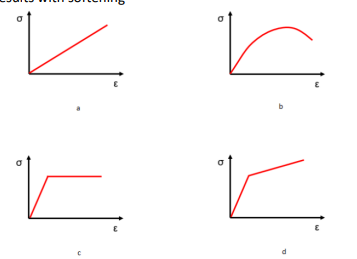
Choose which one of the below graph best describe nonlinear results with softening
b
How does conduction differ from convection in heat transfer?
a) No difference, both method transfer heat through equally
b) Conduction is the transfer of heat from high to low temperatures (fixed molecules) whereas convection transfers heat via bulk movement of molecules within fluids such as gases and liquid.
c) FEA can model conduction but not convection
d) Heat transfer faster via conduction given all other parameters being equal
b
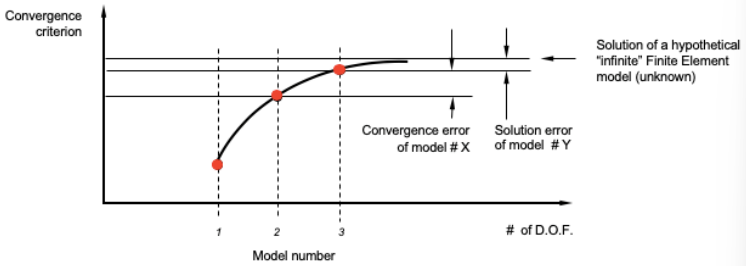
What are the values of X and Y for the given convergence curve.
a) X= 3 Y=2 b) X=2 Y=3 c) X=2 Y=2 d) X=3 Y=3
d
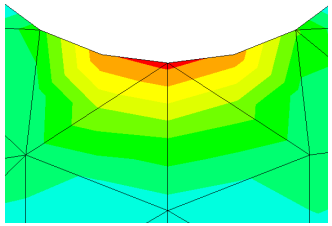
What kind of stresses are shown in the image below
a) Nodal Stresses
b) Element Stresses
c) Guass Stresses
d) First Order Stresses
a
Why are all terms on the main diagonal of a stiffness matrix positive?
a) Negative Terms would indicate negative stiffness
b) Zero Terms would indicate no stiffness in given direction
c) Displacement boundary conditions have not yet be defined
d) A & B
d
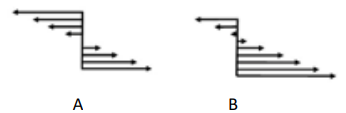
Which resultant bending stress includes membrane stress?
a) A b) B c) Both A&B d) Neither
b
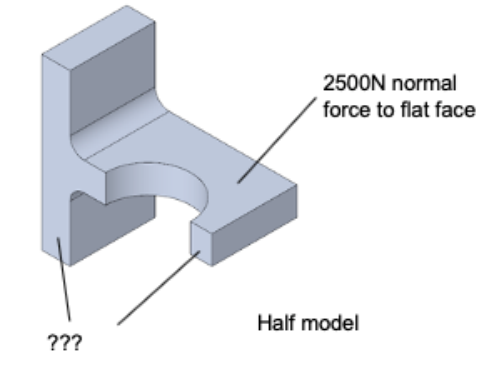
The below image shows a model cut in half, what belongs where the arrows point to:
a) Fixed Supports
b) Nothing Required
c) Symmetry boundary Conditions
d) Axial boundary Conditions
c
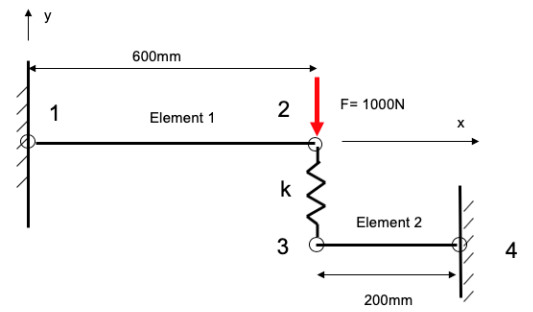
How do you connect the elements 1 and 2 using the spring?
a) Include the 1D spring constants between nodes 2 and 3 in the global stiffness matrix
b) Consider nodes 2 and 3 to be the same
c) Treat the spring as an additional element
d) Decrease the size of the global stiffness matrix
a
Which analogy for thermal analysis compared to structural analysis is correct?
a) Displacement is analogous to heat flux
b) Strain is analogous to temperature
c) Displacement is analogous to temperature
d) Strain is analogous to heat flux
c
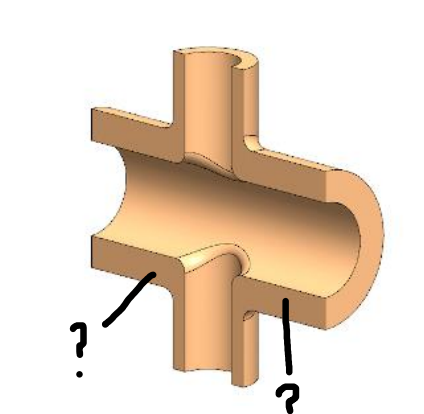
The below image shows a thermal analysis model cut in half, what belongs where the arrows point to:
a) Fixed Supports
b) Nothing Required
c) Symmetry boundary Conditions
d) Axial boundary Conditions
b
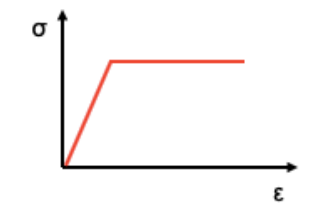
Which material model is shown below in the plot.
a) Linear Elastic
b) Non-Linear with softening
c) Elastic-perfectly plastic
d) Bi-linear with softening
c
Which is situation best describes buckling?
a) A situation where a very small increase in load causes large displacement
b) A situation where a very large increase in load causes large displacement
c) A situation where a very small increase in load causes small displacement
d) A situation where a very large increase in load causes small displacement
a
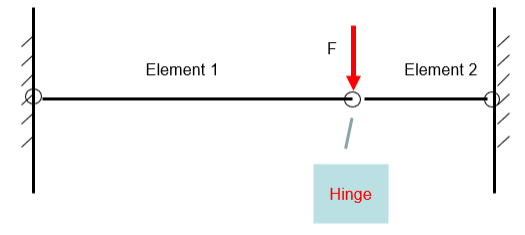
How many nodes are in this model?
a) 1 b) 2 c) 3 d) 4
d

Which Symbol is this in SolidWorks?
a) Beam Element
b) Beam Stress
c) Truss Element
d) Truss Stress
a
Before FEA processing, what is required?
a) Fully detailed CAD Geometry
b) Simplified CAD Geometry
c) Verification of Results
d) Iterations of Mesh Size
b
What is the difference between Verification and Validation?
a) Verification: checks if results match FEA model; Validation: checks if results match math model
b) Verification and Verification are interchangeable
c) Verification: checks if results match reality/intended use; Validation: checks if results match math model
d) Verification: checks if results match math model; Validation: checks if results match reality/intended use
d
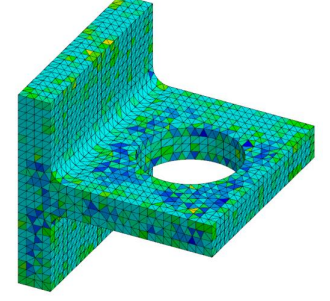
What plot is this an example of?
a) Displacement b) Stress c) Aspect Ratio d) Strain
c
Which of the following analyses is NOT an application of the Finite Element Method?
a. Buckling
b. Vibration
c. Wear
d. Heat transfer
c
Which of the following is NOT an advantage of the Finite Element Method?
a. Requires minimal understanding of the method in order to obtain correct results
b. Models irregularly shaped bodies quite easily
c. Handles unlimited numbers and kinds of boundary conditions
d. Handles non-linear behaviour existing with large deformations and non-linear materials
a
Which of the following is NOT a valid element geometry?
a. Shell
b. Beam
c. Truss
d. Surface
d
Which of the following is NOT a difference between beam and shell elements?
a. Shell elements have two distinct sides, while beam elements do not
b. Shell elements allow for axial loads, while beam elements do not
c. Shell elements can be used to model parts of greater than 1-dimension, while beam elements cannot
d. Shell elements can be used to model beams, but beam elements cannot be used to model shells
d
Which of the following best explains why a fixed support at a singularity is ill-advised?
a. Causes the part to fail more quickly
b. Hard to determine the exact stress at that point
c. Leads to the nonsensical result of infinite stress
d. Can never truly occur in the real world
c
Which of the following describes one type of singularity?
a. Infinite stress; infinite displacement
b. Infinite energy; infinite stress
c. Infinite energy; finite stress
d. Infinite energy; finite displacement
b
Which of the following is the best method to manage singularities present in a model?
a. Increase mesh refinement
b. Decrease mesh refinement
c. Use adaptive mesh refinement
d. Singularities cannot be managed via mesh adjustments
d
Which of the following is true regarding membrane stress?
a. Is not considered at all in linear analysis
b. Depends only on the amount of displacement in the membrane
c. Is generally small in comparison to resultant bending stresses
d. Can only occur in symmetric parts
a
Which of the following best describes the way in which to determine whether a given problem requires non-linear analysis?
a. If the load-time history graph is not a straight line
b. If the force-displacement graph is not a straight line
c. If the resultant maximum von Mises stress is significantly higher than expected
d. If other supports (i.e. not fixed supports) are used in the simulation
b
Which of the following best describes the difference between linear and non-linear analyses?
a. Linear analysis will always give less accurate stresses than non-linear analysis
b. Linear analysis will always show higher displacements than non-linear analysis
c. Linear analysis cannot account for changing stiffness
d. Linear analysis cannot model non-linear displacements
c
Which of the following is NOT true about non-linear analysis?
a. It should not be used if yielding is not present
b. It should not be used if stiffness does not change
c. It will never give an incorrect result
d. It is an order of magnitude more expensive to compute
a
A beam loaded at its centre with a fixed support at one end is supported at the other end in two ways: (A) fixed support, (B) roller-slider. Linear analysis will show ____ maximum displacement in model (A) compared to model (B), while non-linear analysis will show ____ maximum displacement in model (A) compared to model (B).
a. Higher; higher
b. Lower; lower
c. The same; higher
d. The same; lower
d
Which of the following is NOT true about supports?
a. Fixed supports remove all 6 rigid body motions
b. Immovable supports remove all 6 rigid body motions
c. Roller-slider supports remove 5 rigid body motions, allowing only translation in one direction
d. Hinge supports remove 5 rigid body motions, allowing only rotation about one axis
b
Which of the following is NOT true about the stiffness matrix in the Direct Stiffness Method?
a. It is symmetric about the main diagonal
b. It is square with dimension equal to the total number of DOFs of the system
c. It is independent of coordinate system
d. It becomes sparse as it gets large
c
Which of the following is NOT true about the Direct Stiffness Method?
a. It is useful in order to verify results obtained via FEM simulations
b. It never yields more than one possible non-trivial solution
c. The number of equations is always equal to the number of DOFs
d. It remains unchanged regardless of whether or not symmetry is employed
d
Which of the following material categories typically exhibits the highest thermal conductivity?
a. Liquids
b. Pure metals
c. Non-metallic solids
d. Alloys
b
Which of the following best describes how heat transfer by convection works?
a. Excited molecules from one medium excite neighbouring molecules from another medium in direct contact with the first
b. Energy from a hot fluid is transferred to a cooler solid surface
c. Energy from a hot solid surface is transferred to a cooler liquid
d. Two fluids of different temperatures are directly combined and reach thermal equilibrium
c
Which of the following is NOT an analogy between structural and thermal analyses?
a. Displacement; thermal conductivity
b. Strain; temperature gradient
c. Stress; heat flux
d. Load; heat source
a
Which of the following accurately describes rigid body motion?
a. Any form of displacement of a body accompanied by deformation.
b. Any motion of solid structures.
c. Any form of displacement of a body that is not accompanied by deformation.
d. All types of translational motion.
c
Which of the following elements below contain the most degrees of freedom per node?
a. beams
b. solids
c. shells
d. both a and c
d
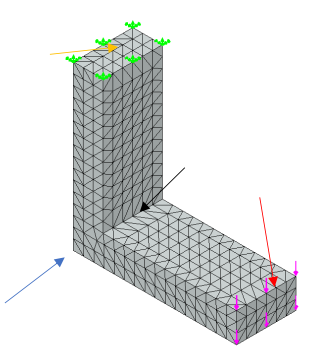
Consider the L-bracket shown below with the applied loads and fixtures. At which location will there be a stress singularity?
a. Location of red arrow
b. Location of blue arrow
c. Location of black arrow
d. Location of yellow arrow
c
Which of the following describes p-convergence?
a. Element size is reduced while element order stays the same
b. Element size is reduced while element order is increased.
c. Element order is increased while element size stays the same.
d. Element order is increased while element size is increased.
c
How many degrees of freedom does each node in a solid element have for a thermal problem?
a. 0
b. 1
c. 2
d. 3
b
Which of the following represents a verification error?
a. Poorly refined mesh resulting in inaccurate results
b. Incorrect dimensioning of the element
c. Incorrect loadings applied
d. Assuming small displacements when invalid
a
What must be assumed to remain constant in order to carry out linear analysis in a structural problem?
a. Displacement
b. Stiffness
c. Time
d. Temperature
b
Which of the following is FALSE when regarding first order elements?
a. Linear interpolation function
b. Nodes only at corners
c. Able to capture curvature
d. Very fast computational time
c
Truss elements can only withstand loads…
a. in compression
b. in tension
c. perpendicular to the axis of the member
d. along the axis of the member
d
What does the slope of the linear portion of a stress-strain plot represent?
a. Factor of safety
b. Modulus of Elasticity
c. Yield strength
d. Displacement
b
What colour corresponds to the bottom face of a shell element in SolidWorks?
a. Gray
b. Yellow
c. Orange
d. Red
c
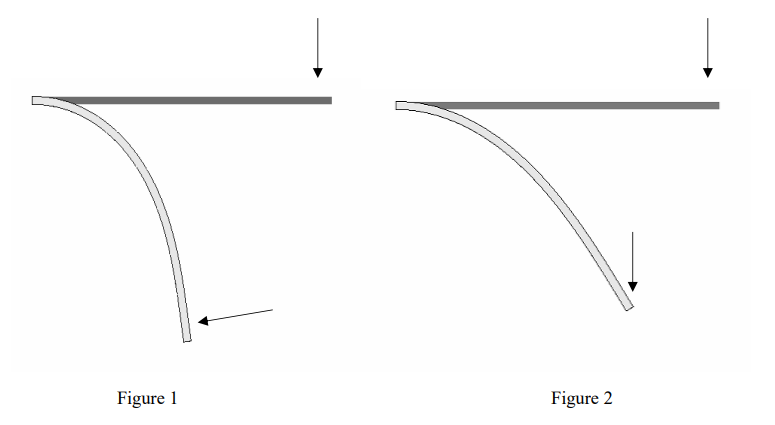
Consider the following figures. Which type of loads are applied in each?
a. Figure 1 is a following load, Figure 2 is a non-following load
b. Figure 1 is a non-following load, Figure 2 is a following load
c. Figure 1 is a conservative load, Figure 2 is a non-conservative load
d. Both Figures are conservative loads
a
Which best describes validation?
a. Process of determining if the mathematical model has been correctly discretized and solved.
b. Process of checking if FEA model correctly represents the reality of the intended use.
c. Process of progressive mesh refinement.
d. Process of increasing element order
b
For which element listed below is there a difference between fixed geometry and immovable restraints?
a. Shells
b. Solids
c. Trusses
d. All of the above
a
How many DOFs does a first order solid tetrahedral element have?
a. 4
b. 24
c. 12
d. 30
c
What is the definition of the small displacements assumption?
a. Stiffness changes with displacement
b. Stiffness does not change with displacement
c. The linear material behaviour complies with Hooke’s law
d. The linear material behaviour does not comply with Hooke’s law
b
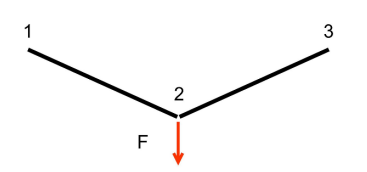
If you were to apply symmetry boundary conditions to the series of trusses shown below, what would you need to change about the original force F in your DSM calculation?
a. Multiply F by 2
b. Divide F by 2
c. No changes to F
d. Set F = 0
b

What does the following symbol in SolidWorks represent?
a. Surface geometry is meshed with shell elements
b. Solid geometry is meshed with solid elements
c. Solid geometry is meshed with beam elements
d. Sheet metal geometry is meshed with shell elements
d
In SolidWorks, what does the term immovable mean?
a. No rotation or translation
b. Still allows translation
c. Still allows rotation
d. Allows rotation and translation
c
With respect to non-linear problems and large displacements, what is a synonym for following load?
a. Conservative load
b. Non-conservative load
c. Non-following load
d. Displacement load
b
Which of the following statements is correct?
a. If the change in stiffness throughout load application is negligible, then non-linear analysis is not required
b. If yielding is not present then non-linear analysis is not required
c. Non-linear analysis is always better than linear analysis
d. Non-linear analysis will always only be solved once
a
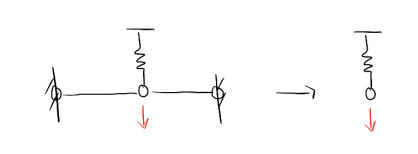
Why can the series of trusses and springs (on the left) be simplified to only the spring (on the right)?
a. Springs have stiffness when loaded axially
b. Springs do not have stiffness when loaded axially
c. Trusses have stiffness when loaded non-axially
d. Trusses do not have stiffness when loaded non-axially
d
With respect to modal analysis, what is the relationship between the vibrational frequency and the period?
a. f = 1/T
b. f = 2T
c. T = 2f
d. T = f
a
Which of the following statements is correct?
a. Buckling is defined as gradual large displacements due to compressive loads.
b. Buckling is defined as the sudden large displacements due to compressive loads.
c. Buckling is defined as the gradual large displacements due to tensile loads.
d. Buckling is defined as the sudden large displacements due to tensile loads.
b
Which of the following statements is incorrect about the Buckling Load Factor (BLF)?
a. The critical load makes up the numerator of the BLF
b. The applied load makes up the denominator of the BLF
c. The BLF represents a number by which the applied load must be divided in order to obtain the buckling load magnitude
d. The BLF represents a number by which the applied load must be multiplied in order to obtain the buckling load magnitude
c
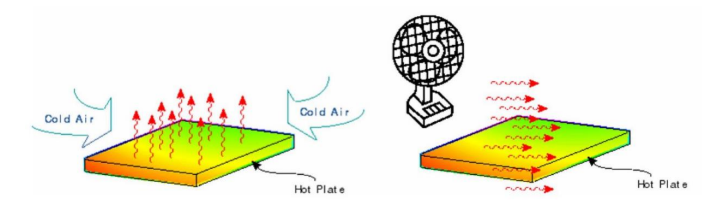
Which of the following statements is correct about the types of convection in the two figures below?
a. left - natural convection, right - natural convection
b. left - natural convection, right - forced convection
c. left - forced convection, right - forced convection
d. left - forced convection, right - natural convection
b
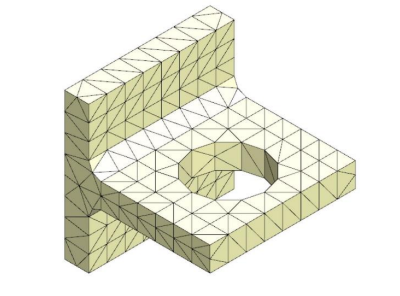
What is the problem with this model?
a. Mesh has been refined too much
b. Second order elements were used
c. The hole is too big
d. First order elements were used
d
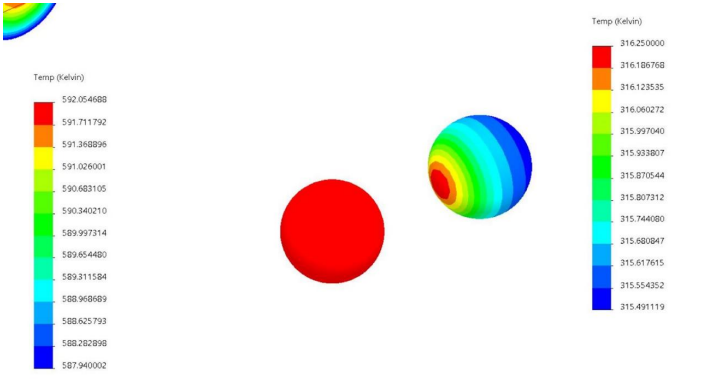
Based on the models and their temperature plots shown below, which statement is correct?
a. Heat radiates from the left ball to the right ball
b. Heat radiates from the right ball to the left ball
c. Heat does not radiate at all from either ball
d. This is a convection problem and we do not have enough information
a
Which of the following is not an example of mesh incompatibility?
a. Unattached node due to first order element and second order element meshing
b. Gap forming under loading due to first order and second order element meshing
c. High curvature distortion in the mesh
d. Hinge forming along the connection between a shell element and a solid element
c
What is the correct definition of the stiffness, K for a beam element (to be used in the DSM solution)?
a. EI/L^2
b. EI/L^3
c. EI^4 /L^3
d. EI/L
b