Chapter 2.5: Elements
 Call Kai
 Learn
Learn Practice Test
 Spaced Repetition
 Match
Match Flashcards
 Knowt Play
1/13

Name | Mastery | Learn | Test | Matching | Spaced | Call with Kai | Chat |
|---|
No analytics yet
Send a link to your students to track their progress
14 Terms
Dmitri Mendeleev
Russian scientist who, in 1871, arranged elements by increasing atomic mass and chemical properties to form the periodic table of elements
Periodic table of elements
Table based on work by Mendeleev, arranged by atomic number
Arranged in periods (rows) and groups (columns)
Each period has a number from 1 to 7; each group has a number from 1 to 18
Group
A column on the periodic table; elements in a group usually have the same outer electron configuration and thus similar chemical behavior
Numbered from 1 to 18; includes:
1: alkali metals
2: alkaline earth metals
13 to 16: named for first element in group
17: halogens
18: noble gases
Also called a “family” for elements
Main-group elements
This includes groups 1, 2, and 13 through 18, with predictable outer charges
Transition elements (transition metals)
These include groups 3 through 12
Inner transition elements
Includes the lanthanides and actinides between groups 3 and 4
Alkali metals
The name for group 1, except for hydrogen
Classified as reactive metals
Alkaline earth metals
The name for group 2
Classified as reactive metals
Halogens
The name for group 17
Classified as reactive nonmetals
Noble gases
The name for group 18
Classified as relatively unreactive nonmetals due to their full valence shells
Element classifications
Can be grouped into three:
Metals
Nonmetals
Metalloids
Marked by a staircase line from boron to tellurium (not aluminum)
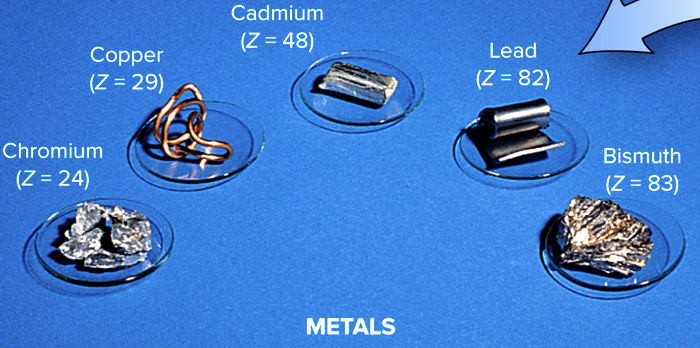
Metals
Group of elements located in the left and middle portions of the periodic table
Includes many main-group elements and all transition elements
Shiny and solid at room temperature
Can conduct heat and electricity
Malleable and ductile

Metalloids (semimetals)
Group of elements located along the staircase line of the periodic table
Includes boron to tellurium, except aluminum
Shiny and solid, but brittle
Semiconductors of heat and electricity
Has properties of both metals and nonmetals
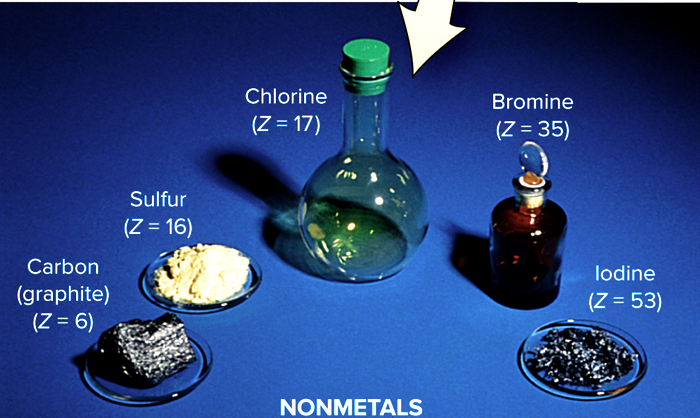
Nonmetals
Group of elements located in the upper-right portion of the periodic table; includes hydrogen as well
Includes some of the main-group elements
Gases or dull, brittle solids at room temperature
Poor conductors
Not malleable or ductile