ch7 acid base balance
 Call Kai
 Learn
Learn Practice Test
 Spaced Repetition
 Match
Match Flashcards
 Knowt Play
1/108

There's no tags or description
Looks like no tags are added yet.
Name | Mastery | Learn | Test | Matching | Spaced | Call with Kai | Chat |
|---|
No analytics yet
Send a link to your students to track their progress
109 Terms
maintenance of a normal pH and homeostatic allows for what 3 things:
Normal cellular function
Enzyme activity
Membrane stability
what are acids
substance that gives or donates hydrogen (H+) ions
what are volatile acids
acids that can be converted into gas form and eliminated via the lungs
what is the volatile acid we have and its equation
carbonic acid (HCO3)
H2CO3 ←→ CO2 + H20
how is the concentration of CO2 expressed
PaCO2
what is PaCO2
a measurement of partial pressure exerted by CO2 in the blood
how are volatile acids eliminated?
through the lungs as CO2
what are nonvolatile acids
products of metabolism
what are the 2 categories of sources nonvolatile/fixed acids come from?
exogenous and endogenous
what are exogenous sources of nonvolatile/fixed acids? (4)
ingestion of food
metabolism of protein (phosphoric acid, sulfuric acid)
fat (ketoacids)
carbs (pyruvic, lactic, and citric acid)
what are the endogenous sources of nonvolatile/fixed acids? (5)
Starvation
Fever
Exercise
Disease
drugs
how are nonvolatile/fixed acids eliminated?
via the kidneys
what are bases?
can accept or receive H+ ions
define pH
ratio of base (HCO3-) to acids (H2CO3)
in a healthy state, what is the ratio of bases:acids
20 base: 1 acid
to maintain a steady pH, the ratio must remain
constant
what is the predominant base in human acid-base balance
bicarbonate (HCO3-)
how does bicarbonate appear in the ECF
NACHO3- , or with K or Mg
what organ provides primary regulation of bicarbonate regulation
kidney
high pH =
alkaline
low pH=
acidic
what is normal pH range
7.35-7.45
define acidosis
process leading to the accumulation of acid or loss of base
define acidemia
pH < 7.35
define alkalosis
process leading to accumulation of base or loss of acid
define alkalemia
pH > 7.45
In clinical practice, this distinction is generally not make, and the terms acidosis and alkalosis are used to refer to
abnormal pH
what regulates the concentration of HCO3
kidneys
which is the predominant base in the body?
bicarbonate
what are the 3 types of regulation of acid-base balance?
Chemical buffering (cellular)
Respiratory regulatory control of CO2 (lungs)
Renal regulatory control of HCO3- (kidneys)
how do buffers work
Buffers don’t change the actual number of H+ but they limit the amount of free H+ including both extracellular and intracellular buffers
bicarbonate-carbonic acid buffer system is the primary buffer in
ECF
what does the bicarbonate-carbonic acid buffer system do?
buffers the fixed acid load (diet generated, etc)
does not work against carbonic acid changes
equation for bicarbonate-carbonic acid buffer system
H + HCO3 <--> H2CO3 <--> CO2 + H20
what is the role of the lungs for the Bicarbonate-carbonic acid buffer system
Lungs expel the excess CO2 by increasing rate and depth of breathing
the strength if the Bicarbonate-carbonic acid buffer system is related to the availability of
HCO3- (bicarbonate)
bicarbonate is regulated by the
kidneys
what are the other chemical buffer systems (4)
protein buffer system
hemoglobin buffer system
phosphate buffers
bone carbonate buffer
what is the protein buffer system (function and where)
primary intracellular buffer
proteins can operate as both acid and base buffering systems
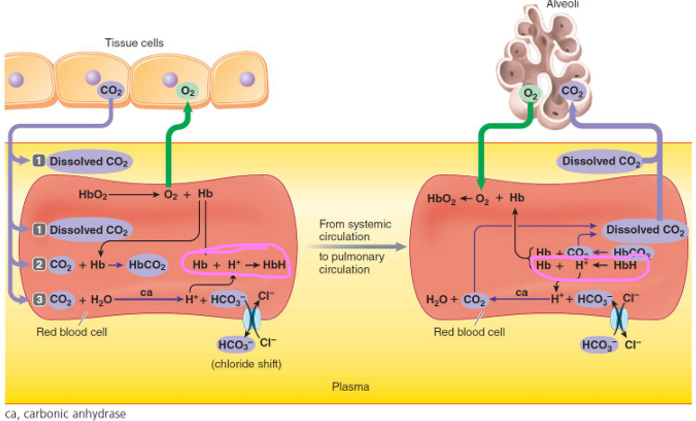
what is the hemoglobin buffer system (what does it do, where?. primary buffer against what changes?)
most important blood buffer
primary buffer against carbonic acid changes
CO2 + H2O <--> H2CO3 <--> H + HCO3 ---> Hbg binds to H+
what do the phosphate buffers do?
reduced acidity of urine --> protects kidneys
how does respiration (lungs) regulate acid base balance?
lungs have the ability to change the rate of respiration and depth of breathing to control the release or retain CO2
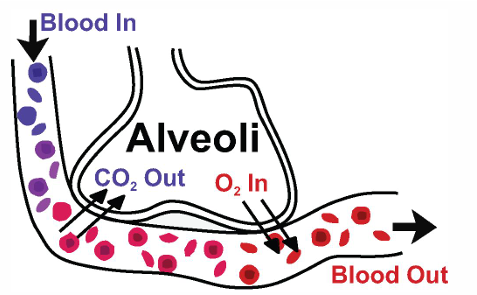
normal relationship between CO2 generated and CO2 released
equal
how do lungs regulate acid-base?
respond to changes in (H+) by changing rate or depth (or both)
which system has the best buffering ability?
respiration regulation (immediate and spontaneous)
1-2x > buffering power of all chemical buffers
In metabolic disturbances (high fixed acid load), what happens to the lungs
they cant excrete enough CO2 to maintain a normal pH BUT this is usually compensated to maintain a range compatible with life
renal regulatory control allows control for what 2 things
both free H+ and HCO3- (can impact both of these)
rate of renal regulation?
a lot slower than respiratory…
In normal healthy kidneys and normal pH how much bicarbonate (HCO3-) is resorbed?
100% of HCO3- is resorbed (to be able to balance acids)
what does renal H+ secretion refer to?
H+ secretion refers to kidney pumping H+ ions from blood into the urine (to get rid of acid)
renal responses for acidosis (changes made):
H+ secretion
H+ excretion
HCO3 reabsorption and addition to plasma
HCO3 excretion
pH of urine
compensatory change in plasma pH (what is the goal)
H+ secretion (increase)
H+ excretion (increase)
HCO3 reabsorption and addition to plasma (increase)
HCO3 excretion (normal→ zero: all is reabsorbed)
pH of urine (acidic)
compensatory change in plasma pH (what is the goal) —> alkalinization toward normal
renal responses for alkalosis:
H+ secretion
H+ excretion
HCO3 reabsorption and addition to plasma
HCO3 excretion
pH of urine
compensatory change in plasma pH (what is the goal)
H+ secretion (decrease)
H+ excretion (decrease)
HCO3 reabsorption and addition to plasma (decrease)
HCO3 excretion (increase)
pH of urine (alkaline)
compensatory change in plasma pH (what is the goal)—> acidification towards normal
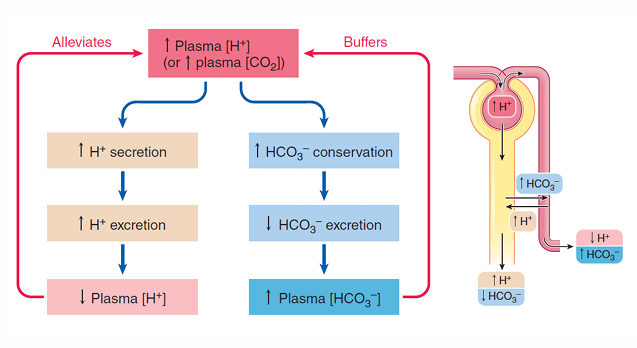
renal response to acidosis path?
increase in H+ secretion —> increased excretion —> decrease H+ in plasma
increase HCO3- conservation —> decreased excretion —> increase bicarbonate in plasma —> increased ability to buffer
H+ and bicarbonate are both considered
electrolytes
how do acid-base changes impact electrolytes
affect concentration of other electrolytes (potassium, chloride, sodium)
what are the main 4 base-acid disorders?
respiratory acidosis
respiratory alkalosis
metabolic acidosis
metabolic alkalosis
what does simple refer to? mixed?
simple is one acid-base disturbance event; mixed means more than one
A presence of a disturbance can affect what?
electrolytes (for example, shifts in K levels)
respiratory acid base disorders involve what compound
CO2
metabolic acid base disorders involve what compounds
HCO3 concentration by the kidneys OR nonvolatile acids
respiratory acidosis is caused how?
retention of CO2
why is ti hard to assess for acid base balance
Body attempts to self-correct changes in pH
If both acid and base increase or decrease within the same proportion, pH will remain steady
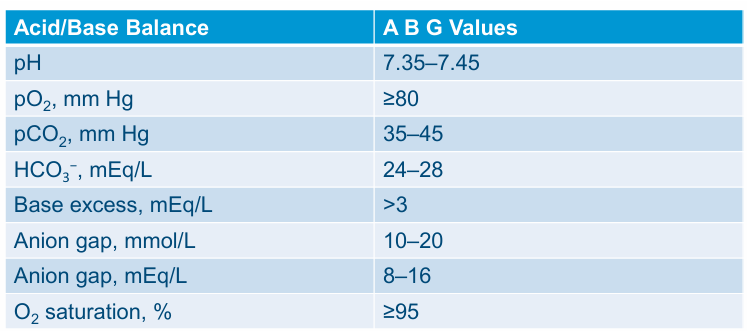
what are the 3 common types of labs measured?
Arterial blood gas (ABG)
Serum chemistries
Anion gap: difference between unmeasured anions and cations
normal lab values for acid-base balance
what does compensated and uncompensated acid base status mean?
Uncompensated means that the CO2 value changes without changes in bicarbonate
Compensated means CO2 value changes and also bicarbonate
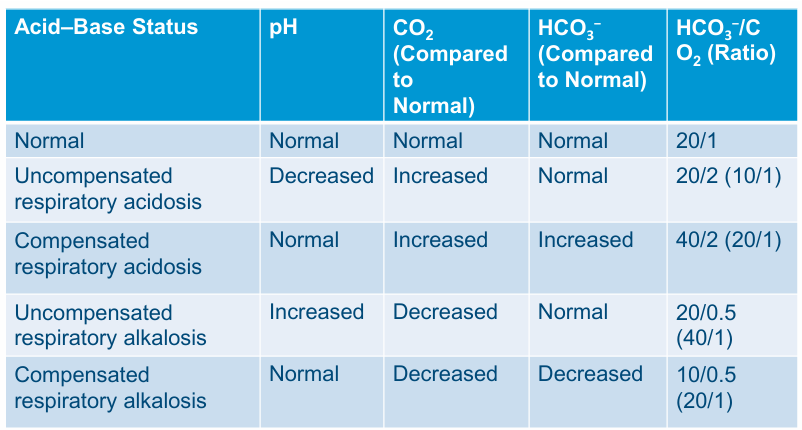
uncompensated respiratory acidosis
pH
CO2 (compared to normal)
bicarbonate (compared to normal)
HCO3/CO2 ratio
decreased
increased
normal
20/2 (10/1)
compensated respiratory acidosis
pH
CO2 (compared to normal)
bicarbonate (compared to normal)
HCO3/CO2 ratio
normal
increased
increased
40/2 (20/1)
uncompensated respiratory alkalosis
pH
CO2 (compared to normal)
bicarbonate (compared to normal)
HCO3/CO2 ratio
increase
decrease
normal
20/0.5 (40/1)
compensated respiratory alkalosis
pH
CO2 (compared to normal)
bicarbonate (compared to normal)
HCO3/CO2 ratio
normal
decreased
decreased
10/0.5 (20/1)
for respiratory acidosis, what are the common lab values
pH
pCO2
bicarbonate
Ca, K, Cl
oxygen levels
pH : decreased
pCO2: increased
bicarbonate: slightly elevated
Ca, K, Cl: increase in serum
oxygen levels: hypoxemia present
symptoms of respiratory acidosis (7)
restlessness
apprehension
lethargy
muscle twitching
tremors
convulsions
coma
what are common caused of respiratory acidosis (15)
Hypoventilation (lack of CO2 excretion)
Chronic obstructive pulmonary disease (COPD)
Severe pneumonia or asthma
Acute pulmonary edema
Pneumothorax (collapse lung)
Drugs: opiate, sedative, anesthetic overdose (acute)
Excessive oxygen treating chronic hypercapnia
Sleep apnea
Neuromuscular disease (such as amyotrophic lateral sclerosis (ALS), Guillain-Barre syndrome, spinal cord injury)
Morbid obesity, Pickwickian syndrome
Chest wall injury or skeletal deformity
Aspiration of foreign body or vomitus
Laryngospasm, laryngeal edema, severe bronchospasm
Excessive production of CO2
Overfeeding, especially with high carb components of nutrition support
treatment for resp. acidosis?
Focuses on correcting the underlying condition
Focuses on increasing oxygenation (Through mechanical ventilation)
The lungs work to get rid of an increased amount of acid by
Increasing rate and depth of breathing
what is respiratory alkalosis?
Increase in base (HCO3) as a result of increased CO2 release via hyperventilation
what is the acute response for respiratory alkalosis
shift of acid from ICF to ECF with the movement of bicarbonate into cells in exchange for chloride
uncontrolled respiratory alkalosis presents what in terms of
pH
paCO2
K, Ca, Cl
pH >7.45
paCO2 decreased
↓K, Ca, and ↑Cl
what is the compensatory response for respiratory alkalosis
Kidneys retain H+ and excrete HCO3-
in order to lower pH (more acidic)
what are common causes of respiratory alkalosis? (9)
Hyperventilation (increase in CO2 excretion)
Respiratory infection (Pneumonia)
Asthma
Change in altitude environment (ex: high altitude)
Drugs that stimulate respirations (ex: theophylline, catecholamines)
Anxiety and cerebrovascular accident
Fever and sepsis
symptoms of alkalosis (lab)
pH
plasma HCO3 in chronic
PaCO2 in acute
pH > 7.45
Plasma HCO3 is low in chronic
PaCO2 is low in acute
respiratory alkalosis includes what system symptoms?
cardiovascular, central nervous, and respiratory symptoms
treatment for respiratory alkalosis
Sedative, anti-anxiety agents for hyperventilation related anxiety
Hyperventilation related to other medical causes will be focused on treatment of those conditions (fever, pulmonary embolism, etc.)
what is metabolic acidosis
Refers to all types of acidosis that are not causes by excessive CO2
what is the most common cause of metabolic acidosis
diarrhea
common causes of metabolic acidosis? (9)
Ileostomy or pancreatic, biliary, or intestinal fistulas
Kidney loss of HCO3-
Chronic kidney disease
Systemic loss of HCO3-
Diarrhea and fistula drainage
Excessive production of acid
Ketoacidosis secondary to conditions such as diabetes mellitus, alcoholism, or starvation
Lactic acidosis secondary to conditions such as diabetes mellitus, salicylate overdose (form of aspirin)
signs and symptoms of metabolic acidosis
Tachypnea leading to Kussmaul respirations, hypotension, cold and clammy skin, coma
what is the primary compensatory response for metabolic acidosis?
Lungs increase the release of CO2 by increasing the rate and depth of breathing to deepen respiration
what is the secondary compensatory response for metabolic acidosis?
Kidneys increase excretion of H+ and retention of HCO3 --> effectiveness is decreased if renal disease is present
treatment for metabolic acidosis focuses on what and has goal of what ?
the underlying cause
Goal: raise systemic pH to safe level
examples of treatments (3)
Ketoacidosis --> insulin therapy
Hyperosmolality --> rapid rehydration
Bicarbonate replacement
Why does diabetic ketoacidosis result in metabolic acidosis?
Ketones are strong acids and a buildup will result in lack of bicarbonate to neutralize them, resulting in lowering the pH. They cause metabolic acidosis when there is a severe lack of insulin forces for the body to break down fat for energy (use the ketone bodies )
what is metabolic alkalosis
Due to excessive amount of base
metabolic alkalosis relation with fluid balance?
Fluid imbalance: alkalosis with volume decrease
Without fluid imbalance: alkalosis without volume contraction
Initiation of metabolic alkalosis begins with the underlying event that causes either what or what?
an excessive loss of acid or accumulation of base
common causes of metabolic alkalosis (7)
Loss of acid
Vomiting
Nasogastric suctioning
Hypokalemia
Intravenous therapy
Blood transfusion
Excessive or chronic use of antacids
signs and symptoms of metabolic alkalosis?
No specific signs and symptoms
lab values that could show metabolic alkalosis?
Indicated pH > 7.45 and elevated levels of HCO3-
treatment for metabolic alkalosis focuses on
correction of underlying cause
how is volume imbalances with metabolic alkalosis corrected?
isotonic saline with KCL
In severe conditions what is used to enhance HCO3 excretion?
carbonic anhydrase inhibitor (rmb that this enzyme allows for Hgb to bind to H+; so inhibiting it will allow for more acid in the blood)