Session 5: Restorative DTP
 Call Kai
 Learn
Learn Practice Test
 Spaced Repetition
 Match
Match Flashcards
 Knowt Play
1/43

There's no tags or description
Looks like no tags are added yet.
Name | Mastery | Learn | Test | Matching | Spaced | Call with Kai | Chat |
|---|
No analytics yet
Send a link to your students to track their progress
44 Terms
oral path/med/radiology consult is what axium code?
D99992
student will complete the oral dx 2024 form, book a 20min appt with front disk in pilot clinic on tues or wed morning
for radiology consult send directly to radiology faculty
common dx of failing restorations
cracks/fractures
open margins
voids in material
loose restorations
poor contour
overhang
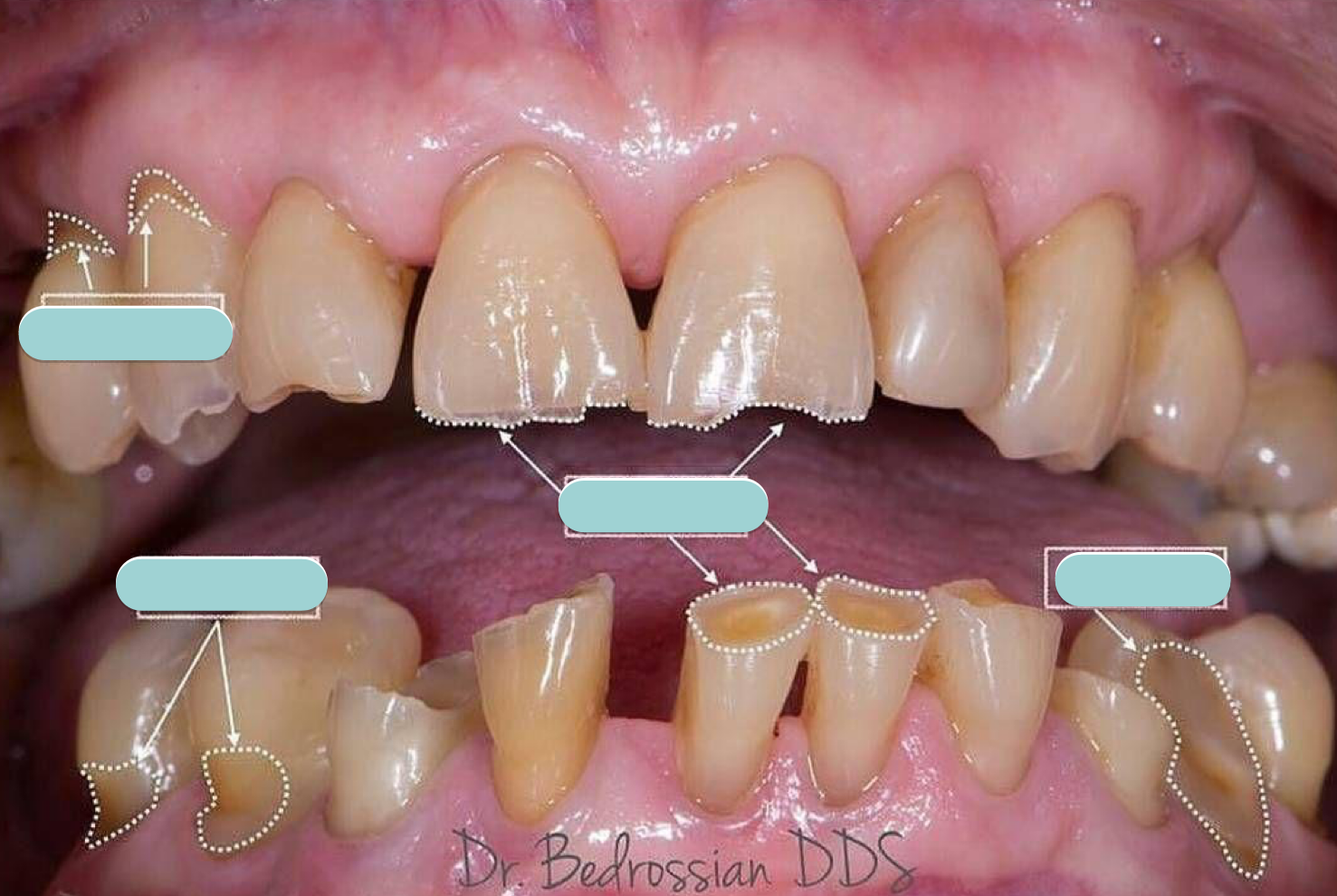
most common tooth structure problems
attritions (wear facets)
abrasion
abfraction
erosion
(last three are non-carious cervical lesions)
abfraction vs abrasion
Abfraction is tooth wear caused by internal flexural stress from biting forces that creates V-shaped lesions at the gum line, whereas abrasion is physical wear from external friction that creates flat, scooped-out damage on exposed tooth surfaces

In cases of asymptomatic teeth, where tooth vitality and function are not compromised, abfraction/erosion lesions should be monitored for at least (?) months before any invasive procedure is planned
6
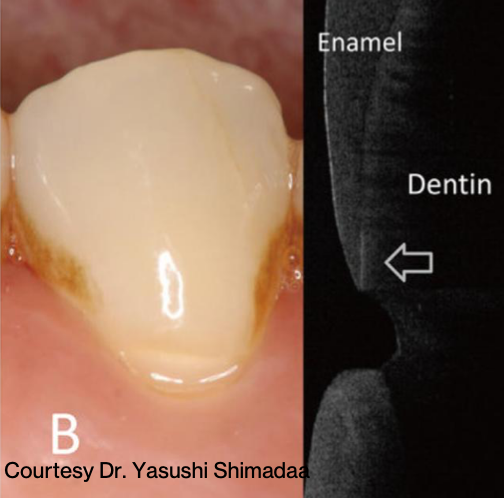
abfraction is associated w (?) meaning there are restorative and perio considerations
gingival recession
most common functional problems with tooth position
hyper-erupted tooth
crossbite
most common esthetic complaints
discolored teeth:
extrinsic staining
intrinsic staining: physical trauma, congenital and developmental conditions
diastema
most common pulpal and periapical dx:
(cold test + PA w/in 6 mo for endo consult)
Reversible pulpitis
Irreversible pulpitis
Pulpal necrosis
Acute apical periodontitis
Chronic apical periodontitis
Calcified canals
Internal/external resorption
Root fractures
Secondary to trauma
what are four reasons a crown is indicated?
(either to improve appearance or fix structurally damaged dentition)
tooth fracture
esthetic reason
tooth w craze lines
large existing restoration (MOD, deep, leaving thin axial walls)
fillings can create (?) effect that leads to tooth fracture
wedging effect
fillings that take up 1/3rd of intercuspal distance of tooth (increases/reduces) tooth resistance to fracture by one half
reduces
a tooth’s risk for fracture increased substantially as its filling approached 50% of its intercuspal distance. so fillings, composites, or amalgam should not exceed (?-?) of this distance
1/3rd to 1/4th this distance
what are some examples of structurally damaged dentition?
Pre-existing defective crown
Large pre-existing defective restoration
Large pre-existing restoration as preventative measure
or damage due to:
Caries
Large Enamel-Dentin fractures
Cracked tooth Syndrome
what is the difference between a crown and a direct restoration?
The width of the prep or the defective restoration exceeds one-half of the facial- lingual cusp tip to cusp-tip distance = Crown
A direct restoration is a filling placed directly into a prepared cavity in a single visit, while a crown is a custom-made cap that covers the entire visible portion of a tooth and typically requires two visits and laboratory fabrication.
The width of the prep or the defective restoration exceeds one-half of the facial- lingual cusp tip to cusp-tip distance = Crown
crown
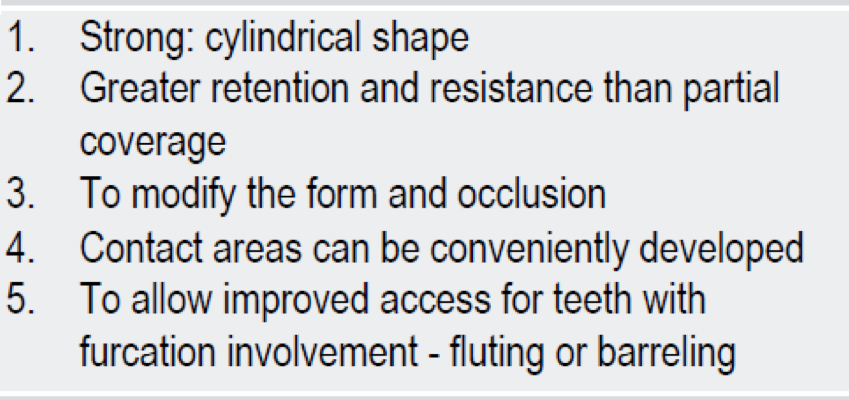
advantages
full cast metal crown

advantages
plus superior esthetics
PFM

advantages
all ceramic crown

disadvantages
cast metal

disadvantages
PFM

disadvantages
all ceramic
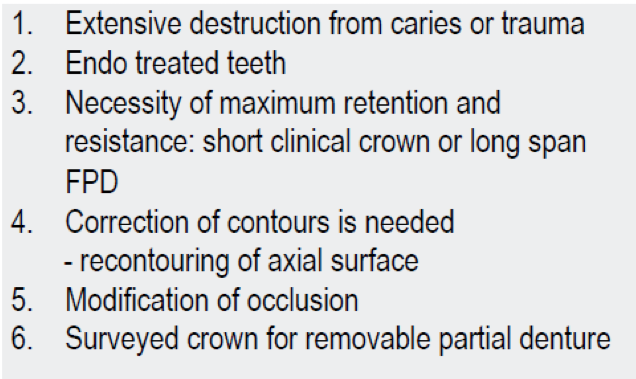
indications
cast metal

indications
PFM
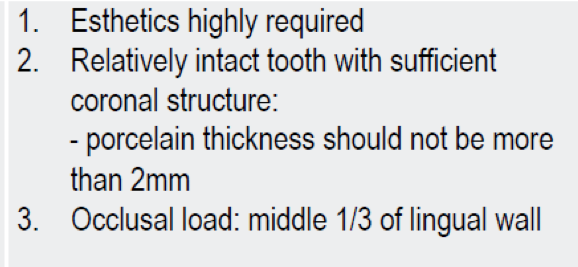
indications
all ceramic

contraindicationsx
cast metal

contraindications
PFM
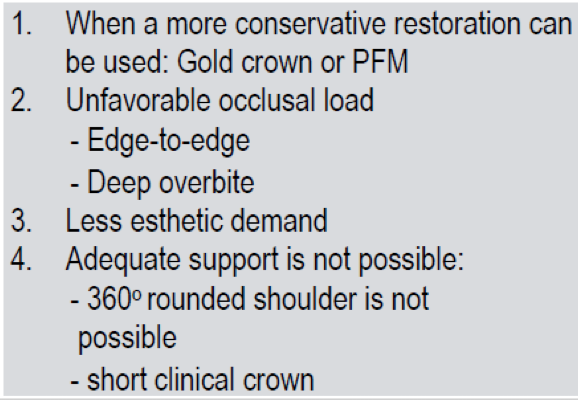
contraindications
all ceramic
which crown?
esthetics: superior translucency and color matching as well as thin tissue biotype
E- max and zirconia
which crown?
surveyed crowns: modification difficulty, precision in design
PFM (zirconia would be a challenge)
which crown?
metal allergy/sensitivity: metal-free, highly biocompatible
zirconia (E-max would be a challenge for molars and bruxism)
which crown?
heavy bruxism: high risk of fracture in heavy occlusion situations
zirconia and cast metal (PFM would be a challenge and avoid e-max)
axial reduction: 1.2-1.5mm facial
occlusal/incisal reduction: 1.5-2.0mm
minimum thickness: about 1.5mm
best use case: esthetics + strength but not ideal for limited space
PFM
axial reduction: 1-1.5mm
occlusal/incisal reduction: 1-1.5mm
minimum thickness: 1mm
best use case: best for short crowns or reduced interocclusal space
zirconia (monolithic)
axial reduction: 1-1.5mm
occlusal/incisal reduction: 1.5-2mm
minimum thickness: about 1.5mm
best use case: high esthetics but needs more space than zirconia
all-ceramic (e.max)

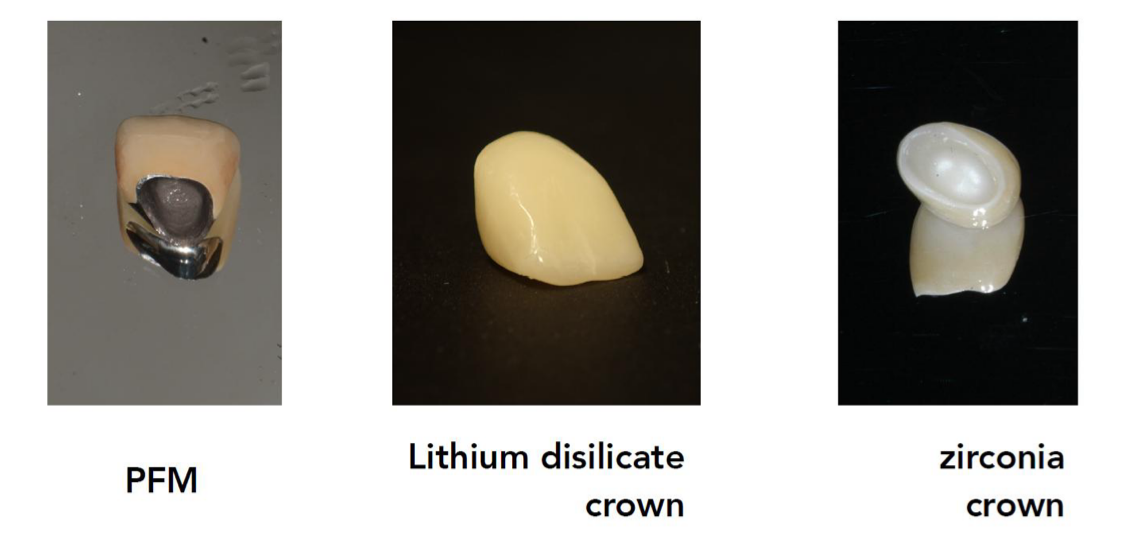
my summary of porcelain classification and composition
They can be predominantly glassy (Feldspathic), particle-filled glasses (Lithium-Disilicate) , or polycrystalline ceramics (Zirconia)
Glassy ceramics are more aesthetic, while crystalline ceramics offer higher strength
*zirconia can be layered like PFM to make it more esthetics
*PFZ porcelain fused to zirconia - layer e.max on top, for anterior only bc will fracture w function

materials used at tufts
