Nucleic Acids
 Call Kai
 Learn
Learn Practice Test
 Spaced Repetition
 Match
Match Flashcards
 Knowt Play
1/151

There's no tags or description
Looks like no tags are added yet.
Name | Mastery | Learn | Test | Matching | Spaced | Call with Kai | Chat |
|---|
No analytics yet
Send a link to your students to track their progress
152 Terms
James Watson, Francis Crick, Rosalind Franklin
Modern molecular biology really started with ___________, __________, and ________ ‘s 1953 discovery of DNA’s structure
Gregor Mendel
discovered the laws of heredity in 1865
Studied well-defined characteristics (unigenic trait) rather than gross morphology like size (multigenic trait – led others nowhere)
Developed concepts of genes as units of heredity that can be dominant or recessive
Phenotype
Physical appearance
Genotype
gene complement of phenotype
Friedrich Miescher
discovered nucleic acid in 1869
Obtained pus from soldier’s wounds - good white blood cell source
Digested alcohol-washed pus with pepsin (a protease to free DNA), extracted with salts and acid, obtained cell nuclei (1st subcellular fractionation!)
Walter Sutton, Theodor Boveri
made connection between genetics and cell biology in 1900
recognized chromosomes’ behavior during meiosis similar to behavior of Mendel's gametes during meiosis –diploid chromosomes segregate each gamete gets 1 chromosome
Led to realization that genes were located on chromosomes
Frederick Griffith (1928)
found that mixing heat-killed crude pathogenic bacteria could change non-pathogenic bacteria into killers
Hypothesis: Material in dead bacterial cells can genetically transform living bacterial cells
Conclusion: A chemical substance from one cell is capable of genetically transforming another cell
Protein
Most biochemists thought genes were _________ until 1944
Oswald Avery
An ex-Haligonian, ____________, used DNA purified from dead pathogenic cells to transform non-pathogens into pathogens
Purified deoxyribonuclease enzyme destroyed transforming factor (DNase has no effect on RNA or protein)
Purified RNA, lipids, and protein failed to transform bacteria, RNase or protease degradative enzymes had no effect on transformation
First demonstration that DNA was the active genetic particle
Alfred Hershey, Martha Chase
____________ and ____________ (1952) demonstrated DNA to be the genetic material in a more biochemical way (measure it!)
Only phage DNA needs to enter the cell for virus replication to occur
1950
X-ray diffraction first used in 1938, but good pictures of DNA weren’t available until _______ (William Ashbury, Rosalind Franklin)
These suggested helix of not 1, but 2 or 3 polynucleotide chains
Organic chemists found DNA to have polarity (5' 3') (Alexander Todd)
Watson & Crick’s 1st model was embarrassingly wrong, (chemically impossible), worked on new model for 1.5yrs
Clone
a molecule, cell, or organism that was produced from another single entity
Restriction Enzymes
DNA cutting enzymes (molecular scissors)
Plasmid DNA Vectors
circular form of self-replicating DNA
Can be manipulated to carry and clone other pieces of DNA
Polymerase Chain Reaction (PCR)
1983
Specific amplification of gene sequences using custom DNA ‘primers
Watson-Crick
Original _________ model required that while one strand would be copied in a 5′ to 3′ direction, the other strand would have to be copied in a 3′ to 5’ direction (Anti-parallel!)
Antiparallel
DNA must be made in __________ fashion
Arthur Kornberg
Demonstrated DNA synthesis in cell-free extracts of bacteria
Identified DNA polymerase I, won Nobel prize for it (obtained mg quantities from thousands of litres of bacterial culture…)
Purines
Adenine, Guanine
Pyrimidines
Cytosine, Urasil, Thymine
H2O
Joining of PO43- to deoxyribose, or base will yield ________ (Condensation reactions in nucleotide formation)
AsO43-
NASA’s Astrobiology Institute held news conference in 2010 with a major claim from published research that GFAJ bacterium could use ________ in place of PO43-
Xeno Nucleic Acids, XNAs
Artificial nucleic acids that use same bases and phosphodiester bonds as DNA but use very different nucleoside sugars
Still form Watson-Crick double helixes
can be replicated from DNA with mutant polymerases, and copied back to DNA using another mutant polymerase – accurately!
invulnerable to acids, nucleases (enzymes that cleave up DNA, RNA)
Can perhaps be used to target viral DNA
Matthew Meselson, Frank Stahl
Demonstrated that the two strands of the double helix
separate during DNA replication
Used stable heavy isotope 15N to differentially label the
parental and daughter DNA strands
Separated heavy from light DNA in cesium chloride density
gradients that exploits minor mass difference of 15N and 14N
Led to discovery of ‘semi-conservative’ DNA replication
Stable Isotope Labelling
Semi-conservative DNA replication discovered by ______________
Distributive, Semi-Conservative, Conservative
3 possible models of DNA replication
Conservative Replication
Parental strands stay together
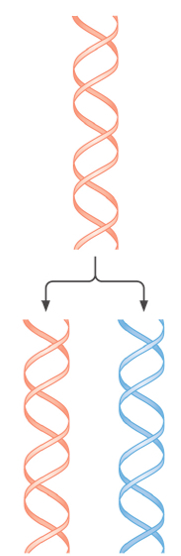
Semi-Conservative Replication
Mix, 1 strand each

Distributive Replication
Chopped up
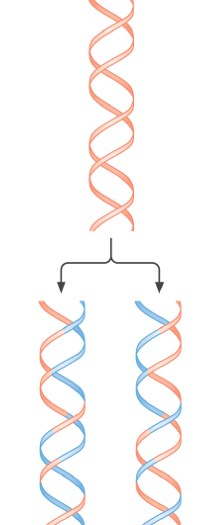
1
RNA can also assume double helix shape, but with only ____, not 2 polynucleotide chains
Non-Classical Base-Pairing
RNA can assume lots of diverse tertiary structures, also _______________
Right-Handed
DNA structure is a _________ double-helix (5′ curls & points around like right
index finger grasping a cup of water)
35.6
In a DNA double-helix, on average each base pair is rotated _______° from the adjacent base pair.
T
A bonds with _______ (2 H-Bonds)
G
C bonds with ______ (3 H-Bonds)
Purines
larger, double‑ring nitrogenous bases
Pyrimidines
smaller, single‑ring nitrogenous bases
Tautomeric
Normally, each nitrogenous base has a common form that overwhelmingly predominates. But occasionally, a proton (H⁺) shifts position, and the electrons/double bonds rearrange along with it. This produces a rare _______ form.
Wrong Base
When a base changes into its rare tautomer, the positions where it can donate or accept hydrogen bonds change.
That means the rare form may temporarily pair with the __________ during DNA replication.
Nucleotide
If DNA polymerase happens to copy the DNA while the base is in that rare form, it can insert the wrong __________
Bacterial Virus
A _________ (phage) utilizes alternative base in place of A, called 2-aminoadenine
Base forms a triple bond with T, whereas A forms only a double bond (temp. stability increases)
Why? Bacteria use enzymes to destroy invading phage DNA but can’t degrade this base as easily
Biosynthesis pathway only found in 2021 (50 yrs after discovery!)
Z, P
Synthetic biologists created 2 more bases, ‘__’ and ‘___’
Z & P base pair, but do not pair with any other base (like C-G, A-T), are replicated faithfully
DNA replicating enzymes (polymerases) can replicate Z & P both in vitro and in vivo
Sequencing services, cloning all work with Z and P
A-DNA, B-DNA, Z-DNA
DNA can exist in 3 conformations:
A-DNA
occurs in crystalline structures where the water concentration is reduced
the structure is distorted and the bases are no longer co-planar
Right-handed

B-DNA
right-handed
is the standard form in biological systems
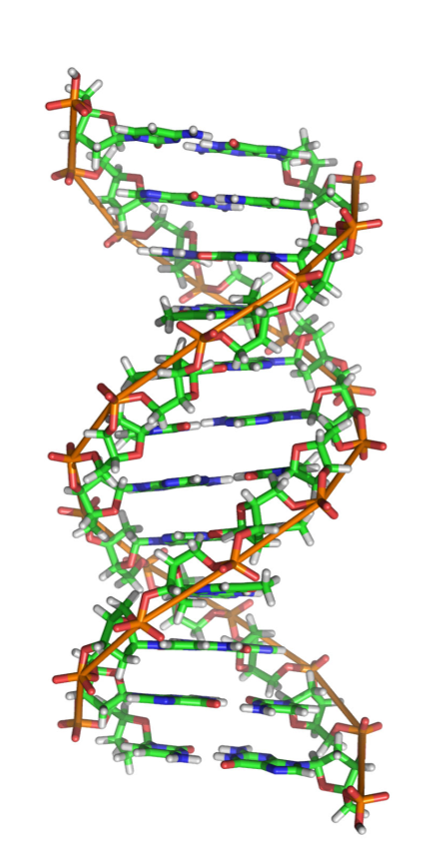
Z-DNA
occurs occasionally in the middle of a B-form molecule.
Left-handed.
Bases are co-planar in both the B and Z forms.

Propeller Twist
The 2 members of each base pair don’t always lie in same plane
This is called “_________”- normal in (a), twisted in (b)
This causes alteration in width of major and minor grooves, so DNA is never a perfect helix (we just draw it like one!)
this is dictated by local DNA sequence (like 2o structure in proteins)

Topoisomerase
DNA replication induces positively supercoiled regions ahead of replication fork
Must remove these “over-wound” regions otherwise replication stalls
an enzyme needed: __________
Topology
study of geometric properties and spatial relations unaffected by the continuous change of shape or size of figures
surrounding ionic environment (water, salt), protein bound with the DNA
DNA is a flexible molecule but….
..flexibility constrained by;
1) __________________
2) __________________
10
DNA rotates once per _____ bases (36o turn per base)
Rotate
linear DNA should freely ________ to accommodate any changes
Length
long linear DNA can’t rotate due to ________, DNA-binding proteins
covalently closed circular DNA (cccDNA)
two polynucleotide backbones of (circular) DNA too wound up to be separated unless covalent bond broken
Linking Number (Lk)
number of times 2 DNA strands need to be passed over each other to be entirely separate from the other
L(k)
= T(w) + W(r)
T(w)
Twist (# of helical crossing)
W( r )
Writhe (# of Super-helical crossing)
Macromolecules
DNA is unique among biological ____________ in the simple and direct way in which its structure is related to its biological function
Double-Stranded
In the cell, DNA molecules are ____________
Complementary
Cytosine on one strand makes three hydrogen bonds with the __________ surface of guanine on the other
Watson-Crick Base Pairing
the specific way nitrogenous bases link together in DNA and RNA through hydrogen bonds.
Adenine (A) always pairs with Thymine (T) in DNA (or Uracil (U) in RNA) using two hydrogen bonds.
Guanine (G) always pairs with Cytosine (C) using three hydrogen bonds.
Complementary
Since the sequence of bases in one strand dictates the sequence of bases in the other, we say that the two strands are ______________ to one another
Double Helix
The most energetically favourable confirmation for double-stranded DNA is one in which the two strands wind around one another, forming a __________
Propeller
The B-DNA crystal structure confirmed all of the essential features of the Watson and Crick model, with some interesting deviations, The DNA base pairs were not perfectly planar but rather contained various degrees of __________ twist
Nucleosome
Another key feature was that the helix axis was not perfectly straight but rather was bent by about 19 degrees. The authors duly noted that this degree of bending, when extended over longer DNA fragments, would be sufficient to allow DNA to wrap around a histone core to form a _____________, the fundamental unit of eukaryotic chromatin
Base Stacking
The vertical alignment and tight physical attraction of neighboring chemical bases in a DNA strand that holds the double helix together
20
Since both A-T and G-C base pairs have similar widths, the helix has a fairly uniform diameter of _______ Å along its length
B-DNA, 10.5
Double-stranded DNA in cells generally adopts a conformation called ________, whose helical structure repeats itself approximately every ____ bp as one looks along the double helix.
3.4
In B-DNA, each successive base pair is separated by ____ Å
Major and Minor Grooves
Two spiral depressions that run along the outside of the DNA double helix, created because the strands' sugar-phosphate backbones are not attached to the base pairs at opposite positions (13 Å vs 9 Å width)
The edges of the base pairs are exposed in these depressions
A-DNA
has 11 bp per turn
base pairs tilted relative to the DNA axis, as well as being displaced farther from the DNA axis than they are in B-DNA
Has a narrower, deeper major groove and a shallower, wider minor groove than B-DNA
right-handed
A-DNA
can be induced by some proteins that form a complex with DNA
is particularly important in RNA structure, since this is the only type of double helix that double-stranded RNA can form
Bend
Regions of the DNA double helix containing successive A-T followed by T-A base pairs tend to ______ more readily than helices with G-C steps
Z-DNA
An unusual type of DNA helix that spirals in the opposite direction, and is therefore left-handed
can form under special conditions in DNA strands with alternating G and C bases
favoured by a chemical modification of cytosine, methylation, and high salt concentrations
promoted by torsional stress on the DNA
Negative Supercoils
An initial unwinding of the DNA - which is in the clockwise direction and is equivalent to separating the DNA strands - leads to accumulation of ____________
Negative, Positive
__________ supercoiling involves underwinding the DNA double helix, while __________ supercoiling involves overwinding it
Positive Supercoils
An initial twisting of the DNA in the counterclockwise direction leads to formation of _____________
Immobilized
Supercoiling can also occur in linear fragments of DNA in which the ends are _____________, and therefore not free to rotate and release superhelical tension

Linking Number (Lk)
the number of times one strand of duplex DNA wraps around the other
Twist (Tw)
the number of turns in the DNA helix in a given fragment of DNA
positive sign is or a right-handed helix, a negative sign is for a left-handed helix
e.g. a 105 bp fragment of relaxed B-DNA has a _____ of 10 (=105 bp / 10.5 bp per turn)
0
A relaxed plasmid has a writhe of ____
Positive
_______ supercoiled DNA has a value of writhe greater than 0

Negative
____________ supercoiled DNA has a value of writhe that is less than 0

Topoisomerase
Introduce or remove supercoils from DNA in the cell
Change the supercoiling by introducing a transient break in either one of both DNA strands in the double-stranded DNA, depending on the type of enzyme
DNA
It is the ability of RNA to form base pairs with ______, as well as with RNA, that allows cells to synthesize RNA copies of genes from a DNA or RNA template
2’ OH
The presence of the ______ on ribose and the distinct chemical structure of uracil, as compared with thymine, allow RNA to adopt diverse structures that are not readily formed by DNA
Chemical Modification
Many RNA molecules require ___________ of some of their nucleotides in order to become fully functional. These modifications, which alter the chemical structure of the bases, are introduced after the RNA is synthesized
2’-deoxyribose
The nucleotide consists of a phosphate joined to a sugar, known as __________, to which a base is attached
Nucleoside
The sugar and base alone are called a ____________
Nucleotide
Adding a phosphate (or more than one phosphate) to a nucleoside creates a __________.
Phosphodiester Linkage
Nucleotides are joined to each other through _____________
5’ to 3’
DNA is always synthesized in the __________ direction
Template
DNA polymerase is unusual enzyme since it needs a _______ to work from
Xeno Nucleic Acids, XNAs
use different sugars than DNA & has practical applications
Tautomeric
Nucleic acid bases are not static but can take alternative ____________ forms
B-DNA
is the major biological conformation of DNA (but Z occasionally)
Positive
As helicases and polymerases move along DNA, unwinding and copying it as they go, they generate _______ supercoils in the double-stranded helical DNA in front of them. These _________ supercoils are a consequence of the fact that the DNA template unwinds as the two strands separate

10
During DNA replication, one full turn of the double helix is unwound for every ____ bp of DNA that is replicated
-1
Twist (Tw) changes by ____ for each turn of the helix that is unwound