[2nd Sem Midterms] Advanced Biology
 Call Kai
 Learn
Learn Practice Test
 Spaced Repetition
 Match
Match Flashcards
 Knowt Play
1/86

There's no tags or description
Looks like no tags are added yet.
Name | Mastery | Learn | Test | Matching | Spaced | Call with Kai | Chat |
|---|
No analytics yet
Send a link to your students to track their progress
87 Terms
Femur, thighbone
the longest and strongest bone of the human skeleton
Stapes
Malleus - Incus - Stapes (Auditory Ossicles)
the smallest and lightest bone of the human skeleton.
skeleton
supports the body, protects internal organs, provides for movement, stores mineral reserves, and provides site for blood cell formation.
206
There are ____ bones in the adult human skeleton.
Axial Skeleton
supports the central axis of the body. Consists of the skull, the vertebral column, sternum, and the rib cage.
Frontal
Sphenoid
Ethmoid
Parietal
Temporal
Occipital
The skull is made up of 8 bones:
26
The vertebral column has ___ vertebrae with intervertebral disk between each vertebrae..
Spinal Column
protects the spinal cord.
Intervertebral Disk
serve as shock absorbers between each vertebrae.
Costae
another term for Ribs
7; 5; 2
Composed of 24 ribs
___ pairs of true ribs and
____ pairs of false ribs (___ of
which are floating ribs)
Hematopoiesis
the production of blood
Appendicular Skeleton
consists of the extremities of the body e.g. shoulder girdle,
arm bones, pelvic girdle, and leg bones.
2 clavicles (collar bones)
2 scapulas (shoulderbones)
Shoulder Girdle - comprised of 4 bones
Humerus (upper arm)
Radius & Ulna (lower arm bones)
Arm - composed of 3 bones:
8 carpals
5 metacarpals (palm bones)
14 phalanges (fingers and thumbs)
Wrist Bones
- comprised of _______
Hand Bones
- comprised of ________
Wrist Bones
- comprised of ________
Pelvic Girdle
structure to which the leg bones are attached
Femur
thigh bone
patellar ligament
knee cap
Tibia
shin bone
Femur
upper leg bones
Tibia and Fibula
lower leg bones
7 Tarsals (Ankle Bones)
5 Metatarsals
14 phalanges (Toes )
Calcaneus (Heel Bone)
Lower leg bones are composed of:
proximal epiphysis
diaphysis
distal epiphysis
Parts of a long bone
Bones
solid network of living cells and protein fibers that are surrounded by deposits of calcium salts.
Bones
a living tissue composed mainly of mineral salts - calcium and phosphorus.
Periosteum
tough layer of connective tissue surrounding the bone.
Compact Bone
forms the hard, dense outer layer of bones which functions to primarily to provide strength and protection to bones.
Cortical Bone
Compact bone is aka
Periosteum
Compact bone
Spongy bone
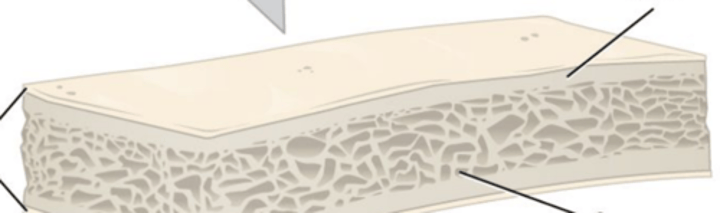
Spongy Bone
houses the bone marrow, allow for RBCs formation or erythropoiesis, and allow bones to be less dense and more light. It also allows flexibility.
Haversian System (Osteon)
a network of tubes that contain blood vessels and nerve fibers
Erythrocytes
RBC
Leucocytes
WBC
Thrombocytes
Platelets
Blood plasma
nutrients from digestive system will float here
Hemophelia
prevention of blood clotting
RBC
where oxygen attaches to
WBC
fights against foreign substances
2 million
the body makes about ____ RBCs every second
Bone Marrow
a soft tissue within bone cavities.
Yellow Marrow
made up primarily of fat cells usually found in round bones.
Red Marrow
produces red blood cells, some kinds of white blood cells, and cell fragments called platelets.
Spongy bone
Compact bone
Cartilage
Periosteum
Yellow Bone Marrow
Blood Vessels
Red Bone Marrow

Cartilage
a type of connective tissue scattered in a network of protein fibers - tough collagen and flexible elastin.
Cartilage
does not contain blood vessels and rely on nutrients from the tiny blood vessels in surrounding tissues.
Hyaline cartilage
Elastic cartilage
Fibrocartilage
Types of cartilage
Red; Yellow; Center
Conversion of _____ marrow to ______ begins at the ______ and extends axially and peripherally
Ossification
the process of bone formation where cartilage is replaced by bone
Osteoblasts
(Development of bones)
creates bone.
Osteocytes
(Development of bones)
maintain the cellular activities of bone.
Osteoclasts
(Development of bones)
break down bone.
seven months before
Ossification begins to take place up to ____________ birth.
osteocytes
When osteoblasts become surrounded by bone tissue, they mature into _______.
growth plates
Many long bones, including those of the arms and legs, have _________ at either end.
bone tissue
new growth of cartilage is replaced by ______
ossified
The bones becomes ______, and the person "stops growing".
bone formation
also occurs when a bone is broken.
Osteoclasts
(Fixing a bone)
remove damaged bone tissue.
Osteoblasts
(Fixing a bone)
produce new bone tissue.
- the tip of the nose
- the external ears
- ribs are attached to the sternum,
cartilage is found in those parts of the body where flexibility is needed, such as
Joint
a place where one bone attaches to another bone.
Joint
permit bones to move without damaging each other.
Synarthrosis
Immovable Joints (Fixed Joints)
Synarthrosis
- allow no movement.
- the bones are interlocked and held together by connective tissue, or they are fused.
- where the bones in the skull meet
Example of synarthrosis
Amphiarthrosis
Slightly Movable Joints
Amphiarthrosis
- permit a small amount of restricted movement
- the bones are separated from each other
- the joints between the two bones of the lower leg
- joints between adjacent vertebrae
Example of Amphiarthrosis
Diarthrosis or Synovial
Freely Movable Joints
Diarthrosis or Synovial
permit movement in one or more directions. grouped according to the shapes of the surfaces of the adjacent bones
Ball-and-socket joints
Hinge joints
Pivot joints
Saddle joints
Common types of Diarthrosis:
Ball-and-socket joints
permit circular movement
Hinge joints
permit back and forth motion
Pivot joints
allow one bone to rotate around another
Saddle joints
permit one bone to slide in two directions
cartilage
In freely movable joints, the ends of the bones are covered with a smooth layer of _______ that protects the bones as they move against each other.
Capsule
fibrous joint that helps hold the bones while still allowing them to move.
Ligaments and Synovial fluid
2 layers of the joint capsule:
Ligaments
attached to membranes that surround bones and hold the bones together.
Synovial Fluid
produced by the cells in the other layer of the joint capsule
Synovial Fluid
forms the thin film within the bone surfaces of a joint
Synovial Fluid
this lubricating film enables the ends of the bones to slip past each other smoothly
Inflammation
the body's response when a tissue is damaged
swelling, redness, heat, and pain
symptoms of Inflammation
Arthritis
involves the inflammation of one or more joints
Arthritis
this affects 10% of the world's human population