Econ 5515 - Module 2 Test Study Questions
 Call Kai
 Learn
Learn Practice Test
 Spaced Repetition
 Match
Match Flashcards
 Knowt Play
1/15

Earn XP
Description and Tags
Econ 5515 - Module 2 Test Study Questions
Name | Mastery | Learn | Test | Matching | Spaced | Call with Kai | Chat |
|---|
No analytics yet
Send a link to your students to track their progress
16 Terms
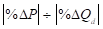
The absolute value of price elasticity of demand |E|
a. is
b. is less than one when marginal revenue is positive.
c. is always greater than one.
d. is always greater than one when marginal revenue is negative.
e. gets smaller as price falls along demand.
The absolute value of price elasticity is directly related to price. Thus, as price falls along demand, so does |E|.
The cross-price elasticity is
a. positive for normal goods.
b. negative for substitute goods.
c. negative for complementary goods.
d. positive for inferior goods.
EXY < 0 for complementary goods.
The income elasticity of demand is
a. positive for normal goods.
b. negative for substitute goods.
c. negative for complementary goods.
d. positive for inferior goods.
a EM > 0 for normal goods.
The interval method is used to compute price elasticity
a. when a price change causes a relatively large movement along demand.
b. so elasticity can be computed for rather small changes in price.
c. for nonlinear demand curves because point elasticity cannot be computed for curves.
d. because demand curves are downward sloping.
a An interval measure instead of a point measure of elasticity is used when price changes over a relatively wide arc of demand.
The demand for most agricultural products is rather inelastic. Thus, when bad weather reduces the size of crops (i.e., supply decreases),
a. farmers’ incomes rise.
b. the marginal revenue of selling one more unit of an agricultural product is negative.
c. the percentage decrease in crop sales exceeds the percentage increase in price.
d. both a and b.
e. both b and c.
d When demand is inelastic, an increase in price (in this case due to bad weather) increases total revenue (income to farmers). It is also true that MR < 0 when E < 1.
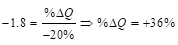
6. If price elasticity of demand is –1.8 and price falls by 20 percent, then sales increase by
a. 11.1 percent.
b. 36 percent.
c. 9 percent.
d. 90 percent.
b
If price falls along a segment of demand that is price inelastic,
a. arrows representing the price and quantity effects both point down.
b. an arrow representing the price effect points down and is longer than an arrow for the quantity effect.
c. an arrow representing the price effect points down and is shorter than an arrow for the quantity effect.
d. arrows representing the price and quantity effects both point up.
b When demand is inelastic, the price effect dominates. In this case, price falls and the arrow representing the price effect points down and is longer than the arrow for the output effect (which points up). Total revenue moves in the direction of the dominant effect, and so in this case total revenue falls.
If price rises along a segment of demand that is price elastic,
a. an arrow representing the quantity effect points down and is longer than an arrow for the price effect.
b. an arrow representing the quantity effect points up and is longer than an arrow for the price effect.
c. total revenue moves in the direction of the arrow for the price effect.
d. the arrows for the price and quantity effects point in opposite directions and are of equal length.
a When demand is elastic, the quantity effect dominates. In this case, price rises and the arrow representing the quantity effect points down and is longer than the arrow for the price effect (which points up). Total revenue moves in the direction of the dominant effect, and so in this case total revenue falls.
Which of the following would NOT tend to make demand for a good X more elastic?
a. A major competitor of good X goes out of business.
b. Product X is improved so that it becomes more durable.
c. Incomes fall, which increases the share of families’ budgets spent on X.
d. both a and c.
a The exit of a major competitor would decrease the number of substitutes, thereby making demand less elastic.
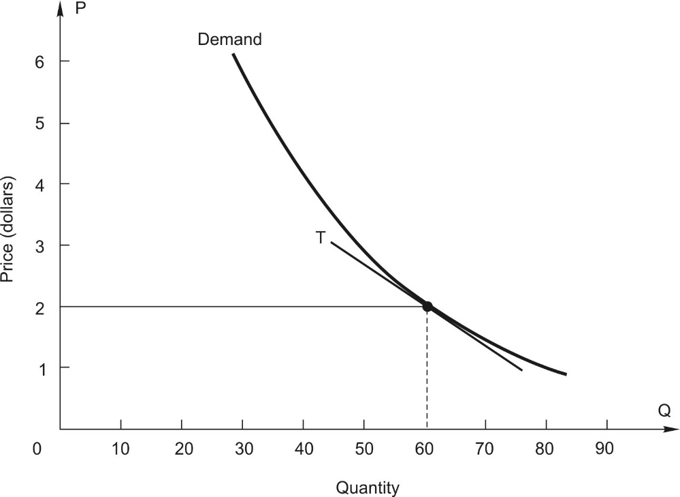
The point elasticity of demand when price is $2 is
a. –6/90.
b. –15.
c. –1/2.
d. –2.
c Extend tangent line T to cross the P-axis to find the value of A, which equals 6. Then, substituting A = 6, E = –1/2 = P/(P – A) = 2/(2 – 6). Since tangent line T crosses the Q-axis at 90, the same answer can be obtained using the equivalent formula: –1/2 =

If price falls from $2 to $1.99, then
a. total revenue rises because E = –15.
b. total revenue falls because E = –1/2.
c. marginal revenue must be positive because total revenue rises.
d. total revenue equals $1.99.
b Since demand is inelastic at $2, TR must fall when price decreases to $1.99.
When price is $2, marginal revenue is
a. negative.
b. zero.
c. positive.
d. equal to price.
a Since total revenue is falling at P = $2, marginal revenue must be negative (which must, of course, be less than the positive value of price).
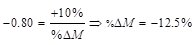
13. If the income elasticity of demand is –0.80 and quantity demanded increases by 10 percent as a result of a change in income, the income must have
a. increased by 8 percent.
b. increased by 80 percent.
c. decreased by 8 percent.
d. decreased by 12.5 percent.
d
When demand is unitary elastic
a. marginal revenue is zero.
b. the percentage change in quantity equals the percentage change in price.
c. an increase in price has no effect on the quantity demanded.
d. both a and b
e. all of the above
When E = –1,. Since MR = P(1 + 1/E), MR = 0 when E = –1.


. When marginal revenue is negative
a. .
b. is less than one.
c. an increase in price causes total revenue to rise.
d. both a and c
e. all of the above
e All are true when MR < 0.
16. Which of the following will NOT affect the price elasticity for a product?
a. The number of substitutes.
b. How long consumers have to adapt to price changes.
c. The cost of producing the product.
d. The percentage of consumers’ budgets spent on the product.
e. All of the above will affect the elasticity of demand for a product.
c Cost of producing the product is a factor affecting supply not demand.