DMV Road Law Refresher
 Call Kai
 Learn
Learn Practice Test
 Spaced Repetition
 Match
Match Flashcards
 Knowt Play
1/90

There's no tags or description
Looks like no tags are added yet.
Name | Mastery | Learn | Test | Matching | Spaced | Call with Kai | Chat |
|---|
No analytics yet
Send a link to your students to track their progress
91 Terms

If you see a sign with a cancel sign over a left turn what does that mean? Hint: Black symbol + red slash/circle = the action is forbidden.
You can't make a left turn. Signs that have a black symbol with a cancel sign on it mean's that the activity is forbidden
First thing that alcohol impairs is what?
Your judgement and skills
You're approaching an intersection with a constant yellow light from a traffic signal. If you have not yet arrived at the intersection, you should:
Hint: If the light turns yellow and you are still BEFORE the intersection, Always come to a ___ ___. : If the light turns from green to yellow when you are already AT the intersection, you can ______ through at a safe speed.
Always come to a safe stop. If the light turns from green to yellow while you are already at the junction, it's okay to go through the intersection at a safe speed.

What does this sign mean: (Arrow pointing right sign)
Hint: The road ahead is _________ at an _________. It's warning you to (the opposite of going fast) and (knee bra…) yourself for a (opposite of a dull turn)
It's warning you that the road is changing directions at an extreme angle. It's also warning you to slow down and brace yourself for a sharp turn
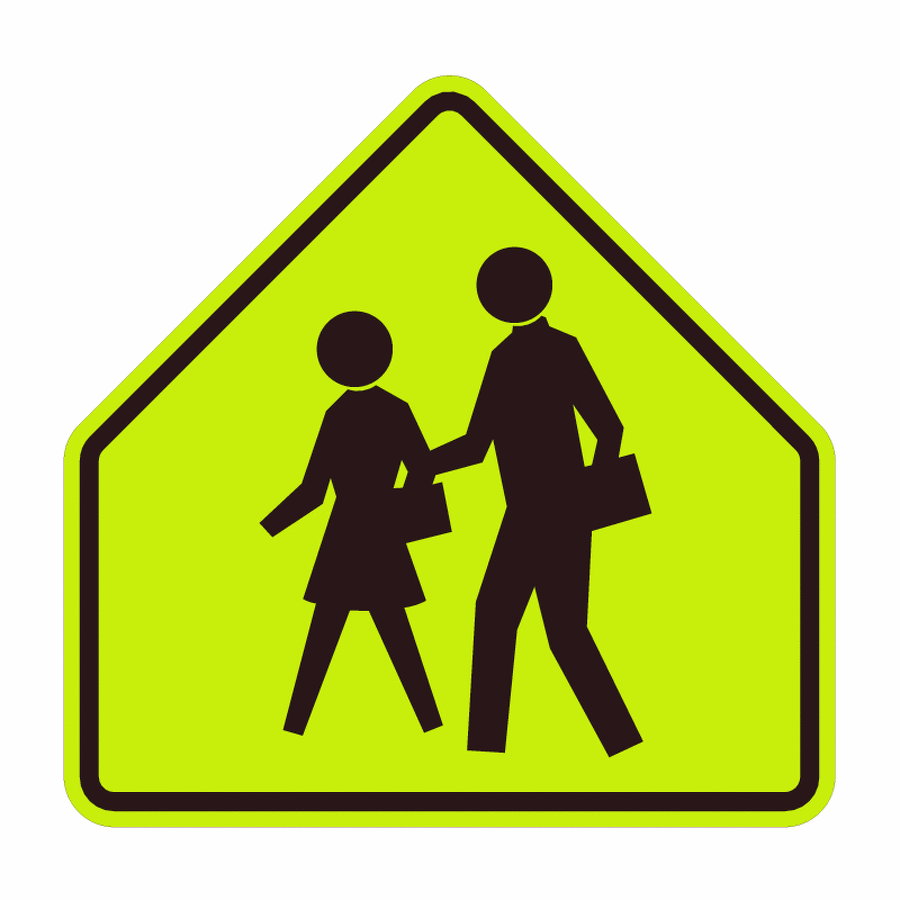
What does this sign mean?
Hint: Be prepared to (opposite of go) if you see who crossing?
If you see thissign, what kind of area are you in? Think about where children go to learn.
So, be (opposite of not focused — starts with “A”) and (opposite of go).
It means to be prepared to stop if you see children crossing the crosswalk. A five-sided sign indicates a school area, so be alert and stop when necessary.
If there is no crosswalk and you notice a pedestrian crossing your lane, what should you do? Hint: Always (opposite of fast) and let them cross safely
Always slow down and let the pedestrian cross safely. Even if there is no crosswalk or sign, always yield to the pedestrian and give them the opportunity to cross safely.

What should you do when driving in snowy or icy conditions? Hint: You have to change these things gradually:
Another word for acceleration → ______
Dire… → ______
Don't use what kind of control? Think: What is a boat trip called?
Using it could cause you to lose two things: ______ and ______.
Make speed and directional changes gradually than you would otherwise. When driving on roads like that be prepared to gradually change your speed and direction.
DO NOT use cruise control since your tires might lose traction and you can lose control
If you believe your tires have lost touch with the road, what should you do? Hint: Do something with your foot off of what? → ______
Then, before you stop or turn, wait until what happens to your tires? → ______
Always ease your foot off the gas pedal and wait until the tires are firmly back on the road before making a stop or turn.
When passing another vehicle, when should you return to the right lane?
Hint:
What do you need to see in your rearview mirror before moving back? → ______
You can also return to the driving lane when you have an adequate amount of what? → ______
Return to the right lane when you can see both headlights of the vehicle you passed in your rearview mirror.
You may also return to the driving lane when you have an adequate amount of space to safely move back.
A driver's license is a:
Hint: it's not a right it's a...
Privilege that is to be earned and kept

What does a broken yellow line down the center of the road indicate?
Hint: You're allowed to do what? → ______
Any driver can _____ when there is no incoming _____ and it is safe to do so.
Passing is allowed from either direction. Any driver can pass when there is no incoming traffic and it is safe to do so.
When approaching an intersection with a flashing red light, what must you do?
Hint: Stop completely first and yield to other traffic and p____? A flashing red light means you must treat it like a ______ sign.
Come to a complete stop and yield to other traffic and pedestrians as required. Proceed only when it is safe to do so.
A flashing red light is equivalent to a STOP sign.

When approaching a roundabout, you should slow down and do what?
Hint: Look at the red-and-white triangle sign. What does that sign tell you to do? → ________
Yield to any two people who are crossing → ________ and ________
Also yield to a car that is already where? → ________
Always slow down and yield to pedestrians and bicyclists crossing the roadway and to traffic already in the roundabout. Enter the roundabout only when it is safe to do so.
Driving on interstates requires drivers to:
Hint: Have the ability to safely drive at what? (opposite of decreased speed) and be on what? (opposite of unfocused)
The ability to safely drive at increased speeds and be constantly alert.
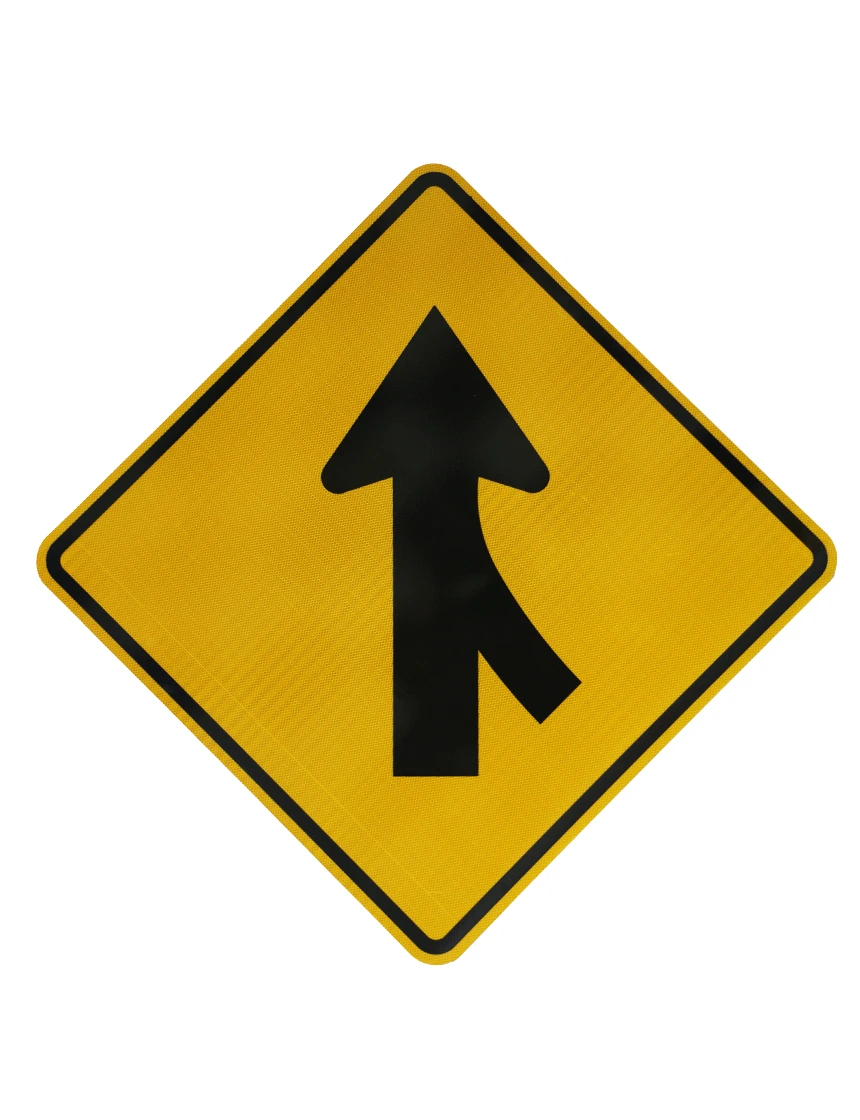
When encountering this sign, what should you do? Hint: Always watch for ____ merging from where? → ______
Always watch for traffic merging from the right. The sign warns drivers that a right-side lane may merge into the roadway.
As you speed up, it's critical that you:
Hint: Always look → (opposite of behind) of your car
Increased speed does what? → Takes away something away from your car to halt.
Always keep a good lookout for what? → (triangle button in the car)
This will give you time to safely respond.
Always look ahead of your car. Increased speeds take more distance away from your car to halt, so always keep a good lookout for hazards, which will help you safely respond in time.
You're driving down the street when you notice an emergency vehicle with flashing lights behind you. What should you do? (Move Over Law) Hint:
Always pull safely to which side? → ______
And do what? → (opposite of go)
If you're already in an intersection, should you stop there? → (don't stop)
Then what should you do? → ______
Safely pull to the right edge of the road and come to a complete stop.
If you are already in an intersection, clear the intersection first, then safely pull to the right and stop. Do not stop in the middle of the intersection.
If you park on an uphill roadway with a curb, use the parking brake and: Hint: With a curb: Turn the wheels (opposite of near) the curb. → ______
Without a curb: Turn the wheels (opposite of away) from the curb. → ______
Always turn the wheels away from the curb when parked uphill with a curb.
When parked uphill without a curb, turn the wheels toward the curb/right side of the road.

What does this sign mean? Hint: Think “The Polar Express.” 🚂
What would you expect to encounter along the train's route?
A railroad crossing is ahead.

Signs and lane markings indicating a no-passing zone inform you that: Hint: You're not _____ enough ahead to safely _____.
It could be a chance for another vehicle to _____ or _____, so passing is risky.
Locations for these are typically what? → _Inter_________, ____Rail______, and ______Sto____
They mean you are not far enough ahead to safely pass.
There could be a chance for another vehicle to enter or cross the road, making passing risky.
No-passing zones are typically located where passing would be unsafe because of limited visibility or other roadway conditions, such as intersections, railroad crossings, and storefronts
If an incoming vehicle's driver fails to dim their headlights:
Hint: Look to which side of the road?
Look to the right side of the road
This sign informs drivers that (diamond orange and black sign, guy holding a flag):
A construction flagger is ahead.
If you see stop signs on all corners at an intersection, yield the right-of-way to any driver:
Hint: Who always what? (opposite of arriving late)
Who has already come to a complete stop and arrived at the intersection.
The streets that you're driving down is one-way. A left turn into a different one-way street is only permitted if:
Hint: If you're already on a one-way street and turn left, the street you're turning onto must allow traffic to go which way? → ________
You can turn left only if traffic on the street you're turning onto goes to the left and there are no signs prohibiting the turn.
If you notice a pedestrian with a guiding dog or a white cane:
Hint: Don't do something and also (opposite of left of way)
Don't honk and always as the driver yield to the right of way
When approaching an intersection with a flashing yellow light, you must:
Hint: Opposite of go fast and proceed…..
Always slow down and proceed with caution.
When parking your vehicle on a hill:
Hint: Always use what you press your right foot on (not acceleration) and then leave it in (opposite of drive).
Always use your parking brake and leave it in park when parking on a slope.
Worn tires can:
A) Be difficult turning
B) Hydroplane
C) Increase stopping distance
D) All of the above
The answer is all of the above due
Which of the following statement is false?
A) You should always check your seat and mirrors before you start driving
B) After market any changes to equipment, such as tinted windows, are legal
C) The driver should always have his or her seatbelt on
D) Only your brakes can stop your vehicle
The answer is after market any changes to equipment, such as tinted windows, are legal.
Just because you get your car from the market doesn't make your car automatically legal. CT has requirements of how dark tints can be, what equipment modifications are allowed, and what safety requirements are needed for the car.
the no-zone area is
a. an area where pedestrians cannot cross the street
b. an area where vehicles are not allowed to park
c. the danger areas around a truck where there are blind spots for the driver
d. none of the above
The answer is the danger areas around a truck where the blind spots are for them.
Typically their blind spots (no zone areas) are in front of the truck, behind the truck, and along the sides (especially the right. since their driver seat is on the left of course)

Intersections include which of the following?
A) Only cross streets
B) Only highways
C) Cross streets, driveways, and parking lot entrances
D) Railroads crossings only
The answer is intersections being cross streets, driveways, and parking lot entrances.
Before entering an intersection, you should:
A) Honk your horn
B) Speed up
C) Look left and right for vehicles, bicycles, and pedestrians
D) Only look for straight ahead
Always look left and right for vehicles, bicycles, and pedestrians. Intersections are high risk areas due to traffic crossing ( car crossing) or merging (car coming into a lane), so looking both ways prevents collisions and ensures the path is clear.
When stopped at an intersection, you should look left and right:
A) After you begin moving
B) Just before you start moving
C) Only if there is a stop sign
D) Only at night
Do this just before you start moving
Before turning left across traffic, who has the right-of-way?
A) You do
B) Oncoming traffic, including bicycles
C) Pedestrians only
D) Vehicles behind you
Oncoming traffic, including bicyclists, has the right-of-way. This includes traffic or bicyclists traveling straight or turning. You must yield to them before making your left turn.

Before turning left, you must also check:
A) Only oncoming traffic
B) Your rearview mirror
C) The street you are turning onto for vehicles, bicycles, or pedestrians
D) Your radio volume
Always check the street you are turning onto for vehicles, bicycles, or pedestrians. This ensures that they're not in your path and you can safely make the turn.
Before turning right, you must check for:
A) Traffic approaching from your left
B) Oncoming traffic turning into your path
C) Pedestrians crossing
D) All of the above
You have to do all of this.
You may turn right at a red light:
A) Without stopping
B) Only during the daytime
C) After stopping, unless prohibited by a sign
D) Never
You can do this after stopping, unless a sign prohibits it. It helps it fuel saving, keeping the flow of traffic, and turning right crosses the LEAST AMOUNT (not never!) of oncoming traffic
Why should you not rely only on traffic signals?
A) Signals are optional
B) Some drivers may not obey signals or signs
C) They are hard to see
D) They only apply at night
Because some drivers may not obey signals or signs, therefore signs may not always guarantee safety.
If a traffic light is not working, you must:
A) Drive through quickly
B) Treat it like a yield sign
C) Stop as though it is a stop sign
D) Wait for police instructions only
Stop as though it is a stop sign
If your view of a cross street is blocked, you should:
A) Speed forward
B) Stay stopped forever
C) Edge forward slowly until you can see
D) Honk repeatedly
Always edge slowly until you can see both sides of the road. Sometimes things can obstruct your view therefore it is needed to edge to the surface slowly and safely (making sure your bumper is not in traffic) until you have a clear view path.
"Blocking the box" or "gridlock" happens when:
A) You drive too slowly
B) You enter the intersection without enough space on the other side
C) You stop at a stop sign
D) You park near an intersection
It's happens when you enter the intersection without enough space on the other side. This creates congestion and the inability for cross traffic to move. It’s illegal
You should be especially alert for people crossing when near:
A) Empty highways
B) Shopping centers and school yards
C) Rural farmland only
D) Bridges only
Be alert in shopping centers and school yards.
A work zone is defined as:
A) Any area where the traffic is stopped for more than 10 mins
B) Any type of roadwork that may delay traffic conditions
C) Only highway construction projects lasting more than one month
D) Any accident scene on a roadway
It's any type of road work that may delay traffic
Temporary work zone signs are typically:
A) Yellow with black letters
B) Red with white letters
C) Orange with black letters or symbols (these will be typically be found on the ride side of the road, or both left and right when it's a divided highway)
D) Green with white letters
Orange with black letters or symbols (these will be typically be found on the right side of the road, or both left and right when it's a divided highway)
When approaching a work zone, drivers should first:
A) Speed up to pass through quickly
B) Ignore signs if workers are not visible
C) Slow down and obey the posted work-zone speed limit. Reduced speeds are necessary to help protect drivers, pedestrians, and road workers.
D) Change lanes at the last possible moment
Slow down and obey the posted work-zone speed limit. Reduced speeds are necessary to help protect drivers, pedestrians, and road workers.
If there are no reduced speed limit signs posted in a work zone, you should:
A) Drive 10 mph below the normal speed limit
B) Obey the normal posted speed limit
C) Guess a safe speed
D) Follow the speed of the fastest driver.
Obey the normal posted speed limit. If no reduced work-zone speed limit is posted, you must follow the regular posted speed limit while still driving cautiously through the work zone.
In Connecticut, fines for illegally using a hand-held cellphone in a work zone are:
A) Reduced
B) The same as anywhere else
C) Doubled
D) Only if given if an accident occurs
The fine is doubled
Work zones are most commonly seen during:
A) Winter
B) Spring
C) Summer
D) Fall
Summertime is when you most commonly see work zones in effect.
"Sharing the road" means:
A) Getting ahead of other drivers
B) Driving aggressively when in a hurry
C) Getting along, not getting ahead
D) Letting only larger vehicles pass
Always about getting along and NEVER getting ahead. You're all trying to drive somewhere safely so being an alert, safe, and patient driver is needed for that
Under Connecticut's Vulnerable User Law, vulnerable users include:
A) Only pedestrians
B) Pedestrians, bicyclists, highway workers, and others at greater risk
C) Only emergency responders
D) Only children
Vulnerable users include pedestrians, bicyclist, highway workers, and others at greater risk
When passing a vulnerable user, drivers must allow at least:
A) 1 foot
B) 2 feet
C) 3 feet
D) 4 feet
Always 3 feet
Under the "Move Over Law," when a vehicle is pulled over you must:
A) Maintain speed
B) Speed up
C) Slow down below the posted speed and move over if safe (move over one lane whenever it's safe to do so)
D) Stop completely in all cases
Always slow down below the posted speed and move over if safe, move over one lane whenever its safe to do so.
At intersections, crosswalks exist:
A) Only where painted lines are visible
B) Only in school zones
C) At every intersection, even if unmarked (whether marked or unmarked every intersection has a cross way.)
D) Only cities
They always exist at every intersection, whether marked or unmarked.
A pedestrian indicates intent to cross by:
A) Standing near the road
B) Raising a hand or moving into the crosswalk (They can step on the curb at the entrance of the cross walk and raising the hand or moving into the cross walk for further explanation)
C) Looking both ways
D) Wearing bright clothing
Raising a hand or moving into the crosswalk (They can step on the curb at the entrance of the cross walk and raising the hand or moving into the cross walk for further explanation)
A bicyclist may "take the travel lane" when:
A) They want to block traffic
B) The lane is too narrow for a car and bicycle side-by-side (This means they will travel in or near the center of the lane)
C) They are riding slowly
D) They are lost
They can take the travel lane when its too narrow for a car and them to be side-by-side. This means they'll travel in or near the center of the lane.
Fines are doubled in Connecticut for:
A) Speeding near schools only
B) Failure to yield to a bicyclist
C) Not wearing a helmet
D) Parking near a bike rack
Failure to yield to a bicyclist
When passing a bicyclist, you should:
A) Honk loudly to warn them
B) Pass closely and quickly
C) Slow down and allow at least three feet of space
D) Force them to the shoulder
Always slow down and allow at least three feet of space.
You may drive in a bicycle lane:
A) Anytime traffic is heavy
B) When preparing for a turn
C) Only when entering or leaving a driveway, directed by police, performing official duties, or in an emergency
D) To pass slower vehicles
Drivers can only do this when entering or leaving a driveway, directed by police, performing official duties, or in an emergency (basically if you have a legal reason)
Before opening your parked car door, you should:
A) Exit quickly
B) Check for bicyclists and other traffic
C) Honk
D) Turn on hazard lights
Always check for bicyclists and other traffic
True or False: Drivers must yield to pedestrians in both marked and unmarked crosswalks.
True
True or False: Children are predictable pedestrians and easy to see.
False. Children are very unpredictable and the least easy to see.
True or False: Bicyclists must follow traffic signs and signals.
True
True or False: It is safe to turn sharply in front of a bicyclist if you signal first.
False. Doing so would be illegal and very dangerous for both you and DEFINITELY for the bicyclist
True or False: Drivers may pass a bicyclist in a no-passing zone if it can be done safely.
True. Drivers may pass a bicyclist in a no-passing zone if the maneuver can be done safely, with enough space and visibility to avoid interfering with or endangering oncoming traffic.
True or False: Bicyclists must always ride as far right as physically possible.
False (Bicyclist do this as deemed as SAFELY as possible NOT as physically possible)
You are about to make a right turn but notice a bicyclist approaching from behind on your right. What should you do?
A) Speed up and turn first
B) Pass immediately and turn
C) Slow down and let the bicyclist clear the intersection before turning (doing so can create a dangerous 'right hook' situation, so always check your blind spots (right side mirror and over your shoulder) and merge into the dashed bike lane only after checking that it's clear. If solid then turn behind the cyclist
D) Honk to warn them away
Slow down and let the bicyclist clear the intersection before turning (doing so can create a dangerous 'right hook' situation, so always check your blind spots (right side mirror and over your shoulder) and merge into the dashed bike lane only after checking that it's clear. If solid then turn behind the cyclist
A vehicle is stopped on the shoulder with flashing lights. What is required?
A) Ignore it
B) Maintain speed
C) Slow down below the speed limit and move over if safe (The Move Over Law requires slowing down and changing lanes if safe.)
D) Stop completely in your lane
Slow down below the speed limit and move over if safe (The Move Over Law requires slowing down and changing lanes if safe.)
While backing out of a driveway in a residential area, you should:
A) Rely only on mirrors
B) Assume no one is behind you
C) Check carefully for children and bicyclists
D) Back quickly
Check carefully for children and bicyclists
Motorcyclist have:
A) Fewer rights than other drivers
B) More rights than other drivers
C) The same rights and responsibilities as other drivers
D) Rights only during daylight hours
Motorcyclist have the same rights and responsibilities as other drivers. It's hard for drivers to see them and determine what they'll do.
Two motorcycles may:
A) Share a lane
B) Never ride near each other
C) Ride in the same blind spot
D) Be passed in the same lane
They can share a lane. They also have the right to use a complete traffic lane.
When driving near a motorcycle, you should:
A) Pass the motorcycle in the same lane if there is enough room
B) Share the lane closely to move ahead faster
C) Avoid passing the motorcycle in the same lane because it needs space to react to traffic
D) Honk and squeeze past carefully
Always avoid passing the motorcycle in the same lane. The motorcyclist needs space to react to traffic
Nearly 40% of motorcycle crashes involving another vehicle occur because:
A) The motorcycle was speeding
B) The motorcycle was in a blind spot
C) The other vehicle turned left in front of the motorcycle
D) The motorcycle ran a stop sign
40% of motorcycle crashes involve a driver turning left into the motorcycle. Motorcycles have much smaller profiles than motor vehicles. This can make it difficult to judge speed and distance as they approach. Before turning left, be alert for motorcycles by looking carefully to the front and sides of your vehicle.
When following a motorcyclist, especially in bad weather or poor road conditions, you should:
A) Follow closely so other vehicles cannot merge between you
B) Maintain the same following distance as you would for a car in dry conditions
C) Allow at least a 3-4 second following distance, and increase it in wet conditions
D) Follow within one second to avoid being cut off
Always allow at least 3-4 seconds following distance, and increase it in wet conditions. Motorcyclists can stop quickly and following too closely endangers your life and that of the motorcyclist.
Why should you always signal before changing lanes or merging near a motorcycle?
A) To warn other cars only
B) To give motorcyclist time to anticipate traffic flow and adjust safely
C)Because motorcycles must slow down for you
D)To avoid getting a ticket only
To give motorcyclist time to anticipate traffic flow and adjust safely.
Why should you allow extra room when driving near a motorcycle?
A) Motorcycles are always speeding
B) Motorcycles cannot change lanes
C) Road hazards that are minor for cars can be dangerous for motorcycles
D) Motorcycles prefer to ride near the center of the lane
Obstacles like potholes, gravel, wet pavement, railroad crossings, and grooved pavement can be much more dangerous for motorcycles than for cars. Riders may need to make sudden lane or speed adjustments to avoid these hazards. Giving them extra space allows them to maneuver safely and reduces crash risk.
When approaching a motorcycle at night, you should:
A) Use your beams at all times
B) Dim your headlights
C) Honk your horns to alert them
D) Speed up
Always dim your headlights. This is due to the vulnerability the motorcyclist has. Your high beams can be far more dangerous to them than to regular drivers
If a motorcycle's turn signal is flashing, you should:
A) Assume it's turning
B) Immediately pull out
C) Wait until you see the motorcycle actually begin turning
D) Honk
Always wait until you see the motorcycle actually begin turning. Sometimes motorcycles may not self cancel (turn the signal off) the turn, also they could forget to turn it off. They also may not have turn signals so it's important to leave them enough room to maneuver.
When a motorcycle is passing you, you should:
A) Speed up
B) Maintain lane position and speed
C) Move into their lane
D) Block them
Always maintain your lane position and speed. Allow them to completely maneuver (pass) and assume the proper lane position as quickly as possible. Never speed up or interfere with their ability to pass.
Farm tractors and similar vehicles usually travel:
A) 45 mph
B) 35 mph
C) 25 mph or less
D) Highway speed
They usually go 25mph or less. These vehicles should have a slow-moving decal (an orange triangle) on the back.
The "four-second sight-distance rule" helps you determine:
A) If you are too close to another car
B) If you are driving too fast for conditions
C) When to change lanes
D) When to pass
Helps you when you're going too fast. Trick of rule is find a sign or pole and count to four, if you get there before getting to four than you're going too fast and need to slow down.
When approaching an ice cream truck with flashing lights and stop arm extended, you must:
A) Slow down slowly
B) Stop at least 10 ft away
C) Honk and proceed
D) Drive around quickly
Always stop at least 10 ft away
After stopping for an ice cream truck, you may proceed past it at:
A) 15 mph
B) 10 mph
C) 5 mph
D) Normal speed
5 mph
When approaching a horse on a roadway, you must:
A) Honk to alert the rider
B) Speed up to pass quickly
C) Reduce speed and avoid frightening the horse
D) Drive close to it
Always reduce speed and avoid frightening the horse.
True or False: Motorcycles are harder to see and may easily enter your blind spot.
True
True or False: You should pass a motorcycle within the same lane if there is room.
False. Motorcycles are entitled to a full lane, so never pass in the same lane.
True or False: Motorcycles can stop more quickly than cars.
True. Motorcyclists can stop more quickly, therefore avoid tailgating as this can be dangerous.
True or False: You may cross a double yellow line to pass slow-moving vehicles if it is safe and you can see far enough ahead.
True. CT laws permits cars to cross a double yellow line to pass any slow moving vehicles AS LONG as it's safe to do so AND you can see far ahead enough.
True or False: Drivers must yield the right-of-way to a bus traveling in the same direction when the bus properly signals to re-enter traffic.
True. Drivers must yield the right-of-way to a bus traveling in the same direction when the bus properly signals to re-enter traffic. This helps the bus safely merge back into traffic and maintain a smooth flow of vehicles.
You are preparing to turn left at an intersection and see a motorcycle approaching. What should you do?
A) Turn quickly before it arrives
B) Judge speed based on its size
C) Wait until you are certain of its speed and distance
D)Assume it will slow down
Wait until you are certain of the motorcyclist’s speed and distance. Motorcycles can appear smaller and farther away than they actually are, which can make it easy to misjudge their speed and distance.
You approach a tractor traveling 20 mph on a two-lane road with a double yellow line. You can clearly see far ahead. What is legal?
A) You must stay behind it
B) You may pass if it is safe
C) You may honk until it moves
D) You must stop
You can pass them if its safe
You are driving next to a large truck. You cannot see the truck's mirrors. What does this likely mean?
A) The truck driver can see you clearly
B) You are in their No-Zone (blind spot)
C) The truck is slowing
D) You are safe
You're in their No-Zone (blind spot)