Energy transfers
 Call Kai
 Learn
Learn Practice Test
 Spaced Repetition
 Match
Match Flashcards
 Knowt Play
1/60

Earn XP
Description and Tags
section 5
Name | Mastery | Learn | Test | Matching | Spaced | Call with Kai | Chat |
|---|
No analytics yet
Send a link to your students to track their progress
61 Terms
nitrogen cycle
nitrogen gas is turned into ammonium ions
then into nitrite then into nitrate
which are then absorbed by plants
when consumers eat the plants this nitrogen is transferred into their body
when they die or excrete its decomposed by saprobiontics
then back into n2 gas

why is nitrogen cycle important
nitrogen is limited availability in usable form so its important to recycle
why is nitrogen important
it is used to make DNA,RNA,ATP and other biological molecules
how does plants take up nitrogen
the take in nitrate ions through the roots by active transport
explain the process of nitrogen fixation
nitrogen gas from atmosphere is reduced into ammonium ions by free living nitrogen fixing bacteria in the soil
the nitrogen gas can directly taken in by plants by mutualistic nitrogen fixing bacteria in their root nodules
describe the process of nitrification
ammonium ions are oxidised into nitrites then into nitrates by nitrifying bacteria in aerobic conditions so soil with air spaces
describe the process of ammonification
production of ammonium ions from the organic matter from dead organisms and wate products like urea by saprobiontics
describe the process of denitrification
conversion of soil nitrates into nitrogen gas by denitrifying bacteria in anaerobic conditions its worst for the farming as plants wont have enough nitrates
what is the main form of phosphorus found in environment
it occurs mainly as phosphate ions in rocks, soils and ocean
why is phosphorus important
it is a component of ATP, phospholipids and nucleic acids
how do phosphate enter the soil
through weathering or erosion of sedimentary rocks
how does plants and animals obtain phosphorus
plants absorb via their roots
animals gain phosphate by feeding on plants
what happens to phosphorus when organisms die or excrete
decomposers break down organic matter releasing phosphate ions back into soil
what process returns phosphorus back into rocks
sedimentation forms new phosphate containing rocks
how can human activity affect the phosphorus cycle
use of fertilisers increase phosphate that can cause eutrophication
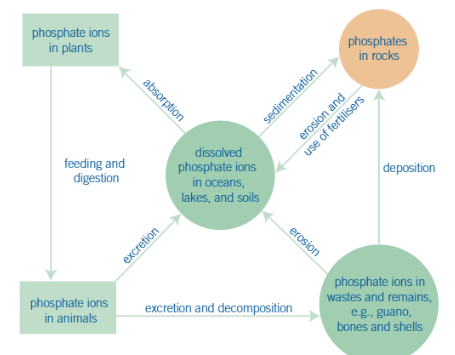
show phosphorus cycle and describe it
Saprobionts decompose organic molecules such as DNA/ATP/phospholipids in dead remains and waste products which releases phosphate ions;
Phosphate ions (in water/soil) are absorbed by producers and used to make molecules such as DNA/ATP/phospholipids;
Phosphorus in phosphate is passed to consumers when they eat producers;
Weathering of rocks releases phosphate ions into soil/water;
what are mycorrhizae
they are associations between fungi and plant roots forming a symbiotic relationship

how do mycorrhizae benefit plants
they act as extensions of the root system increasing the surface area for the absorption of water and minerals
how does the mycorrhizae benefit from this
a mutualistic relationship so in return they get organic compounds such as sugar and amino acid
why are fertilisers needed in agriculture
crops remove mineral ions from soils once they are harvested and those ions wont return to the soil so soil nutrient decrease and plant growth limits
two main types of fertilisers
organic
inorganic
what are organic fertilisers
its made from dead and decaying animals and plants
slower - saprobiontics need to ammonification and nitrifying bacteria to nitrification
they are water soluble
less chance of leaching
what are inorganic fertilisers
fertilisers made from inorganic materials
quicker as immidiate supply of nitrate
water soluble
more chance of leaching
how can fertilisers reduces species diversity
fertilisers causes crops to grow quicker
these species outcompetes the slower growing species for light,water and space
as a result only few plant species survive
what is leaching
leaching is the removal of soluble mineral ions from soil by water, rainwater dissolves the nutrients in soil and carry them into streams, lakes etc
why is leaching harmful
the soluble nutrients ions can contaminate the drinking water which can be harmful for health
describe the process of eutrophication
mineral ions leached into lakes, streams
which cause rapid algae growth forming a algal boom
it blocks sunlight from reaching the deeper water
so aquatic plants below cant photosynthesis and they die
the dead plants cause increase in the number of decomposers and carry out aerobic respiration
which reduces the oxygen content in water and cause the aerobic organisam to die
decreasing the biodiversity
what are producers
plants or autotrophs they can make their own food using the energy from sun
plants only take in 1-3 percent of suns energy where does the rest goes
absorbed by clouds
reflected back to atmosphere
some just pass through the leaves
how are producers releasing energy
they take heat energy from sun and carbon dioxide from atmosphere to make glucose and other sugar which is used in respiration to release energy
equation linking net production
net production = gross production - respiration
what is the meaning of gross production and net production
net primary production is the energy that is left and gross primary production is the all the energy from the sun
State and explain the equation that links GPP and NPP.
NPP = GPP – R
NPP is net primary production, GPP is gross primary production and R is respiratory losses;
GPP is the total chemical energy store fixed by producers in photosynthesis in a given area or volume;
NPP is the chemical energy store in plant biomass after respiratory losses to the environment (R);
NPP is the energy available for plant growth and subsequently, to other trophic levels;
what is biomass
Photosynthesis produces sugars, Sugars that are not used in respiration are used to make other biological molecules which become the biomass of the plan
Biomass is the mass of carbon or dry mass of tissue in a given area;
how is biomass measured
dry mass
mass of carbon per unit of area
State and explain the equation for net production (N) of consumers.
N = I – (F + R)
I is the energy ingested, F is energy in faeces, R is energy lost in respiration;
Of the energy ingested by a consumer, some is lost in faeces, some in lost in respiration;
The remainder is used for growth/biomass and is available to the next consumer/trophic level;
how is dry mass obtained and why is wet mass not used
dry mass used as water content can varies in each organisms
heat in the oven at low temperature and weigh until you get a constant mass
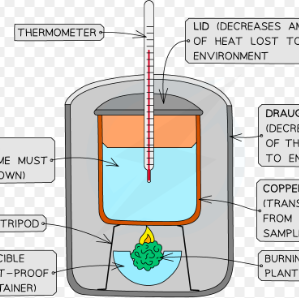
how do you find the energy in biomass
by a calorimetery - the amount of energy released from burning biomass is used to heat the known vol of water
describe the features of calorimetry
termometer to measure the temperature change
stirer to distribute the heat evenly
insulated air to prevent heat loss to the surroundings
what is respiration
its process by which cells produce ATP from glucose
two types of respiration and where does it takes place
aerobic respiration - takes place in mitochondria
anaerobic respiration - takes place in cytoplasm
whats the difference between aerobic and anaerobic respiration
aerobic requires oxygen, completely oxidises the glucose and produce large amount of ATP
anaerobic does not require oxygen, incomplete oxidation of glucose and a small yield of ATP produced
what are coenzyme and whats their function
it is an organic molecule that assists enzyme catalysed reaction and it works by transferring chemical group from one molecule to another and it is regenerated at the end
what are the stages of aerobic respiration
glycolysis
link reaction
krebs cycle
oxidative phosphorylation
where does glycolysis occur
in cytoplasm
what is the first step of glycolysis
phosphorylation
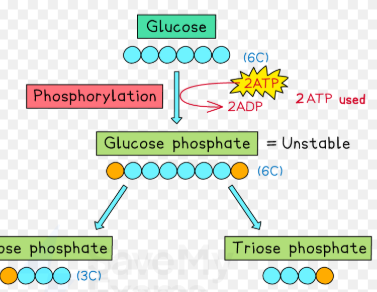
describe the process of phosphorylation in glycolysis
glucose is phosphorylated using a phosphate from ATP this creates 1 molecule of glucose phosphate and a ADP
another ATP is hydrolysed and addition of 2nd phosphate forms hexose biphosphate
which is then split into two triose phosphate
describe the process of oxidation in glycolysis
triose phosphates are oxidised, releasing hydrogen
they hydrogen is accepted by the coenzyme NAD and it becomes reduced NAD
ATP is produced by substrate level phosphorylation
and it forms 2 pyruvate (3C)

what are the products of glycolysis
2 pyruvates
2 NADH
2 ATP - 4 ATP produced but 2 are used up in the early stages
where does link reaction take place
in mitochondrial matrix
describe the process of link reaction
pyruvate enters the mitochondrial matrix by active transport
pyruvate get oxidised to acetate (2C)
one CO"2 is removed and H+ are accepted by NAD to form NADH
acetate combines with a coenzyme A to form acetyl coenzyme A

products of link reaction
2 acetyl coenzyme A
2 CO”2
2 NADH
for one glucose molecule as it has 2 x pyruvates
where does krebs cycle take place
in mitochondrial matrix
describe the process of krebs cycle
acetyl coenzyme A combines with a 4 carbon chain to form citrate (6C)
decarboxylation and dehydrogenation occurs to form 5 carbon molecule and a co2 is removed and NAD accepts hydrogen to form NADH
this happens again to form a 4 carbon molecule from 5 carbon molecule also CO2 and NADH formed
FAD is reduced by accepting hydrogen to form NADH
ATP is produced by substrate level phosphorylation from ADP also another NADH formed
so citrate is converted to oxaloacetate (4C)

what are the products of krebs cycle
it happens twice as two pyruvate per glucose
4 CO2
6 NADH
2 FADH
2 ATP
what is the importance of krebs cycle
breaks molecules into smaller ones
production of hydrogen ions that are carried by NAD/FAD providing energy for the next step electron transmission chain
regeneration of oxaloacetate prevents the accumulation and allows cycle to continue
where does oxidative phosphorylation/ ETC takes place
in the inner membrane of mitochondria - cristae
how is mitochondria adapted for the oxidative phosphorylation
the folding of cristae - increases the surface area for electron carriers and ATP synthases enzyme
ETC is embeddded in the the inner membrane - it contains a series of electron carriers that transfer electron from reduced NAD/FAD to release energy to pumps
intermembrane space - narrow space allows rapid accumulation of hydrogen ions to create a steep electrochemical gradient
describe the process of oxidative phosphorylation/ETC
hydrogen atoms are released from reduced NAD/FAD and each hydrogen atom splits into a proton(H+) and electrons (e-) and turning reduced NAD/FAD to just NAD/FAD
electrons move down the electron transport chain, losing energy at each carriers and h+ moves into intermembrane of mitochondria
energy from e- is used to pump h+
the accumulation of H+ creates a electrochemical gradient
so they diffuses into the matrix down the conc gradient via ATP SYNTHASE
this movement drives the production of ATP from ADP + pi
at the end of the chain electrons combines with H+ and oxygen to form water it is the final electron acceptor

why is oxygen so important in ETC and its role
because it is the final electron acceptor
so if it doesn’t accept the electrons it accumulate and stops the flow of electrons it can stop the pumping of H+ ions so no gradient established so it cant pass via ATP synthase and no ATP production
it combines with electron and proton to form water
how is ATP made in mitochondria
ATP is produced by substrate level phosphorylation in Krebs cycle which occurs in the matrix of mitochondria
Link reaction produces reduced NAD in the matrix of mitochondria
Krebs cycle produces reduced NAD and reduced FAD
Electrons are released from reduced NAD and reduced FAD (reduced coenzymes)
Electrons pass along carriers on the inner mitochondrial membrane
Redox reactions occur OR oxidation/reduction reactions occur;
Energy is released as electrons pass between carriers;
Protons/hydrogen ions move from matrix into intermembrane space;
ATP is made from ADP and Pi as protons/hydrogen ions pass through ATP synthase from intermembrane space to matrix
ATP synthase in the inner membrane catalyses the formation of ATP;