Microbial growth
 Call Kai
 Learn
Learn Practice Test
 Spaced Repetition
 Match
Match Flashcards
 Knowt Play
1/43

There's no tags or description
Looks like no tags are added yet.
Name | Mastery | Learn | Test | Matching | Spaced | Call with Kai | Chat |
|---|
No analytics yet
Send a link to your students to track their progress
44 Terms
What is binary fission
An asexual process in which a single cell divides into two cells
Occurs in prokaryotes
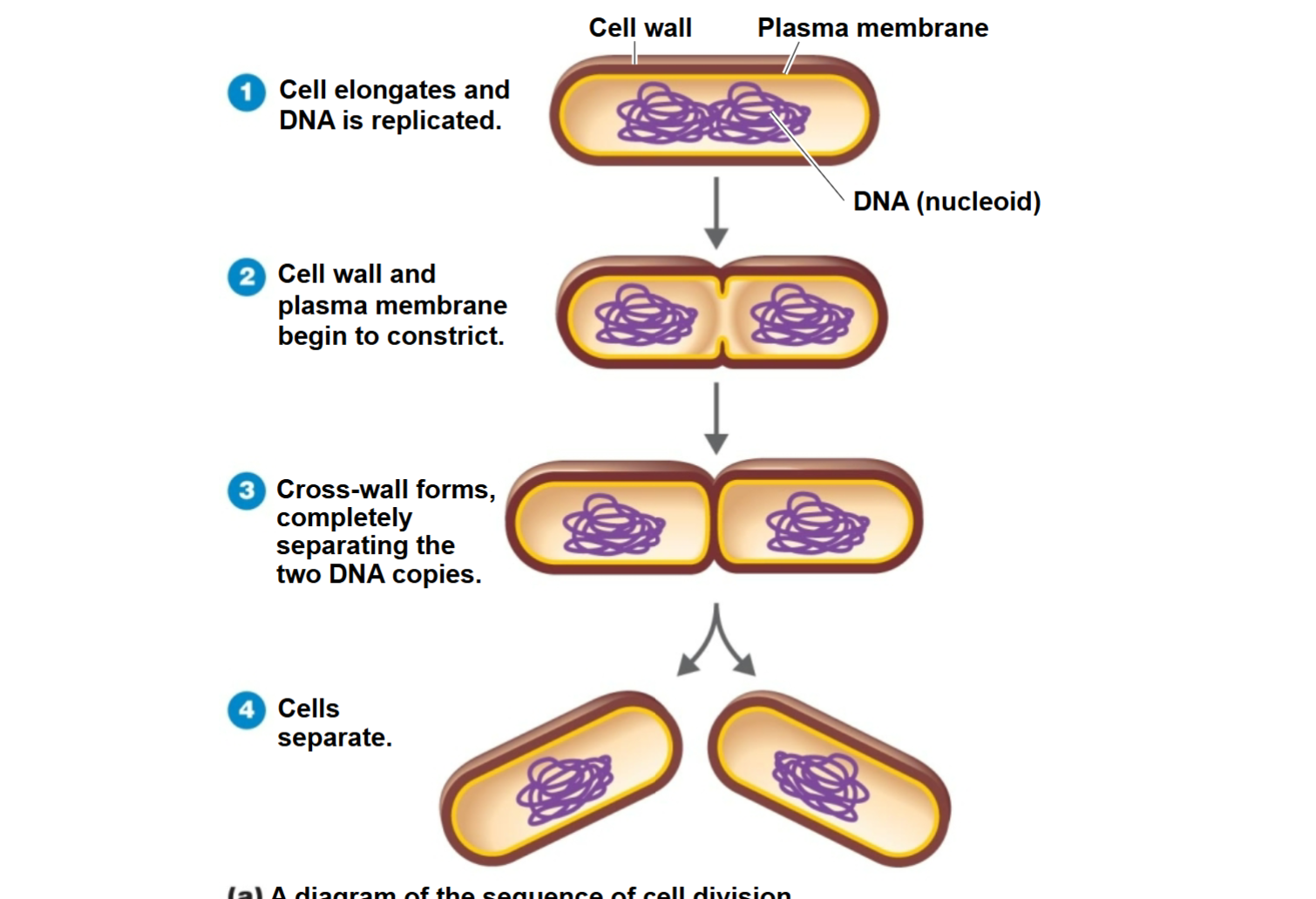
Binary fission process
The cell elongates, and DNA is replicated
Cell wall and plasma membrane begin to constrict
A cross wall forms, separating 2 DNA copies
Cells separate
What is a generation time
Time it takes for a cell to divide
Ranges from 15 minutes to 24 hours
Depends on species and conditions
Bacteria growth is exponential, what does that mean?
Exponential growth formula
Generation time = Growth time (minutes) / number of generations
E.g. E. coli went through 3 generations of growth in the span of 1 hour. The generation time was calculated by 60 mins/ 3 generations = 20 minutes of generation time
Generation time for E.coli
20 minutes but depends on nutrients available
Generation time for mycobacterium tuberculosis
15-20 hours but depends on nutrients available
What are the phases of bacterial growth
Lag, Log, Stationary, and Death phase. They are detected by the count of viable (live) cells.
What happens during lag phase
1st phase
Delay in growth occurs while cells adjust to their new environment
what happens during log phase
2nd phase
Period of rapid exponential growth
What happens during stationary phase
3rd phase
Nutrients are depleted; waste accumulates
Population growth RATE levels off
What happens during the death phase
4th phase
Waste builds up, and nutrients continue to deplete
Cells begin to die
The rate of death is exponential (rapid)
A small number of cells adapt to the waste, and they feed off dead cells
How does temperature affect microbe’s environment
It can decrease or speed up enzymatic reactions and increase growth rates at increased temperatures. However, temperature too high can cause the cell’s proteins to denature
Optimal temperatures for Psychrophiles
-20 C and 10 C
Optimal temperatures for psychrotrophs
0-30 C
Associated w/foodborn illness
Optimal temperatures for Mesophiles
10-50 Celsius
Associated with most pathogens
Optimal temperatures for Thermophiles
40-75 C
Associated w/compost piles and hot springs
Optimal temperatures for Hyperthermophiles
Extreme thermophiles
65-120 C
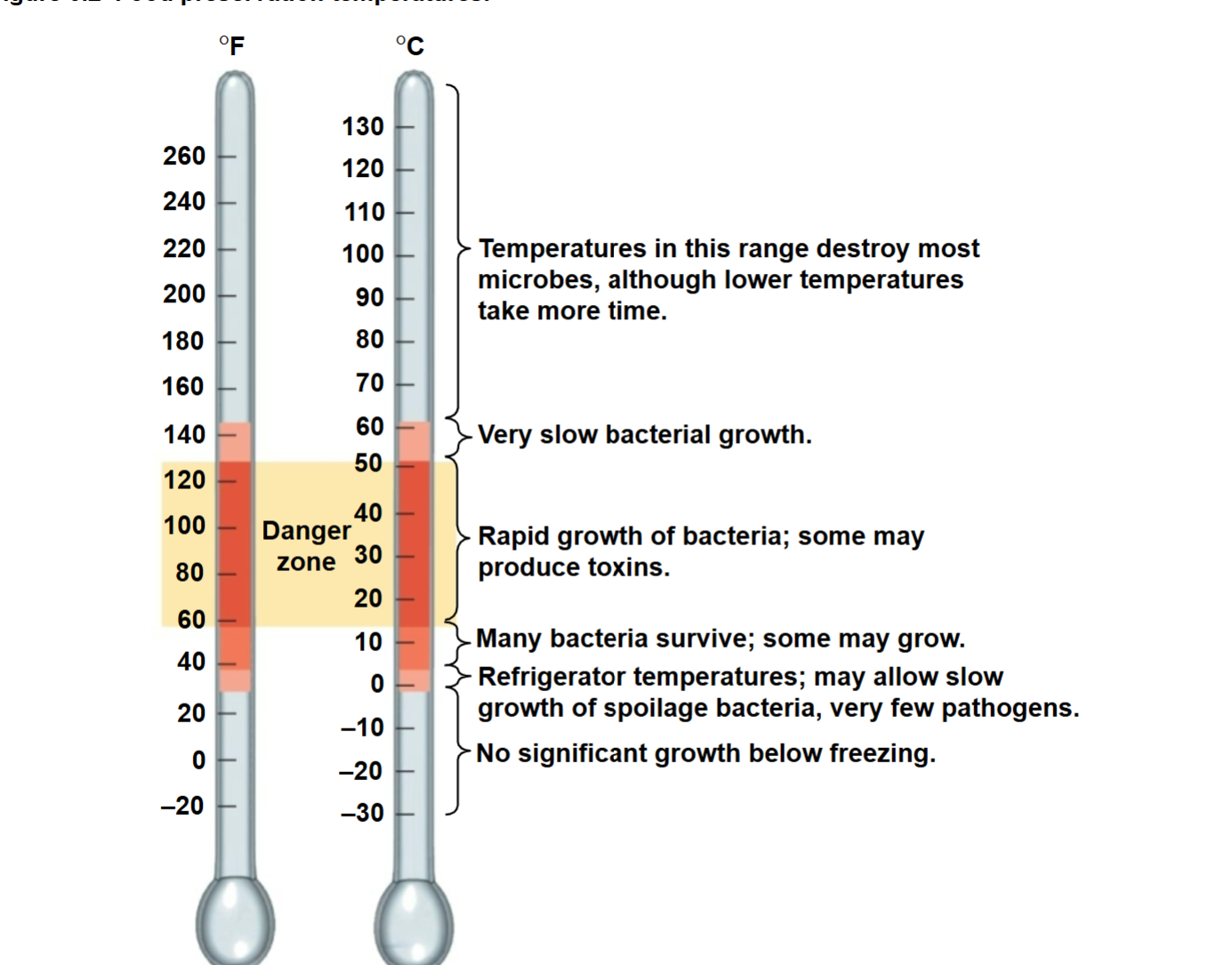
Danger zone or temperatures at which to store food
15-50 C as bacteria grows rapidly and produce toxins
Above 60 C destroys most microbes but is better to go w/low temps
Below 0 C (below freezing) is best for no growth
Why are hyperthermophiles that grow at temperatures above 100 C seemingly limited to the oceanic depths
Acidophiles
Grows at less than 1-5 pH
Live in sulfur hot springs and volcanic vents
Keep a neutral cytoplasmic pH
Proton pumps expel excess protons from cytoplasm to raise pH (expels H molecules to make the cell more acidic)
Neutrophiles
Grow at 5-8 pH
Most microorganisms fall within this range
Akaliphiles
Grow best at 9-11 pH
Associated w/soda lakes
What is a halophile
Thrive in high-salt environments
tolerate up to a 35%
Associated w/the Dead Sea and Great Salt Lake of Utah
What are facultative halophiles
Tolerate higher salt than normal halophiles HOWEVER they make not grow well
E.g. Staphylococcus Aureus
How does osmotic pressure affect bacteria
The bacterial cytoplasm made up of 80% water
If the cell enters a surrounding with higher concentration than their own, through osmosis the water will move out of the cell and make the cell appear as wilted or collapsed
This process is called plasmolysis which can affect bacteria by reducing osmotic pressure
How is osmotic pressure used in food preservation
What are organic growth factors
Organic molecules that the cell cannot synthesize and that must be obtained from their environment to support growth
E.g. Amino acids, vitamins, peptides, etc.
Aerotolerant anaerobes
Tolerate O2 but don’t use it in their metabolic process
Can deactivate ROS
How does Oxygen affect obligate anaerobes
They do not use oxygen in their metabolic processes
When exposed to oxygen, they can form Reactive Oxygen Species (ROS) that poison the bacteria and cause it to die as proteins and DNA are damaged
Obligate aerobes
Absolute dependence on O2
Can manage and deactivate ROS
Microaerophiles
Use only small amounts of O2
Can deactivate ROS but in low amounts
Facultative anaerobes
Grow w/ and w/o O2
Can switch between using O2 and fermentation
Can deactivate ROS
How do obligate, facultative, aerotolerant, and microaerophiles survive toxic forms of oxygen
What are biofilms
Structures made by bacteria to ADHERE to a surface, making it difficult to treat.
Reside in indwelling devices like catheters and heart valves
How are biofilms formed
Why are biofilms important to microbes?
What is the medical importance of biofilms
What are the characteristics of agar
Chemically defined media
Complex media
Reducing media
Selective medium
Differential medium