An Overview of Magnetostrictive Ultrasonic Application
 Call Kai
 Learn
Learn Practice Test
 Spaced Repetition
 Match
Match Flashcards
 Knowt Play
1/31

There's no tags or description
Looks like no tags are added yet.
Name | Mastery | Learn | Test | Matching | Spaced | Call with Kai |
|---|
No analytics yet
Send a link to your students to track their progress
32 Terms
Set Up steps 1-12
1.Disinfect and prepare the treatment operatory using the wipe-wipe method.
2.Ensure the ultrasonic unit is plugged into the electrical outlet.
3.Ensure the blue water supply cord is connected to the water supply opening on the dental unit. (the opening to the right)
4.Place the foot pedal on the floor.
5. Disinfect all the hoses and connections of the ultrasonic unit.
6. Place a barrier loosely over the ultrasonic unit.
7. Obtain the black ultrasonic handpiece from central supply
and the appropriate inserts (Wearing over gloves).
8. Insert the black handpiece into the end of the
black hose by aligning the connectors (Wearing pt. treatment gloves)
9. Run water through the handpiece for 2 minutes by depressing the foot pedal or pressing the purge button, while holding the handpiece over the cuspidor.
10. Hold the handpiece upright (vertically) and fill it
with water by depressing the foot pedal until
water is visible at the top of the handpiece.
11. Insert a sterile ultrasonic insert into the
handpiece, pushing until the insert snaps into
place.
12. Adjust power and water controls while holding
the handpiece over the cuspidor. Activate the
foot pedal: the water spray should create a light
mist or "halo" at the working end with a steady
drip.
Contraindications for ultrasonic use
•Communicable disease transmitted by aerosols(COVID-19, tuberculosis)
•Immune suppression or susceptibility to infection(uncontrolled diabetes or organ transplants)
•Respiratory risk (chronic pulmonary disease, emphysema, or cystic fibrosis)
•Difficulty with swallowing/gagging.
•Cardiac pacemakers or other electronic life support devices
•Children with newly erupted teeth
•Avoid contacting the tip with hypersensitive teeth, porcelain crowns, composite resin restorations, demineralized enamel surfaces
if a patient has a communicable disease transmitted by aerosols, what do we do as clinicians?
Postpone Tx until resolved
If a patient has immune suppression or susceptibility to infection, what do we do as clinicians?
Physician Consult
If a patient has cardiac pacemakers or other electronic life support devices, what do we do as clinicians?
Physician Consult
how do we prepare the patient for ultrasonic use
- Explain the procedure to the patient
•If the patient wears a hearing aid they may want to turn it off.
•Have the patient rinse with an antibacterial solution for 60 seconds prior to treatment.
•Provide patient with protective eyewear, suction, and paper towels in order to keep them dry
ultrasonic inserts components

Insert Tips
designed to provide access to specific areas in the mouth
Water Outlet
for spraying preheated water on the activated tip.
Handle Grip
allows the clinician to comfortably grasp the instrument
O-Ring
acts as a water seal when the insert is placed into the open end of the handpiece.
Connecting Body
transmits motion from the stack to the insert tip.
Magnetostrictive Stack
converts electrical power into mechanical oscillations which activate the insert tip
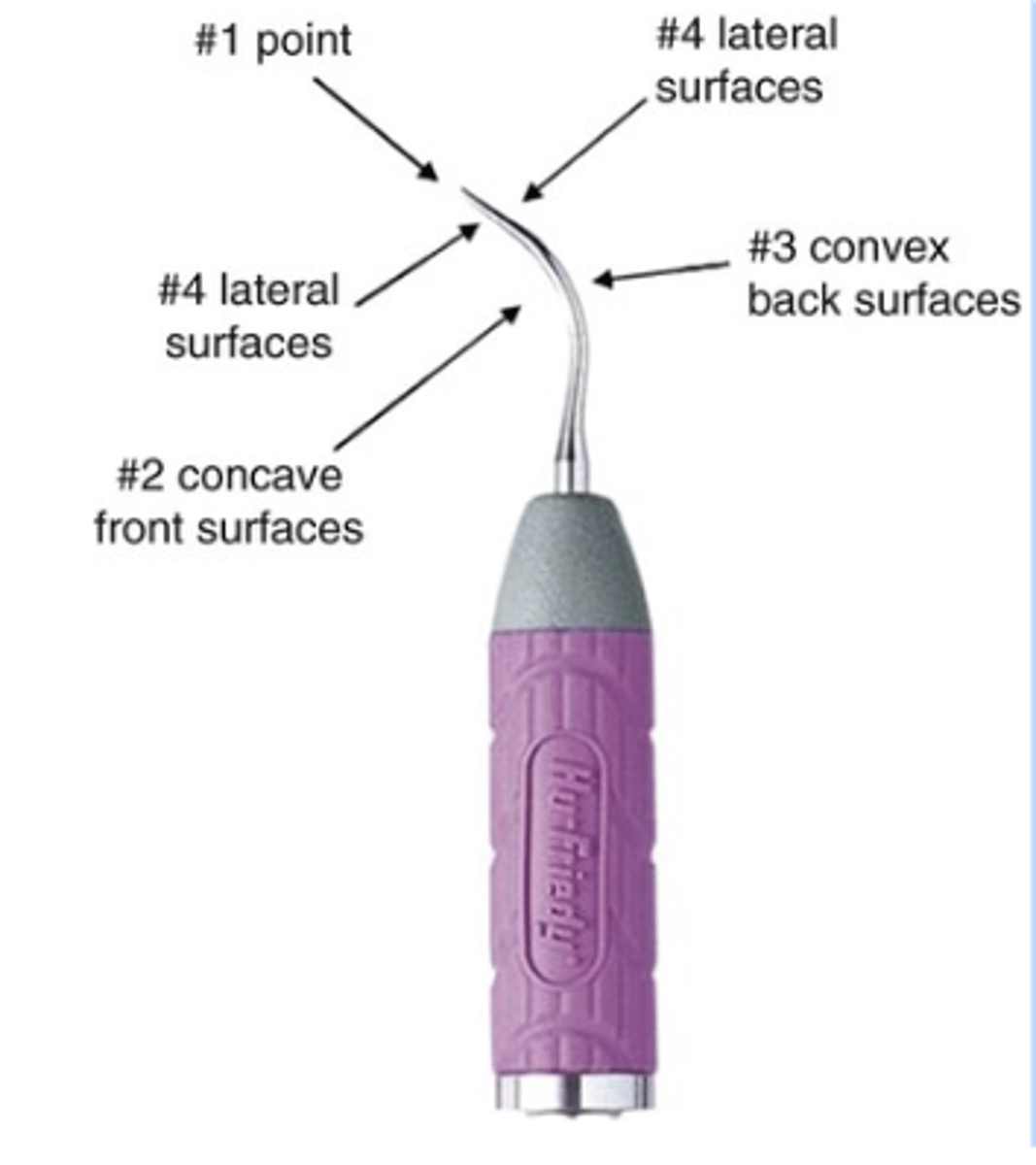
power dispersion of a Magnetostrictive Insert Tip
- point is the most powerful surface.
- concave surface (inner surface) is the second most powerful area
- convex (back) surface is third
- The least amount of energy is on the sides of the insert
To avoid root damage, clinicians should
use inserts on low power with light lateral pressure and tip angulation near zero degrees.
The point of the insert should never be applied to the tooth at a __-degree angle.
90
Two criteria should be used to determine the power setting for instrumentation:
1. The size of the calculus deposit
2. The diameter of the instrument tip
Large deposits may require a _________ tip diameter and a ___________ power setting
standard tip diameter
medium power setting
Medium-sized deposits may require a _________ tip diameter and a ___________ power setting
standard tip diameter
low-medium power setting
small-sizes or deplaquing deposits may require a _________ tip diameter and a ___________ power setting
slim tip diameter
low power setting
Two basic stroke motions are used with the instrument tip:
1. Sweeping strokes
2. Tapping strokes
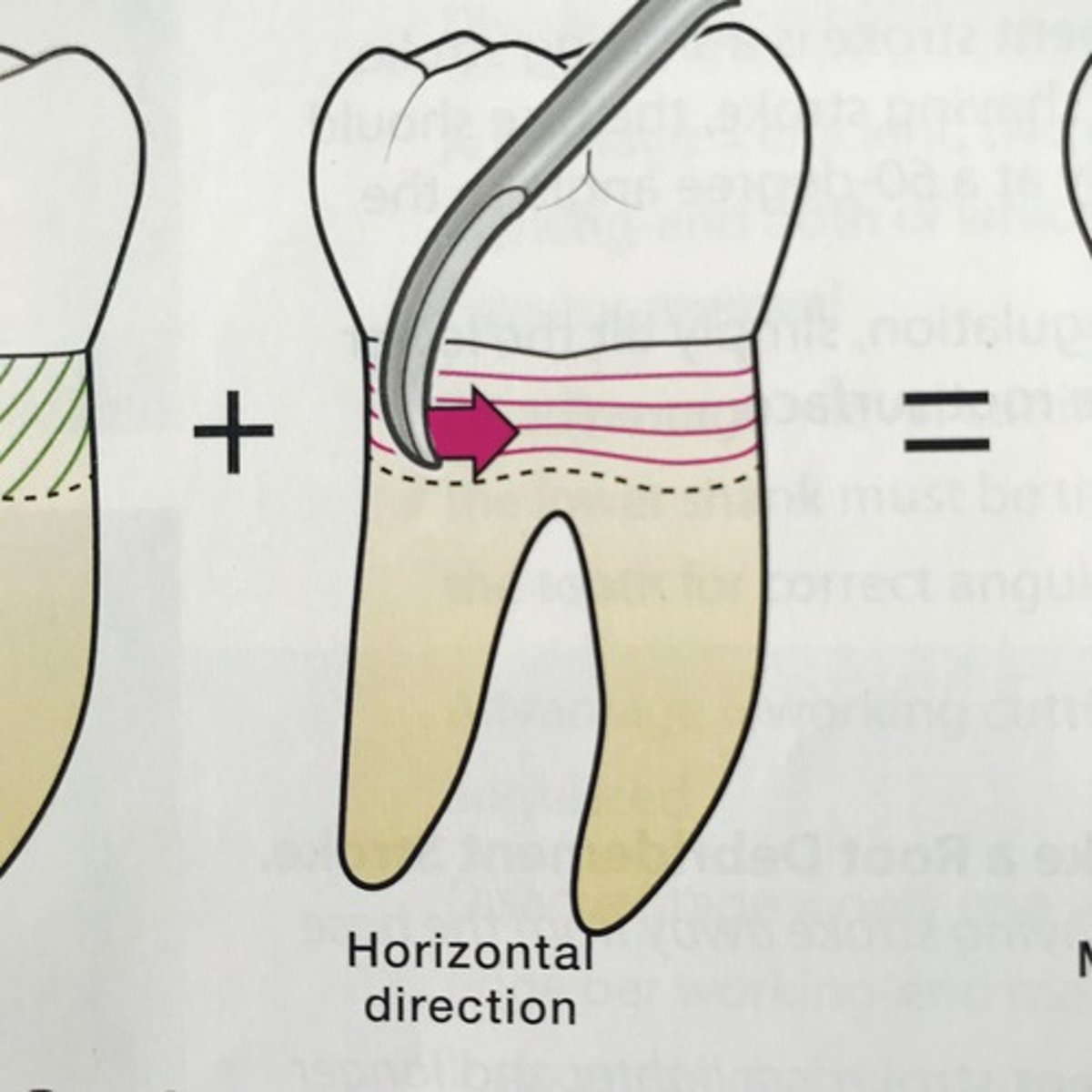
Sweeping Strokes
- on tooth surface
- Use a combination of vertical, oblique and horizontal strokes.
Tapping Strokes
- against deposits
-
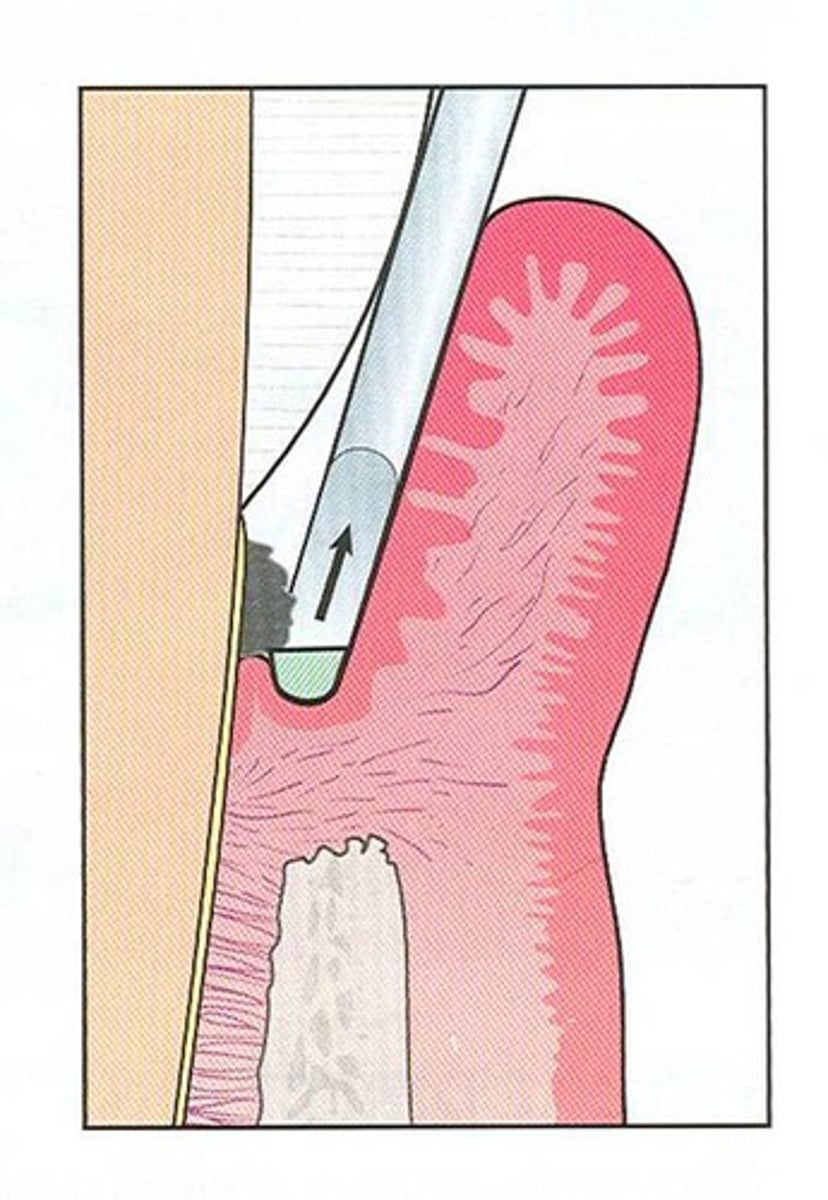
when removing calculus with a curet, what approach should we use
Bottom up approach
• from the base of the pocket toward the CEJ.
•Curet positioned under deposit
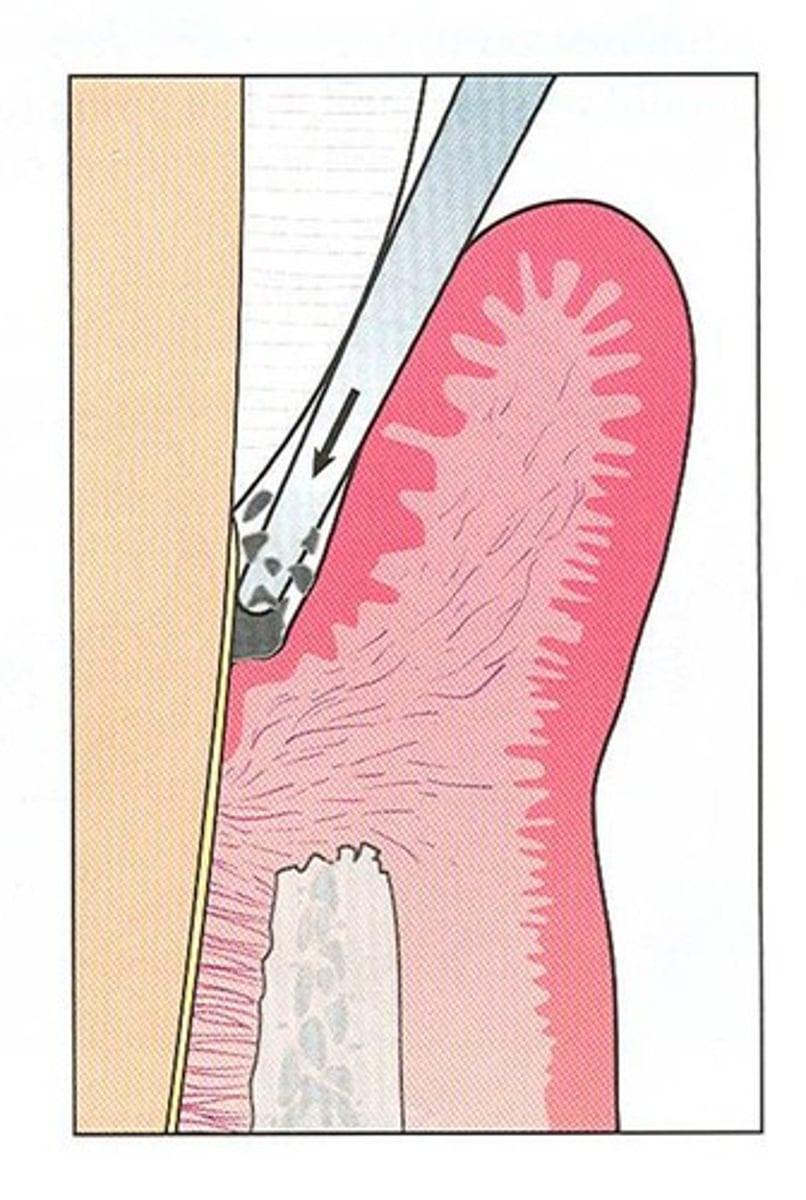
when removing calculus with a Powered Instrument Tip, what approach should we use
•"Top down approach"
•from the top of the deposit working in an apical direction.
T/F: The point of a powered instrument tip should never be adapted to the tooth surface
True
correct technique of Powered instrument tips adaption
should be adapted with either the lateral surface or back against the tooth surface.
Postoperative Instructions
1. tell patient about possible temperature sensitivities after treatment
2. Review OHI
3. Recommend warm saline solution rinses for sensitive gingiva (1/2 tsp salt, 1/2 cup water)
4. Review the need for fluoride dentifrice, desensitizing agents and mouth rinses with newly exposed tooth surfaces.
Ultrasonic Scaler Unit Breakdown steps 1 -7
1. Turn water off
2. Remove insert from handpiece
3. Hold handpiece over cuspidor and drain remaining water from hose by depressing foot pedal
4. Turn the power to the ultrasonic scaler unit off
5. Remove the handpiece from the hose and set aside with the
insert to be taken to central supply for sterilization
6. Disinfect the ultrasonic unit with the wipe-wipe method
7. Gently coil cords and hoses over bracket tray
ultrasonic is a power driven scaling device that converts high frequency ______energy to ________ energy
electrical into mechanical
sonic scalers use
air pressure, turned into high frequency sound waves
sound waves produce
rapid vibrations in the tip