Arterial Hemodynamics Refresher
 Call Kai
 Learn
Learn Practice Test
 Spaced Repetition
 Match
Match Flashcards
 Knowt Play
1/14

There's no tags or description
Looks like no tags are added yet.
Name | Mastery | Learn | Test | Matching | Spaced | Call with Kai | Chat |
|---|
No analytics yet
Send a link to your students to track their progress
15 Terms
Intima
inner most layer
consists offer of endothelial cells supported by an internal elastic lamina
Media
middle layer
consists primarily of smooth muscle cells
allows rhythmic changes in the arterial size that occurs during cardiac cycle
collagen is also found in this area of the wall structure
the external elastic membrane lies between the media and the adventitia
Adventtia
outer llayer
contains connective tissue and collage
contains the vasa vasorum; tiny blood vessels that supply the artery wall
The highest pressure in the arterial system is in the…ventricle and…during systole
left, thoracic aorta
The intraarterial pressure in the distal vascular bed is…during left ventricular contraction, so blood flows…the vascualr beds
lower, towards
Describe normal arterial flow:
In systole, intra-arterial pressure is high, flow. moves forward.
In diastole intra-arterial pressure is decreased and pressure distally is high (due to peripheral resistance); pressure gradient (&flow) reverses.
The third component is through to be due to the elasticity of the arterial wall (rebounding).
Resistive index AKA?
Pourcelot’s index
RI = (PSV - EDV) / PSV
Pulsatility index
PI =3.142 (PSV - EDV) / TAV (time avg velocity)
Why are RIs and PIs important?
increased or decreased resistance in flow reveals the presence of pathology
Changes in arterial hemodynamics are clues in diagnosing…
peripheral arterial disease PAD
Describe the hemodynamics in PAD…
increased resistance
stenosis = highest PSV
Post-stenotic turbulent bidirectional flow
Tardus parvus distal to stenosis
Changes in artery wall for inflammation and plaque are:
monocyte migration through endothelium
foam cells
migration of smooth muscle cells
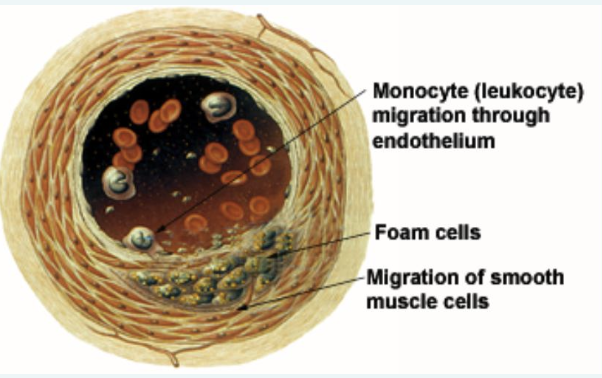
changes in artery wall for advanced atherosclerosis:
fibromuscular cap (ruptured)
blood, fibrin, platelets are released when cap ruptures
calcium carbonate
cholesterol crystals
ruptured vaso vasorum
describe chronic PAD:
appears echogenic chunks of plaque, less likely to break away
describe soft plaque:
appears hypoechoic, fresh, more likely to break away