Chapter 2: Surface Anatomy
 Call Kai
 Learn
Learn Practice Test
 Spaced Repetition
 Match
Match Flashcards
 Knowt Play
1/92

There's no tags or description
Looks like no tags are added yet.
Name | Mastery | Learn | Test | Matching | Spaced | Call with Kai | Chat |
|---|
No analytics yet
Send a link to your students to track their progress
93 Terms
What is surface anatomy?
Study of structural relationships of external features of the body to internal features
What are the regions of the head (Skull)?
Frontal, parietal, occipital, temporal, auricular, orbital, nasal, infraorbital, zygomatic, buccal, oral and mental
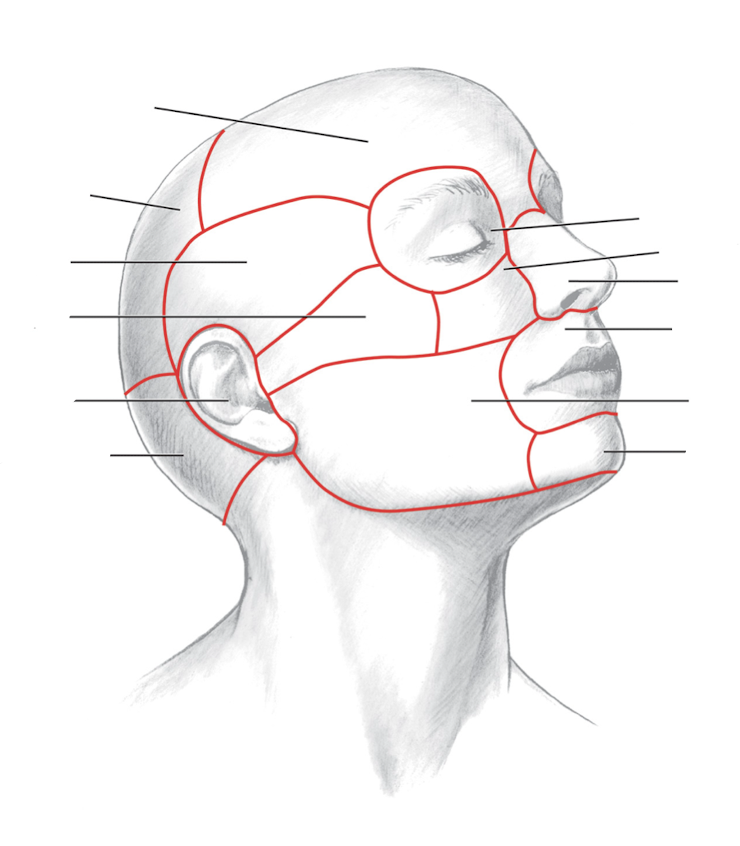
Label each region of the head (Practice on ipad!)
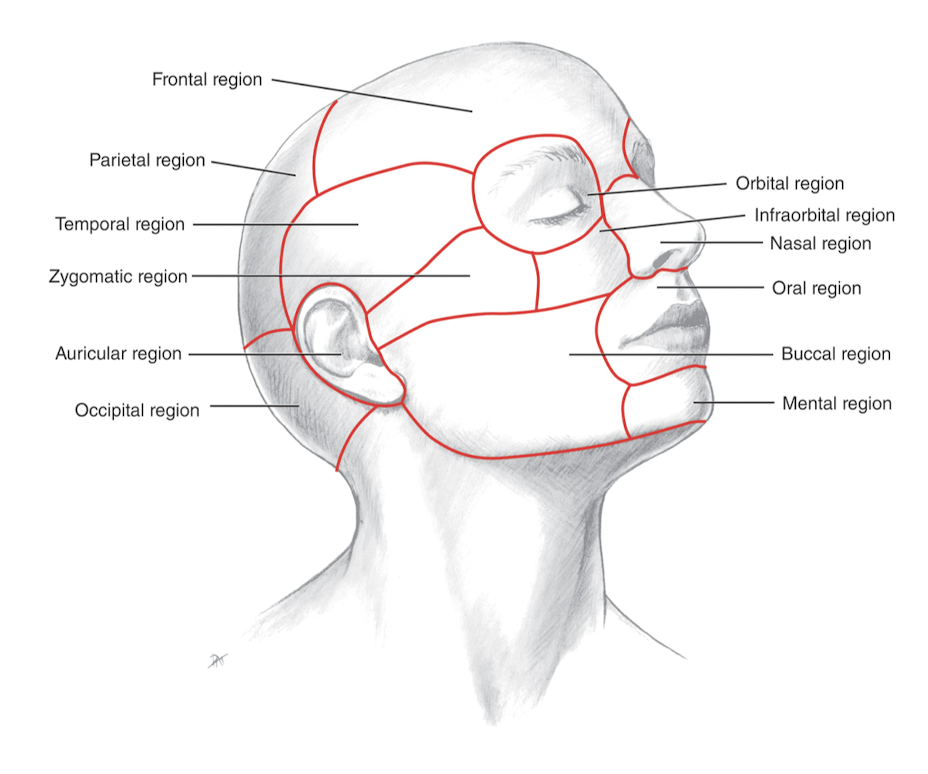
What does the frontal region of the head include?
forehead and areas superior to the eyes
Where is the supraorbital ridge located?
directly inferior to each eyebrow
What is the glabella?
Smooth elevated area between the eyebrows
What is the frontal eminence?
Prominence of the forehead
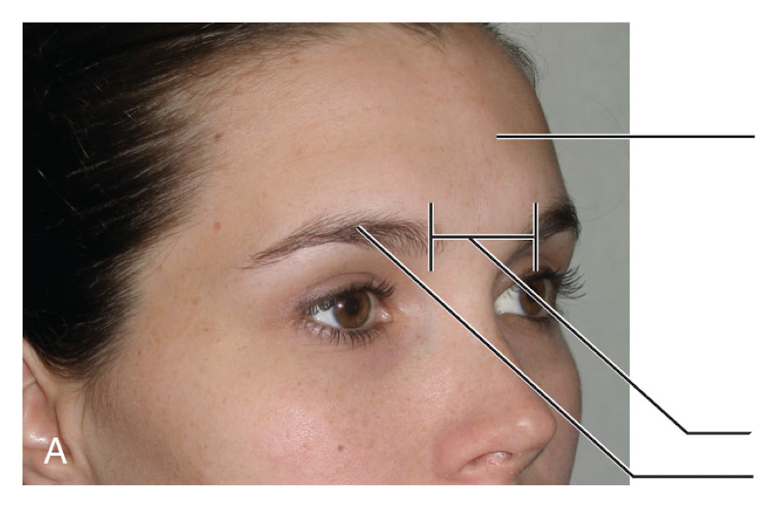
Label these (use ipad!)
What covers both the parietal and occipital regions?
The scalp
What defines the parietal region and occipital region?
By related deeper skull structures
How do orbital hematomas occur?
to injuries to the scalp
Why can’t fluid descend into the orbits during a orbital hematoma?
Due to orbicularis oculi muscle attaching to skin
Why can’t fluid pass into the neck or subtemporal regions?
Because of attachments of the epicranial aponeurosis
Where is the temporal region?
On superficial side of the head posterior to each eye
Where is the auricular region?
Between each side of external ear or outer ear
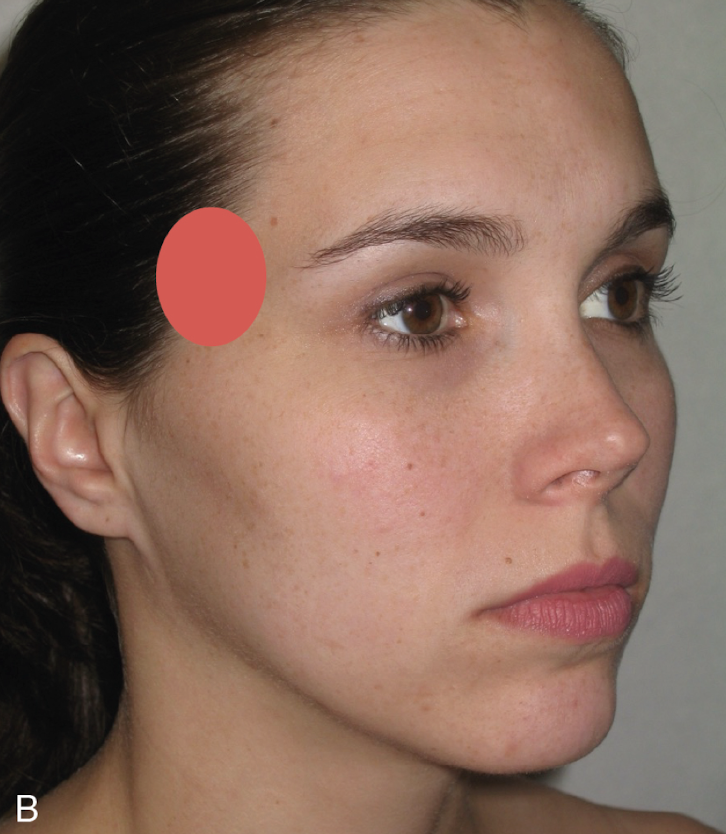
What is this region?
temporal region
What is the external ear compose of?
aurical or oval flap and the external acoustic meatus (EAM)
Where is the helix and where does it end?
Superior and posterior free margin of the auricle and ends inferiorly at the lobule
What is the lobule?
ipsilateral fleshy protuberance of the earlobe
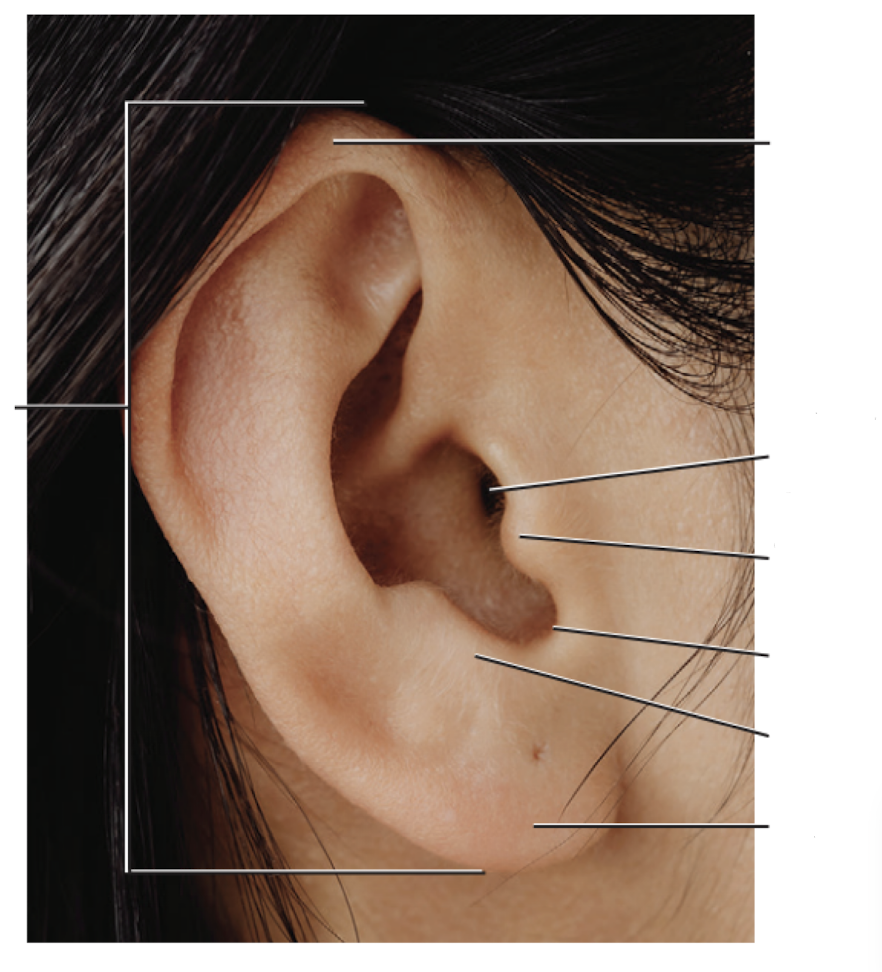
Label this (use ipad)
What is the tragus?
Smaller flap of tissue of auricle anterior to EAM
What is the antitragus?
other flap of tissue contralateral to tragus
Where is the intertragic notch?
between tragus and antitragus small groove
What does the orbital region have on each side of the head?
A eyeball, and supporting structures contained in the orbit
What is the orbit?
the boney socket formed by various skull bone
What is the sclera of the eye?
white area
What is the iris on the eyeball?
The central area of circular coloration
What is the pupil?
Opening in the center of iris which appears black
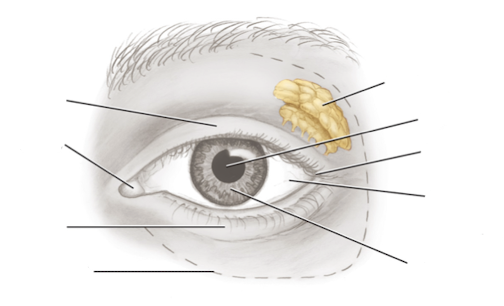
Label these (use ipad)
Where are the lacrimal glands located?
Posterior to each upper eyelid and deep within orbit
What does the lacrimal glands produce?
lacrimal fluid or tears
What is conjunctiva?
delicate and thin membrane lining inside of each eyelids and anterior to eyeball
What are the lateral/outer canthus (canthi)?
Outer corners where upper and lower eyelids meet
What are the medial/inner canthus (canthi)?
Inner angles of the eye
What is the main feature of the nasal region?
external nose
Where is the root of the nose located?
between the eyes
Where is the nasion located?
Inferior to glabella midpoint landmark of nasal region that corresponds with junction between underlying bones
Where is the bridge of the nose located?
inferior to nasion bony structure
What is on the other end of the bridge of the nose?
the apex of the nose
Where are the noris (nostril) located?
Inferior to apex on each side of the nose
What separates the nares internally?
nasal septum
What forms the nasal septum?
various skull bones and adjoining nasal septal cartilage
Where are the ala (alae)?
Nasal borders laterally on each side by winglike carilaginous structures
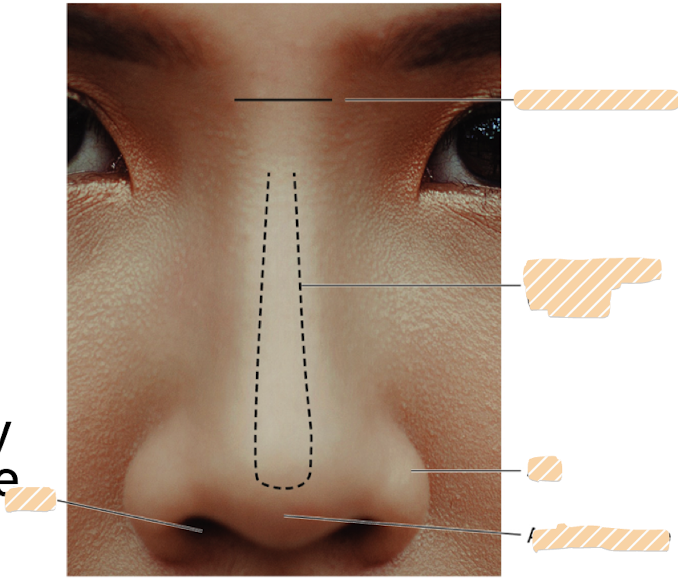
Label these (use ipad)
How can a nasal obstruction occur?
acutely or chronic in nature
What can cause a nasal obstruction?
large adenoids (kid), neoplasms, deviated nasal septum, foreign bodies
What are some patient complaint that could be signs of nasal obstruction?
snoring, abnormal speech, breathing difficulties when eating
Where is the infraorbital region located?
inferior to orbital region and lateral to the nasal region
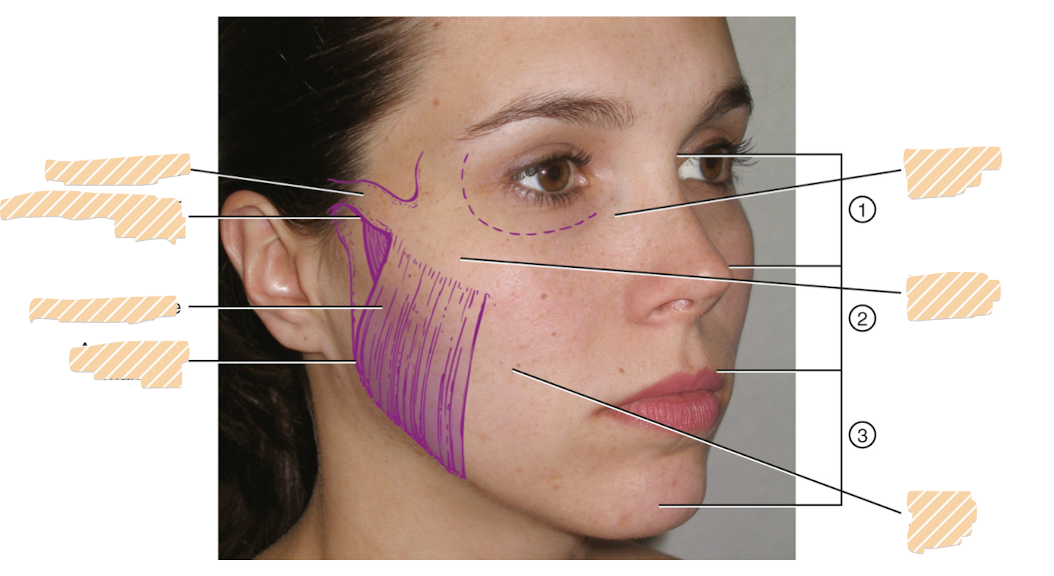
label these (use ipad)
Where is the zygomatic region?
father laterally to the nasal region and overlying the cheekbone
What is the zygomatic arch?
cheek bone
Where is the zygomatic arch?
extends from just inferior to lateral margin of the eye towards midline of the ear
Where is the temporomandibular joint (TMJ)?
inferior to zygomatic arch and just anterior to the ear
What makes the TMJ?
Where the upper skull forms joint with lower jaw
What is the only joint in the skull?
temporomandibular joint (TMJ)
What is the buccal region composed of?
soft tissue of cheek from side of the face and broad area between nose, mouth and ear
What muscle is fult when a patient clenches their teeth together?
Masseter muscle
How can the masseter muscle become enlarged?
bruxism (grinding) and clenching
How can you examine the TMJ?
TMJ movements can be felt and opening or closing the mouth or movie the lower jaw right or left
How can we visually divide the face?
With 3 vertical dimensions
What is the Golden Proportions?
Discussion of ideal vertical dimension allows comparison of 3 parts of the face for functional and esthetic purposes
How can vertical dimension loss of the lower 3rd occur?
Loss of bony jaw support from increased aging and severe chronic periodontal disease
What structures are found in the oral region?
lips, oral cavity, palate, tongue, floor of the mouth, parts of the throat/pharynx
How can the lip’s vermillion zone be different among people?
Redder, darker or physiological pigmentation
What is the transition area of mucocutaneous junction?
the vermilion border
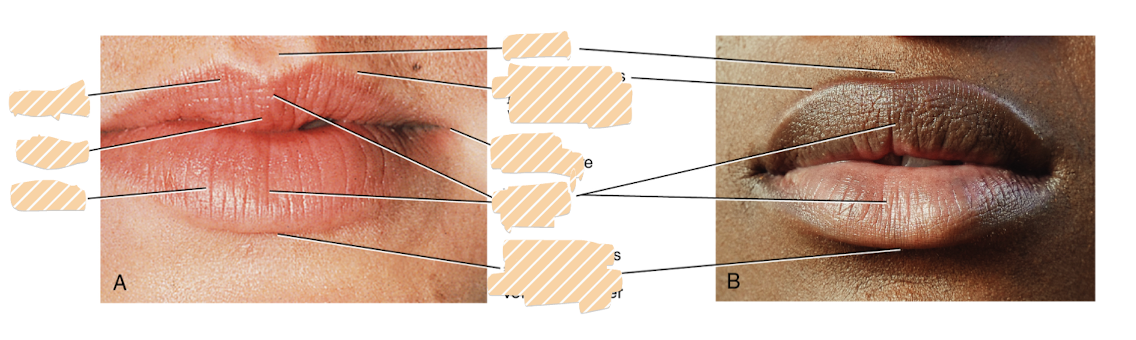
Label these (use ipad)
What is beneath the skin of the lip?
many muscles (orbicularis oris), nerves, blood vessels
Where does blood supply come from to the lip?
Superior and inferior labial arteries that branch from facial arteries
Where does sensory supply come from to the lip?
Branches of 5 cranial (trigeminal nerve)
What nerves extends to the upper lip for sensation?
infraorbital nerves
What nerves extends to the lower lip for sensation?
mental nerves
What drainage from both submental and submandibular lymph nodes can be bilateral?
lymphatic drainage
What is present on the inner part of each labial minor salivary glands?
small duct the are penetrating mucosal membrane
What is the philtrum?
Vertical groove on the skin superior to midline of upper lip extending inferiorly from nasal septum
Where and what is the tubercle of the upper lip?
Inferior to philtrum is a thicker area
What are the labial commissure?
Where the upper and lower lips meet at each corner of the mouth
What is the nasolabial sulcus?
groove running upward between each labial commissure and each ala of the nose
What separates lower lip from the chin in mental region?
labiomental groove
What marks the anterior border of the oral cavity?
the lips of the face
What marks the posterior border of the oral cavity?
throat/pharynx
What marks the lateral borders of the mouth?
cheeks
What mark the superior border and roof of the mouth?
palate
What marks the inferior border of the mouth?
floor of the mouth
What is facial?
Structures closet to the facial surfaces
What is labial?
facial structures that are closer to the lip
What is buccal?
Facial structures closest to inner cheek
What is lingual?
Structures closest to the tongue
What is palatal?
Lingual structures closest to palate
Where is oral mucosa?
lines the entire oral cavity
Where is labial mucosa?
lines the lips
What is continuous with labial mucosa that lines inner cheeks?
buccal mucosa
What is the parotid papilla?
small elevation of tissue that protects duct opening of parotid salivary gland on inner part of mucosa just opposite of maxillary 2nd molar