chapter 6 - organic synthesis
 Call Kai
 Learn
Learn Practice Test
 Spaced Repetition
 Match
Match Flashcards
 Knowt Play
1/21

There's no tags or description
Looks like no tags are added yet.
Name | Mastery | Learn | Test | Matching | Spaced | Call with Kai | Chat |
|---|
No analytics yet
Send a link to your students to track their progress
22 Terms
what is included in the standard set of quickfit apparatus?
1) round bottom or pear-shaped flask
2) receiver
3) screw-tap adaptor
4) condenser
5) still head

apparatus needed for reflux?
round bottom or pear-shaped flask
condenser
rubber tubing
stand and clamp
heat source
what would you use when heating flammable liquids?
a heating mantle, so that there is no naked flame present
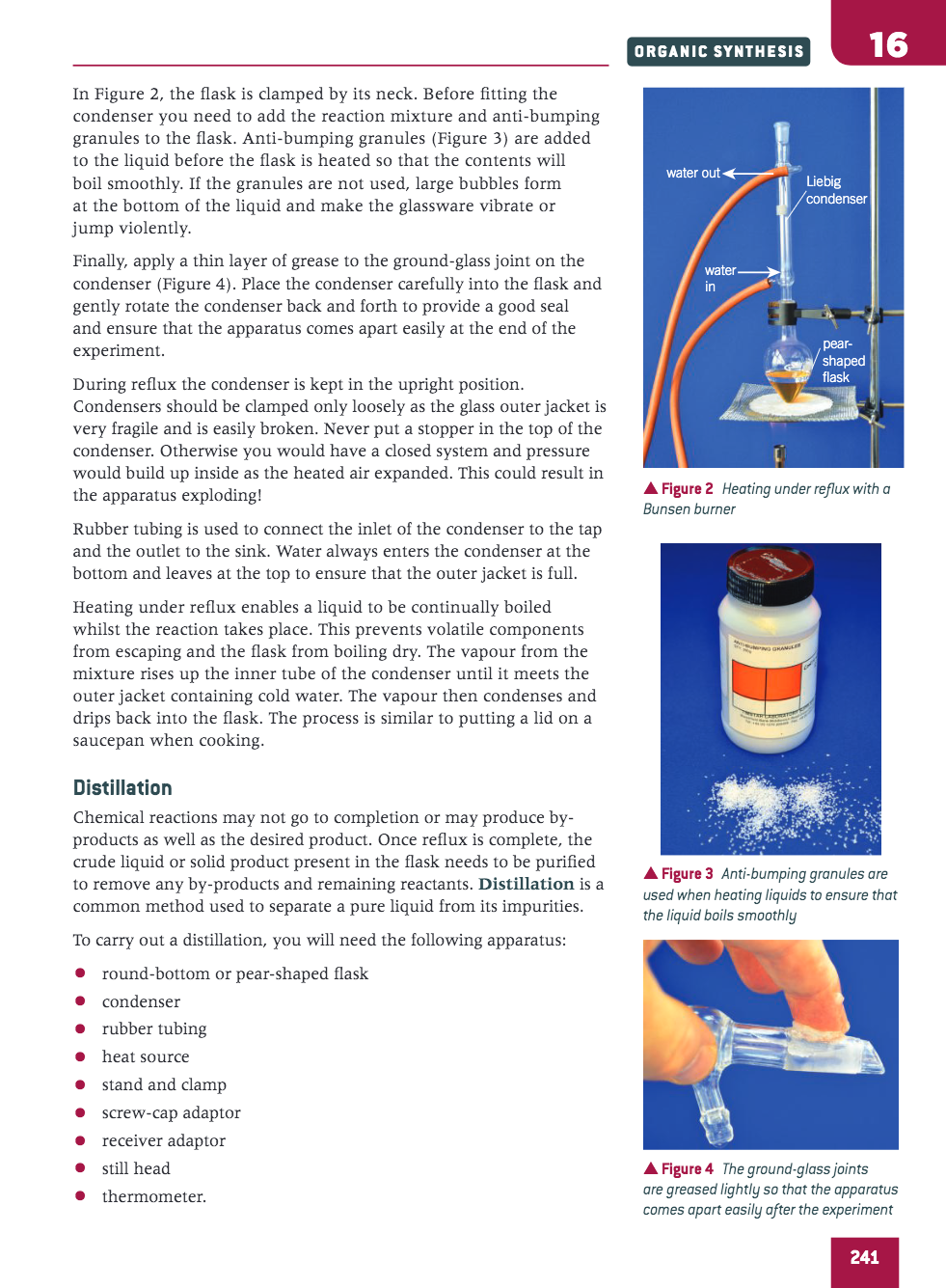
what are anti-bumping granules used for?
so that the contents will boil smoothly
what would happen if granules were not used?
large bubbles form at the bottom of the liquid and make the glassware vibrate or jump violently
why should you never put a stopper at the top of a condenser?
because otherwise you will have a closed system
pressure will build up inside as the heated air expands
which could result in apparatus exploding
how does water enter and leave condenser?
water enters - bottom
water leaves - top
this ensures that the outer jacket is full
what does heating under reflux enable?
it enables a liquid to be continually boiled whilst the reaction takes place
this prevents volatile components from escaping and the flask from boiling dry
what is distillation used for?
it separates a pure liquid from its impurities
apparatus needed for distillation?
round bottom or pear-shaped flask
condenser
rubber tubing
heat source
clamp and stand
screw-cap adaptor
receiver adaptor
still head
thermometer

how to know which layer is the aqueous layer and which is the organic layer?
add water to your mixture
the layer that gets bigger is the aqueous layer
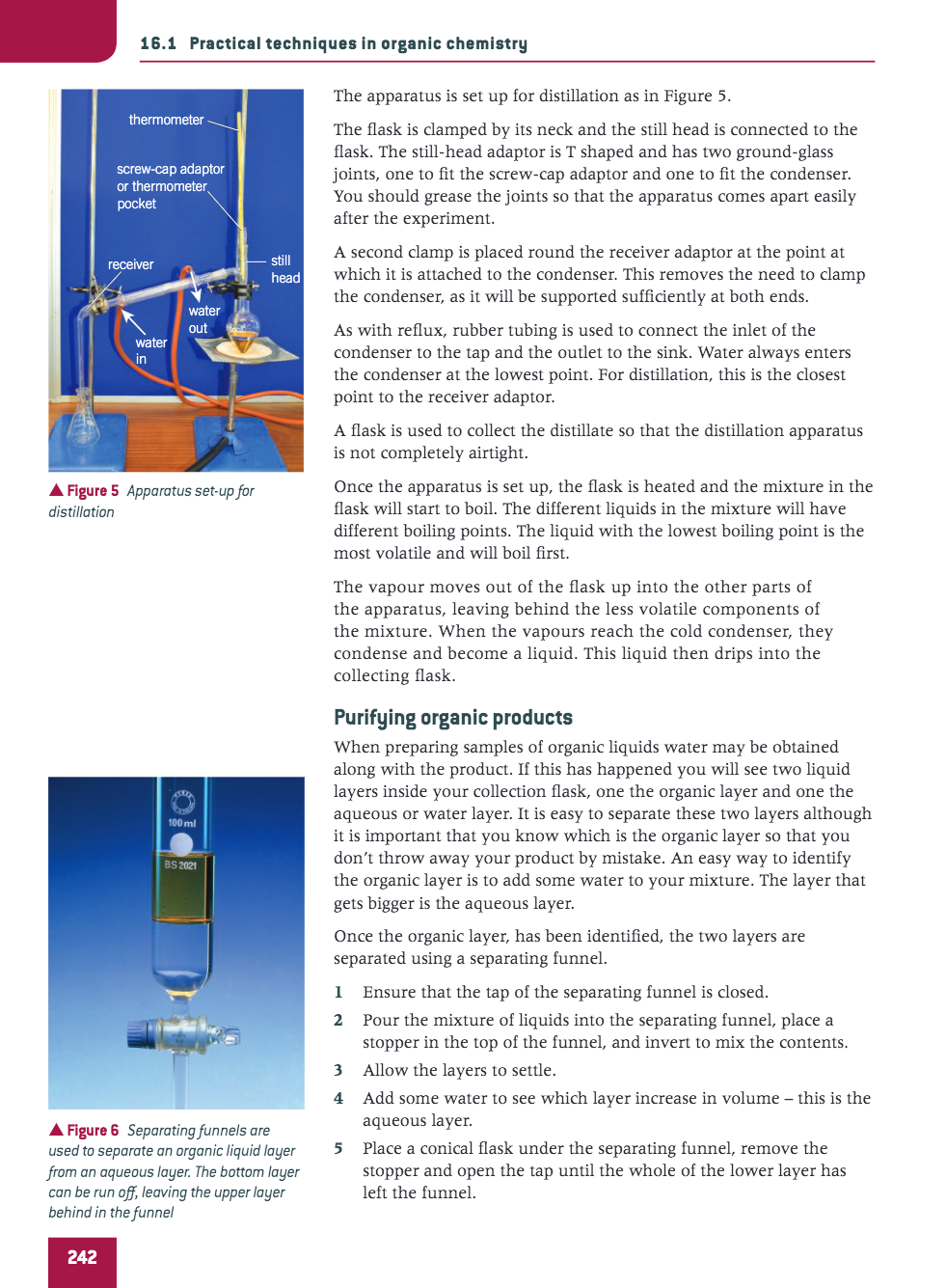
how to separate the 2 layers?
by using a separating funnel
ensure that the tap of separating funnel is closed at first
pour mixture of liquids into a separating funnel, place a stopper in the top of the funnel and invert to mix the contents
allow the layers to settle
add some water to see which layer will increase in volume- this is aqueous layer
place a conical flask under the separating funnel, remove the stopper and open tap until whole of the lower layer has left the funnel
place a second conical flask under the separating funnel to collect the other layer
label flasks so that you don’t muddle them
how to remove traces of water from organic product?
by using a drying agent
what is a drying agent?
an anhydrous inorganic salt that readily takes up water to become hydrated
common anhydrous salts?
anhydrous calcium chloride (drying hydrocarbons)
anhydrous calcium sulfate (general drying)
anhydrous magnesium sulfate (general drying)
process for drying an organic liquid?
add the organic liquid to a conical flask
using a spatula, add some of the drying agent to the liquid and gently swirl the contents to mix together
place a stopper on the flask to prevent product from evaporating away. leave for about 10 mins
if the solid has all stuck together in a lump, there is still some water present. add more drying agent until some solid is dispersed in the solution as a fine powder
decant the liquid from the solid into another flask. if the liquid is dry, it should be clear
redistillation?
sometimes organic liquids have boiling points that are relatively close together, so your prepared sample may still contain some organic impurities
the distillation apparatus is cleaned and dried and set up again so that a second distillation can be carried out
this time only collect the product with the boiling point of the compound you are trying to make
the narrower the boiling range, the purer the product
conditions needed for fermentation?
yeast enzyme
anaerobic conditions
temp range: 25 - 40C
how do you know when fermentation of glucose is complete?
no more bubbles/gas/CO2
equation for fermentation of glucose to produce ethanol?
C6H12O6 (aq) → 2C2H5OH(l) or (aq) + 2CO2(g)
use of mass spectroscopy outside the lab?
breathalysers
monitoring of air pollution
MOT emission testing
compare sustainability of the 2 methods of manufacturing ethanol in terms of:
availability of starting materials and energy requirements
atom economy
availability
sugar is renewable because it can be grown
ethane is finite because it is obtained by processing of crude oil
energy:
fermentation: energy is required for distillation
hydration: energy is required to generate steam
atom economy and waste products:
atom economy for hydration is greater than the atom economy for fermentation
in fermentation, CO2 is produced in addition to ethanol
whereas in hydration, only ethanol is produced
atom economy of fermentation could be increased by finding a use CO2