Microbiology
 Call Kai
 Learn
Learn Practice Test
 Spaced Repetition
 Match
Match Flashcards
 Knowt Play
1/25

Earn XP
Description and Tags
Eduqas Biology Alevel component 1.4
Name | Mastery | Learn | Test | Matching | Spaced | Call with Kai | Chat |
|---|
No analytics yet
Send a link to your students to track their progress
26 Terms
Different shapes of Bacteria
Cocus= round
Spirillum= spiral
Bacillus= rod shaped
What are bacteria cell walls made of
largely peptidoglycan- a mixed polymer of hexose sugars and amino acids
How does cross-linking help with the cell wall
adds strength, flexibility, supports cells contents and protects cell of lysis
Features of gram positive bacteria
thick peptidoglycan layer walls, meaning it can retain the crystal violet stain
Retains crystal violet/ iodine complex stain,
counterstain with safranin has no effect
more susceptible to antibiotics and lysozymes
Features of gram negative bacteria
thinner walls of peptidoglycan
does NOT retain crystal violed/iodine complex and colour will be washed away by alcohol
safranin counterstain stains it red
layers of lipopolysaccherides which means they are
not effected by lysozyme and resistant to peniciln
Why does gram negative bacteria not retain crystal violet stainm
outer lipopolysaccharide layer lost with the alcohol wash so crystal violet stain no longer there so can take up safranin stain
How to gram stain
-heat fix the bacteria
-stain with crystal violent
-seal stain with iodine
-decolourise with alcohol (if negative the stain will wash away)
-counter stain with safranin
Obligate aerobes
microorganisms that Need oxygen for metabolism/ to grow
Obligate anaerobes
microorganisms that require an absence of oxygen to grow/metabolise
Facultative anaerobes
Microorganisms that prefer to grow/ metabnolise in oxygen but can anaerobically
Genetic variance in bacteria
-random mutations that can be passed on to daughter cells by vertical transmission or other bacteria by horizontal transmission
Growing bacteria- nutrition
-require a carbon compound, usually glucose as an energy source
-a nitrogen source for amino acids
-growth factors like vitamins and mineral salts
Growing bacteria- Temperature
25-45° is favourable for most.
27° for mammalian pathogens
Growing bacteria- pH
-most favour slightly alkaline (7.4)
-ph of medium may change during growth
Bacterial growth chart
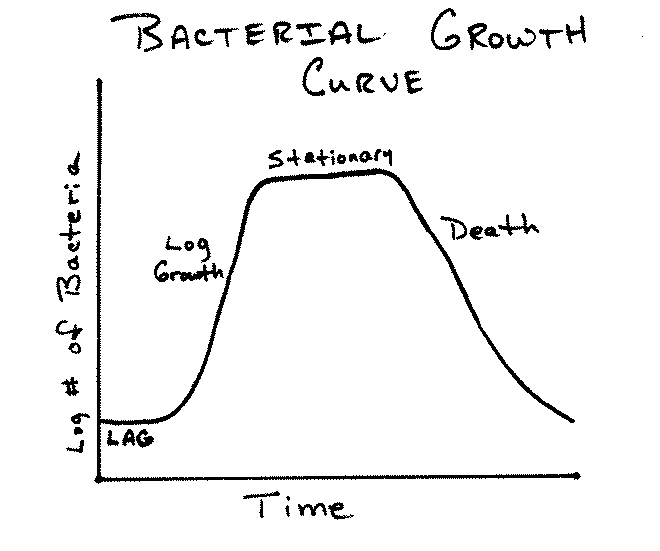
Growth chart- lag phase
Little growth but cells take yo water and carry out protein synthesis and produce enzymes
Growth chart- exponential phase
Population increases rapidly
growth chart- starionary phase
Dying at the same rate they are being produced
Growth chart- death phase
More are dying then being produced
Aseptic technique
-bunsen burner on a roaring flame for a convection current
-sterilise equipment by passing over flame
-keep lids in hands
-flame neck of agar bottle
-lids of petri dishes should not be taken fully off
-bit off tape NOT fully tape
-incubated upside down at 25degrees
culturing bacteria-serial dilutions
-take 1cm cubed of solution and add it to 9cm of water, MIX
-take 1 cm of this solution and add it to 9cm of water, MIX
-keep going until a spear cultured sample has a countable number of colonies
10^-1, 10^-2, 10^-3 ect
What is the equation for finding the original count of bacteria after a serial dilution?
number of colonies or cells x dilution factor= number of original cells
total cell count
counts living and dead
viable cell count
counts living bacterial
turbidimetry
the size of a population in a liquid culture can be measured by looking at the cloudyness using a colorimeter.- total cell count
What is the problem wiht assuming one colony is one cell
doesnt account for cells possibly clumping, meaning the estimate of cells is lower