WPS 264 S&S defects
 Call Kai
 Learn
Learn Practice Test
 Spaced Repetition
 Match
Match Flashcards
 Knowt Play
1/15

There's no tags or description
Looks like no tags are added yet.
Name | Mastery | Learn | Test | Matching | Spaced | Call with Kai | Chat |
|---|
No analytics yet
Send a link to your students to track their progress
16 Terms
S&S degradation
Reduction or increase in dimensions or varying S/S as result of MC or density distribution leads to:
opening/tightening of joints
change of cross-sectional shape
warping
casehardening
honeycombing
collapse
loosened or raised grain
Dimensional changes
Appear in all wood
Magnitude influenced by tension/compression wood & knots
Joints
Doors can’t close in winter or is too loose if shrank
Change of cross-sectional shape
Results from different radial & tangential shrinkage
Depends on where on log wood was cut
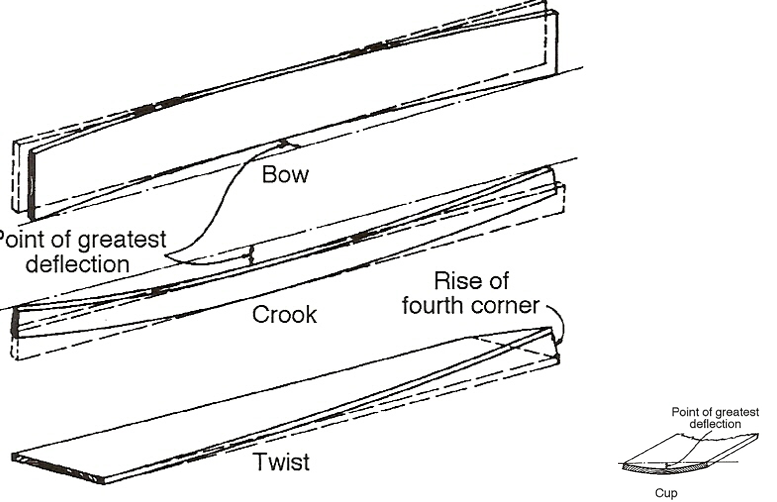
Warping
Results from different r&t S&S
Lumber boards longer in tangential direction are most likely to warp
Warping also caused by MC differences
Checking (splitting of fibres)
Unequal dimension change due to MC gradient in wood
Appear at ends or on surface where moisture is lost quicker
Loose knots
Unequal shrinkage between knot & wood might lead to loosening of knot
Honeycombing
Internal checking of wood occuring in core at high MC & too high temp in kiln drying
Collapse
Severe distortion of cells caused by eg. high kiln temps
Loose / raised grain
Raised grain: rough lumber surface caused by latewood being raised above earlywood
Loose grain: partial separation of growth rings, loose portions protrude
Control of shrinkage
Mechanical modification
Water repelling coating
Bulking treatment
Reduction of hygroscopicity
All expensive or experimental
Mechanical modification
Avoid anisotrophy eg. plywood
Adjacent layers with grain direction at right angles
Decrease in shrinkage in direction of length & width
Magnitude of shrinkage close to longitudinal value of solid wood
Water repelling coating
Exterior coating protects atmospheric variation through retardation of moisture exchange
S&S also retarded but not prevented. EMC not affected.
Interior coating eg. alkydic resin (10-15%) + paraffin wax (0.5-1%)
Wood immersed in solution, which changes hygroscopic character of wood.
Protective coatings wear off with time
Bulking treatment
Wood kept swollen by depositing chemicals (salt, sugar, ect.) in cell walls
Reduces strength
At high humidities salt, sugar, ect. appear on surface & deplete
Monomeric methacrylates, vinyl compounds or styrene with a swelling agent can be used the same way
They polymerise in cell wall & reduce shrinkage up to 90%
Mechanical properties, weather & insect resistance improved
Expensive
Reduction hygroscopicity
Reduced by thermal treatment; breakdown of hemicelluloses (oak 160C & 6atm reduces shrinkage by 70%)
Replacement of hydroxyl groups with acetyl groups reduces shrinkage up to 75% (expensive)
Over-treatment results in loss of stability
Crosslinking of hydroxyl groups with formaldehyde vapours reduces shrinkage by ~90%; strength reduced due to hydrolysis of cellulose & hemicelluloses by acidic catalysts
Drying
Best method if done carefully
Dry according to specified relative humidity rather than specified MC
Outdoor wood especially subject to environmental factors
Wood shrinks in dry, hot summer & dwells in wet winter
Dry to EMC of area, not lower