Exam 1: Plants- Bio 2
 Call Kai
 Learn
Learn Practice Test
 Spaced Repetition
 Match
Match Flashcards
 Knowt Play
1/28

There's no tags or description
Looks like no tags are added yet.
Name | Mastery | Learn | Test | Matching | Spaced | Call with Kai | Chat |
|---|
No analytics yet
Send a link to your students to track their progress
29 Terms
synapomorphy
defining characteristic or trait of an evolutionary group
three domains
bacteria- prokaryotes (cells w/o nuclei and peptidoglycan in cell walls, 1 RNA pol)
typcially has motion
archaea- prokaryotes (cells w/o nuclei or peptidoglycan in cell walls, 3 RNA pol)
cell wall is different from baceteria
don’t really see them, volcanoes, thermal vents
nearest living relatives to all eukaryotes
Eukarya- eukaryotes (cells with nuclei and 3 RNA polyerase)
photosynthesis
-harvests light energy and uses this to synthesize high-energy molecules
-chemiosmotic theory- protein gradient that was established by protein transport in light reactions can be used to synthesize ATP, concentration gradient
Used to convert CO2 into sugars
6CO2 + 6H20 —> glucose + O2
cyanobacteria
-Ubiquitous photosynthetic prokaryotes (no nucleus, circular chromosomes, etc.)
-These were the first organisms to do oxygenic photosynthesis (typical carbon-fixing type prevalent today
-can also “fix” nitrogen gas from the atmosphere
-N2 (gas) → NH4 , NO2 & NO3
Ammonia, nitrite, nitrate = fertilizer.
Needed for synthesis of amino acids (proteins) and nucleic acid (DNA, RNA)
origin of photosynthesis
-Oxygenic photosynthesis drastically influenced the course of evolutionary history on earth.
-Oxygen rich atmosphere favored organisms that could withstand and utilize oxygen.
-Set the stage for the rise and diversification of the eukaryotes.
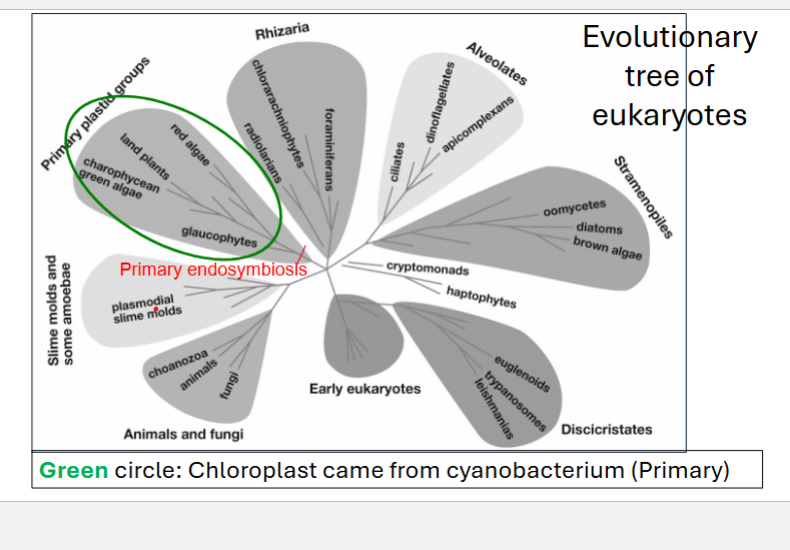
primary endosymbiosis- need to know
-All chloroplasts can be traced back to one cyanobacteria
- A eukaryotic host cell directly engulfs a free-living prokaryotic organism (like a bacterium or cyanobacterium) instead of digesting it
-The eukaryotic chloroplast originated from symbiotic cyanobacteria. It has membranes similar to both cyanobacteria and eukaryotes. Chloroplasts are now considered an “organelle” within photosynthetic eukaryotic cells.
-the domestication of cyanobacterial cells occurred in an ancestor of red algae, green algae and land plants
secondary endosymbiosis- need to know
-three chloroplast membranes
-occurs when a living eukaryotic cell (a complex cell with a nucleus) engulfs and retains another eukaryotic cell that already contains a photosynthetic organelle
tertiary endosymbiosis
-an evolutionary event where a eukaryotic host cell engulfs a different eukaryotic alga that already carries a secondary plastid
-ex. dinoflagellates (red tide)
what is a plant
Plantae- that clade of eukaryotic life with chloroplasts derived from primary endosymbiosis
-Most of the earliest splits in this tree have led to aquatic lineages (marine or freshwater): ALGAE

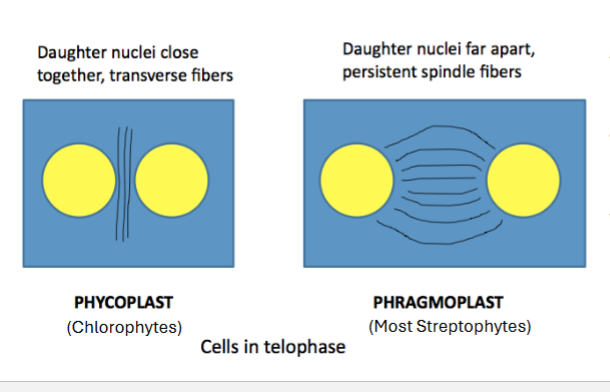
phragmoplasts- need to know
-thought to help algae grow 3-dimesntionally- create cell plates with plasmodesmata
serves as a scaffold of cell plate assembly
assemble perpendicular to the plane of the future cell plate so that new cells can grow outwards
red algae
-vary from single-celled to elaboratey branced multicellular organisms
cell walls- cellulose
photosynthetic pigment- chlorophyll
red color- phycoerythrin pigments that absorb green and blue light
-”corraline” red algae represent one of the earlist lineages of eukaryotes that we can see in the rock record
improtant as reef builders, food for reef organisms
plasmodesmata- need to know
-channels that penetrate the cell walls of adjacent cells
-most streptophtes have plasmodesmata
parenchyma
-the basic tissue type in the streptophyes with cells linked by plasmodesmata
isogamy vs oogamy need to know
oogamy- fusing gametes are very different in size and mobility
egg is large and does not move, sperm is small and mobile
isogamy- fusion of two gametes that look identical in size and shape
same size, strucute, and form. they cannot be called male of female
streptophte
-plant group that includes all land plants (embryophytes) and several classes of freshwater and terrestrial green algae
glaucophytes
-rare group of microscopic, single celled freshwater algae that provide vital clues about the evolutionary origin of plant chloroplasts
-archaeplastida
evolutionary changes that not all streptophytes have
-oogamy, plasmodesmata, and apical growth
-many other green algae may be single cleed or filamentous multicellular without branched structure
-isogamy and no plasmodesmata
key adaptations permitted plants to colonize land
-they had to
adapt to dry, high-light conditions
develop transport systems for water and nutrients
develop structural support
ex. redwood trees
find new ways to disperse reproductive cells and progeny (offspring)
prior to this it had been water. land plants had to get creative.
specific physical adaptations to plants
-cuticle- a waxy coating that slows water loss on the surface of everything above ground
-spores- with thick walls containing sporopollenin for desiccation resistance (halts their metabolism during droughts and revives when water returns)
-stomata- closable openings that regulate gas exchange; when the stomata are open, there is almost no resistance to airflow. When they close, they resist transpiration
-pigments- protect against UV radiation; anthocyanins absorb UV light and remit it as blue or purple light
-relationship with fungi (mycorrhizae)- promotes nutrient uptake from the soil
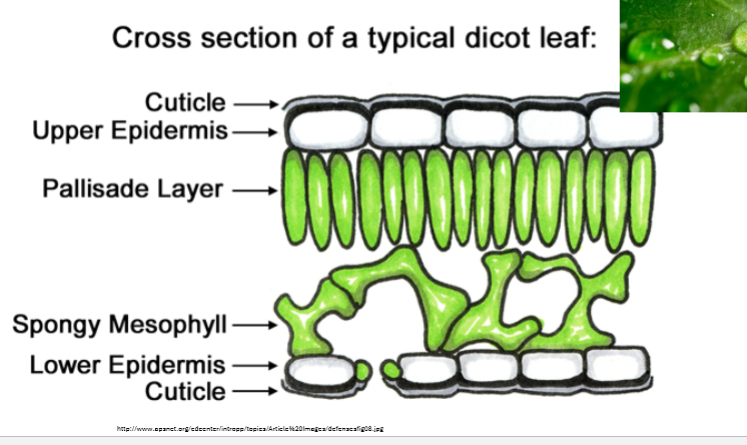
cross section of a leaf (need to know and what parts each does)
-carbon dioxide gets stored is spongy mesophyll
-palisade layer holds the chloroplasts, where photosynthesis happens
-stomata- closes and opens for gas exchange, controlled by guard cells
allows CO2 to enter and H20 to exit
-cutilce- prevents evaportation across the epidermis
spores and sporopollenin wall
-protects spores against drying out and decay
-swimming spore and spore blown in wind
-spores protected against desiccation and decay
guard cells and stomata
-when guard cells are flaccid (soft) they are open
-when guard cells are sturgid (filled with water) they are closed
accessory photosynthetic pigments
-in the streptophytes chlorophyll b evolved
-they absorb light in different wavelengths then chlorophyll a
-can help increase photosynthetic efficiency
-flavonoids protect from uv exposure
-involved in pollination
flowers produce nectar to attract animals for pollination
pigments can serve as a private communicating channel with pollinators
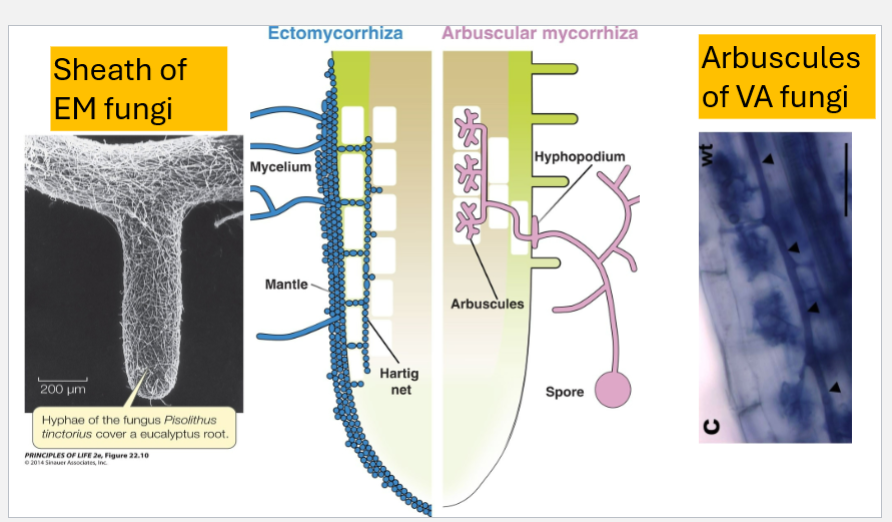
mycorrhizae
-fungi associated with underground plant parts (roots)
have biochemical enzymes that enable the release of phosphate that is tightly bonded to soil particles, then will bring to roots
- vesicular-arbuscular mycorrhizal fungi- grow into root cells and exchange water and nutrients, invade the root and kill a small …-
-ectomycorrhizal fungi- have cillia that grow between the cell walls, increasing surface area for water and mineral absorption
land plants have alternation of genertions
-there are both haploid and diploid multicellular stages
-this life cycle is a synapomorphy for the land plant clade
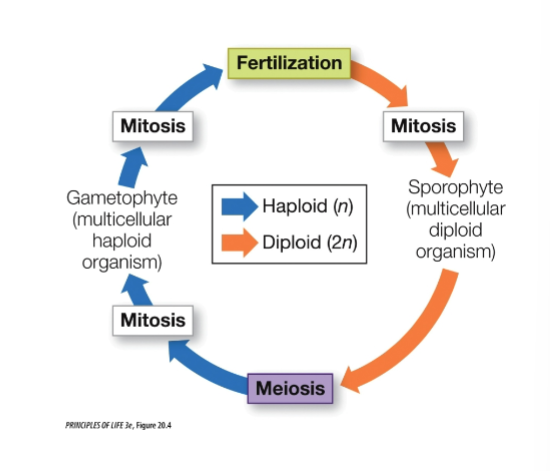
alternation of generations
-spores grow via mitosis to produce haploid multicellular gametophytes which make gametes in gametangia
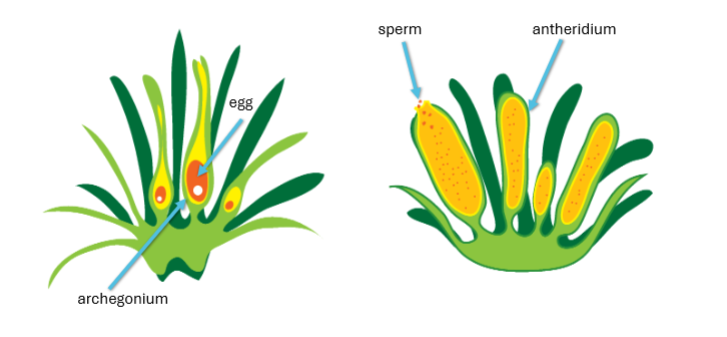
two types of gametangia- antheridia (make sperm) and archegonia (make eggs)
-eggs are fertilized by sperm to form diploid zygotes
-the diploid zygote develops by mitosis into a multicellular embryo, which eventually grows into a mature diploid plant (sporophyte).
forms spore producing sporangia
cells in sporoangia produce haploid spores by meiosis
gametangia
-organs that enclose gametes and prevent them from drying out
-two kinds
archegonium- produces egg cell; houses embryo after fertilization
antheridium- produces motile sperm
embryos
-young plants contained within a protective structure
-found in all land plants, and the land plant clade is called “Embryophyta”
-early growth of diploud, sporophyte generation, protected by archegonium
