Psych 20: Language
0.0(0)
Studied by 5 people Call Kai
 Learn
Learn Practice Test
 Spaced Repetition
 Match
Match Flashcards
 Knowt Play
Card Sorting
1/52

Earn XP
Description and Tags
Last updated 12:49 AM on 6/15/23
Name | Mastery | Learn | Test | Matching | Spaced | Call with Kai | Chat |
|---|
No analytics yet
Send a link to your students to track their progress
53 Terms
1
New cards
Word frequency effect
Tasks used to assess word frequency
2
New cards
Lexical decision
Participants read stimuli 1 at a time and are asked to respond as quickly as possible whether the item is a word or not.
3
New cards
Eye-fixation time during reading
how long is a word fixated
4
New cards
Effects of Word frequency
High frequency words processed more quickly than low-frequency words
5
New cards
Semantic priming
Prime consisting of a semantically related vs. unrelated word
6
New cards
Results of Semantic Priming
\
Faster processing with semantic vs. neutral prime
Faster processing with semantic vs. neutral prime
7
New cards
Elision
Omission of sounds, syllables, or words in speech
8
New cards
Coarticulation
speaking such that one speech sound influences another
9
New cards
Speech segmentation
Determining syllable/word boundaries
10
New cards
What does context’s (including visual information of the scene and the speaker) role in understanding words
\
Facilitates comprehension
Facilitates comprehension
11
New cards
Lexical ambiguity
1. Words with the same spelling often have multiple meanings
2. Words with the same spelling can also have different \n pronunciations
12
New cards
Lexical priming
Priming that involves the meaning of words
13
New cards
Tenenhaus Lexical Priming
People briefly access all meanings of a word before relying on \n context to determine relevant meaning
14
New cards
Meaning dominance
Some words are used more frequently than others
15
New cards
Biased dominance
When words have two or more meanings with different dominance
16
New cards
Balanced dominance
\n When words have two or more meanings with similar dominance
17
New cards
Explain the results of: Accessing meaning of ambiguous words while reading a sentence determined by word’s dominance and sentential context
\
If there is no prior context: (a) competition between equally likely meanings of a word with balanced dominance results in slow access; (b) activation of only the most frequent meaning of a word with biased dominance results in fast access.
If there is context before a word with biased dominance: (c) activation of both the less frequent and most frequent meanings results in slow access; (d) activation of only the most frequent meaning results in fast access.
If there is no prior context: (a) competition between equally likely meanings of a word with balanced dominance results in slow access; (b) activation of only the most frequent meaning of a word with biased dominance results in fast access.
If there is context before a word with biased dominance: (c) activation of both the less frequent and most frequent meanings results in slow access; (d) activation of only the most frequent meaning results in fast access.
18
New cards
Semantics
meanings of words and sentences
19
New cards
Syntax
Rules for combining words into sentences
20
New cards
Parsing
Mentally groups the words into phrases
21
New cards
What does parsing help listeners do?
Create meaning
22
New cards
Garden path sentences
Sentences that begin by appearing to mean one thing, but then end up meaning something else
23
New cards
Temporary ambiguity
\n When the initial words are ambiguous, but the meaning is made clear by the end of the sentence
24
New cards
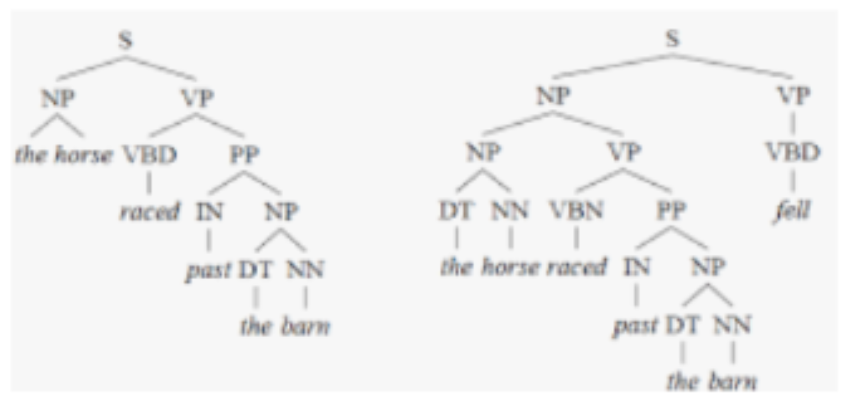
What does this image show?
Parsing. Two sentences differing in just the final word but with very different structures
25
New cards
The garden path model of parsing
* Listeners use heuristics to group words into
phrases
* Rules are based on syntax a sentence
* Late closure
phrases
* Rules are based on syntax a sentence
* Late closure
26
New cards
Heuristics
Rules that can be applied quickly to make a decision
27
New cards
What are benefits and costs of heuristics?
* Benefit – fast (necessary when processing 200 words/min)
* Cost – can make wrong decision
* Cost – can make wrong decision
28
New cards
Syntax
The grammatical structure of a sentence
29
New cards
Late closure
Parser assumes new word is part of the \n current phrase
30
New cards
Parsing and Sentence Comprehension
* The proposition to be conveyed that is intended by the speaker (writer) is represented by the syntactic tree
* The speaker (writer) generates a sequence of words from the syntactic
* The listener (reader) must generate a syntactic tree from the sequence of words to understand the proposition
* Comprehension challenges arise because the listener (or reader) must generate the intended syntactic tree
* Visual world paradigm, the context of a scene
* The speaker (writer) generates a sequence of words from the syntactic
* The listener (reader) must generate a syntactic tree from the sequence of words to understand the proposition
* Comprehension challenges arise because the listener (or reader) must generate the intended syntactic tree
* Visual world paradigm, the context of a scene
31
New cards
Visual world paradigm
The context of a scene
32
New cards
Constraint-based approach to parsing combines: ?
* Syntax
* Word meaning
* Story context
* Scene context
* Word meaning
* Story context
* Scene context
33
New cards
What did Tenenhaus & Trueswell Scene Context expirement show?
\
* Visual world paradigm, the context of a scene
* Eye movements change when information suggests revision of interpretation of sentence is necessary
* Linguistic and nonlinguistic information used simultaneously
* Visual world paradigm, the context of a scene
* Eye movements change when information suggests revision of interpretation of sentence is necessary
* Linguistic and nonlinguistic information used simultaneously
34
New cards
What was the Tenenhaus & Trueswell Scene Context expirement?
a) One-apple scene similar to the one viewed by Tanenhaus et al.’s (1995) participants. (b) Eye movements made while comprehending the task. (c) Proportion of trials in which eye movements were made to the towel on the right for the ambiguous sentence. (Place the apple on the towel in the box) and the unambiguous sentence (Place the apple that’s on the towel in the box
35
New cards
Coherence
Representation of the text in one’s mind that creates clear relations (between parts of the text and between parts of the text and the stories main topic)
Archived by making inferences
Archived by making inferences
36
New cards
Inferences
Readers create information during reading not explicitly stated \n in the text
37
New cards
Anaphoric Inferences
Connecting objects/people (e.g., pronouns)
38
New cards
Instrument Inference
Specific tools or methods used for the task
39
New cards
Casual Inferences
Events in one clause caused by events in previous sentence
40
New cards
Situation model
Mental representation of what a text is about (Represent events as if experiencing the situation/Point of view of protagonist)
41
New cards
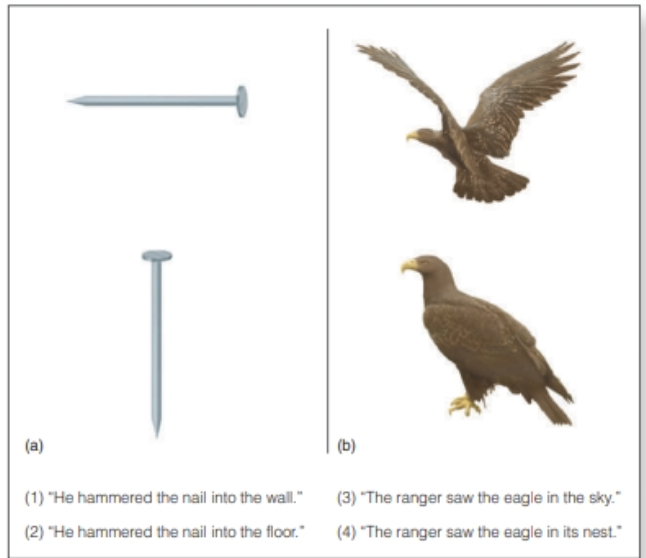
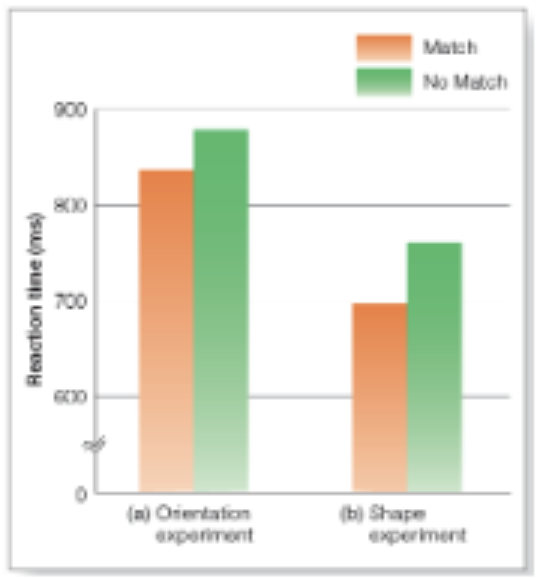
(what were the results?) Subjects heard sentences and were then asked to indicate whether the picture was the object mentioned in the sentence
\
Results of Stanfield and Zwaan’s (2001) and Zwaan et al.’s (2002) experiments. Subjects responded “yes” more rapidly \n for the orientation, in (a), and the shape, in (b), that was \n more consistent with the sentence.
Results of Stanfield and Zwaan’s (2001) and Zwaan et al.’s (2002) experiments. Subjects responded “yes” more rapidly \n for the orientation, in (a), and the shape, in (b), that was \n more consistent with the sentence.
42
New cards
Physiology of simulations
* Approximately the same areas of the cortex are activated by actual movements and by reading related action words
* The activation is more extensive for actual movements
* The activation is more extensive for actual movements
43
New cards
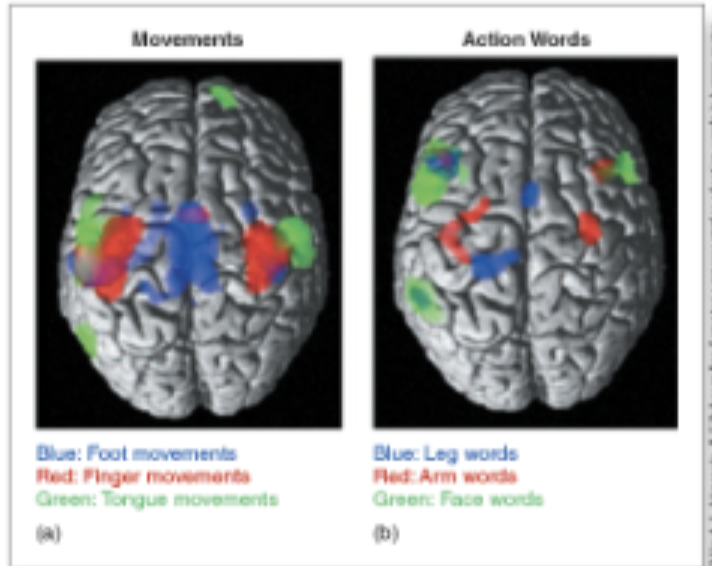
Situation Model and Brain Activation Hauk et al. (2004) results.
Colored areas indicate the areas \n of the brain activated by (a) foot, finger, and \n tongue movements; (b) leg, arm, and face words
44
New cards
Other skills are necessary for people to engage in effective \n conversations:
Theory of mind
Nonverbal communication
Nonverbal communication
45
New cards
Theory of mind
Being able to understand what others feel, think, or believe
46
New cards
Nonverbal communication
being able to interpret and react to the person’s gestures, facial expressions, tones of voice, and other cues to meaning
47
New cards
Given–new contract
Speaker constructs sentences so they include \n – Given information \n – New information \n – “New” can then become “given” information
48
New cards
Syntactic coordination
Using similar grammatical constructions
49
New cards
Syntactic priming
\
* Production of a specific grammatical construction by one person increases chances other person will use that construction
* Reduces computational load in conversation
* Production of a specific grammatical construction by one person increases chances other person will use that construction
* Reduces computational load in conversation
50
New cards
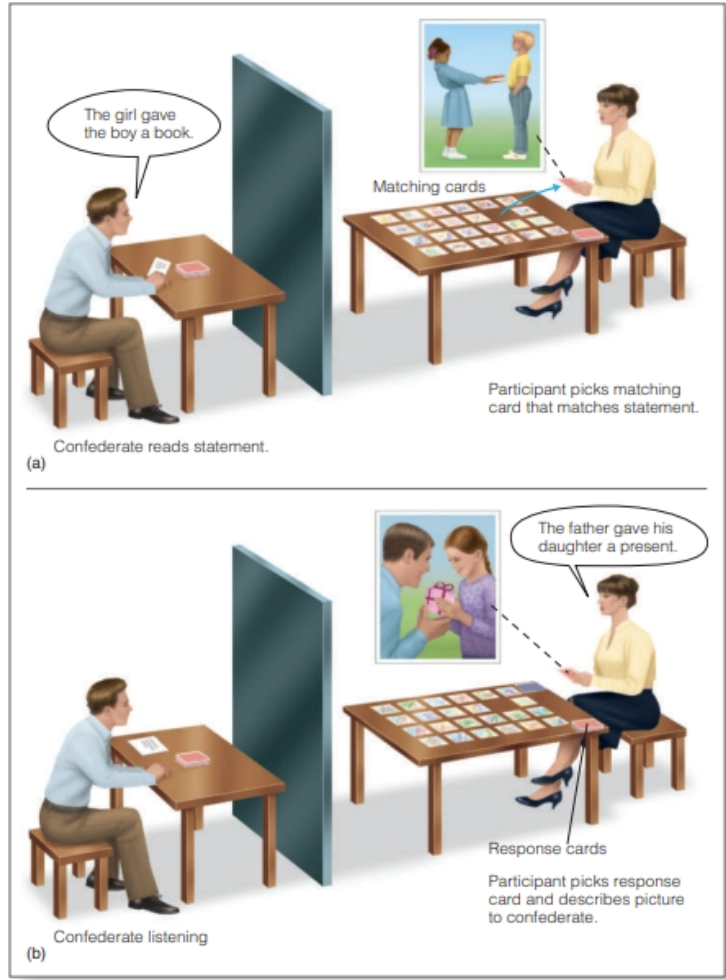
Syntactic Priming: Different constructions to express the same thing: \n 1) The girl gave the boy a book. \n 2) The girl gave a book to the boy
\
The Branigan et al. (2000) experiment. \n (a) The subject (right) picks, from the cards laid out on \n the table, a card with a picture that matches the \n statement read by the confederate (left). (b) The \n participant then takes a card from the pile of response \n cards and describes the picture on the response card \n to the confederate. This is the key part of the \n experiment, because the question is whether the \n participant on the right will match the syntactic \n construction used by the confederate on the left.
The Branigan et al. (2000) experiment. \n (a) The subject (right) picks, from the cards laid out on \n the table, a card with a picture that matches the \n statement read by the confederate (left). (b) The \n participant then takes a card from the pile of response \n cards and describes the picture on the response card \n to the confederate. This is the key part of the \n experiment, because the question is whether the \n participant on the right will match the syntactic \n construction used by the confederate on the left.
51
New cards
Prosody
The pattern of intonation and rhythm in spoken language
52
New cards
Music as the “language of emotion”
Music creates emotion through sounds that have no meaning
53
New cards
Whats the difference between language and music?
Language combines words and music combines tones to create structured sequences that unfold over time